You’re past the initial hype of AI. You understand its transformative potential and are now faced with a more complex challenge: sifting through a crowded market to find the right AI solutions for your specific business needs. This isn’t a task to take lightly. While nearly 80% of organizations engage with AI, a staggering 75% report failing to achieve their expected return on investment, leaving significant value on the table. The difference between success and disillusionment lies in a structured, data-driven approach to evaluation and selection.
At BenAI, we understand this journey because we guide businesses through it every day. We’ve built proven AI systems for growth, automation, and efficiency, and our approach isn't just about implementing technology—it’s about empowering you to make confident, strategic decisions that transform your business into an AI-first entity.
Most businesses need guidance on how to evaluate, what to consider, and who to partner with. That's exactly what we'll provide: a comprehensive framework to navigate the complexities, mitigate risks, and ensure your AI investments deliver tangible, long-term value.
The High Stakes of AI Investment: Why Your Evaluation Process Matters Now
The competitive landscape is shifting rapidly. US companies are investing aggressively in AI, with projections of $109.1 billion in 2024. This isn't just a tech trend; it's a fundamental change in how businesses operate. From automating routine tasks to generating new revenue streams, AI is creating both challenges and unprecedented opportunities. However, the high failure rate of AI initiatives, with some generative AI projects failing to deliver measurable ROI in as many as 95% of cases, underscores a critical point: successful AI adoption isn't just about procuring a tool; it's about strategic alignment and meticulous planning.
This guide will equip you with the frameworks to move beyond surface-level evaluations and select AI solutions that genuinely accelerate your business objectives.
Your Strategic Guide: The BenAI AI Solution Evaluation Framework
To achieve measurable ROI and innovation, you need a systematic approach. Our framework breaks down the complex selection process into digestible, actionable phases, ensuring all critical aspects—from business alignment to ethical considerations—are addressed.
Phase 1: Define Your AI Vision & Needs
Before you even look at specific tools, you need absolute clarity on what you want AI to achieve within your organization. This phase is about setting a clear strategic compass.
Clarify Business Objectives
Any AI initiative must directly support your overarching business goals. Don't invest in AI for AI's sake. Ask yourself:
- What core business problems are we trying to solve?
- What strategic outcomes (e.g., increased revenue, reduced costs, enhanced customer experience) will this AI solution drive?
- How will success be measured objectively?
As Forbes and other industry leaders emphasize, a "business-first" approach is essential. This means defining success before diving into solutions.
Identify Specific Use Cases & Problem Statements
With objectives clear, pinpoint the exact areas where AI can deliver the most impact. Whether it's optimizing marketing campaigns, streamlining recruitment, or improving operational efficiency, specific use cases prevent scope creep and focus your efforts. For example, are you looking to automate content creation for your marketing agency? Or are you aiming to enhance candidate monitoring systems in your recruiting firm?
This granular understanding allows for a precise evaluation of potential solutions against your real-world challenges.
Phase 2: Technical & Operational Feasibility Assessment
Once your vision is clear, the next step is a deep dive into the practicalities. Can your infrastructure support the solution? Is your data ready? This phase is crucial for identifying potential roadblocks before they become costly failures.
Data Readiness & Governance
Quality data is the lifeblood of effective AI. Issues like data accuracy or bias (a concern for 45% of organizations) and insufficient proprietary data (42%) are major challenges. Before implementing any solution, you must assess:
- Data Quality: Is your data clean, accurate, and consistent?
- Data Quantity & Variety: Do you have enough relevant data to train and sustain the AI solution?
- Data Governance: Do you have policies for data collection, storage, access, and security?
A robust AI data strategy guide is non-negotiable here. Overlooking data readiness is a leading cause of AI project failure.
Integration with Existing Systems
Your new AI solution won't operate in a vacuum. It needs to seamlessly integrate with your current technology stack. Consider:
- API Capabilities: Does the AI solution offer robust APIs for smooth data exchange?
- Compatibility: Is it compatible with your existing platforms (e.g., CRM, ERP, HRIS)?
- IT Infrastructure: Do you have the necessary AI infrastructure guide and capabilities to support the new solution?
Legacy IT systems can pose significant integration challenges, so thorough due diligence here is critical.
Scalability & Performance Metrics
AI solutions must scale with your business and deliver consistent performance. This involves benchmarking against clear metrics. Key considerations include:
- Scalability: Can the solution handle increased data volumes and user loads as your business grows? Referencing solutions with scalable AI infrastructure ensures future-proofing.
- Latency & Throughput: How quickly does the AI solution process data and provide results?
- Accuracy: How accurate are the AI's predictions or automations for your specific use case?
Benchmarking AI performance involves not just initial tests but ongoing monitoring to ensure continued value. For example, if you’re using AI for quality control, you’ll want to benchmark its accuracy against human inspection. Learn more about AI-driven quality control guide here.
Security, Privacy & Ethical Considerations
With increasing regulations and public scrutiny, embedding ethical AI practices from the outset is paramount.
- Data Security: How does the vendor protect your sensitive data?
- Privacy Compliance: Does the solution comply with GDPR, CCPA, and other relevant privacy regulations?
- Bias Mitigation: How does the solution address potential biases in its algorithms and data?
- Transparency & Explainability: Can you understand why the AI makes certain decisions?
Purdue University and Grantboost AI highlight these as non-negotiable criteria. Ignoring them risks not only legal repercussions but also significant reputational damage.
Phase 3: Vendor & Solution Analysis
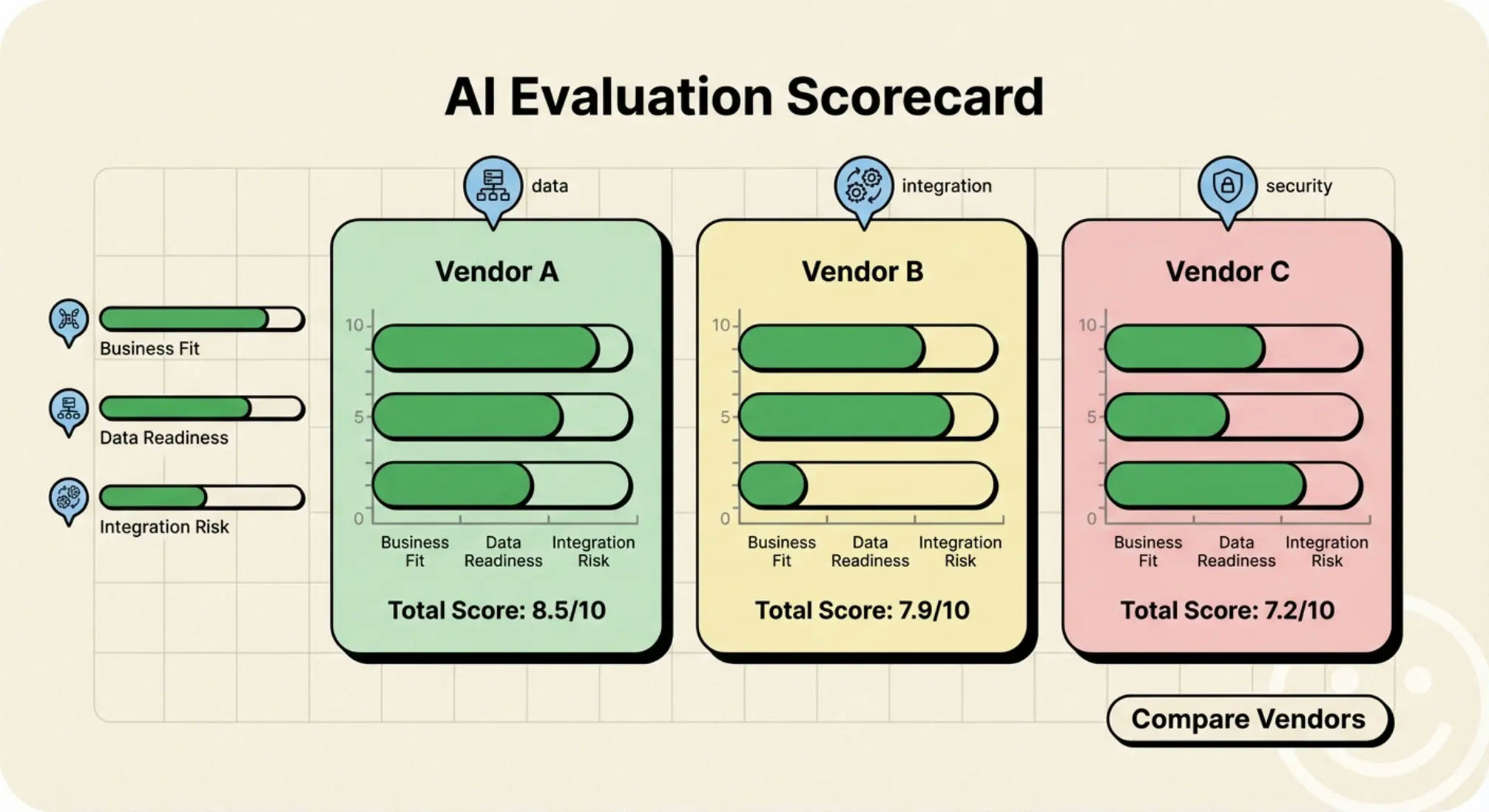
Once you know what you need and what’s feasible, it's time to evaluate potential partners and their offerings. This is where you move from internal assessment to external comparison.

Choosing the right vendor is as critical as choosing the right technology. Remember, 52% of organizations prioritize AI vendor capabilities over cost, signifying a shift towards strategic partnerships. The Segal Group offers eight essential criteria, which we expand upon here:
- Expertise & Track Record: Does the vendor have proven experience in your industry or with similar use cases? What case studies can they provide?
- Technology Stack: Is their technology robust, current, and aligned with your long-term vision?
- Support & Maintenance: What level of ongoing support, training, and maintenance do they offer? This is crucial for long-term operational success.
- Implementation Methodology: Do they have a clear, structured plan for deployment and integration?
- Organizational Fit: Does their culture and communication style align with yours?
- Financial Stability: Is the vendor a reliable, long-term partner?
Total Cost of Ownership (TCO) & ROI Calculation Models
Understanding the true cost and potential return of an AI investment goes beyond initial licensing fees. It includes:
- Implementation Costs: Setup, integration, data preparation, and customization.
- Operational Costs: Ongoing maintenance, support, data storage, and compute resources.
- Training Costs: For your team to effectively use and manage the AI solution.
Calculating ROI requires a clear framework. While some benefits are straightforward (e.g., reduced manual labor), others are more intangible but equally valuable, such as improved decision-making, enhanced customer satisfaction, or increased innovation. For detailed financial modeling, our "ROI Calculation for AI Investment Decisions: A Step-by-Step Guide with Templates" provides comprehensive frameworks for both quantitative and qualitative benefits.

Before full-scale deployment, a well-designed pilot program is your best friend. It’s a controlled environment to test, learn, and validate value, especially given how many generative AI projects fail to deliver measurable ROI.
Effective AI Pilot Program Strategies
A pilot isn't just a small-scale trial; it's a strategic stage for proving value and building internal buy-in. Our "Conducting AI Pilot Programs Effectively: A Blueprint for Success & Scaling" provides a deep dive, but here are key elements:
- Clear Objectives & KPIs: What specific metrics will define pilot success?
- Defined Scope: A focused project with clear boundaries and manageable risks.
- Cross-Functional Team: Involve stakeholders from all relevant departments, including those with AI-first leadership buy-in for smoother transition.
- Change Management: Address potential human impact and integrate user feedback early.
- Testing & Iteration: Be prepared to adjust and refine the solution based on pilot results.

. Ensure every AI initiative ties back to a measurable business outcome.
- Pitfall: Ignoring Data Quality.
- Avoid: Don't skip the data readiness assessment in Phase 2. Poor data equals poor AI. Implement a robust AI data strategy guide.
- Pitfall: Underestimating Integration Complexity.
- Avoid: Thoroughly vet the AI solution's compatibility with your existing systems and infrastructure. Consider a detailed AI infrastructure guide.
- Pitfall: Neglecting Change Management.
- Avoid: Early and continuous involvement of end-users and a strong AI-first leadership buy-in are crucial for successful adoption and long-term acceptance.
- Pitfall: Poorly Designed Pilot Programs.
- Avoid: Follow a rigorous pilot blueprint (Phase 4) with clear KPIs and a plan for iteration and scaling. Many promising generative AI projects fail measurable ROI, underscoring this point.
By proactively addressing these common issues, you can significantly increase your chances of a successful AI implementation. You also need to consider your overall AI operational automation process to identify interdependencies.
Future Outlook: Staying Ahead in the AI Curve
The AI landscape is not static. Emerging trends like multimodal AI, advanced reasoning, and dynamic AI agent ecosystems are constantly reshaping what's possible. As you evaluate solutions today, consider their adaptability for future advancements. Will your chosen solution grow with these breakthroughs, or become obsolete?
we're not just implementing current solutions; we're building an AI agent ecosystem guide to help our clients anticipate and integrate future capabilities, ensuring they remain at the forefront of AI innovation.
Frequently Asked Questions About Evaluating AI Solutions
Q1: How do I calculate the ROI for an AI investment when many benefits are intangible?
A1: While direct cost savings are quantifiable, consider a blended approach for ROI. Categorize benefits into direct (e.g., reduced manual labor, increased output) and indirect (e.g., improved decision-making quality, strategic agility, enhanced customer satisfaction, faster time-to-market for new products). Assign realistic monetary values or impact scores to indirect benefits and track them over time. Our "ROI Calculation for AI Investment Decisions" guide offers templates for this. Remember, nearly 80% of organizations adopt AI, but only 25% report achieving expected ROI, highlighting the importance of robust ROI frameworks.
Q2: What's the most critical factor in selecting an AI vendor?
A2: While functionality and cost are important, deep expertise and a proven track record (especially in your industry or with similar use cases) are paramount. The ability to provide world-class AI implementations, training, and consulting for your specific needs, coupled with a strong support system, often outweighs initial price considerations. The Futurum Group notes that 52% of organizations prioritize vendor capabilities over cost.
Q3: How do I ensure data privacy and ethical considerations are met during AI solution evaluation?
A3: This requires rigorous technical due diligence. Ensure the vendor has robust data security protocols and complies with relevant regulations (GDPR, CCPA). Request information on their bias mitigation strategies, model transparency (explainability), and how they handle data anonymization. Ethical AI should be a core criterion, as highlighted by Purdue University and Grantboost AI. It’s not just about compliance, but about building user trust.
Q4: My organization lacks internal AI expertise. How can we still make informed decisions?
A4: Many businesses face this. Focus on vendors that offer comprehensive training and consulting, not just software. Look for partners who can help you build internal capabilities and provide ongoing strategic guidance. The Ben AI Accelerator program is specifically designed to help businesses become "AI-first" through structured courses, 1:1 help, and coaching, bridging expertise gaps. You can also leverage a free community & templates to get started with foundational knowledge.
Q5: What should be the scope of an AI pilot project?
A5: An AI pilot should be tightly scoped, focusing on a single, high-impact use case with clear, measurable objectives. It should be small enough to manage risk and demonstrate tangible value quickly, but large enough to provide meaningful data for future scaling. A common mistake is overly ambitious pilots, which can contribute to the high pilot failure rate (up to 95% for some generative AI projects). Our "Conducting AI Pilot Programs Effectively" blueprint provides detailed guidance.
Your AI-First Future Starts With the Right Choice
Evaluating and selecting AI solutions is a pivotal moment for your business. It demands clarity, diligence, and a forward-thinking perspective. By applying the strategic frameworks outlined here, you can transform a daunting task into a confident stride toward an AI-powered future.
Whether you're a marketing agency automating service delivery, a recruiting firm streamlining hiring, or an enterprise seeking custom AI implementations, BenAI is your trusted partner. We don't just offer solutions; we provide the expertise, guidance, and proven systems to help you navigate this complex landscape and achieve tangible, transformative results.
Ready to confidently choose the AI solutions that will drive your business forward?
- Explore our AI Marketing Solutions
- Discover our AI Recruiting Solutions
- Learn about our Enterprise Solutions
- Join our Free Community & Templates for immediate resources and insights.
Your AI-first business starts here. Let's build it together.
Join Our Growing AI Business Community
Get access to our AI Automations templates, 1:1 Tech support, 1:1 Solution Engineers, Step-by-step breakdowns and a community of forward-thinking business owners.
Latest Blogs
Explore our latest blog posts and insights.