You're beyond the "what if" of AI. You're deep into the "how to" – actively evaluating how artificial intelligence can transform your core business operations. But here's the stark reality: while 78% of organizations are dabbling in AI, only 6% qualify as "AI high performers," achieving significant business impact. The gap between adoption and true value realization is vast, and you're determined not to fall into the 70-85% of AI projects that fail to deliver expected outcomes. You need more than just tools; you need a blueprint for genuine, impactful AI integration.
This guide is designed for leaders like you. We'll cut through the marketing noise, providing a comparative framework, evidence-backed insights, and clear differentiation points to empower your decision-making process for AI-driven operational automation.
Decoding Operational Workflows for AI Automation: A Strategic Blueprint
The first step toward impactful AI automation isn't about choosing software; it's about understanding your operations at a granular level. Many projects falter because they automate the wrong things or tackle processes ill-suited for AI. Our research consistently shows that the most successful AI implementations begin with meticulous workflow mapping and strategic prioritization.
Map & Prioritize: Identifying Automation Potential
Start by identifying "intent signals" within your operational workflows. These are the repetitive, rule-based tasks ripe for automation versus complex decision-making processes that might require a nuanced, human-in-the-loop approach. Think data entry, report generation, routine customer inquiries, or even certain aspects of content generation. For instance, in marketing, tasks like topic ideation, basic drafting, and social media scheduling can be significantly automated, freeing creative teams for higher-level strategy. Reducing manual SEO workflows with AI offers a deeper dive into this for specific marketing-focused operations.
Our recommended methodology involves a combination of traditional process mapping techniques with modern AI-powered discovery. Process Mining, for example, can analyze event logs from your existing systems to visualize actual workflows, identify bottlenecks, and pinpoint high-frequency, low-variance tasks perfect for AI intervention. This data-driven approach removes guesswork and grounds your automation strategy in reality.
When prioritizing, consider these key decision factors:
- ROI potential: Which processes offer the greatest cost savings or revenue generation from automation?
- Complexity: Start with simpler, well-defined processes to build confidence and demonstrable success.
- Data availability & quality: Does the process rely on accessible, structured, and accurate data? AI lives and dies by data. Poor data hygiene is a common culprit for project failure.
- Human impact: How will automation affect your team? Prioritize tasks that free up human talent from drudgery, allowing them to focus on strategic, creative, and customer-centric work.
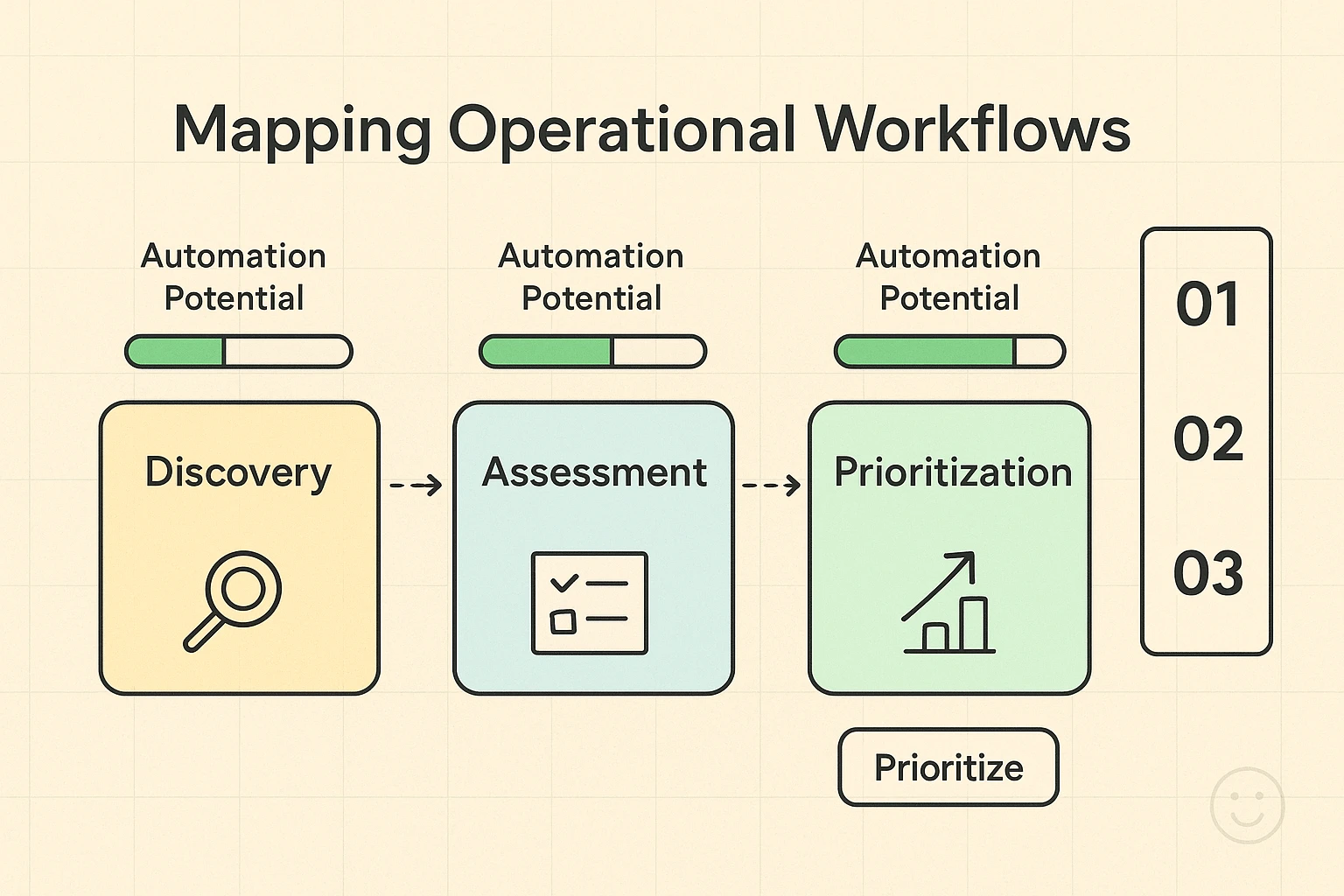
Early evaluation section — 'Map & Prioritize'
Selecting the Right AI Technologies for Your Business Processes: Beyond the Hype
The market is flooded with AI tools, each promising revolutionary change. Your challenge is discerning which solutions genuinely match your operational needs. This involves moving beyond generic claims and understanding the specific capabilities and limitations of different AI technologies.
Matching Technology to Need
Here's an overview of key AI technologies and their core operational applications:
- Robotic Process Automation (RPA): Ideal for highly structured, repetitive tasks that interact with existing IT systems through defined rules. Think data transfer between applications, invoice processing, or generating standard reports.
- Intelligent Document Processing (IDP): Combines AI techniques like Optical Character Recognition (OCR), Natural Language Processing (NLP), and Machine Learning (ML) to extract, categorize, and validate data from unstructured documents (e.g., invoices, contracts, emails). This goes beyond simple RPA by understanding context.
- AI Agents: These are a significant evolution. Unlike RPA bots, which are primarily tethered to rules, AI agents (or "agentic AI") can reason, plan, execute tasks, and even learn from interactions. They can orchestrate workflows, make autonomous decisions within defined parameters, and adapt to changing conditions. Gartner projects 33% of enterprise software will embed agentic AI by 2028, heralding a shift from static bots to adaptive digital workers. For example, BenAI demonstrates the power of AI agents in orchestrating complex marketing tasks, like building an entire marketing team with 37 AI agents.
- Process Mining & Discovery: AI-powered tools that analyze system logs to automatically map "as-is" processes, identify inefficiencies, and suggest automation opportunities.
- Predictive Analytics: Uses ML to forecast future outcomes based on historical data. Crucial for demand forecasting, supply chain optimization, and predictive maintenance in operations.
- Natural Language Processing (NLP): Enables computers to understand, interpret, and generate human language. Used in chatbots, sentiment analysis, and extracting insights from customer feedback.
- Computer Vision: Allows systems to "see" and interpret visual information. Applied in quality control (e.g., AI-driven quality control), inventory management, and security.
Navigating the Competitive Landscape
When evaluating solutions, consider how vendors address specific operational challenges, not just their general capabilities. Competitors like IBM and SAP offer broad enterprise AI solutions, often integrated deeply into their existing platforms, which can be advantageous if you're already within their ecosystem. Boomi emphasizes its platform for "AI Business Process Automation" with features like Boomi GPT and DesignGen, highlighting its AI agent capabilities. UiPath is a leader in RPA, increasingly integrating AI.
However, a key hidden intent for many decision-makers is avoiding vendor lock-in, managing integration complexity, and ensuring scalability. You need solutions that are flexible and can seamlessly integrate with your existing tech stack. This often means looking for providers who specialize in custom-built, cutting-edge AI automation solutions that are tailored to your unique operational footprint, rather than force-fitting a generic tool. For instance, successfully integrating AI into your marketing stack requires careful planning, as discussed in AI SEO marketing stack integration. A strong AI data strategy guide is also fundamental to any successful AI integration.

Tool selection section — 'Choose the Right Tech'
The Human Element in AI Automation: Navigating Change Management for Operational Success
The most significant factor separating successful AI implementations from failures isn't technological prowess; it's the human element. The MIT Report on GenAI Pilots confirmed a 95% failure rate for pilot programs, primarily due to a "learning gap" in workflow integration, not model quality. This highlights a crucial point: technologies like RPA, advanced analytics, and AI agents aren't just tools; they fundamentally alter roles, responsibilities, and organizational culture.
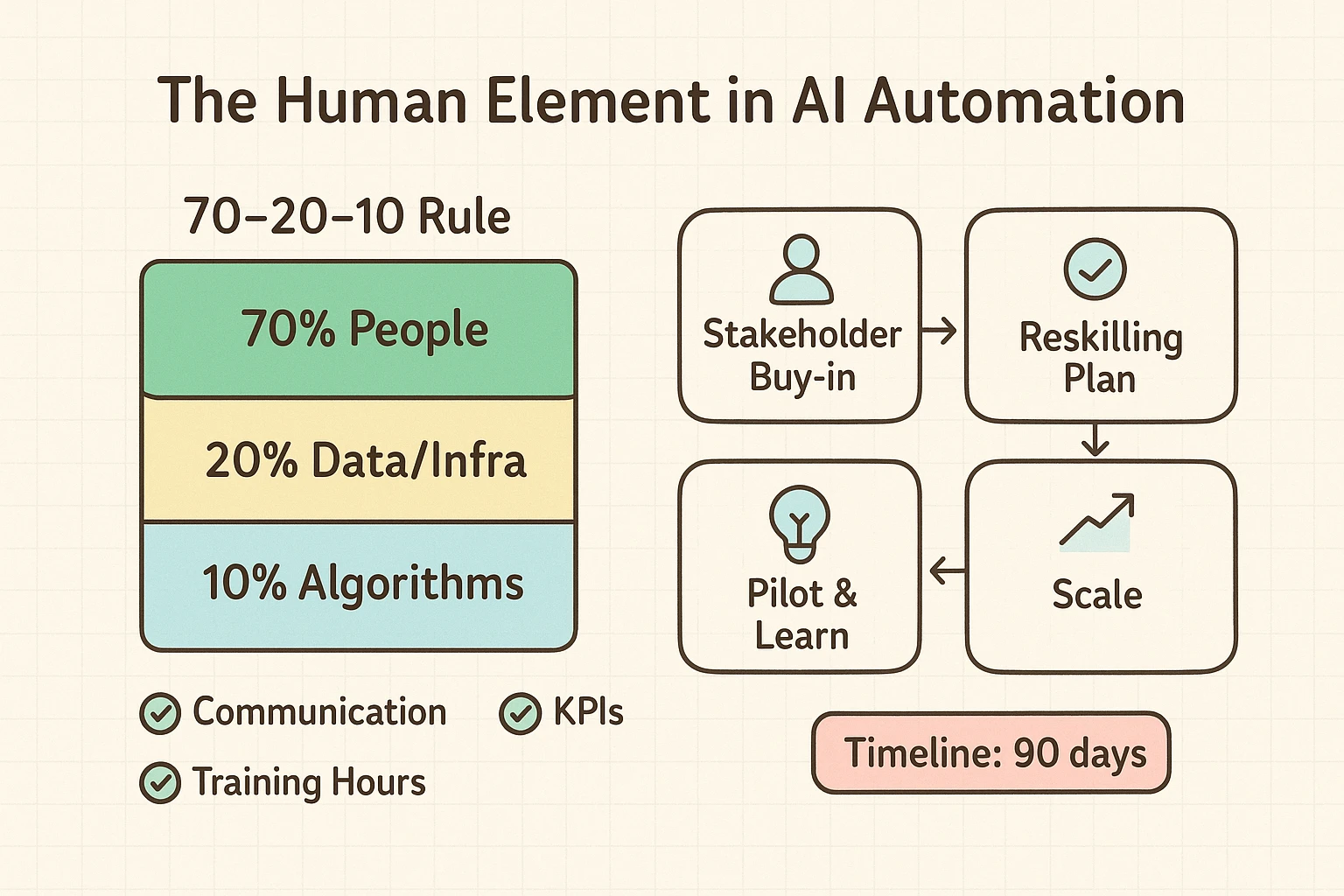
Our research, confirmed by industry leader Perplexity AI, suggests a "70-20-10 rule for AI success": 70% of resources should focus on people and processes, 20% on data/tech infrastructure, and a mere 10% on algorithms. This revalidates the importance of your team and internal processes over pure tech.
Fostering Human-AI Collaboration
Successfully introducing AI into your operations requires a deliberate strategy to address concerns about job displacement, facilitate upskilling, and build trust. Employees who use AI actually report a 40% average productivity boost, demonstrating its potential as an empowering partner.
Key strategies include:
- Transparent Communication: Clearly articulate why AI is being implemented (e.g., to reduce manual, repetitive work, free up time for strategic tasks, improve accuracy, enhance customer experience), not just what is being automated.
- Reskilling and Upskilling Programs: Invest in training that empowers your workforce to manage, monitor, and collaborate with AI systems. This could involve teaching prompt engineering for generative AI, data analysis for AI output interpretation, or new skills for higher-value tasks unlocked by automation.
- Developing an "AI-Ready" Operational Culture: Foster an environment where experimentation with AI is encouraged, and feedback loops are established to continuously improve AI-driven processes. Mars Wrigley's supply chain transformation, for instance, was characterized by 80% change management efforts, underscoring the critical role of organizational adaptation.
- Designing for Human Oversight: Ensure there are clear human checkpoints and decision points within AI-automated workflows, especially for critical processes. This reduces risk and builds confidence.
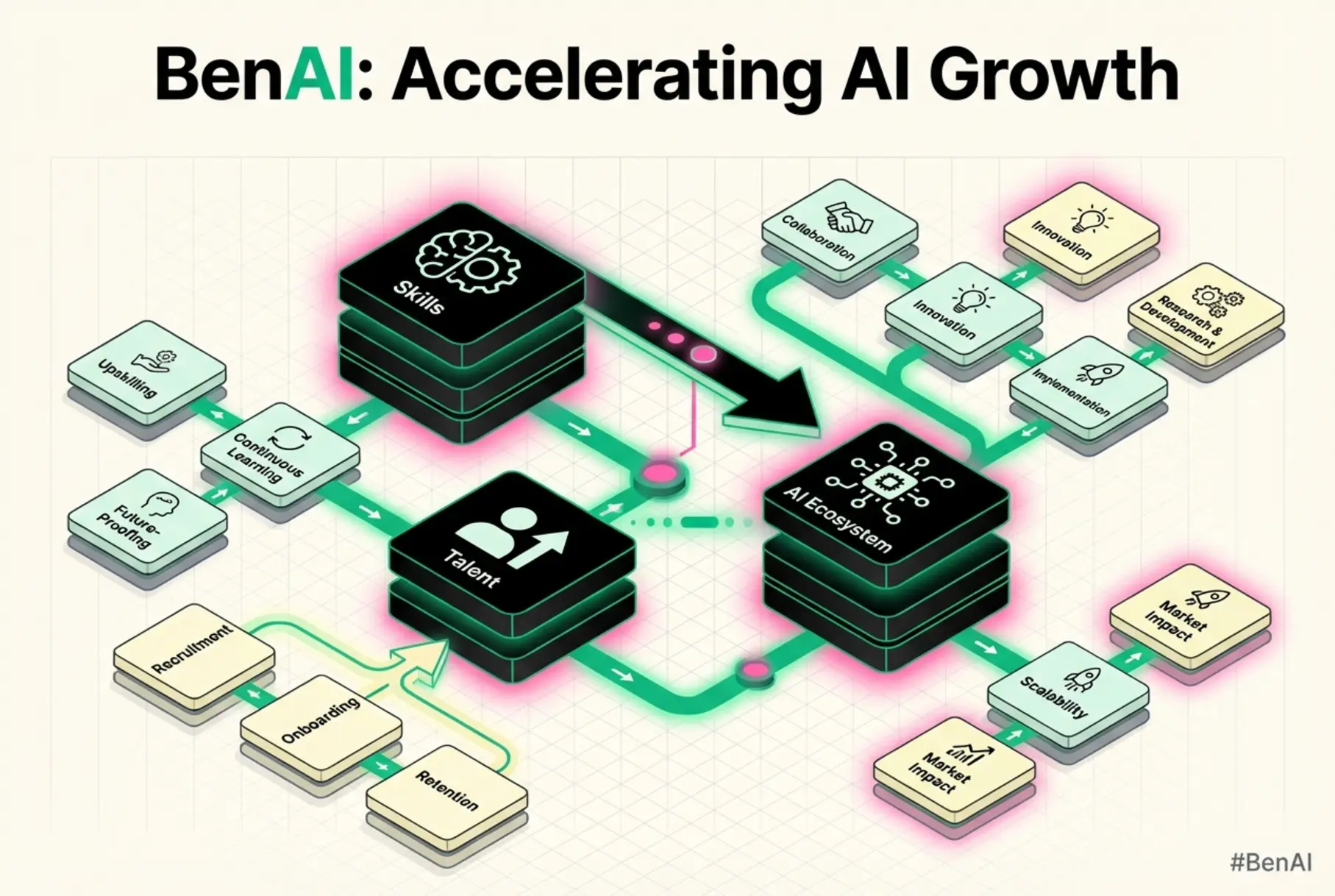
The goal isn't to replace humans but to augment their capabilities, creating capacity without increasing headcount, as BenAI's core mission emphasizes. This allows for scalability and growth that wouldn't be possible with manual efforts alone. For recruitment, AI automation can streamline candidate sourcing and monitoring, allowing recruiters to focus on strategic human connections, as highlighted in our AI Recruiting Solutions. Likewise with AI-driven LinkedIn outreach optimization, where AI frees up sales teams to focus on relationship building rather than manual prospecting.

Change management section — 'People & Process'
Measuring Efficiency Gains: Proving the Business Case for AI in Operations
Your investment in AI process automation needs to demonstrate tangible returns. This requires establishing clear, quantifiable metrics from the outset and rigorously measuring impact post-implementation. Without this, even successful projects struggle to secure ongoing support. A compelling ROI narrative is essential for stakeholders.
Quantifiable Metrics for AI Impact
Focus on metrics that directly reflect operational efficiency and business value:
- Cycle Time Reduction: How much faster are processes completed with AI intervention? (e.g., reducing invoice processing from days to hours).
- Error Rate Decrease: AI can significantly reduce human errors in data entry, calculations, and compliance.
- Cost Savings: Direct savings from reduced manual labor, minimized rework, or optimized resource utilization. The largest ROI from generative AI, for example, is often found in back-office automation tasks.
- Throughput Increase: The volume of work processed within a given timeframe (e.g., number of customer queries handled, reports generated, or candidates processed).
- Resource Reallocation: The number of hours or FTEs freed up from repetitive tasks, now available for higher-value activities.
- Improved Compliance/Reduced Risk: Quantify the reduction in regulatory fines or operational risks due to AI-driven adherence to protocols.
Establishing Baselines and Measuring Success
Before implementing any AI automation, create robust baseline metrics for the targeted processes. This provides a clear "before" picture against which to measure your "after." Post-implementation, continuous monitoring and measurement are critical.
- Define Clear KPIs: Directly link your AI automation goals to specific, measurable Key Performance Indicators (KPIs).
- Automate Data Collection: Leverage your existing systems and AI tools themselves to automatically track relevant data points.
- Regular Reporting: Establish a cadence for reporting on AI's impact to stakeholders, demonstrating incremental improvements and overall ROI.
- Iterative Optimization: Use performance data to identify areas for further optimization of your AI models and automated workflows.
ROI & metrics section — 'Prove Efficiency Gains'
Advanced AI Automation: Overlooked Technical Details for True Operational Intelligence
For the technically discerning leader, understanding the underlying architectural and methodological nuances of AI implementation is crucial. Many off-the-shelf solutions gloss over these details, leading to scalability issues, integration headaches, and a ceiling on true intelligence.
Dynamic Workflow Orchestration & Adaptive Decision-Making
Moving beyond static, rule-based RPA to truly intelligent process automation requires systems that can learn and adapt. This entails:
- Intelligent Process Orchestration: Instead of rigid sequences, AI agents can dynamically adjust workflow steps based on real-time data, exception handling, and learned patterns. For instance, an AI agent managing recruitment might dynamically re-prioritize candidates based on emerging company needs and candidate engagement signals, rather than a fixed pipeline.
- Reinforcement Learning (RL): This branch of AI allows systems to learn optimal behaviors through trial and error, making iterative improvements to operational processes based on observed outcomes. This is key for self-optimizing systems.
Robust Data Integration & Governance for AI
AI's effectiveness is intrinsically linked to the quality and accessibility of your data. This is where many projects stumble:
- ETL (Extract, Transform, Load) Pipelines: Designing robust ETL processes to clean, standardize, and integrate data from disparate sources is non-negotiable. AI models trained on messy or inconsistent data will produce unreliable results.
- API Best Practices: Secure and efficient API integrations are vital for enabling seamless communication between AI systems and your existing legacy applications. This prevents data silos and allows real-time data exchange.
- Data Governance Frameworks: Establishing clear policies for data ownership, access, security, compliance (e.g., GDPR, CCPA), and lifecycle management is paramount. Ethical AI begins with responsible data handling.
Building for Scale & Resilience
An AI solution that works for a pilot project might crumble under enterprise-level load. Scalability and resilience must be baked into the architecture:
- Cloud-Native Architectures: Leveraging cloud computing (e.g., AWS, Azure, GCP) offers elastic scalability, allowing your AI infrastructure to expand or contract based on demand.
- Microservices & Containerization: Breaking down complex AI applications into smaller, independently deployable services (microservices) managed by containers (e.g., Docker, Kubernetes) enhances agility, fault tolerance, and easier maintenance.
- Continuous Monitoring & Observability: Implementing advanced monitoring tools to track AI model performance, data drift, system health, and operational KPIs in real-time. This allows for proactive intervention and continuous self-optimization.
- Graceful Error Handling: Design AI workflows with explicit contingency plans for errors, anomalies, or unexpected inputs, ensuring that the process doesn't halt or produce critical failures.
Contextual Understanding & Unstructured Data
A large portion of business data is unstructured (text, images, audio). Extracting value from this requires specialized AI capabilities:
- Intelligent Document Processing (IDP): As mentioned, combines OCR, NLP, and ML to automatically understand and extract information from documents.
- Retrieval-Augmented Generation (RAG): For enterprise knowledge, RAG models combine the power of large language models (LLMs) with your proprietary knowledge bases. Instead of generating responses purely from their training data, they retrieve relevant information from your secured documents and then use an LLM to formulate an accurate and context-specific answer. This is critical for internal knowledge management, compliance queries, and complex customer support, drastically reducing hallucinations.
Future-Proofing Your Operations: Emerging Trends & Strategic Roadmapping
The AI landscape is dynamism itself. To maintain a competitive edge, your AI strategy must be adaptable and forward-looking.
Key Emerging Trends:
- Advanced AI Agents: Moving beyond simple task execution, these agents will boast improved autonomous decision-making capabilities, acting as adaptive digital workers capable of orchestrating complex, multi-step processes across systems.
- Predictive Automation: AI won't just automate tasks but will anticipate needs and initiate actions proactively. Think predictive maintenance schedules, proactive customer support outreach, or even dynamic resource allocation based on predicted demand.
- Hyperautomation: The combination of multiple advanced technologies, including AI, ML, RPA, and process mining, to automate as many business processes as possible.
- Product-Led Automation: Embedding AI directly into software products and services, making AI capabilities seamlessly accessible to end-users without requiring specialized AI development.
Building an Evolving AI Roadmap
Your AI journey is not a one-time project but a continuous evolution. A strategic roadmap should:
- Prioritize long-term capabilities: Focus on building systems with continuous learning, adaptability, and self-optimization from day one.
- Balance quick wins with moonshots: While immediate ROI is important, allocate resources to exploratory projects that could unlock significant future advantage.
- Foster a culture of continuous learning: Encourage your team to stay abreast of AI advancements and actively participate in identifying new automation opportunities.
Conclusion: Becoming an AI Operations Leader
Successfully leveraging AI for process automation isn't about chasing the latest tech; it's about a holistic approach that seamlessly blends technology with robust processes and empowered people. It's about consciously bridging the critical "learning gap" that derails so many AI projects.
BenAI stands ready to be your trusted partner in this journey. We don't just provide solutions; we help you architect a future where your operations are not just automated but intelligently optimized, agile, and resilient. We guide you from identifying the perfect automation candidates to implementing custom, cutting-edge AI systems and ensuring your team is fully equipped to harness their power.
Ready to move beyond mere AI adoption to becoming an AI high performer?
Schedule a consultation with our experts to discuss custom AI implementations, training, and consulting tailored for your enterprise. If you're a recruiting firm, explore our specialized AI Recruiting Solutions to streamline your hiring processes.
Frequently Asked Questions (FAQs)
Q1: What is the biggest mistake businesses make when trying to implement AI for process automation?
The biggest mistake is focusing solely on the technology without adequately addressing the "people and process" aspects. Our research shows a staggering 70-85% AI project failure rate, often due to a "learning gap" in workflow integration, not the AI model itself. Many neglect meticulous workflow mapping, change management, and proper employee upskilling.
Q2: How do I identify which operational processes are best suited for AI automation?
Start by identifying tasks that are repetitive, rule-based, high-volume, and time-consuming. Look for processes with structured data inputs and clear, measurable outcomes. Tools like Process Mining can help you visualize "as-is" workflows and pinpoint bottlenecks or inefficiencies ripe for AI intervention. Prioritize based on potential ROI, current pain points, and data availability.
Q3: How can BenAI help us avoid common AI implementation pitfalls like the "learning gap"?
BenAI's approach emphasizes a holistic strategy. We focus significantly on custom implementations, comprehensive training, and consulting. This includes:
- Strategic Workflow Mapping: Guiding you to identify the right processes for automation.
- Tailored Solutions: Building custom AI systems that fit seamlessly into your existing operations.
- Extensive Training: Empowering your teams with the knowledge and skills to collaborate effectively with AI, thus bridging the "learning gap."
- Change Management Support: We help develop strategies to manage the human element of AI adoption, ensuring your workforce is ready and engaged.
Q4: Do we need technical experts on staff to implement AI automation with BenAI?
While internal AI expertise is beneficial, it's not a prerequisite when working with BenAI. We provide the world-class AI implementations, training, and consulting necessary to adopt AI the "right way." Our solutions are designed to be integrated and managed, reducing the burden on your internal technical teams, allowing you to focus on your core business.
Q5: How do we measure the ROI of AI in operations?
Measuring ROI requires establishing clear baseline metrics before implementation and continuously monitoring after. Key metrics include cycle time reduction, error rate decrease, cost savings from reduced manual labor, increased throughput, and resource reallocation. BenAI works with you to define these KPIs and build frameworks to track them, ensuring you can demonstrate tangible business value to stakeholders.
Q6: What's the difference between RPA bots and AI agents, and why does it matter?
RPA bots are primarily rule-based. They mimic human interactions with software to automate highly structured, repetitive tasks. AI agents, on the other hand, are an evolution. They use AI algorithms to reason, plan, execute tasks, and even learn from interactions, enabling them to make autonomous decisions within defined parameters and adapt to changing conditions. This matters because AI agents can handle more complex, dynamic operational scenarios, moving beyond static automation to intelligent, adaptive orchestration.
Join Our Growing AI Business Community
Get access to our AI Automations templates, 1:1 Tech support, 1:1 Solution Engineers, Step-by-step breakdowns and a community of forward-thinking business owners.
Latest Blogs
Explore our latest blog posts and insights.