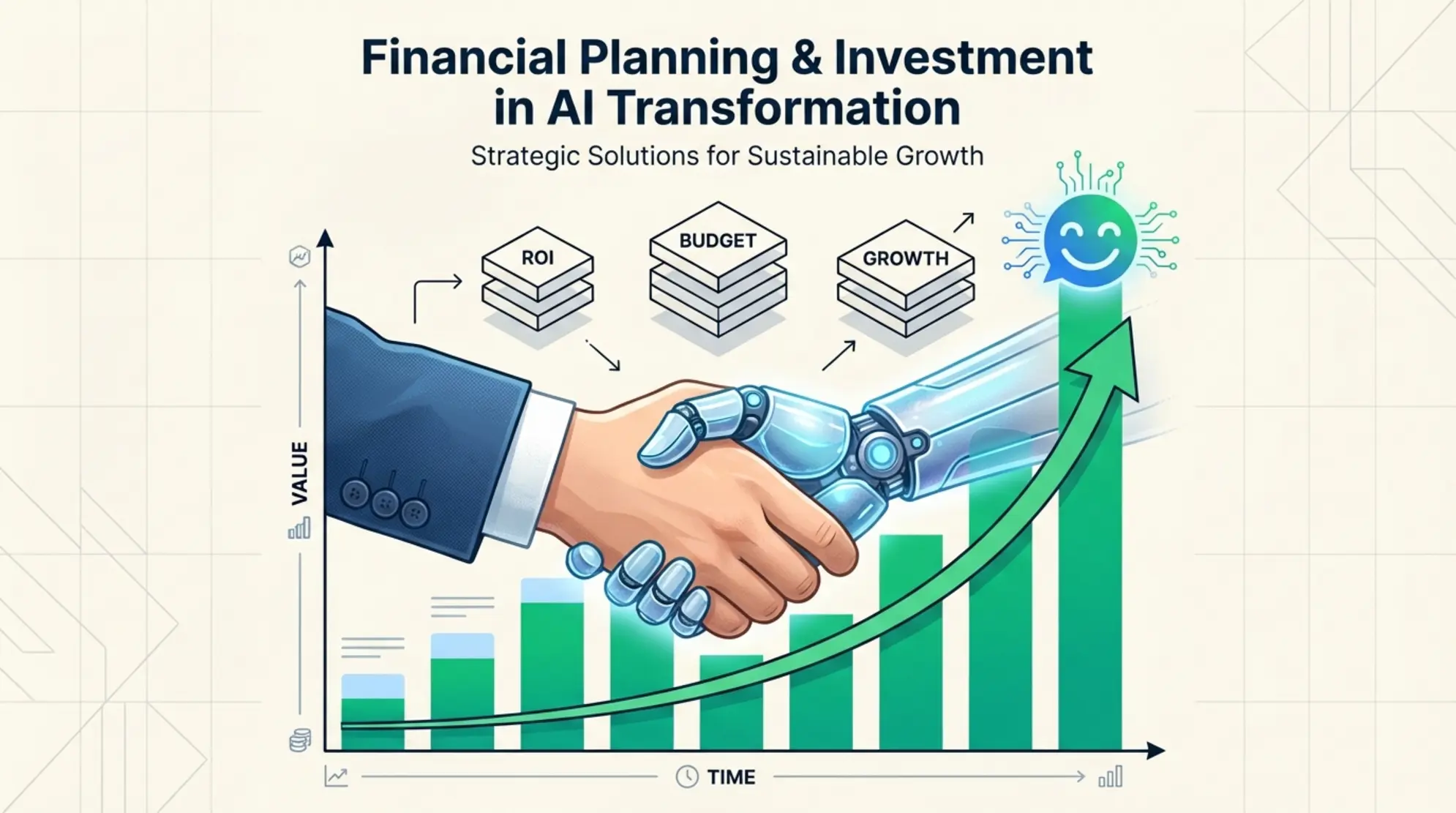
You’re evaluating AI solutions, and the technical capabilities are clear. But what about the financial side? How do you move beyond the hype to build a financially sound AI strategy, secure crucial investments, and ensure every dollar spent translates into measurable growth?
This isn't just about cutting costs; it's about intelligent investment, robust financial planning, and mastering the return on AI. At BenAI, we understand that becoming an AI-first company means marrying technological innovation with impeccable financial foresight.
Mastering the Economics of AI Transformation: A Strategic Guide for CFOs & Decision-Makers
The global AI market is soaring, projected to hit an astounding $1.8 trillion by 2030, with a compound annual growth rate of approximately 36%. Investment is pouring in, particularly with Generative AI attracting $33.9 billion in private funding in 2024 alone. Yet, despite this explosive growth, over 80% of AI projects reportedly fail. Often, the root cause isn't a lack of technical prowess, but a mismanaged financial strategy.
This guide is designed for finance leaders and executives who need to confidently navigate the complex financial landscape of AI transformation. We’ll provide the frameworks, insights, and actionable strategies to ensure your AI investments deliver tangible, long-term value.
The AI Investment Lifecycle: From Concept to Financial Impact
Transforming into an AI-first business is a journey with distinct financial phases, each requiring meticulous planning and oversight.
Phase 1: Strategic Budgeting for AI Initiatives
Effective AI budgeting goes far beyond a simple line item; it's a strategic exercise that demands foresight and a deep understanding of unique AI cost drivers.
Deconstructing AI Project Costs
Many businesses underestimate the true cost of AI because they focus solely on software licenses or initial development. A comprehensive AI budget must account for:
- Development & Implementation: This covers custom model training, software development, API integration, and solution deployment.
- Data Acquisition & Preparation: Often a significant hidden cost. This includes data collection, cleaning, labeling (human-in-the-loop services), and ensuring data quality. Poor data quality is a major reason for AI project failures and increased costs.
- Infrastructure: Hardware (on-premise servers, GPUs) or cloud computing resources (compute instances, storage, networking). The cloud AI spend is a critical area for optimization, as we’ll discuss later.
- Talent: AI engineers, data scientists, machine learning operators, and operational staff to manage AI systems.
- Integration: Connecting new AI solutions with existing legacy systems, which can be complex and costly.
- Maintenance & Operations: Continuous monitoring, model retraining, updates, bug fixes, and resource management.
- Ethical AI & Compliance: Costs associated with ensuring fairness, transparency, data privacy (e.g., GDPR, CCPA), and adhering to emerging AI regulations. Legal reviews of AI outputs also fall here.
- Change Management & Training: Educating and upskilling employees to effectively use new AI tools and processes. This is crucial for adoption and maximizing ROI.
Introducing a Flexible AI Budgeting Framework
Think of your AI budget in two core components:
- Initial Investment (CapEx): One-time costs like initial model development, hardware purchases, significant data acquisition efforts, and foundational infrastructure setup.
- Operational Costs (OpEx): Recurring expenses such as cloud subscriptions, continuous data labeling, model retraining, ongoing talent salaries, maintenance, and utility costs for compute.
This distinction helps in financial reporting and tax considerations, but more importantly, it provides clarity on your ongoing financial commitments.
The "Hidden Costs" Checklist: Don't Get Caught Off Guard
Here’s where many AI projects bleed money. These often-overlooked expenses can silently inflate your Total Cost of Ownership (TCO):
- Data Labeling: Human annotation for training data at scale.
- Technical Debt: Costs incurred from quick fixes or sub-optimal architectural decisions made early in development, which must be addressed later.
- Model Drift & Retraining: As data patterns change, AI models degrade. The cost of continuously monitoring and retraining models is ongoing.
- Data Egress Fees: Cloud providers often charge for moving data out of their platforms, which can accumulate rapidly in data-intensive AI applications.
- Cybersecurity for AI: Protecting AI models and data from adversarial attacks, ensuring data integrity, and securing AI endpoints.
- Energy Consumption: AI models, especially large language models (LLMs) and generative AI, are highly compute-intensive, leading to significant energy costs, which also have an environmental impact.
- Legal & IP: Reviewing AI outputs for intellectual property infringement, avoiding legal biases, and protecting proprietary AI algorithms.
Phase 2: Securing Investment for Your AI Vision
Once you have a robust budget, the next step is securing the necessary capital. This requires tailoring your financial narrative to different types of investors.
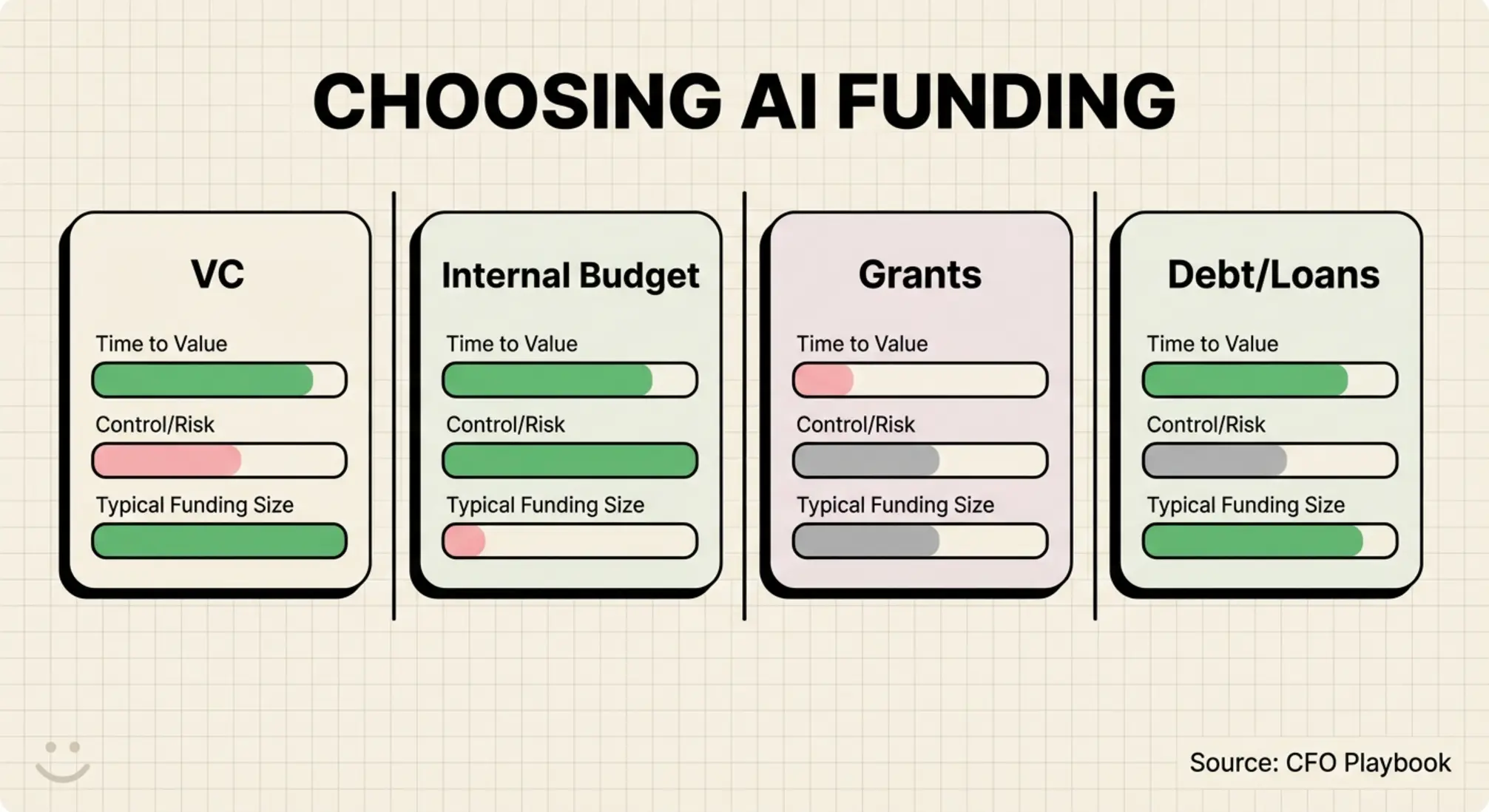
Overview of Funding Sources for AI Initiatives
- Venture Capital (VC) & Corporate VC: Ideal for companies with high growth potential, disruptive AI technologies, and a clear path to market leadership. They seek scalability and innovation.
- Government Grants: Agencies like NSF.gov provide grants for early-stage R&D, transformative AI research, and projects with social impact [3]. Eligibility criteria are strict, often focusing on novel solutions.
- Private Equity: Typically invests in more mature companies looking to scale existing AI-driven operations or acquire AI capabilities.
- Internal Budget Allocation: For enterprises, securing buy-in from internal stakeholders (CFO, departmental heads) is crucial. This often requires a compelling internal business case.
- Debt Financing: Can be an option for more predictable AI projects with clear revenue streams or for infrastructure investments.
Crafting a Financially Compelling AI Business Case
Your pitch needs to resonate with numbers, not just technical jargon. Key financial metrics and projections to include:
- Projected ROI: Quantify both direct cost savings (e.g., reduced manual labor via AI operational automation processes) and new revenue streams (e.g., personalized marketing, new AI-powered products).
- Payback Period: Clearly define when the investment is expected to break even.
- Total Addressable Market (TAM) & Serviceable Obtainable Market (SOM): If applicable, for new AI products or services.
- Scenario Analysis: Present conservative, base, and aggressive financial forecasts to demonstrate understanding of risk and potential upside.
- Impact on Key Financial Statements: How does this AI investment affect P&L, balance sheet, and cash flow in the short and long term?
Phase 3: Measuring & Managing AI's Financial Impact
Measuring ROI for AI projects is notoriously difficult. A staggering 39% of global executives cite measuring ROI and business impact as a primary challenge for AI investments, and less than half of senior leadership truly understands this challenge.
The AI ROI Challenge: Beyond Traditional Metrics
Traditional ROI often falls short for AI because many benefits are intangible or long-term. AI's value creation can be indirect, improving decision-making, enhancing customer experience, or fostering innovation.
Advanced ROI Measurement Frameworks
To capture the true value, you need frameworks that quantify both hard and soft benefits:
- Hard Benefits (Quantifiable):
- Cost Savings: Reductions in operational expenses (e.g., through AI-driven automation, optimized resource allocation).
- Revenue Growth: New income from AI-powered products/services, increased sales efficiency, improved marketing campaign performance.
- Efficiency Gains: Reduced cycle times, faster data processing, improved productivity (e.g., AI in financial planning and analysis professionals freeing up time for strategic decision-making).
- Soft Benefits (Qualifiable & Indirectly Quantifiable):
- Improved Decision-Making: Better insights from data, faster strategic responses, reduced human error.
- Enhanced Customer Experience: Personalized services, faster support (e.g., intelligent automation with RPA).
- Reduced Risk: Better fraud detection, improved compliance, proactive threat identification.
- Innovation Capacity: Freeing up human capital for creative problem-solving and new product development.
- Employee Engagement: Automating repetitive tasks improves job satisfaction.
You can often quantify soft benefits through proxies. For instance, improved customer experience can lead to higher customer retention rates or increased Net Promoter Scores (NPS), which then link back to revenue.
Cost-Benefit Analysis Deep Dive: Methodologies That Work
For any significant AI investment, a rigorous cost-benefit analysis is non-negotiable.
- Net Present Value (NPV): Evaluates the profitability of an investment project by comparing the present value of future cash inflows with the initial investment. Essential for long-term AI projects.
- Internal Rate of Return (IRR): The discount rate that makes the NPV of all cash flows from a particular project equal to zero. Useful for comparing multiple AI initiatives.
- Payback Period: Helps understand how quickly the initial investment will be recouped.
- Real Options Analysis: For highly uncertain AI projects, this methodology treats an investment opportunity as an option, allowing for flexibility as new information becomes available, accounting for the iterative nature of AI development.
Optimizing Financial Performance in an AI-First Company
Once AI solutions are deployed, the focus shifts to continuous financial optimization.
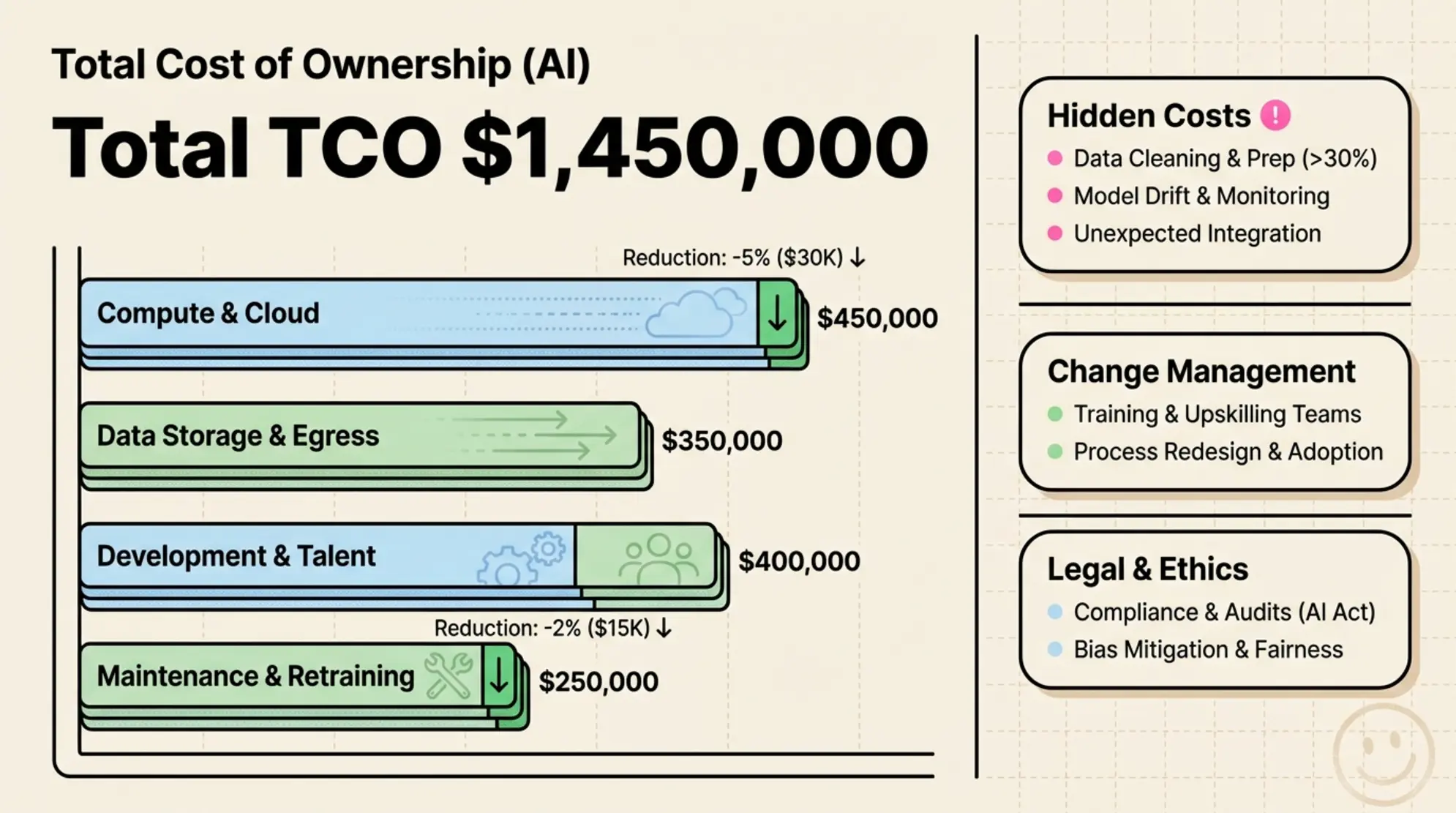
Total Cost of Ownership (TCO) for AI Solutions: A Strategic View
Understanding TCO is paramount for predicting long-term financial commitments. It encompasses direct, indirect, and hidden costs over the entire lifecycle of an AI solution.

Key elements of AI TCO [8]:
- Hardware & Software: Initial purchase or licensing.
- Cloud Services: Compute, storage, network, and specialized AI/ML services.
- Data Management: Storage, movement, processing, and governance.
- Talent: Salaries for development, operations, and maintenance.
- Integration: Connecting AI systems to your existing ecosystem.
- Compliance & Security: Ensuring regulatory adherence and protecting sensitive data and models.
- Energy Consumption: Powering compute-intensive AI workloads.
- Disaster Recovery & Redundancy: Ensuring business continuity.
Strategies for Reducing AI TCO
- Model Efficiency: Optimize AI models for smaller size, faster inference, and lower computational requirements. This also supports reducing AI operational costs.
- Hardware Right-Sizing: Select the appropriate compute resources (e.g., GPUs, TPUs) for your workload, avoiding over-provisioning.
- Strategic Vendor Selection: Evaluate SaaS AI solutions vs. custom builds. Sometimes a ready-made solution with a subscription model is more cost-effective than continuous custom development and maintenance.
- Open Source Leverage: Utilize open-source AI frameworks and models to reduce licensing costs.
- Automation: Implement AI operational automation processes for routine tasks, reducing manual effort and potential errors.
Mastering Cloud AI Spend with FinOps
With AI, especially Generative AI, largely relying on cloud infrastructure, optimizing cloud spend is critical. Google Cloud notes that organizations can significantly reduce costs by implementing FinOps strategies.
Implementing a Cloud FinOps Framework for AI Workloads
FinOps combines finance, operations, and engineering to bring financial accountability to the cloud. For AI, this means:
- Cultural Shift: Foster collaboration between AI engineers, operations, and finance to make cost-aware decisions at every stage.
- Cost Visibility: Implement robust monitoring and reporting to understand where AI cloud spend is going (e.g., training vs. inference, specific models, datasets).
- Governance & Optimization: Establish policies for resource provisioning, implement automated shutdown of idle resources, and utilize cost-saving features like reserved instances or spot instances.
- Resource Tagging: Accurately tag AI resources to attribute costs to specific projects, teams, or business units.
Tactics for Optimizing Cloud AI Spend
- Dynamic Scaling: Automatically adjust compute resources based on real-time AI workload demand. Don't pay for idle capacity.
- Tiered Storage: Store less frequently accessed AI training data or model artifacts in cheaper cold storage tiers.
- Resource Utilization: Continuously monitor and improve the utilization of GPUs and other specialized AI hardware.
- Understanding Pricing Models: Leverage vendor-specific benefits like sustained-use discounts, committed-use discounts, or spot instances for fault-tolerant AI workloads.
- AI Model Architecture Optimization: Design AI models to be efficient, requiring less compute for training and inference.
- Data Locality: Minimize data transfer costs by processing data in the cloud region where it resides.

Financial Models for AI-Driven Growth
AI isn't just a cost center; it's a profound engine for growth. The challenge is modeling that growth quantitatively.
- Revenue Models for AI Products/Services: If you’re developing AI-powered offerings, model subscription revenue, usage-based fees, or value-added service income.
- Integrating AI-Induced Cost Efficiencies: Project the financial impact of AI-driven savings on your P&L, cash flow, and balance sheet. For example, quantifying how AI agent ecosystems reduce headcount needs or how optimized AI infrastructure guides reduce CapEx.
- Scenario Planning & Sensitivity Analysis: Build models that can adapt to changing market conditions, AI model performance, and operational shifts. What happens to profitability if your AI solution achieves 50% vs. 80% efficiency? How does that impact scaling AI with MLOps?
Overcoming Financial Hurdles: Best Practices & Real-World Lessons
Many AI projects fail due to poor data, lack of alignment, or inadequate infrastructure. From a financial perspective, these translate directly into cost overruns and missed ROI targets.
- The Crucial Role of Data Quality & Governance: Investing in data quality upfront reduces costly rework, model inaccuracies, and regulatory fines down the line. It directly impacts your ability to measure AI performance.
- Talent & Change Management Investments: Allocate budget not just for hiring AI experts, but also for upskilling existing teams and managing the organizational transition. Ignoring this leads to resistance and underutilized AI assets. Financial planning and analysis professionals, for instance, need to understand AI to leverage its benefits.
- Ethical AI & Compliance as a Financial Imperative: Proactively budgeting for ethical AI audits, bias detection, and compliance ensures long-term trust and avoids costly legal battles or reputational damage.
The Future CFO & AI: A Strategic Partnership
The role of the CFO is rapidly evolving. From being a guardian of costs, the modern CFO becomes a strategic partner, leveraging AI to drive decisions and growth. AI empowers finance leaders to shift from retrospective reporting to proactive forecasting and strategic advising.
Your AI-First Financial Journey Starts Here
Becoming an "AI-first" company isn't an overnight endeavor; it's a strategic, financially disciplined journey. BenAI helps businesses like yours navigate this complexity by providing proven AI systems, implementations, training, and consulting. We understand that strong financial planning is the bedrock of successful AI transformation.
Ready to build a financially robust AI strategy for your business? Talk to our experts today.
Frequently Asked Questions (FAQs)
1. What's the biggest financial mistake companies make when investing in AI?
The most common mistake is underestimating the Total Cost of Ownership (TCO) by overlooking "hidden costs." These include data preparation and labeling, continuous model retraining, integration with legacy systems, cybersecurity for AI, and the significant costs of change management and employee training. Many companies focus on initial development costs but fail to budget for ongoing operational expenses and critical supporting activities.
2. How can we measure ROI for AI initiatives, especially for intangible benefits?
Measuring AI ROI requires a blend of traditional financial metrics and proxy indicators for intangible benefits. For tangible benefits (e.g., cost savings, revenue uplift), use standard NPV, IRR, and payback period calculations. For intangible benefits (e.g., improved decision-making, customer experience), define measurable proxies. For example, improved decision-making might lead to a measurable reduction in error rates or faster time-to-market. Enhanced customer experience could be tracked through increased customer retention rates, higher Net Promoter Scores (NPS), or reduced customer support interaction times, which then translate into measurable financial gains. Tools and frameworks that track AI performance are invaluable here.
3. What are the key financial metrics investors look for in AI projects?
Investors are particularly interested in:
- Scalability & Growth Potential: Can the AI solution achieve significant market penetration or operational impact?
- Clear ROI & Payback Period: Quantifiable financial returns and a reasonable timeframe for recouping the investment.
- Sustainable Competitive Advantage: How does the AI create a defensible position (e.g., proprietary data, unique algorithms)?
- Team Expertise: The financial and technical acumen of the team to execute the AI vision.
- TCO & Financial Health of the Project: A realistic understanding of all costs involved and how they will be managed, reflecting an intelligent AI operational cost reduction strategy.
- Financial Projections: Robust, scenario-based financial models that demonstrate potential upside and risk mitigation.
4. How can we optimize cloud AI spend?
Optimizing cloud AI spend involves implementing FinOps principles, which unite finance, operations, and engineering teams. Key strategies include:
- Dynamic Resource Scaling: Automatically adjusting compute resources based on real-time AI workload demand.
- Efficient Model Architecture: Designing AI models to minimize computational requirements for training and inference.
- Strategic Storage Management: Utilizing tiered storage for different data access needs (e.g., hot vs. cold storage).
- Cost Visibility & Governance: Implementing strong monitoring, tagging, and policies to track and control AI expenditures.
- Leveraging Discounts: Utilizing reserved instances, committed-use discounts, or spot instances for appropriate workloads.
- Data Egress Management: Minimizing data transfer costs out of cloud providers.
5. What role does a CFO play in successful AI transformation?
The CFO's role is critical. They move beyond traditional cost control to become a strategic partner in guiding AI transformation. This includes:
- Building the Business Case: Quantifying potential financial returns and risks.
- Strategic Allocation: Prioritizing and allocating budget to high-impact AI initiatives.
- ROI Measurement: Developing and implementing frameworks to track AI ROI effectively.
- Risk Management: Identifying and mitigating financial risks associated with AI adoption.
- Driving Adoption: Advocating for AI within the organization and ensuring financial readiness for change management.
- Securing Funding: Presenting compelling financial arguments to internal and external investors.
Ultimately, the CFO ensures that AI investments are not just technologically advanced but also financially sound, driving sustainable growth and a true AI-first approach. This requires strong leadership buy-in from all levels.
Join Our Growing AI Business Community
Get access to our AI Automations templates, 1:1 Tech support, 1:1 Solution Engineers, Step-by-step breakdowns and a community of forward-thinking business owners.

Latest Blogs
Explore our latest blog posts and insights.