You’ve invested in AI. You’ve launched initiatives, perhaps even deployed a few AI agents. But as you evaluate your options and look at the bottom line, a crucial question arises: is your AI delivering real, measurable value? This isn't just about cool tech; it's about validating your investment, driving continuous improvement, and ensuring AI translates into a genuine competitive advantage.
Many businesses are asking this. While 78% of enterprises have adopted AI, a staggering 60% see minimal financial benefits despite substantial investments. This isn't a failure of AI itself, but often a gap in how its performance is measured, optimized, and aligned with core business objectives. At BenAI, we bridge this value gap by providing the frameworks and expertise to ensure your AI initiatives don't just exist, but thrive and deliver.
Beyond Hype: Defining AI Performance with Measurable KPIs
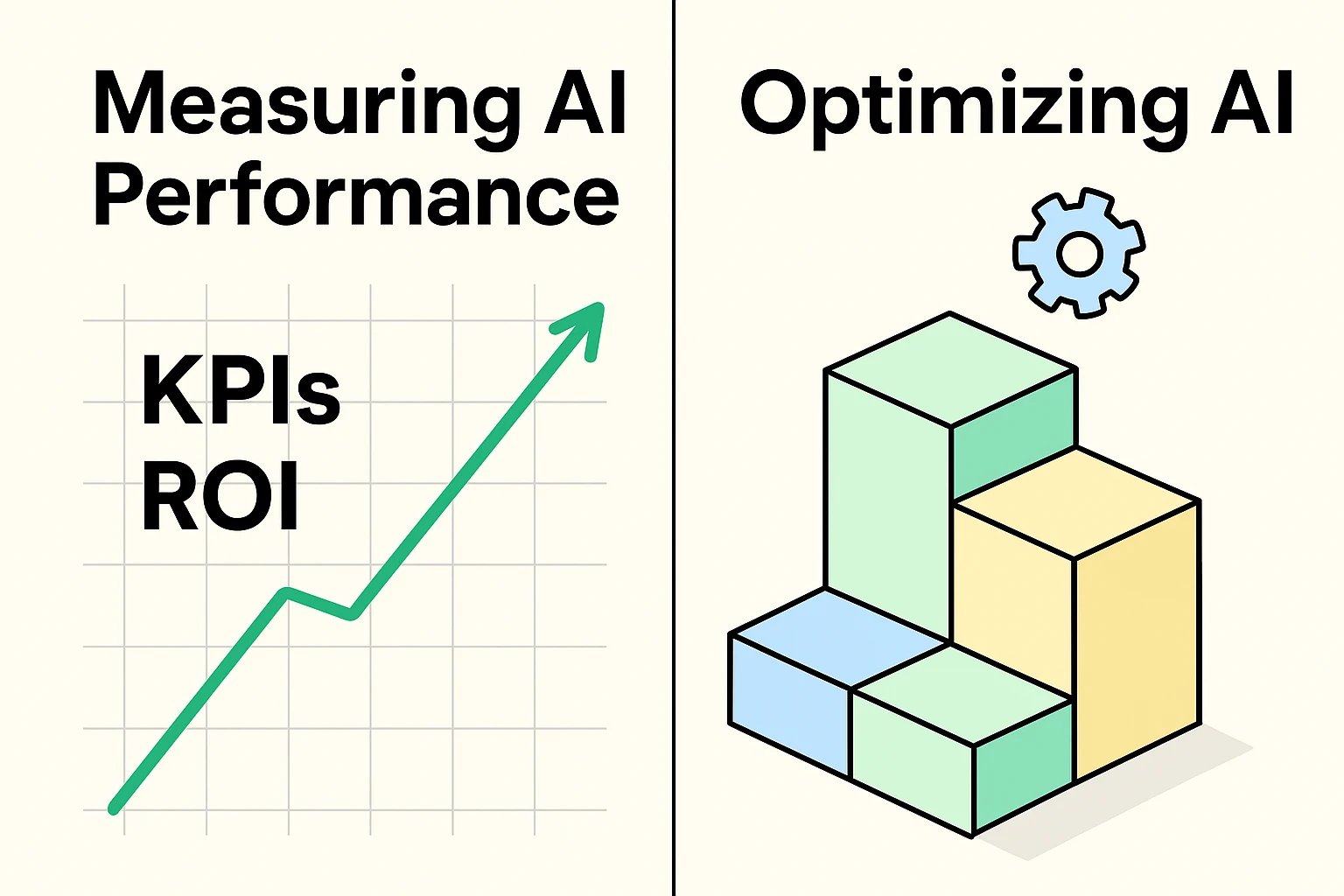
The journey to tangible AI ROI begins with precise measurement. It’s not enough to say an AI is "working"; you need to quantify its impact. Measuring AI performance requires looking beyond mere technical accuracy and aligning closely with broader business goals.
Technical Performance Indicators
For those in the weeds of AI implementation, technical KPIs are critical. They provide the granular data needed to fine-tune models and troubleshoot issues. These include:
- Accuracy: How often the AI makes correct predictions or takes appropriate actions.
- Precision and Recall: Important for classification tasks, balancing false positives and false negatives.
- F1-Score: A harmonic mean of precision and recall, offering a single metric for model effectiveness.
- Latency: The time it takes for the AI system to respond to an input.
- Throughput: The number of requests or transactions an AI system can process in a given period.
- System Uptime: The percentage of time the AI system is operational and available.
- Drift Detection: Monitoring for changes in data or model performance over time that might indicate a need for retraining.
While these metrics are vital, they tell only part of the story. A model can be 99% accurate, but if it's solving the wrong problem or slowing down operations, its business value is diminished.
Business-Oriented Performance Indicators
This is where the rubber meets the road for decision-makers. Integrating AI effectively means connecting technical performance to quantifiable business outcomes. Consider these KPIs:
- Cost Reduction: Savings achieved through AI-driven automation (e.g., reduced manual labor, optimized resource allocation).
- Revenue Increase: New revenue streams or increased sales directly attributable to AI interventions (e.g., personalized marketing, optimized pricing).
- Customer Satisfaction (CSAT/NPS): Improvements in customer experience due to faster responses, better recommendations, or higher quality service.
- Time-to-Market Speed: Accelerated product development or campaign launches facilitated by AI tools and agents.
- Employee Productivity: Measured by tasks automated, time saved, or increased output per employee. Research shows AI-driven tools can boost employee productivity by an average of 40%.
- Conversion Rates: For marketing or sales AI, the direct impact on turning leads into customers.
- Threat Identification Accuracy: For security or fraud detection AI, the effectiveness in preventing losses.
The key is to align these business KPIs with your initial AI project goals. How does improved latency in a customer service chatbot translate to higher CSAT scores? How does a more accurate marketing AI lead to increased conversions? Mapping these connections is where an AI-first strategy truly shines.

Compare technical metrics and business impact side-by-side to decide which AI models best align with your ROI goals.
The ROI Paradox: Unlocking Tangible Value from AI
The biggest challenge isn't just implementing AI, but proving its return on investment. With corporate AI spending reaching $252 billion in 2024 and projected to hit $1.5 trillion by 2025, the pressure to demonstrate ROI is immense. Yet, only 50% of AI initiatives deliver a positive business impact. BenAI’s approach focuses on rigorous cost-benefit analysis and clear justification.
Conducting a Robust Cost-Benefit Analysis
A comprehensive cost-benefit analysis for AI ventures involves more than just comparing initial project costs to anticipated gains. You need to consider both direct and indirect factors.
Costs to Consider:
- Development & Implementation: Talent acquisition, software licenses, infrastructure (cloud computing, hardware), data labeling, model training.
- Maintenance & Operation: Ongoing monitoring, retraining, model drift management, debugging, infrastructure upkeep.
- Data Preparation: Cleaning, structuring, and enriching data, which can account for a significant portion of project costs.
- Integration: Connecting AI systems with existing legacy software and workflows.
- Ethical Oversight: Costs associated with ensuring fairness, privacy, and compliance.
- Change Management: Training employees, addressing resistance to new processes.
Benefits to Quantify:
- Direct Financial Gains: Increased revenue, reduced operational costs, fraud prevention, optimized pricing.
- Productivity & Efficiency: Time saved, faster decision-making, increased output per employee. For instance, AI in marketing and sales can improve conversion rates by up to 60%.
- Improved Quality: Reduced errors, higher product quality, enhanced customer service. (For practical ways AI can improve quality, see our guide on "AI-Driven Quality Control".)
- Enhanced Decision-Making: AI provides comprehensive data analysis and contextual recommendations, leading to smarter, faster business decisions.
- Competitive Advantage: Innovation, market leadership, and improved business agility.
By meticulously tracking these elements, you can build a compelling business case for AI, ensuring stakeholders understand the full financial picture.

A clear ROI snapshot with payback milestones and cost breakdowns to help stakeholders evaluate the financial case for AI projects.
Optimizing AI Models for Peak Efficiency and Accuracy
Once your AI is deployed and its performance is being measured, the next frontier is continuous optimization. This isn’t a one-time task; it’s an ongoing process that refines AI agents and models to extract maximum value.
Deep Dive into Model Optimization Techniques
Optimizing an AI model can dramatically improve its performance and efficiency. Key techniques include:
- Pruning: Removing less important connections or neurons from a neural network without significantly impacting performance. This reduces model size and speeds up inference.
- Quantization: Reducing the precision of numerical representations (e.g., from 32-bit to 8-bit integers). This shrinks model size and speeds up computations with minimal accuracy loss.
- Hyperparameter Tuning: Systematically adjusting configuration parameters (learning rate, batch size, number of layers) that govern the training process to achieve optimal model performance.
- Data Efficiency: Leveraging smaller, higher-quality datasets to train effectively, rather than relying solely on massive quantities of data. This also includes techniques like data augmentation.
These techniques, often combined, allow for more efficient AI operations, leading to reduced inference costs and faster processing.
Practical A/B Testing for AI Model Selection
A/B testing isn't just for website elements; it's a powerful methodology for selecting the best-performing AI models. This methodical approach ensures decisions are data-driven.
- Define Your Hypothesis: Clearly state what you expect to happen and what metrics you'll use to measure success (e.g., "Model B will increase lead generation by 15% compared to Model A").
- Experimental Design:
- Traffic Splitting: Divide your user base or data inputs into statistically significant groups. One group interacts with Model A (control), another with Model B (variant).
- Metric Selection: Go beyond raw accuracy. Consider business metrics like user engagement, conversion rates, customer satisfaction, or revenue per user. For example, when A/B testing AI-driven LinkedIn campaigns, you'd track connection acceptance rates or qualified lead generation.
- Run the Experiment: Monitor performance in real-time, looking for statistically significant differences.
- Analyze Results & Iterate: If Model B outperforms Model A on your chosen business metrics, you can confidently roll it out. If not, refine your models or hypotheses and test again.
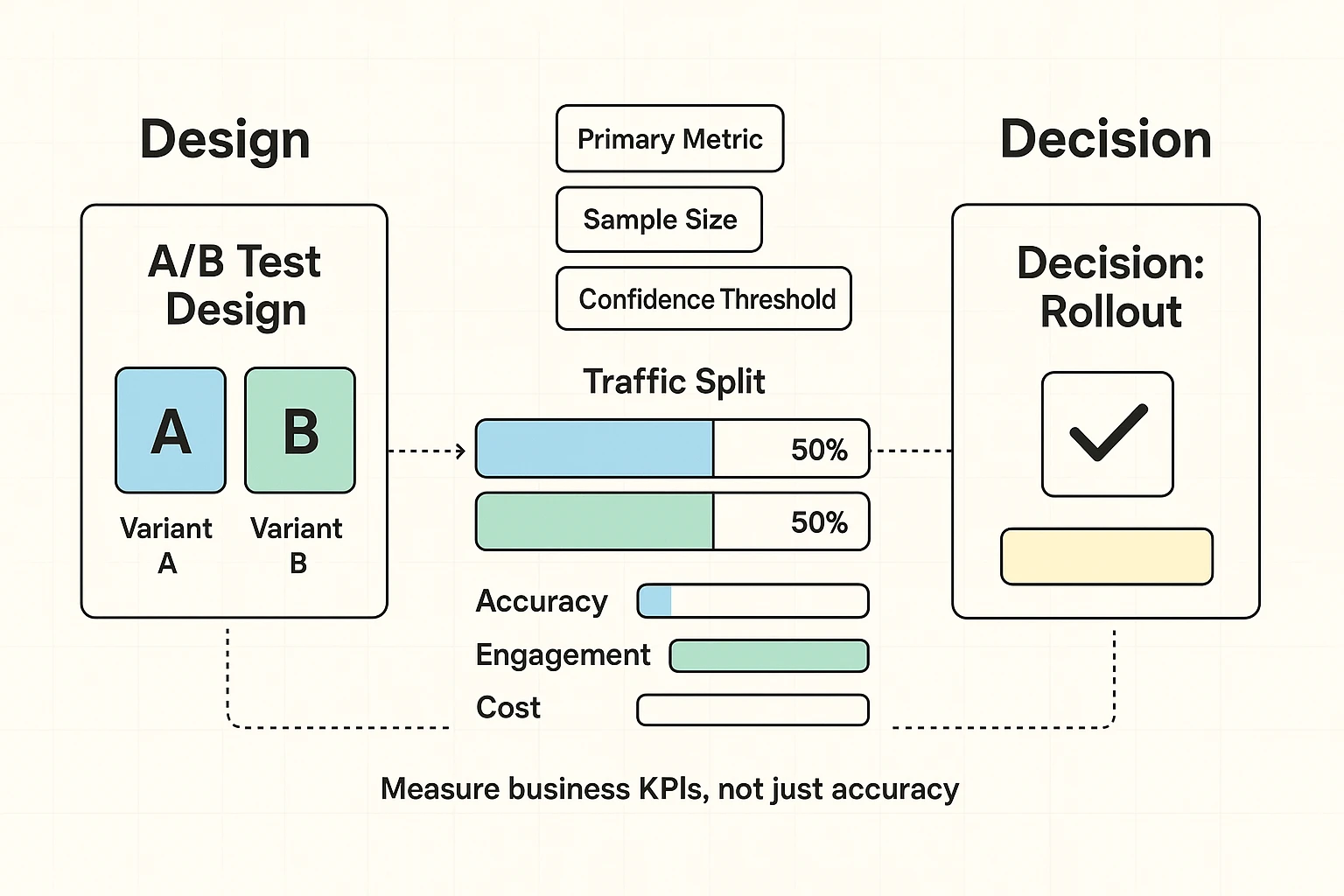
A practical A/B testing playbook that surfaces which model variant drives business metrics, guiding rollout decisions with clear thresholds.
Building Self-Improving AI: The Power of Feedback Loops
The most powerful AI systems aren't static; they learn and adapt. Implementing continuous feedback loops is paramount for long-term optimization and ensuring your AI remains relevant and effective.
Framework for Continuous Learning
A well-designed feedback loop allows your AI to learn from its interactions and performance, constantly improving over time. This typically involves:
- Data Collection: Continuously gather new data from AI interactions, user feedback, and real-world outcomes.
- Performance Monitoring: Track defined KPIs to identify performance degradations, data drift, or opportunities for improvement. (Pro-tip: Consider using tools for AI SEO reporting dashboards to track direct impact on measurable outcomes).
- Human-in-the-Loop Validation: Incorporate human experts to review AI decisions, correct errors, and provide qualitative feedback, especially for critical decisions or complex tasks.
- Model Retraining & Updates: Periodically retrain your AI models with new, refined data. This could be scheduled or triggered by performance alerts.
- Deployment & A/B Testing: Safely deploy updated models, often using A/B testing to validate improvements before a full rollout.
This iterative process ensures your AI systems are not only robust but also capable of adapting to changing market conditions and evolving business needs.
Fine-Tuning AI Agents for Diverse Business Functions
The principles of optimization apply directly to fine-tuning AI agents across various business functions—be it marketing, recruiting, or customer service.
- Marketing Agencies: Fine-tune AI content generation agents by providing targeted feedback on tone, style, and relevance for specific campaigns or client needs. For example, if generating AI meta ad copy, A/B test different AI-generated variations for click-through rates and conversion metrics. If your AI is generating newsletter content, track open rates and subscriber engagement to refine its output.
- Recruiting Firms: Optimize AI candidate screening agents by providing feedback on ideal candidate profiles, successful interview outcomes, and cultural fit criteria.
- Enterprise Solutions: For custom AI in areas like supply chain management or fraud detection, fine-tune models by integrating real-world event data, anomaly detection from human experts, and performance metrics like reduced inventory waste or fewer false positives.
By providing specific, consistent feedback and measuring the impact, you create AI agents that are highly specialized and efficient.
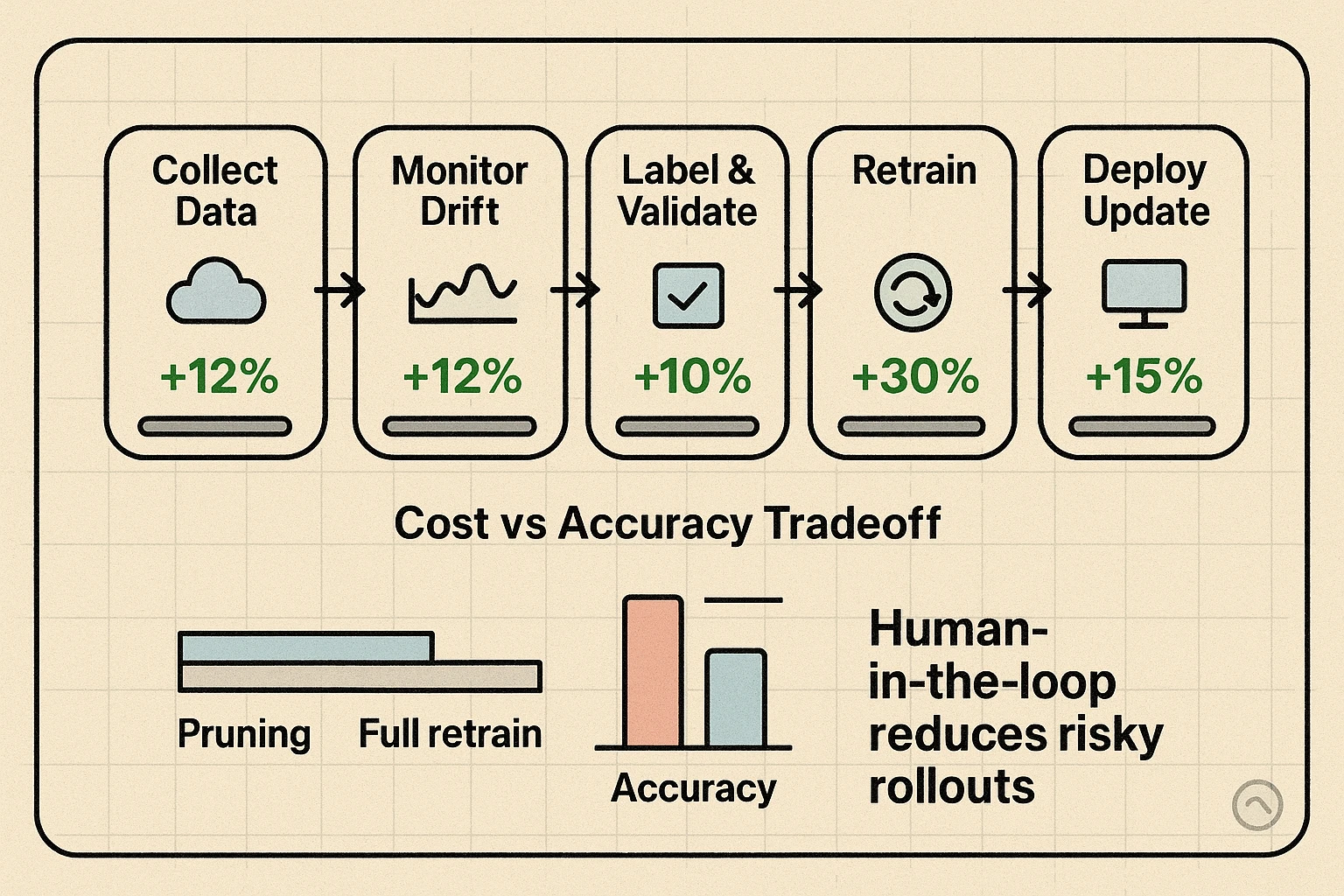
A visual roadmap for continuous learning and model tuning that clarifies tradeoffs and builds confidence in safe, measurable AI improvements.
BenAI's Integrated Approach to AI Performance
At BenAI, we understand that successful AI adoption isn't just about deploying technology; it's about realizing tangible business outcomes. The significant "value gap" where 60% of AI users see minimal financial benefits is precisely what our integrated approach is designed to close. We don't just implement AI; we partner with you to measure its impact, optimize its performance, and ensure it continuously drives growth and efficiency.
Your AI-first business starts here, with a clear mandate for measurable results and continuous improvement.
Frequently Asked Questions About Measuring and Optimizing AI Performance
Q1: We've invested in AI, but haven't seen the expected ROI. What are we doing wrong?
Many businesses face this. The common pitfalls often include:
- Lack of clear KPIs: Not defining what success looks like in measurable business terms from the outset.
- Poor data quality: AI models are only as good as the data they're trained on.
- Insufficient optimization: Treating AI deployment as a "set it and forget it" task instead of an ongoing optimization process.
- Misalignment with business goals: Implementing AI for AI's sake, rather than solving specific, high-value business problems.
BenAI helps you identify these gaps, establish clear metrics, and implement continuous optimization strategies to ensure your AI delivers genuine value.
Q2: How do I choose the right KPIs for my AI project?
The right KPIs depend entirely on your specific business objectives for the AI initiative. Start by asking:
- What problem is this AI solving?
- What measurable impact will this AI have on revenue, cost, or customer experience?
- Which existing business metrics will this AI directly influence?
Combine technical metrics (e.g., latency, accuracy) with business metrics (e.g., conversion rate, customer churn reduction) to get a holistic view. Our team assists clients in mapping technical AI performance to critical business outcomes.
Q3: Is A/B testing AI models truly necessary, or can we just monitor performance post-launch?
A/B testing is crucial for robust AI optimization. While post-launch monitoring can catch major issues, A/B testing provides a controlled environment to confidently compare different model versions or strategies. It helps you statistically prove which AI approach truly drives your desired business outcomes before full-scale deployment, reducing risk and maximizing impact. For instance, testing different prompt engineering approaches for scaling LinkedIn lead generation can reveal which delivers better quality leads.
Q4: How can BenAI help us fine-tune our existing AI agents for better performance?
BenAI's expertise lies in custom AI implementations and strategic consulting. We can:
- Audit your current AI systems: Identify bottlenecks, underperforming models, and optimization opportunities.
- Develop tailored optimization strategies: Apply techniques like model pruning, quantization, hyperparameter tuning, and data efficiency.
- Implement feedback loops: Design and integrate continuous learning mechanisms into your AI agents.
- Provide expert training: Equip your team with the skills to maintain and optimize AI performance internally.
Our goal is to transform your AI initiatives into engines for continuous growth.
Q5: What if my business needs to optimize AI for specific functions like marketing or recruiting?
BenAI specializes in tailored AI growth systems for various business functions. Whether you're a marketing agency needing to automate content creation and improve campaign performance, or a recruiting firm looking to streamline candidate screening and monitoring, we have dedicated solutions. We apply these same measurement and optimization principles to ensure AI delivers tangible results in your specific domain. This includes optimizing aspects like AI-powered image optimization for marketing content or AI tools for site speed analysis.
Q6: How does BenAI ensure our investment in optimization actually pays off?
Our commitment to measurable outcomes is foundational. We ensure payoff by:
- Starting with clear ROI objectives: Every optimization effort is tied to a quantifiable business goal.
- Implementing rigorous A/B testing and performance monitoring: We validate improvements with data, not just assumptions.
- Focusing on cost-benefit analysis: We ensure the cost of optimization is justified by the projected gains.
- Providing ongoing support and iterative improvement: AI optimization is a journey, and we're with you every step of the way, continuously refining for maximum impact.
Ready to ensure your AI investments deliver clear, measurable ROI and drive continuous business growth? Contact BenAI today for a personalized consultation. Let's build your AI-first future, together.
Join Our Growing AI Business Community
Get access to our AI Automations templates, 1:1 Tech support, 1:1 Solution Engineers, Step-by-step breakdowns and a community of forward-thinking business owners.
Latest Blogs
Explore our latest blog posts and insights.