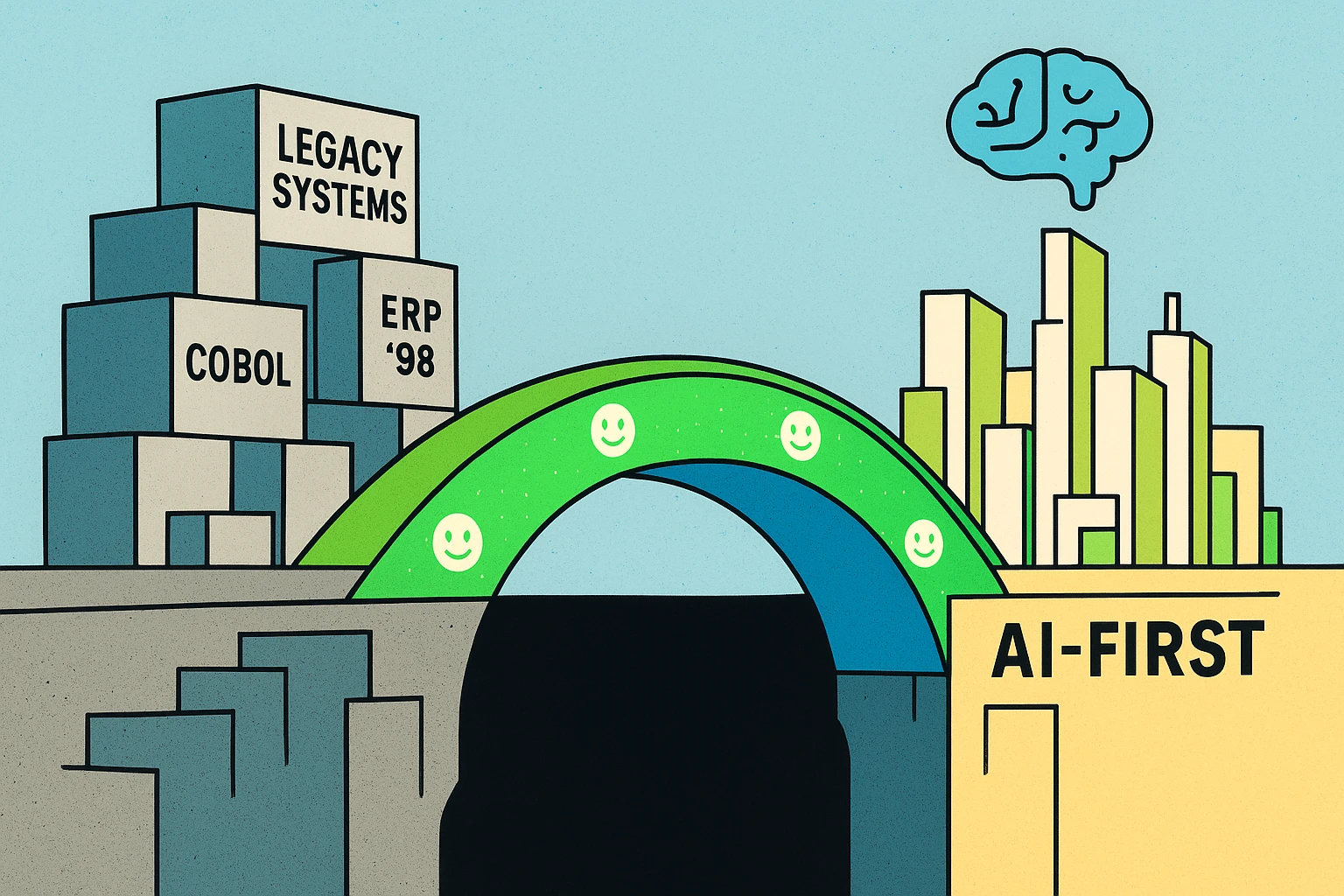
You’ve heard the buzz: AI is the future. It’s revolutionizing industries, automating processes, and unlocking unprecedented growth. But then you look at your own organization, staring down decades-old legacy systems – mainframes humming since the 80s, ERPs implemented before the internet was common, and custom applications built by folks who retired long ago. The gap between the AI dream and your operational reality feels like a chasm. Can AI truly transform a business still running on COBOL?
The answer is a resounding yes. But it’s not about ripping everything out and starting fresh. It's about strategically and intelligently integrating AI into your existing digital transformation roadmap, ensuring that your valuable, battle-tested legacy systems don't become roadblocks, but rather rich data sources and stable operational foundations for your AI-powered future.
The Inevitable Intersection: AI Strategy and Digital Transformation
Before we dive into the "how," let's clarify the "what."
Digital Transformation (DT) is the fundamental shift an organization undergoes to leverage digital technologies to improve processes, culture, and customer experiences. It's often a multi-year journey involving cloud migration, automation, data analytics, and modernizing infrastructure.
AI Strategy is your organization's plan for how artificial intelligence will be used to achieve specific business goals. It defines AI's role in driving innovation, efficiency, and competitive advantage.
The challenge, and indeed the opportunity, lies in harmonizing these two initiatives, especially when legacy systems are involved. Many businesses fall into the trap of viewing AI as a separate, futuristic project, distinct from their ongoing digital transformation efforts. This leads to siloed initiatives, wasted resources, and ultimately, an inability to scale AI's impact across the enterprise.
Why Legacy Systems Aren't AI's Kryptonite (And Why You Might Think They Are)
It’s a common misconception: "Our systems are too old for AI." While integrating AI with legacy infrastructure certainly presents unique hurdles, they are far from insurmountable. Think of your legacy systems not as dead ends, but as deep wells of historical data and critical business logic. These are invaluable assets that, once properly accessed, can feed powerful AI models.
Here are some common myths we need to debunk:
- Myth 1: You must rebuild everything from scratch. False. A "rip and replace" strategy is often cost-prohibitive, risky, and unnecessary. Strategic integration and modernization often yield faster results.
- Myth 2: Legacy data is too messy for AI. Also false. While cleaning and preparing data from older systems can be complex, it's a solvable problem with the right tools and strategy. The richness of historical data can be a significant advantage.
- Myth 3: AI is only for cloud-native applications. Not true. While cloud environments offer flexibility, AI can be integrated with on-premise systems through various architectural patterns.
- Myth 4: Integrating AI is too risky. Every major technological shift involves risk. The real risk lies in not integrating AI and falling behind competitors.
The truth is, ignoring AI's potential because of legacy systems is like owning a gold mine but refusing to dig because you don't have the newest excavator. You might need to adapt your tools, but the value is unquestionably there.
Introducing the Legacy-First AI Integration Framework
To bridge the gap between AI aspiration and legacy reality, we advocate for a structured approach: the Legacy-First AI Integration Framework. This framework recognizes the unique constraints and opportunities of existing infrastructure, providing a phased, practical roadmap.
This framework emphasizes four strategic pillars:
- Assessment & Strategy Alignment: Understanding your current state and defining where AI can deliver the most value.
- Data Foundations & Governance: Preparing your legacy data for AI ingestion and ensuring its quality and accessibility.
- Integration Architectures & Technologies: Choosing the right technical pathways to connect AI models with legacy systems.
- Organizational Change & Upskilling: Ensuring your people and processes are ready for AI.
This holistic view ensures that technology, data, and human elements are all part of a cohesive strategy, paving the way for comprehensive AI Strategy & Roadmap Development.
Building Bridges: A Phased Roadmap for AI Integration
Successfully integrating AI into a legacy environment is not a sprint; it's a marathon with carefully planned stages. Here's a progressive, phased roadmap designed to manage risk, deliver incremental value, and ensure long-term success.
Phase 1: Assessment & Strategy Alignment – Know Before You Go
This initial phase is about thoroughly understanding your current landscape and strategically defining your AI objectives.
- Business Value Identification: Start with business problems, not technology. Where are your biggest bottlenecks, highest costs, or missed revenue opportunities? Identify high-impact, low-risk use cases where even a small AI improvement can yield significant ROI. For instance, can AI automate customer support FAQs currently handled by agents, or optimize inventory management based on historical sales data?
- Legacy System Audit for AI Readiness:
- Data Availability: What data resides in your legacy systems? Is it structured, unstructured?
- Data Quality: How clean and consistent is this data? What are the data governance practices?
- Accessibility: How easily can you extract data from these systems? Do they have APIs, or will you need custom integrations?
- System Agility: How flexible are your legacy systems to integrate with new tools?
- Cross-Functional Team Formation: AI integration isn't just an IT project. Bring together business leaders, data scientists, IT architects, and even legal/compliance teams from the outset.
- Define Clear AI Objectives & KPIs: What does success look like? How will you measure the AI's impact on business outcomes, not just technical performance?
Phase 2: Data Foundations & Governance – Fueling the AI Engine
AI is only as good as the data it's trained on. For legacy systems, this phase is critical.
- Data Extraction & Ingestion: Develop secure and reliable methods to extract relevant data from your legacy systems. This might involve ETL (Extract, Transform, Load) pipelines, database replication, or API calls.
- Data Cleaning & Transformation: Legacy data often comes with inconsistencies, duplicate entries, and outdated formats. Significant effort is required to clean, normalize, and transform this data into a usable format for AI models. This can be one of the most time-consuming steps.
- Data Governance & Security: Establish robust policies for data privacy, security, and access control, especially crucial when dealing with sensitive legacy data. Implement data masking, anonymization, and encryption where necessary.
- Unified Data Layer: Consider creating a modern data lake or data warehouse that acts as a central repository for both legacy and new data, making it easier for AI models to access a comprehensive view. For more on structuring your data for AI, check out our guide on creating an AI Data Strategy.
Phase 3: Integration Architectures & Technologies – Connecting the Dots
This is where the technical magic happens, finding ways for your AI models and legacy systems to "speak" to each other without causing disruption.
Several architectural patterns can facilitate this integration:
- APIs (Application Programming Interfaces): If your legacy system exposes APIs, this is often the cleanest way to interact. You can use APIs to send queries to the legacy system or push results from the AI back into it.
- Middleware & ESBs (Enterprise Service Buses): These act as intermediaries, translating data and commands between disparate systems. They are particularly useful for complex integration scenarios involving multiple legacy applications.
- Data Virtualization: This technology allows you to create a virtual, unified view of data from multiple sources (including legacy systems) without physically moving or copying the data. AI models can then query this virtual layer.
- Microservices: Encapsulating specific legacy functionalities as microservices can create modular, independently deployable components that are easier for AI applications to consume.
- Anti-Corruption Layer: This pattern acts as a protective shield between a new AI application and an old system, preventing the AI's design from being contaminated by the legacy system's complexities. It translates data and calls in both directions.
- Robotic Process Automation (RPA): In cases where direct integration is impossible or too costly, RPA bots can mimic human interaction with legacy system interfaces to extract data or input AI-generated decisions.
- Machine Learning Operations (MLOps): Integrate MLOps best practices from deployment and monitoring to maintain and update AI models efficiently, especially crucial when dealing with constantly evolving data from legacy systems.
The choice of architecture depends on the specific legacy system, the AI use case, and your organizational capabilities. For examples of integrating AI into specific tech stacks, you might find our guide on AI SEO Marketing Stack Integration insightful.
Phase 4: Pilot, Scale & Iterate – Learn, Adapt, Grow
Once connections are established, it's time to test, learn, and expand.
- Pilot Projects: Start small. Implement your AI solution on a limited scale within a specific business unit or process. This allows you to validate your assumptions, iron out technical kinks, and gather early feedback without disrupting critical operations.
- Performance Monitoring & Evaluation: Continuously monitor the AI model's performance and impact on your defined KPIs. Is it achieving the desired business outcomes? Are there any unexpected side effects or biases?
- Feedback Loop & Iteration: Use insights from your pilot to refine both the AI model and the integration strategy. AI is not a set-and-forget technology; it requires continuous learning and adaptation.
- Scaling & Governance: Once successful, plan for broader deployment. This involves robust scaling strategies, clear governance frameworks for AI decision-making, and ongoing maintenance. Consider how AI's influence over system decisions might affect regulatory compliance and AI crawlability for auditing purposes.
The Human Element: Organizational Change and Upskilling
Technology alone isn't enough for successful AI integration. Your organization's people need to be ready.
- Leadership Buy-in: Strong advocacy from senior leadership is paramount to drive cultural change and allocate necessary resources.
- Talent Development: Invest in upskilling your existing IT and business teams. Provide training in AI concepts, data science fundamentals, and new integration tools. This could involve formal courses, certifications, or internal mentorship programs.
- New Roles: You might need to introduce new roles, such as AI architects, MLOps engineers, or data ethicists, to support your expanded AI capabilities.
- Change Management: Actively manage the organizational change process. Clearly communicate the benefits of AI, address employee concerns, and involve users in the design and implementation process. This fosters adoption and reduces resistance.
Comprehensive AI Strategy & Roadmap Development
Integrating AI into legacy systems isn't just a technical task; it's a strategic imperative. By following a structured framework, prioritizing business value, meticulously preparing your data, choosing appropriate integration architectures, and fostering an AI-ready culture, you can unlock immense value. Your legacy systems, far from being a burden, can become powerful engines fueled by AI, propelling your organization into a truly transformative digital future.
Frequently Asked Questions about AI & Legacy System Integration
Q1: What exactly are "legacy systems"?
A1: Legacy systems refer to old computer systems, hardware, or software that are still in use because they fulfil a specific need, but are often based on outdated technologies. They can be critical to business operations, but challenging to integrate with modern technologies due to their age, complexity, and potentially sparse documentation.
Q2: Is it always necessary to replace legacy systems when adopting AI?
A2: No, not at all. While "rip and replace" is an option, it's often expensive and risky. Strategic AI integration often focuses on creating layers or interoperability points (like APIs, middleware, or microservices) that allow AI applications to interact with legacy systems, leveraging the existing infrastructure rather than replacing it. This is a core tenet of the "Legacy-First" approach.
Q3: What are the biggest challenges when integrating AI with legacy systems?
A3: The biggest challenges typically include: - Data Access & Quality: Extracting, cleaning, and standardizing data from disparate, often poorly documented legacy databases. - Integration Complexity: Lack of modern APIs, requiring custom development or specialized middleware. - Performance Constraints: Legacy systems might not handle the data volume or processing demands of real-time AI inference. - Skill Gaps: Few in-house experts familiar with both modern AI and older legacy technologies. - Cost & Risk: Perceived high costs and risks associated with modifying critical, stable legacy systems.
Q4: How can we make sure our data in legacy systems is suitable for AI?
A4: Data suitability for AI usually involves several steps: - Audit & Discovery: Identify where relevant data resides and its structure. - Cleansing & Normalization: Correct errors, remove duplicates, and standardize formats. - Enrichment: Combine data from different sources (even outside legacy systems) to create a richer dataset for AI. - Governance: Establish rules for data consistency, quality, security, and privacy (e.g., anonymization). - Accessibility: Create secure pipelines (e.g., through data lakes, APIs) for AI models to access the prepared data. For a deeper dive, read our article on AI Data Strategy.
Q5: What are specific examples of AI improving operations with legacy systems?
A5: - Predictive Maintenance: AI models analyze data from industrial machinery's legacy sensors to predict failures before they happen, optimizing maintenance schedules and reducing downtime. - Fraud Detection: AI sifts through massive historical transaction data in legacy banking systems to identify anomalous patterns indicative of fraud, often in real-time. - Customer Service Augmentation: Chatbots or AI assistants access information from legacy CRM systems to provide immediate, consistent responses to customer queries, freeing up human agents for complex issues. - Supply Chain Optimization: AI analyzes inventory levels, order histories, and logistics data from various legacy systems to predict demand, optimize routes, and minimize waste.
Q6: What's the role of digital transformation in this process?
A6: Digital transformation provides the broader strategic context. AI integration should be a part of your digital transformation roadmap, not a parallel effort. DT often focuses on modernizing infrastructure (e.g., cloud migration, microservices), which can naturally create more fertile ground for AI adoption. The goal is to evolve the legacy system environment to be more AI-ready over time.
Q7: How do we get started without overwhelming our IT team?
A7: Start small with pilot projects that address high-value business problems with a clear, measurable ROI. Focus on a single, well-defined use case. This allows your team to learn and build expertise incrementally, demonstrating success and gaining buy-in for larger initiatives. Phased implementation and external expertise (consulting services like BenAI) can also significantly reduce the burden on internal teams.
Ready to bridge the gap between your legacy systems and an AI-powered future?Learn more about how organizations are navigating complex transitions in our AI SEO Automation Guide or explore how specific migrations affect your digital presence in our Site Migration SEO Guide. If you're looking to enhance efficiency in specific areas, consider strategies for automated internal linking.
Join Our Growing AI Business Community
Get access to our AI Automations templates, 1:1 Tech support, 1:1 Solution Engineers, Step-by-step breakdowns and a community of forward-thinking business owners.
Latest Blogs
Explore our latest blog posts and insights.