Navigating Your Site Migration: An AI-First Approach to SEO Preservation
Choosing to migrate a website often brings with it a mix of excitement for new possibilities and a deep-seated anxiety about potential SEO fallout. You're likely evaluating platform upgrades, domain consolidations, or comprehensive redesigns, and the critical question on your mind is: how do we do this without destroying our organic traffic? This isn't just about avoiding a temporary dip; it's about safeguarding your digital equity.
Consider this: over one-third of marketers report a significant traffic drop after migration, and nearly 20% never fully recover their rankings. Yet, for those who get it right, migrations can unlock a 210% increase in non-branded organic clicks. The stakes couldn't be higher. In an era where AI influences search visibility more than ever, a strategic, AI-first approach isn't just best practice—it's essential for survival and growth. This guide will walk you through planning and executing a site migration that preserves your SEO assets and sets the stage for future success.
Phase 1: Pre-Migration – Fortifying Your Foundation for an AI-Driven Future
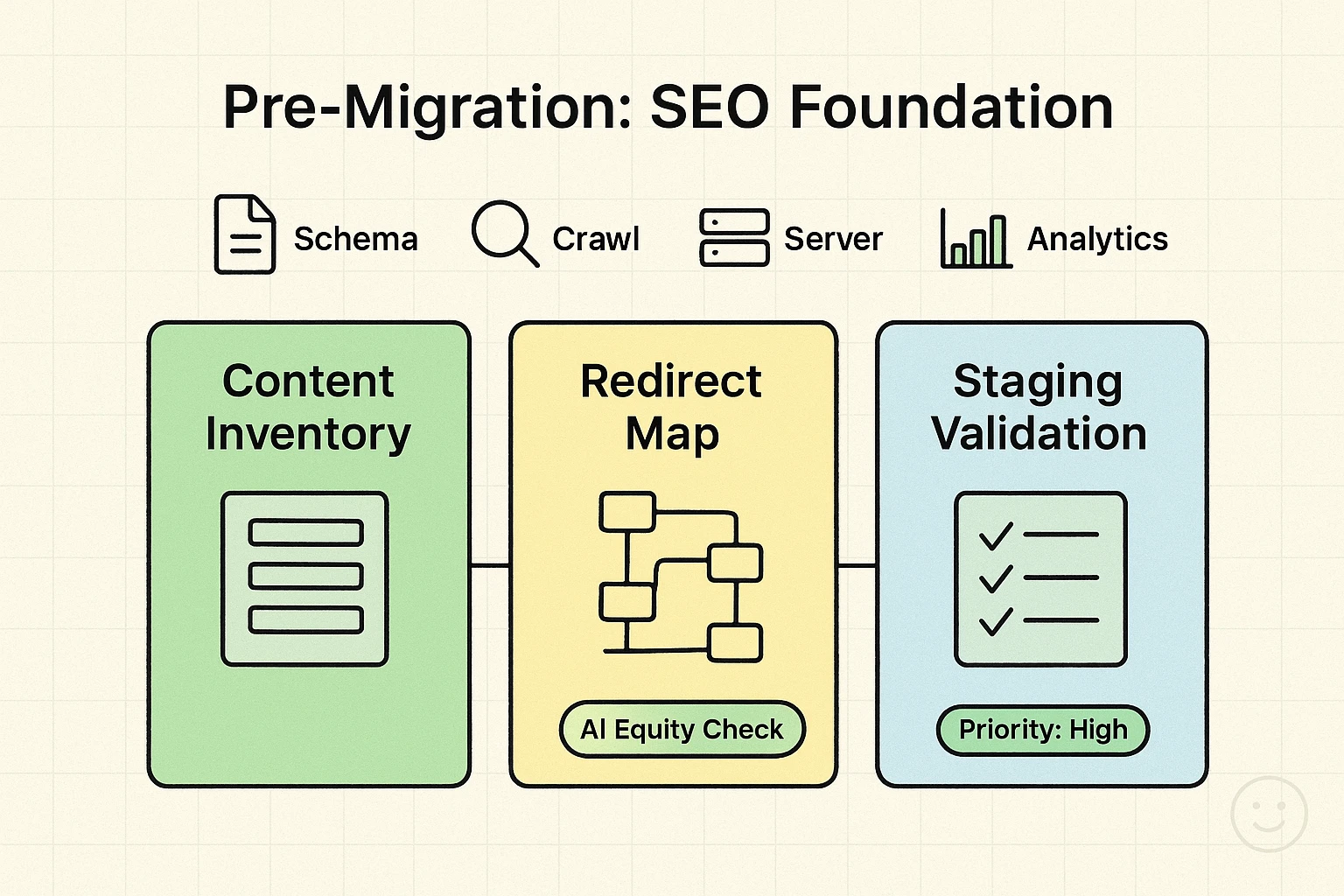
The success of any site migration hinges almost entirely on meticulous planning. This isn't merely about checking boxes; it's about deeply understanding your current SEO status and architecting a future-proof strategy.
Comprehensive SEO Audit & Performance Benchmarking: Digging Deeper than the Surface
Before moving a single page, you need a crystal-clear picture of your current site's health. This goes beyond a basic crawl.
Advanced Crawl Strategy: For large sites, a fundamental crawl with tools like Screaming Frog or Sitebulb is just the starting point. Identify your core content, understand its hierarchy, and map all internal links. This detailed map becomes your baseline.
Deep Dive into Current Performance: Benchmark your current keyword rankings, identify your top-performing content (pages that drive significant organic traffic), and meticulously analyze your backlink profile. Which pages attract the most links? What are your most valuable organic keywords? This data helps you prioritize what absolutely cannot be lost.
Introducing the Content Quality & Consistency Scorecard: A common pitfall in migrations, especially during platform changes, is content inconsistency. Beyond just URLs, you need to evaluate the quality, tone, and messaging of your content. Create a scorecard to assess content assets for:
- Relevance: Is the content still valuable and aligned with user intent?
- Accuracy: Is the information up-to-date and factually correct?
- Brand Voice & Messaging: Does it adhere to current brand guidelines?
- AI Citation Potential: Does the content include structured data (e.g., schema.org markup) that makes it easily understandable and citable by AI models for features like Google's AI Overviews?
This proactive assessment helps identify content to update, merge, or even prune before the migration, ensuring a higher quality and more consistent user experience on the new site.
Crafting the AI-Optimized Redirect Map: Your SEO Lifeline
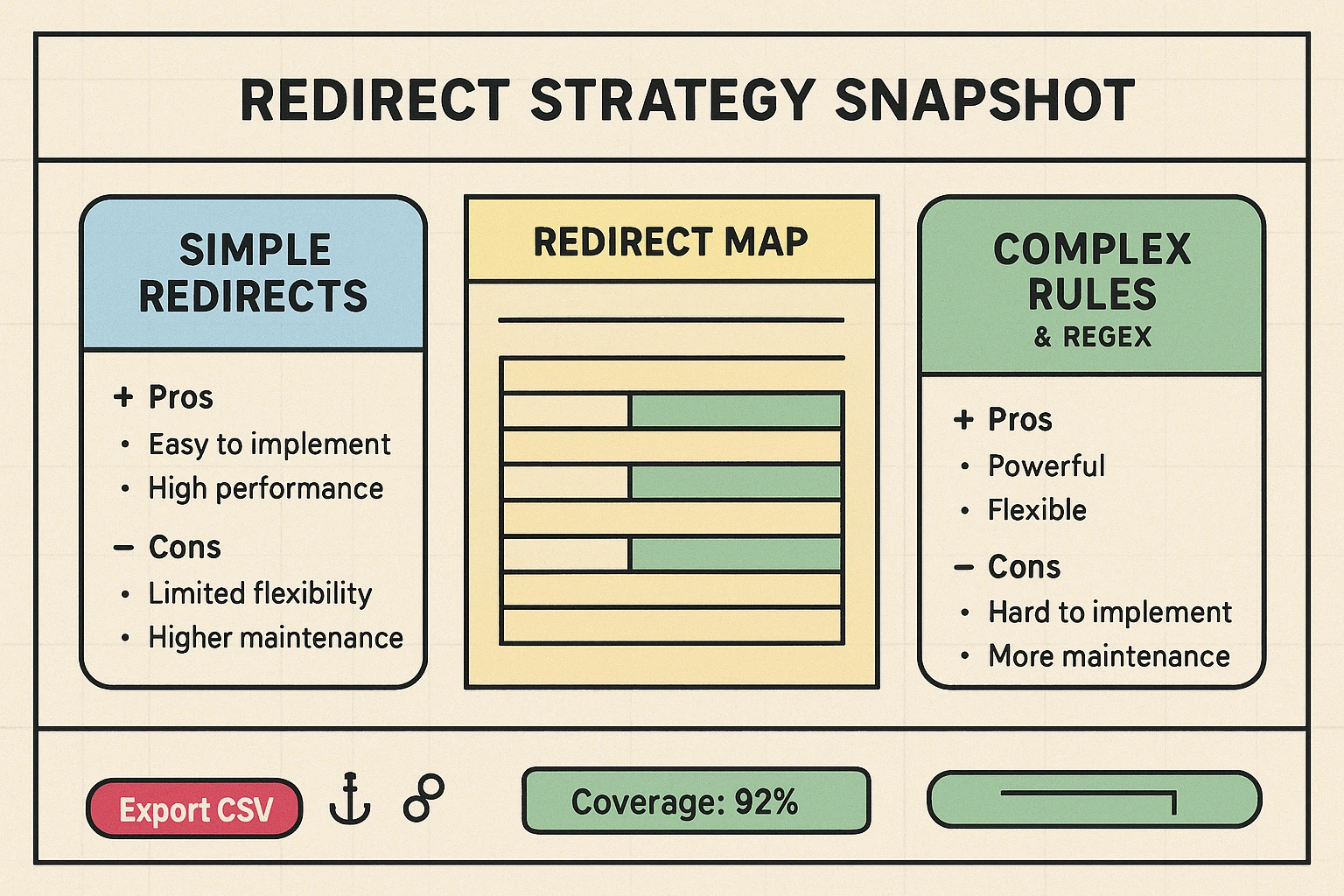
The 301 redirect map is arguably the most critical component of any migration. It tells search engines that a page has permanently moved, preserving its SEO value. Poorly executed redirects lead to lost link equity and dramatically impact rankings and traffic.
- Advanced 301 Redirect Mapping: For large sites or complex migrations (e.g., URL structure changes, domain consolidations), simple one-to-one redirects aren't enough. You'll need to leverage regex (regular expressions) for pattern-based redirects, wildcard rules, and meticulously plan to avoid redirect chains, which can dilute link equity and slow down page loading. Each old URL must map to its most relevant new URL.
- Prioritizing Redirects for AI: Beyond traditional SEO, consider AI citation potential. High-value content that frequently appears in AI Overviews or knowledge panels should have its redirects prioritized and meticulously tested.
- Google's Change of Address Tool: Utilize Google Search Console's Change of Address tool for domain-level migrations. However, understand its limitations: it signals a domain shift, but doesn't replace careful 301 mapping for individual URLs.
Preparing Your Staging Environment for AI & SEO Validation
Your staging site is your sandbox for testing. Treat it as a dress rehearsal for your SEO.
- De-indexing Staging Sites: Ensure your staging environment is robustly de-indexed (e.g., password protection, IP restriction,
X-Robots-Tag: noindex, nofollow, orrobots.txtdisallow) to prevent search engines from indexing incomplete or duplicate content. - Advanced Performance & Accessibility Testing: Use tools beyond basic Lighthouse checks. Integrate custom scripts or enterprise-level tools to test performance under load, critical rendering path, and accessibility on the new platform. These factors directly influence user experience, which in turn impacts SEO.
- AI Citation Readiness Checklist: Validate all structured data implementation (schema markup) on your staging site using Google's Rich Result Test and Schema Markup Validator. Ensure your content is structured logically for AI interpretation. This "AI Equity Check" is vital for future visibility in features like AI Overviews, which rely heavily on well-structured, semantic information.
Phase 2: During Migration – Precision Execution on Launch Day
The migration day is not simply about flipping a switch. It’s about precise execution and immediate validation.
The "Zero-Downtime" Launch Strategy for SEO
Minimizing downtime is crucial, not just for user experience but also for search engine crawling.
- Strategic Timing: Schedule your launch during off-peak hours for your target audience. This reduces immediate impact on users and gives you breathing room for initial checks.
- Immediate Post-Launch Checks:
- Robots.txt & Noindex Tags: Confirm the new
robots.txtis correctly configured to allow crawling. Verify that no lingeringnoindextags are present on live pages unless intended. - DNS Propagation: Monitor DNS changes to ensure your new server is resolving correctly globally.
- Critical Redirect Validation: Immediately spot-check a selection of high-priority URLs from your redirect map to confirm they resolve correctly with a 301 status.
- Robots.txt & Noindex Tags: Confirm the new
Verifying Critical SEO Elements in Real-Time
Launch day requires a dedicated SEO team to monitor and validate key elements live.
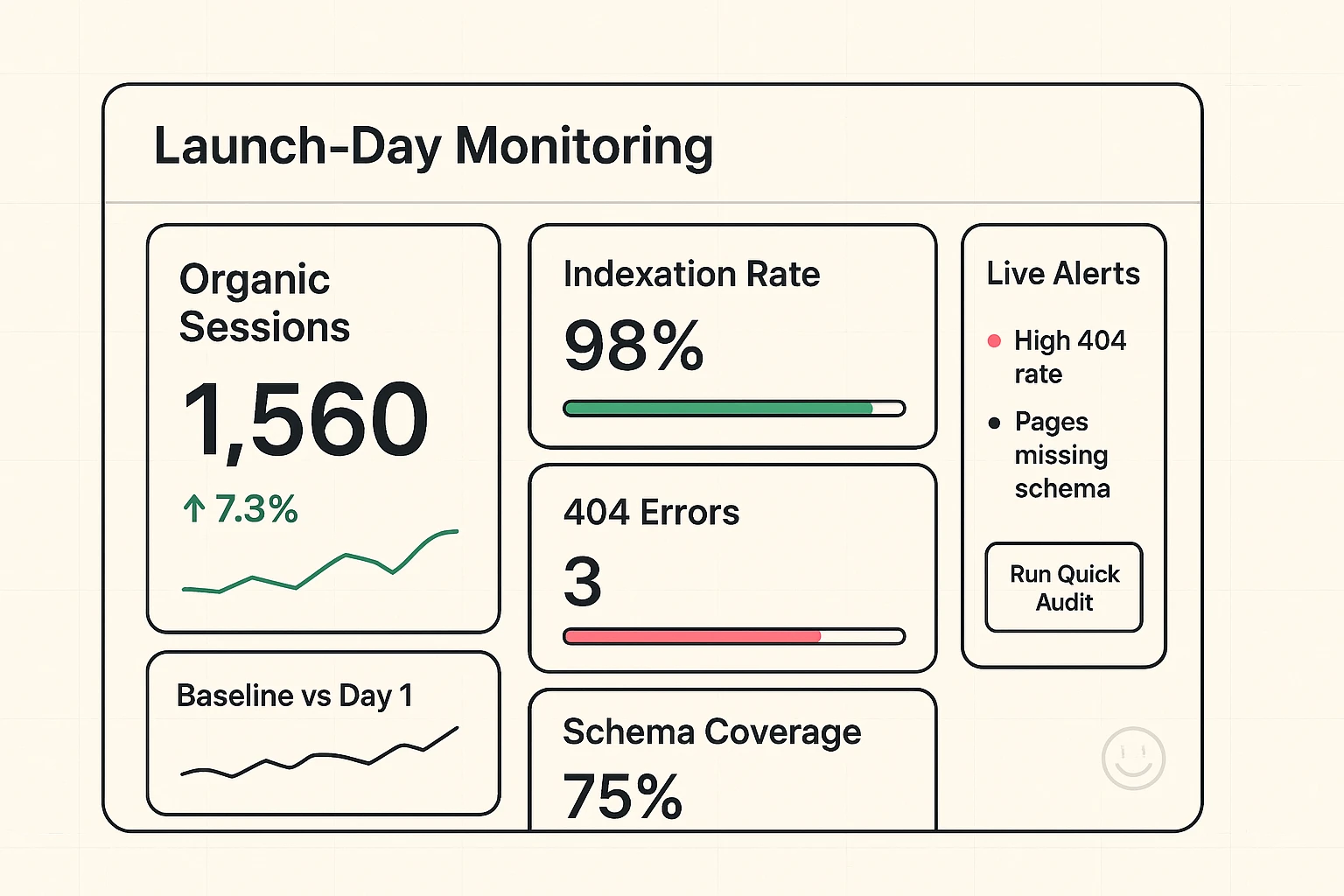
- Live Status Code Monitoring: Use log file analysis or real-time crawl tools to check for 2xx (success), 3xx (redirect), 4xx (client error), and 5xx (server error) status codes. Identify and rectify any widespread 404 or 500 errors immediately, as these significantly impact SEO.
- Tag Implementation Verification: Confirm your analytics, tracking pixels, and especially your schema markup are correctly implemented and firing on the new live site. Missing or broken tracking means you're blind to performance.
Phase 3: Post-Migration – Vigilance, Recovery, and Accelerated Growth
The work doesn’t stop after launch. The weeks and months following a migration are crucial for recovery and harnessing new opportunities.
30-Day Intensive Monitoring & Rapid Response Framework
Expect a temporary dip in traffic and rankings—it’s normal. The goal is to minimize this dip and ensure a swift recovery. Smaller sites might recover within 1-3 months, but larger domain changes can take up to a year. Average recovery is around 523 days, emphasizing the need for relentless monitoring.
- Granular Monitoring: Create custom dashboards combining data from Google Search Console, Google Analytics, and your preferred SEO tools. Monitor:
- Impressions & Clicks: Are they stabilizing or continuing to drop?
- Keyword Rankings: For your most important keywords.
- Indexation: Are pages being indexed as expected? Check the "Coverage" report in GSC.
- Crawl Stats: Is Googlebot actively crawling your new site?
- Core Web Vitals: Are performance metrics improving or declining?
- AI Citations: Is your structured data still being recognized for rich results or AI Overviews?
- Identifying and Fixing Indexation Issues: Proactively troubleshoot any 404s, 500s, or unexpected
noindexissues. If canonical tags are misconfigured, fix them immediately. For critical pages, use Google Search Console's "URL Inspection" tool to request re-indexing. - Tiered Troubleshooting Guide: Develop a quick-reference guide for your team. For example:
- Level 1 (Minor): Small ranking drops for non-priority keywords – Action: Re-check internal linking, content freshness.
- Level 2 (Moderate): Significant traffic dip on a category page – Action: Validate all 301s to that category, check for crawling errors, assess content consistency.
- Level 3 (Severe): Major drop in overall organic traffic or de-indexation of key sections – Action: Escalate immediately, review server logs for 5xx errors, re-audit
robots.txtandnoindexrules, consult link equity loss strategy.
Long-Term SEO Nurturing & Growth Post-Migration
A successful migration isn't just about preserving what you had; it's about building on it.
- Ongoing Backlink Outreach: Actively reach out to sites linking to your old, now-redirected URLs. Request updates to ensure direct links to your new pages. This is crucial for strengthening link equity.
- Continuous Content Refinement: Analyze user behavior on your new site. Did structural changes impact user journeys? Are bounce rates higher on certain pages? Refine content based on new user patterns and search intent. Think about how AI processes content; is your messaging clear and concise? Our AI-driven content optimization services can help here.
- Leveraging Post-Migration Data: Use the wealth of data collected to inform future content strategy, identify new keyword opportunities, and plan further technical improvements. A successful migration gives you a cleaner, faster, and more robust platform to build on. We can help you integrate AI into these workflows to reduce manual effort and identify opportunities faster. Learn more about reducing manual SEO workflows with AI.

Common Pitfalls & How to Avoid Them (Advanced Insights)
Beyond the well-known mistakes, here are frequently overlooked issues that can derail an otherwise solid migration:
- Content Inconsistency: As highlighted earlier, this is a significant operational challenge. Moving content to a new CMS often leads to subtle formatting issues, broken embedded media, or changes in how content is rendered, impacting user experience and AI comprehension. Proactive content audits and automated QA are key.
- Subtle Schema Errors: Validation tools catch basic syntax errors, but subtle logical flaws in schema markup (e.g., incorrect nesting, misattribution) can prevent rich results or confuse AI models. Deep schema audits are essential.
- Mobile Experience Parity: A new platform might render differently across devices. Ensure the mobile user experience (UX) is not just functional, but equivalent or superior to the old site. This is critical for mobile-first indexing.
- Performance Regressions: While the new site might look faster, conduct thorough Web Vitals assessments. Ensure server response times, image optimization, and third-party script loading don't degrade performance under real-world conditions. A shiny new site that loads slowly loses users and SEO.
- Neglecting International SEO Elements: For global sites, carefully re-implement and validate
hreflangtags across all language and region versions. Missing or incorrecthreflangcan lead to duplicate content issues and impact international targeting.
Advanced Tools & Automation for SEO Migration
Leveraging the right tools can make complex migrations manageable. Think beyond basic crawlers.
- Crawling & Auditing:
- Screaming Frog / Sitebulb: Essential for pre- and post-migration comprehensive site crawls, identifying broken links, redirect chains, and auditing on-page elements.
- DeepCrawl / Botify: For enterprise-level sites, these provide advanced crawl data analysis, log file analysis integration, and real-time monitoring capabilities, offering deeper insights into how search engines interact with your site.
- Analytics & Monitoring:
- Google Search Console: Indispensable for indexation status, crawl errors, search performance data, and disavow file management.
- Google Analytics / Data Studio: For traffic, user behavior, and custom dashboards.
- Rank Tracking Tools (Semrush, Ahrefs, Moz): To monitor keyword performance before and after migration.
- Redirect Management:
- Redirect plugins (for CMS like WordPress): For simpler migrations.
- Server-level (Apache .htaccess, Nginx configurations): For robust and scalable redirect implementations, especially for regex.
- Custom-built redirect validators: For massive sites, custom tools can verify the integrity of thousands of redirects quickly.
- AI-Powered Monitoring & Automation:
- AI-driven log analysis tools: These can scan server logs at scale to identify unusual crawl patterns or errors that might indicate an issue with your migration strategy.
- AI for content consistency checks: Specialized AI tools can automatically review content on the new platform for tone, brand voice, and schema adherence. We specialize in building custom AI agents to automate these specific, highly repetitive tasks. Discover how AI can enhance technical SEO automation.
- Automated reporting dashboards: Tools that leverage AI to highlight anomalies in traffic or ranking data immediately post-migration can save valuable time.
The future of SEO, and especially site migration, is increasingly intertwined with AI. From AI crawlability and indexation strategies to comprehensive AI SEO automation guides, AI is transforming how we approach technical SEO. Staying ahead means embracing these advancements.
Frequently Asked Questions About SEO-Preserving Site Migrations
Q1: How long does it take for SEO to recover after a site migration?
A: Recovery timelines vary significantly based on the size and complexity of the migration, as well as the initial SEO vigilance. Smaller migrations might see recovery within 1-3 months. Larger sites, especially those involving domain changes, can take 6 months to a year, or even longer. On average, the full recovery process can span approximately 523 days according to some studies, highlighting the importance of a well-executed plan.
Q2: What's the biggest risk during a site migration from an SEO perspective?
A: The most significant risk is incorrect 301 redirect implementation. Incorrect redirects lead to broken links, lost link equity, and de-indexed pages, which can decimate organic traffic and rankings. Other major risks include misconfigured robots.txt files, noindex tags on live pages, and content inconsistencies across platforms.
Q3: What is "AI Equity" and why is it important for migrations in 2025?
A: "AI Equity" refers to the collective trust and understanding that AI systems (like Google's AI Overviews) have built with your content over time. It's preserved through consistent structured data (schema), clear semantic content, and relevant associations. In 2025, search engines rely heavily on AI to understand and summarize content. A migration that damages these signals can reduce your visibility in AI-generated search results, even if traditional rankings remain stable. Preserving AI Equity means ensuring your content remains machine-readable and highly citable by AI.
Q4: Should I expect a traffic drop after migration?
A: Yes, you should almost always anticipate a temporary dip in organic traffic and rankings immediately following a major site migration. This is normal behavior as search engines re-crawl, re-index, and re-evaluate your new site structure. The goal of strategic planning is to minimize the severity and duration of this dip. Over one-third of marketers report a significant drop, with over 11% never fully recovering, underscoring the need for careful execution.
Q5: How can BenAI help with my site migration to preserve SEO?
A: BenAI specializes in providing custom AI implementations, training, and consulting for businesses aiming to become "AI-first." For site migrations, we can assist by:
- Conducting in-depth pre-migration audits with a focus on both traditional SEO and AI Equity.
- Developing sophisticated 301 redirect maps, including regex for complex scenarios.
- Building custom AI agents to automate content consistency checks, schema validation, and real-time post-migration monitoring.
- Providing expert consulting and training to your team on best practices for SEO preservation and long-term growth in an AI-driven search landscape.
- Ensuring robust AI crawlability and indexation for your new site.
- Helping you leverage AI to create no-code technical SEO automation workflows for ongoing success.
Your AI-First Migration Partner
Executing a site migration with minimal SEO impact, and even setting the stage for growth, is a complex endeavor that demands precision, foresight, and an understanding of the evolving AI search landscape. You're not just moving a website; you're relocating your digital presence and safeguarding your investment.
Given the high risks—where over 80% of data migrations exceed timelines and most fail to improve search rankings—having a trusted, expert partner is invaluable. At BenAI, we're not just about preventing disaster; we're about transforming your migration into an opportunity for an AI-first future for your business. We provide the strategic guidance, custom AI tools, and hands-on expertise to ensure your site migration is a success, preserving your SEO and accelerating your growth.
Ready to confidently navigate your next site migration with an AI-first strategy? Let's ensure your transition is smooth, your SEO is preserved, and your business continues to thrive.
Join Our Growing AI Business Community
Get access to our AI Automations templates, 1:1 Tech support, 1:1 Solution Engineers, Step-by-step breakdowns and a community of forward-thinking business owners.

Latest Blogs
Explore our latest blog posts and insights.