Your leadership team is wrestling with AI. You know it's critical, but you've also heard the whispers: 95% of generative AI pilots fail to deliver measurable financial impact. That statistic alone can freeze decision-making, turning potential innovation into paralysis. The challenge isn't just adopting AI; it's crafting an "AI-First Business Strategy" that truly transforms your operations, drives growth, and avoids becoming another cautionary tale.
This isn't about chasing the latest shiny tool. It's about a fundamental shift in how you operate, compete, and innovate. For decision-makers evaluating solutions, understanding the strategic planning process for AI integration is paramount. This guide will walk you through identifying genuine AI opportunities, aligning them with your core business objectives, and developing a comprehensive AI roadmap that leads to sustainable impact, not just pilot projects. Your AI-first future starts with a clear, strategic vision.
The AI Imperative: From Hype to Strategic Edge
The conversation around AI has moved beyond "if" to "how." We’re seeing widespread AI adoption, with 78-88% of organizations now using some form of AI. Yet, a stark reality persists: only a mere 6% report a significant profit impact (a 5%+ increase in EBIT) from these investments (McKinsey, 2025). This gap isn't because AI lacks potential; it's because many companies approach AI as a collection of tools rather than a strategic imperative. Your goal isn't just to implement AI, but to integrate it in a way that fosters creativity, leverages unique data ecosystems, reinvents core capabilities, and builds strong partnerships. This integrated approach, what we call an AI-first strategy, is key to sustained differentiation.
Decoding the AI-First Mindset: Beyond Implementation to Integration
An "AI-First Business Strategy" is fundamentally different from simply "using AI." It's a mindset shift that embeds AI into the very fabric of your organization, influencing every decision, process, and product. This isn't a technology problem; it’s a business transformation challenge. It acknowledges that while AI tools will become increasingly commoditized, true competitive advantage will stem from how intelligently and uniquely you apply them in conjunction with human creativity, drive, and passion (MIT Sloan, 2025).
To understand where you stand and where you need to go, it's essential to assess your current AI maturity. This isn't a judgment; it's a critical self-assessment to identify your strengths and reveal strategic gaps.
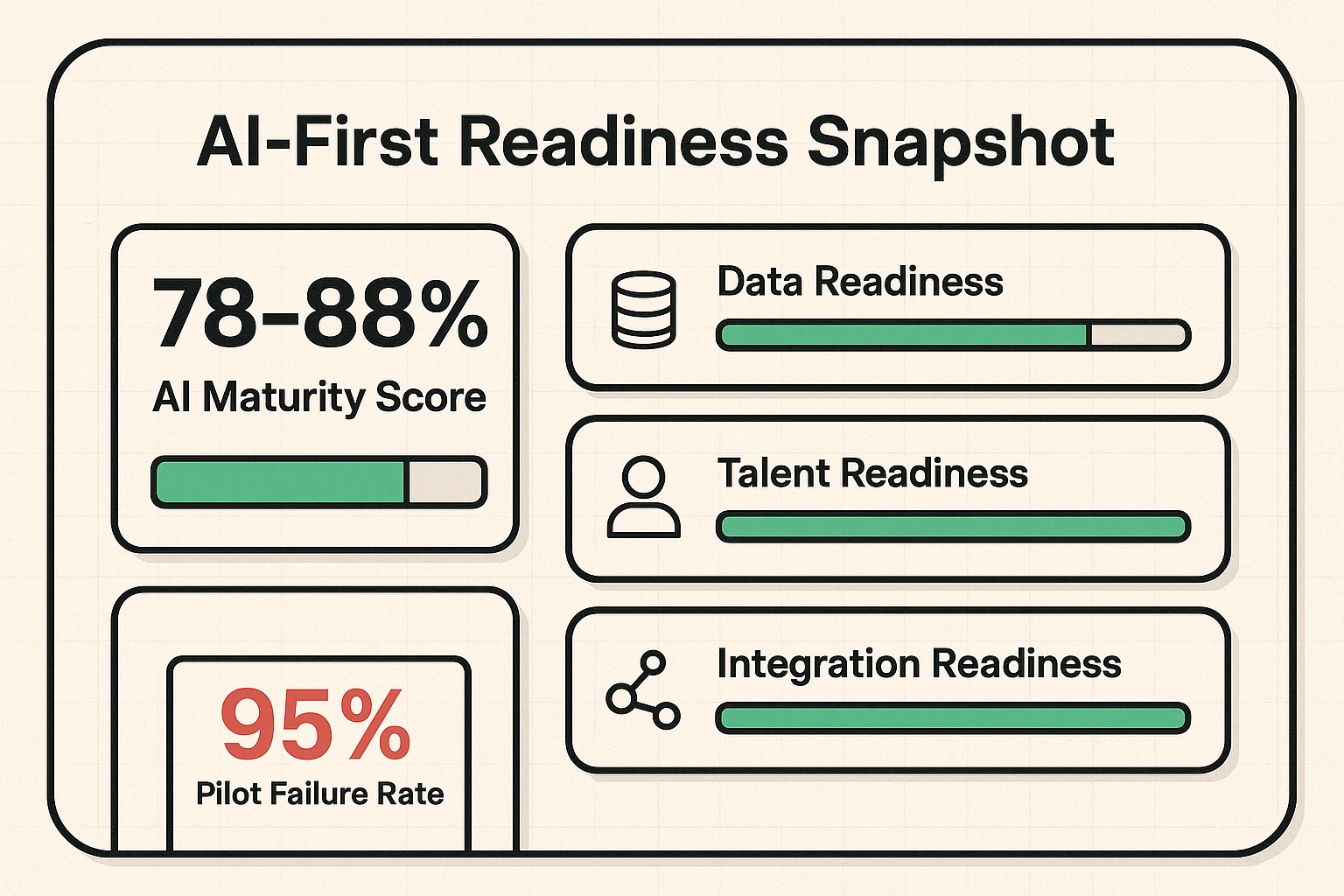
Early evaluation — self-assessment and benchmarking
The image above illustrates the critical disconnect: while AI adoption is high, true maturity and impact remain elusive for many. This is where a structured approach becomes invaluable. We can help you navigate this complex landscape, turning those failure statistics into success stories by focusing on strategic integration over piecemeal adoption.
Phase 1: Foundation Building – Aligning Vision & Data
Every robust AI strategy begins with a solid foundation. This means rigorously aligning AI initiatives with your core business objectives and ensuring your data infrastructure is prepared to support them.
Identify Business Objectives: Linking AI to Core Goals
Before you even think about AI tools, you must clarify your business goals. Are you aiming for a 35% boost in US labor productivity by 2035 (Coherent Solutions, 2025)? Or perhaps eyeing the potential $3.78 trillion AI could unlock in manufacturing by the same year (Exploding Topics, 2025)? Or are you focused on reducing manual SEO workflows with AI by a specific percentage to free up team capacity for strategic ideation and client engagement?
AI initiatives should directly serve these overarching objectives. This avoids the common trap of implementing AI for AI's sake. For instance, if your goal is to enhance customer experience, your AI strategy might focus on personalized AI agents or predictive analytics for customer support. If it's to scale content creation without increasing headcount, leveraging AI for content generation and optimization becomes a priority.
AI Readiness Scorecard: Self-Assessment and Capability Analysis
Understanding your current state is crucial. An "AI-First Scorecard" (inspired by HBS concepts) helps you systematically evaluate your organization's readiness across key dimensions:
- Strategy & Vision: Is there a clear, communicated AI vision?
- Data & Infrastructure: Do you have accessible, high-quality data and the necessary technical foundations? For deeper insights, explore effective AI Data Management Automation.
- Talent & Culture: Is your workforce AI-literate, and do you have the internal skills to manage and scale AI?
- Governance & Ethics: Are frameworks in place for responsible AI use?
This scorecard isn't just a snapshot; it's a diagnostic tool that highlights areas requiring immediate attention and investment.
Comprehensive Data Audit & Strategy
AI is only as good as the data it consumes. A thorough data audit is non-negotiable. You need to assess:
- Data Quality: Is your data accurate, consistent, and complete?
- Accessibility: Can AI systems easily access the data they need, or is it locked in silos?
- Governance: Who owns the data? What are the privacy and compliance implications?
Remember, while structured data is commonly used (58%), unstructured data accounts for 70% of enterprise data, yet its use in AI is still relatively limited (California Management Review, 2024). Unlocking this potential is a significant differentiator. Building a robust data strategy means breaking down these silos, ensuring data integrity, and establishing clear protocols for data collection, storage, and utilization.
Phase 2: Strategic Pillars – Crafting Your AI Advantage
With your foundation set, it’s time to define the strategic pillars that will forge your unique AI advantage. This isn't about incremental gains; it's about leveraging AI to create new sources of competitive power.
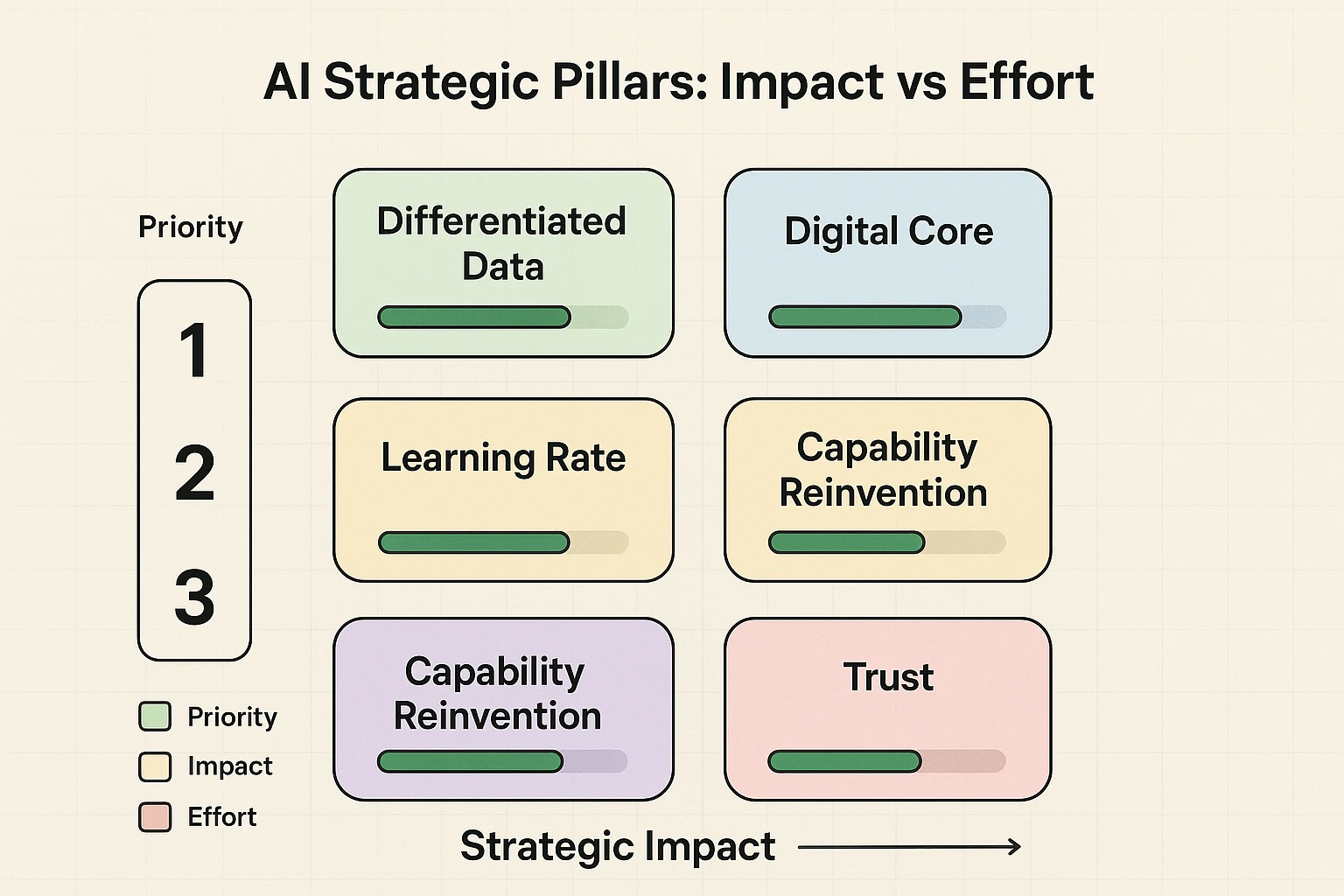
Prioritization stage — choosing strategic pillars to invest in
The prioritization matrix above helps visualize the strategic choices you'll face. Not all AI initiatives are created equal. Focus on pillars that offer high impact with manageable effort, allowing you to build momentum and demonstrate value. Drawing from insights into competitive advantage in the age of AI (California Management Review, 2024), here are six critical pillars:
- Differentiation of Proprietary Data: Your unique data is your most valuable AI asset. Develop strategies to collect, enrich, and leverage proprietary data that cannot be easily replicated by competitors. This could involve specific customer interaction data, operational metrics, or unique market insights.
- Strength of Digital Core: This is your underlying technological infrastructure. Moving from being a "buyer" of off-the-shelf solutions to a "booster" or "builder" of custom capabilities strengthens your ability to integrate AI deeply and effectively. This includes robust cloud infrastructure, API management, and intelligent automation platforms.
- Rate of Learning & Adaptation: The AI landscape evolves rapidly. Foster a culture of continuous learning and adaptation. This means investing in upskilling your workforce, creating flexible team structures, and establishing feedback loops that allow you to quickly incorporate new AI advancements into your strategy.
- Depth of Capability Reinvention: Don't just automate existing tasks; reinvent entire workflows and processes with AI. This might involve completely redesigning your marketing funnel using AI-powered personalization or overhauling your recruitment process with AI-driven candidate screening. For example, BenAI helps clients reduce manual SEO workflows with AI by automating elements to redefine the role of their SEO teams. Similarly, our AI SEO Automation Guide offers insights into how to approach such a reinvention.
- Strength of External Partnerships: No single organization can master all aspects of AI. Strategic partnerships—with AI solution providers, research institutions, or technology vendors—can extend your capabilities, accelerate innovation, and provide access to specialized expertise. This could include partnering for specific AI agent development, a topic covered extensively in our AI Agent Ecosystem Guide.
- Building Trust: Ethical AI & Governance: This is non-negotiable. Implement robust ethical AI practices, address biases, ensure data privacy, and comply with evolving regulations. Only 14% of executives have fully operationalized responsible AI (California Management Review, 2024), highlighting a significant competitive advantage for those who prioritize it. Building trust is foundational for customer adoption and long-term success. Our AI-Driven Quality Control Guide provides insight into how ethical considerations are baked into AI systems.
Phase 3: Execution & Evolution – Roadmap to Sustainable Impact
Strategy without execution is just theory. Once your pillars are defined, the focus shifts to practical implementation, managing challenges, and ensuring measurable impact.
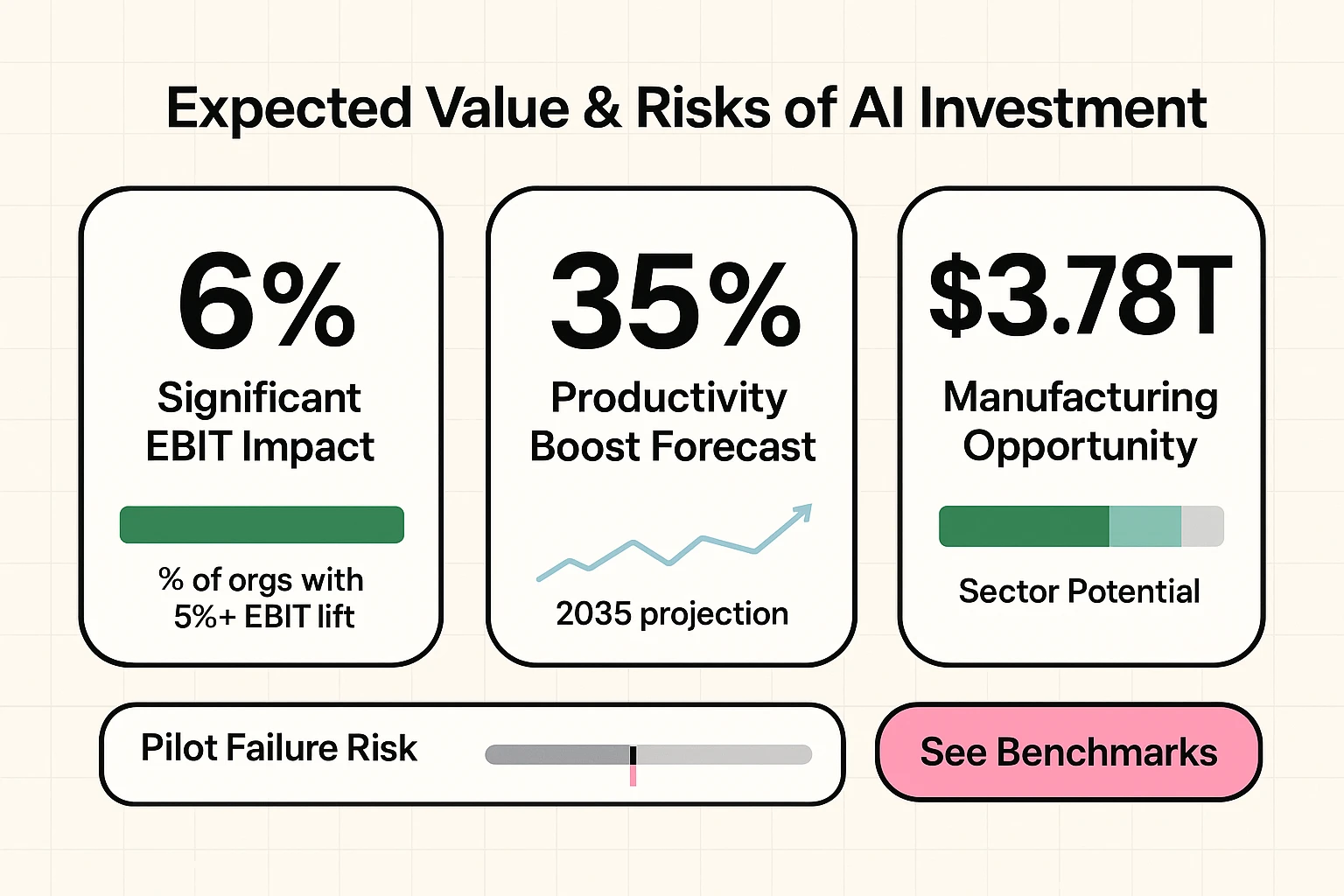
Value assessment — quantifying ROI, risk, and sector opportunity
This value assessment dashboard provides a clear, metric-focused view. It helps you quantify potential ROI, assess risks, and identify the most promising sector opportunities for your AI investments. Prioritization is key to moving beyond those failed pilots.
AI Roadmapping Framework: From Vision to Action
A detailed AI roadmap is your blueprint for execution. This framework should include:
- Prioritized Initiatives: Based on your strategic pillars and readiness assessment, identify which AI projects to tackle first.
- Resource Allocation: Define budget, talent, and technology requirements for each initiative.
- Timeline & Milestones: Set realistic timelines with clear, achievable milestones to track progress.
- Governance & Checkpoints: Establish regular review points to assess performance, adapt to new information, and ensure ethical compliance.
Managing Technical Challenges for Non-Technical Leaders
Many AI initiatives stall due to a knowledge gap between technical teams and business leadership. Only 26% of executives have a clear picture of future workforce skills needed for AI, and only 25% have a talent roadmap (California Management Review, 2024). As a non-technical leader, your role isn't to code, but to understand the strategic implications and overcome common hurdles such as:
- Data Integration: Ensuring AI systems can seamlessly connect with existing legacy systems.
- Scalability: Designing solutions that can grow with your business.
- Vendor Selection: Choosing the right partners who can deliver on your strategic vision.
Your leadership here involves knowing enough to ask the right questions and trust your technical teams to overcome the technical complexities.
Measuring Success: Beyond ROI, Tracking KPIs
While financial ROI is critical, AI success extends beyond immediate returns. You need to track a blend of KPIs that reflect both efficiency and strategic impact. Consider metrics relevant to specific business goals, such as:
- Operational Efficiency: Time saved on manual tasks (e.g., in content creation or data analysis), reduction in errors, improved resource utilization.
- Decision-Making Quality: Accuracy of forecasts, speed of insights, improved strategic outcomes.
- Customer Experience: NPS scores, reduced churn, increased personalization.
- Innovation Velocity: Number of new AI-driven products or features launched, time-to-market.
- Talent Engagement: Employee satisfaction with AI tools, adoption rates, skill development.
For a deeper dive into measuring the success of your AI strategy, explore how to set Enterprise AI Vision KPIs.
Fostering Human-AI Collaboration: The "Human in the Loop" Philosophy
Remember the MIT Sloan insight: sustainable competitive advantage comes from human creativity, not commoditized AI. This means actively fostering collaboration between your human workforce and AI systems.
- Employee Buy-in: Address fears of job displacement through clear communication, re-skilling programs, and demonstrating how AI augments roles, making work more strategic and less repetitive.
- AI-Literate Culture: Provide training and resources to help employees understand AI's capabilities and limitations.
- Psychological Safety: Create an environment where employees feel comfortable experimenting with AI, giving feedback, and even pointing out AI's flaws without fear of reprisal.
This "Human-in-the-Loop" philosophy ensures that AI empowers rather than displaces, leading to a more innovative and resilient organization.
Emerging Trends & Futureproofing Your AI Strategy
The AI landscape is a perpetual motion machine. Your AI-first strategy must be dynamic, ready to incorporate new advancements and adapt to evolving trends.
- Generative AI: Its usage jumped from 55% to 75% in one year (St. Louis Fed, 2025). This technology offers unprecedented opportunities for content creation, personalized marketing, and rapid prototyping. Leveraging it effectively means understanding its nuances and integrating it into your content workflows, such as using AI for Google Business Profile posts or refreshing underperforming articles using AI content refresh techniques.
- Autonomous AI Agents: Approximately 23% of companies are now scaling autonomous AI systems for multi-step workflows (PWC, 2025). These agents can take on complex, end-to-end processes, further freeing up human capacity. Understanding their potential and how to safely deploy them will be a significant differentiator.
- New Business Models: AI is not just optimizing existing models; it's creating entirely new ones. Be vigilant in recognizing how AI can enable new revenue streams, disrupt industries, and redefine customer value propositions.
Your continuous engagement with these trends and proactive adaptation will ensure your AI-first strategy remains future-proof.

Execution planning — roadmap and go/no-go decision points
This actionable roadmap visualizes the iterative and structured nature of AI strategy development and implementation. It integrates phase-based progress, critical checkpoints, and governance oversight to ensure your journey is ethical, strategic, and successful.
Frequently Asked Questions
Q1: What exactly does "AI-First Business Strategy" mean for my company?
An "AI-First Business Strategy" means embedding AI into every core function and decision-making process, rather than treating it as an add-on technology. It's about fundamental business transformation, aiming for efficiency, innovation, and competitive advantage through AI. This ensures AI serves your strategic objectives, not just tactical needs.
Q2: My company is small/medium-sized. Do I really need a full AI strategy, or are individual tools enough?
Even for small and medium-sized businesses, a strategic approach to AI is vital. While individual tools offer tactical benefits, a strategy ensures your investments are aligned, scalable, and contribute to long-term growth. Without one, you risk fragmented efforts and the high failure rate of AI pilots seen across the board (95% of generative AI pilots fail to deliver measurable financial impact, Fortune, 2025).
Q3: How do we identify the right AI opportunities without significant technical expertise?
Start by identifying your most significant business pain points or growth opportunities. This could be manual, repetitive work (a BenAI specialty), inefficient processes, or areas where better data insights could drive decisions. Then, assess where AI could provide solutions. We specialize in working with non-technical leaders, translating complex AI capabilities into practical, revenue-generating solutions for your business.
Q4: What's the biggest risk in developing an AI strategy, and how can we mitigate it?
The biggest risk isn't technical failure, but a failure of strategic alignment and human integration. Many projects fail due to unclear objectives, lack of leadership buy-in, or resistance from employees fearing job displacement. Mitigate this by clearly linking AI to business goals, fostering an AI-literate culture, and emphasizing human-AI collaboration. Ethical considerations and data governance are also critical long-term risks.
Q5: How long does it take to develop and implement an AI-first strategy?
Developing the initial strategy framework can take several weeks to a few months, depending on your organization's complexity and readiness. Implementation is an ongoing, iterative process. It's not a one-time project but a continuous journey of learning, adapting, and refining, typically rolled out in phases to allow for learning and adjustments. This is why having a trusted partner is invaluable.
Q6: We're concerned about data privacy and ethical AI use. How does that fit into the strategy?
Ethical AI and data governance are non-negotiable pillars of any robust AI-first strategy. This involves establishing clear guidelines for data collection, storage, and use, implementing bias detection and mitigation, ensuring transparency in AI decision-making, and adhering to regulatory compliance. Prioritizing this builds trust and is essential for long-term success. Only 14% of executives have fully operationalized responsible AI (California Management Review, 2024), making this a key differentiator.
Your AI-First Future Starts Here
The journey to becoming an AI-first business is complex, but it's also the essential path to sustainable growth and competitive differentiation. It demands a strategic vision, meticulous planning, and a partner who understands both the technological intricacies and the business imperatives.
Don't let the high failure rate of generic AI pilots deter you. Instead, let it fuel your resolve to build a robust, AI-first strategy that delivers tangible, measurable impact. If you're ready to move beyond AI experimentation to strategic integration, our team is equipped to guide you every step of the way.
Ready to transform your business into an AI-first entity?
Join Our Growing AI Business Community
Get access to our AI Automations templates, 1:1 Tech support, 1:1 Solution Engineers, Step-by-step breakdowns and a community of forward-thinking business owners.
Latest Blogs
Explore our latest blog posts and insights.