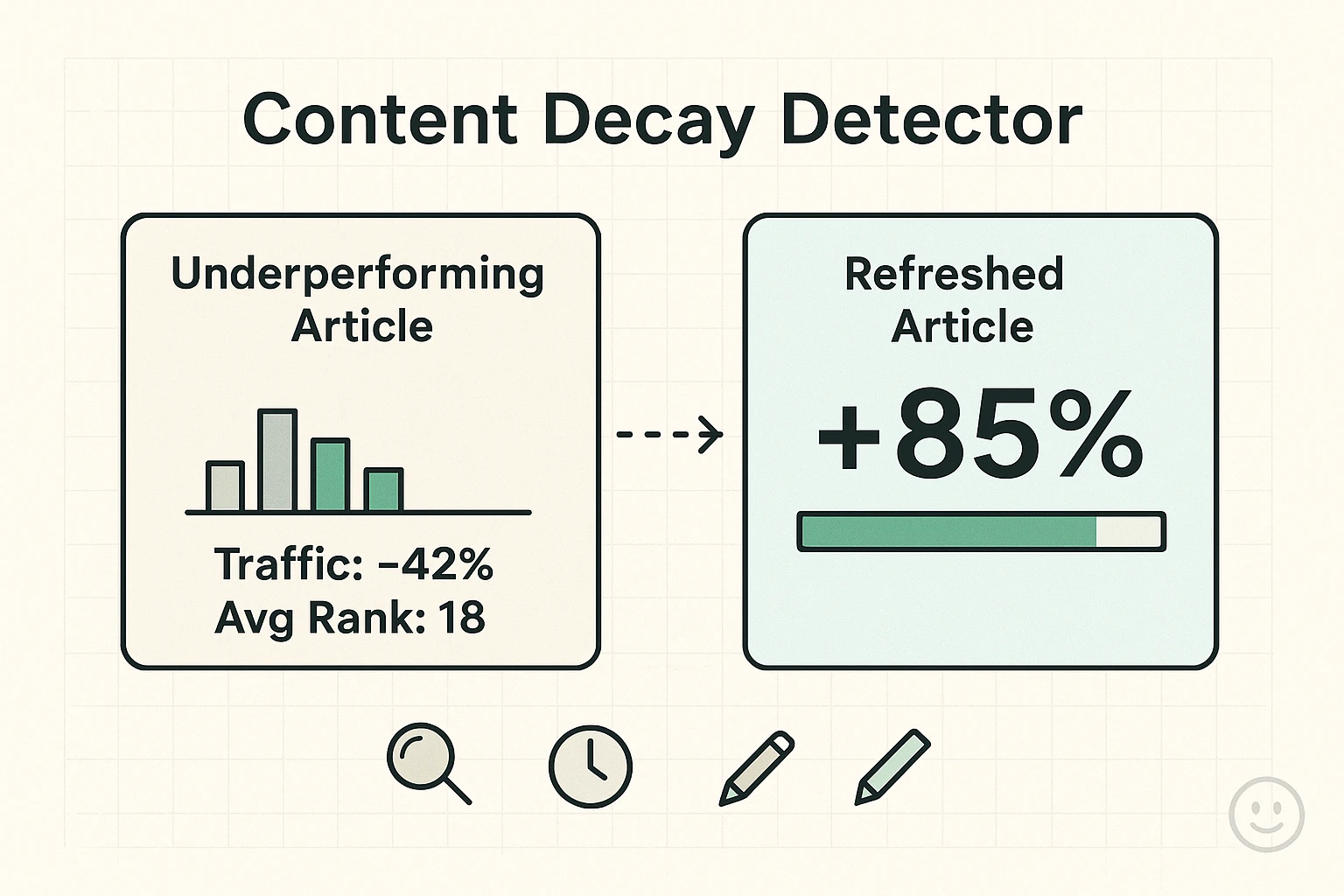
Stagnant content costs businesses billions in lost organic traffic and missed conversions. In today's dynamic digital landscape, content decay is no longer a slow decline but a rapid obsolescence driven by evolving AI search algorithms and user expectations. Businesses frequently struggle with identifying outdated content, optimizing it efficiently, and proving the return on investment for such efforts. This challenge stems from a lack of systematic approaches, insufficient tooling, and an incomplete understanding of how AI now interprets and ranks information. BenAI offers a structured, AI-powered solution to transform underperforming assets into high-ranking, conversion-driving content.
The AI Content Refresh Imperative: Revitalizing Underperforming Content for the AI Era
Businesses seeking to maintain and improve existing content assets efficiently and generate more organic traffic must embrace Artificial Intelligence (AI) for content refresh and optimization strategies. The digital landscape is undergoing a profound transformation, driven by AI-powered search engines and evolving user behavior, which necessitates a proactive approach to content maintenance. Traditional Search Engine Optimization (SEO) methods are inadequate for the sophisticated demands of today’s Large Language Models (LLMs) and AI Overviews, which prioritize fresh, structured content with demonstrable Experience, Expertise, Authoritativeness, and Trustworthiness (E-E-A-T). For instance, Ahrefs, a prominent digital marketing tool, reports that 87% of marketers currently leverage AI for content creation, with AI-assisted content comprising 74% of all new web-based material, highlighting the pervasive integration of AI in content strategies.
Optimizing existing content with AI generates significant competitive advantages in visibility, efficiency, and Return on Investment (ROI). Content that achieves high AI visibility often attracts engaged users, converting at 4.4 times the rate of traditional search traffic. This indicates a shift in content consumption patterns toward more conversational, context-rich queries, with AI prompts averaging 23 words compared to traditional Google searches' 4.2 words (Beeby Clark+Meyler). Additionally, sites refreshing content see up to a 106% increase in organic traffic, underscoring the tangible benefits of a strategic refresh effort (The HOTH).
Decoding the New Search Reality: Why AI Changes Everything
The shift from traditional SEO to AI-Enhanced Optimization (AEO) or Generative Experience Optimization (GEO) redefines how content achieves visibility. AI-driven search, projected to surpass traditional search by early 2028 per Beeby Clark+Meyler, impacts content discoverability through a focus on nuanced criteria. Search engines now deliver direct answers in Search Engine Results Pages (SERPs), leading to nearly 60% of Google searches resulting in no clicks (Beeby Clark+Meyler). This phenomenon, known as "zero-click searches," changes the user journey significantly. Therefore, content must be structured to provide concise, direct answers that LLMs can readily extract from AI Overviews.
AI's preference for fresh, structured, and cited content is evident in ranking patterns. Perplexity AI's analysis indicates that 76% of AI Overview citations originate from the top 10 organic results, with nested, highly specific pages receiving 82.5% of these citations rather than homepages. This highlights the value of comprehensive, yet modular, content that addresses user intent precisely. The emphasis on E-E-A-T, factual accuracy, and citation-worthy sources becomes paramount since AI algorithms can discern and prioritize authoritative information, reducing the risk of content decay in an environment where content ages quickly (Perplexity AI, Marcel Digital).
The AI-Powered Content Refresh Framework: A Step-by-Step Guide
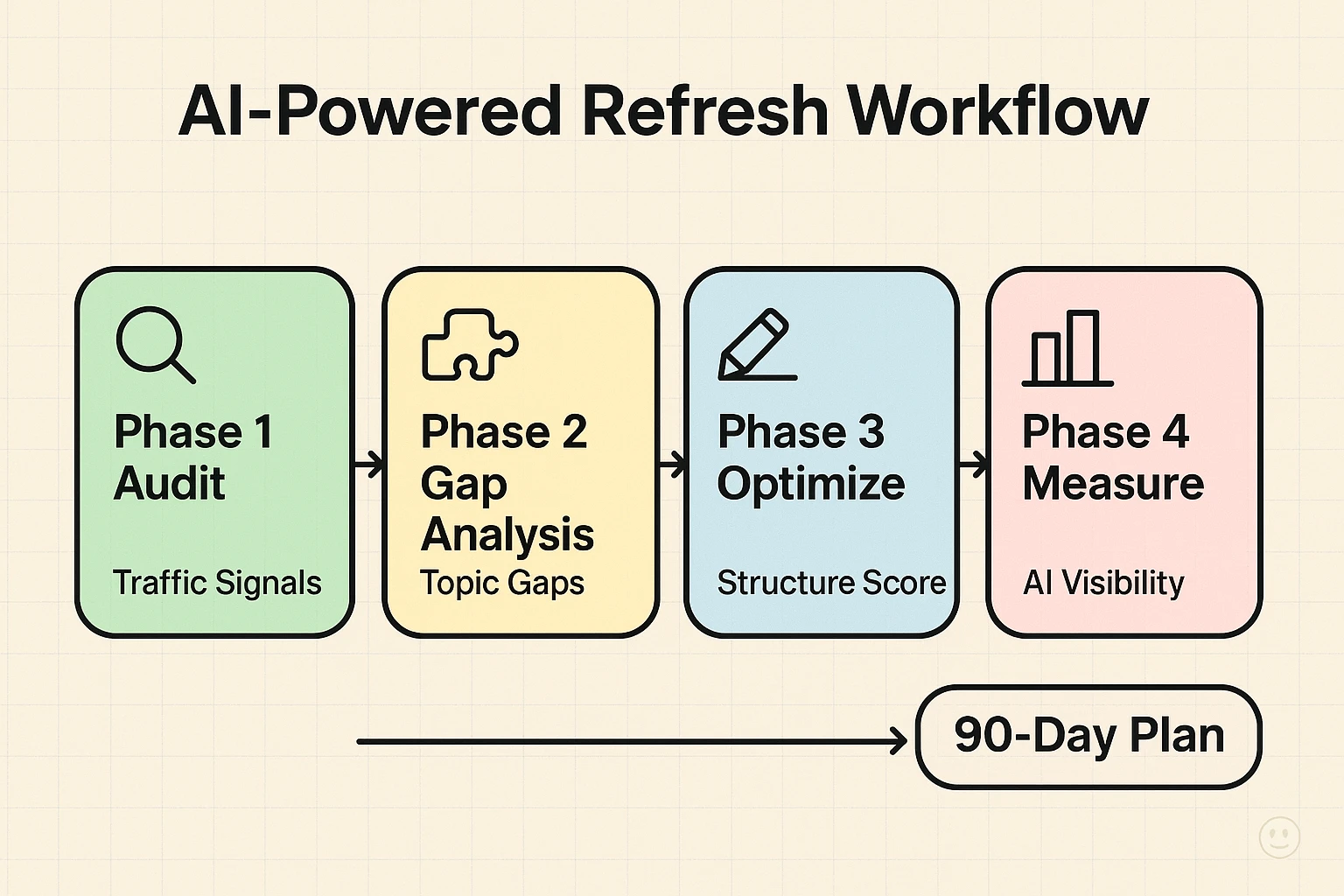
Implementing an AI-powered content refresh framework involves four critical phases: audit, gap analysis, optimization, and technical readiness.
Phase 1: AI-Driven Content Audit & Decay Detection
AI identifies outdated or underperforming content by analyzing critical metrics such as traffic drops, keyword rank declines, click-through rates (CTR), and impression losses. Tools like Semrush and Screaming Frog leverage AI algorithms to pinpoint these performance issues, providing an advanced understanding of content decay rather than relying on manual observation. A practical AI-powered content audit involves:
- Automated Performance Monitoring: AI continuously monitors content performance against predefined benchmarks, alerting teams when articles experience significant metric drops (traffic decreases, ranking volatility, engagement declines).
- Competitor Content Audits: AI performs competitive content audits for refresh opportunities, identifying successful content assets from rivals that address similar topics but outperform current offerings.
- Content Decay Scoring: Implementing a content decay score derived from metrics such as declining organic sessions, increasing bounce rates, or falling average time on page.
Phase 2: AI-Assisted Content Gap Analysis
Leveraging AI for content gap analysis uncovers missing topics, entities, and user intents crucial for comprehensive content coverage. This process moves beyond traditional keyword research to understand the semantic breadth required by AI search engines.
- AI-Driven Entity and Topical Gap Identification: AI tools pinpoint relevant entities (people, places, concepts) and subtopics that high-ranking content covers but existing assets do not, ensuring semantic completeness.
- Competitive Keyword Gap Analysis: AI analyzes competitor content for keywords and phrases driving their organic visibility, identifying areas where current content lacks competitive keyword integration. To learn more about this, explore our comprehensive guide on AI Keyword Content Gap Analysis.
- Semantic Keyword Research and Clustering: AI categorizes keywords into thematic clusters, reflecting topical authority and aligning content with overarching user search intents (informational, transactional, navigational). This process helps in organizing information effectively for both human readers and AI interpreters.
Phase 3: AI-Enhanced Content Optimization & Restructuring
AI-enhanced content optimization restructures content for maximum relevance and search rankings. This involves precision editing, factual verification, and semantic enrichment.
- Factual Accuracy and Data Validation: AI checks existing content against authoritative sources to ensure factual accuracy and update statistics or claims that have become outdated. This minimizes the risk of misinformation and builds greater trust with both users and AI algorithms that prioritize credibility.
- AI-Driven Content Structure Suggestions: AI recommends optimal content structures, including headings (H1-H4), lists, and content chunking, which improve readability for users and enhance parseability for AI. This ensures that answers to specific queries are easily identifiable.
- Automating Content Restructuring for Keyword Density: AI automates content restructuring to integrate relevant keywords and semantic companions naturally, avoiding over-optimization while achieving optimal keyword density. This contributes to improved relevance for comprehensive search queries.
- Natural Language and Semantic Richness: AI analyzes content for natural language flow and suggests semantic enrichments using synonyms, related terms, and contextual phrases. This broadens content discoverability for a wider range of conversational search queries.
- Multimedia Optimization: Enhancing images, videos, and other multimedia elements with descriptive alt text and appropriate schema markup, ensures AI comprehends visual content, and contributes positively to content's overall search performance (Digital Marketing Institute). For a deeper dive into optimizing various aspects of your online presence, refer to our articles on AI for Image Optimization and AI in Content Generation & Optimization.
Phase 4: Technical AI-Readiness & Trust Building
Technical AI-readiness ensures content is optimally configured for AI crawlers and aligns with search engine guidelines.
- Advanced Schema Markup: Implementing advanced schema markup (FAQPage, HowTo, Article) helps AI contextualize content, offering direct answers in AI Overviews and rich snippets (Beeby Clark+Meyler).
- Page Speed and Mobile Optimization: Optimizing page speed and ensuring mobile responsiveness are crucial as AI crawlers prioritize fast-loading, accessible content. These technical factors contribute to positive user experience which search engines reward. To find out more, read about AI Site Speed Analysis Tools and AI-driven crawlability and indexation.
- The Concept and Utility of llms.txt:Implementing llms.txt offers a proactive measure for AI discoverability, directing AI crawlers on content usage and ensuring proper attribution (Beeby Clark+Meyler).
- Building E-E-A-T Signals: Enhancing author bios, citing reputable sources, and building a robust internal and external linking strategy demonstrate E-E-A-T, which is paramount for AI-driven authoritative ranking.
Choosing Your AI Arsenal: Top Tools for Content Refresh & Optimization
Selecting the right AI tools is pivotal for an effective content refresh strategy. Several platforms offer specialized functionalities that streamline the content optimization process:
- Frase: Known for its ability to generate content briefs and provide optimization scores based on top-ranking competitors. It aids in content gap analysis by suggesting topics and questions to cover.
- Clearscope: Focuses on content excellence by providing recommendations for keywords, subtopics, and readability to create comprehensive and semantically rich content. It helps ensure existing content aligns with search intent.
- Surfer SEO: Offers content editor, audit, and keyword research features. It analyzes top-ranking pages to provide guidelines for content length, keyword usage, and structure, making it suitable for automating content restructuring for keyword density.
- Writesonic: Primarily a content generation tool, but its features for rewriting and expanding existing content can be valuable for refresh efforts.
- Ahrefs AI Content Helper: Integrated within the broader Ahrefs suite, it uses content scores to guide optimization, leveraging its extensive keyword and competitor data.
- Semrush: Offers a comprehensive suite of SEO tools, including content audit features that help identify underperforming articles based on traffic, backlinks, and keyword rankings, facilitating AI-driven content audit and decay detection.
Each tool brings unique strengths to the content refresh workflow. For example, while Surfer SEO excels at structural and keyword optimization, Frase and Clearscope provide deeper insights into semantic topical completeness. The best approach involves integrating a combination of these tools to address different phases of the refresh process, creating a cohesive and powerful AI-driven content strategy. For a more detailed look at the evolution of these tools, consider this overview of future AI SEO automation trends.
Measuring Success in the AI Era: Beyond Clicks
Measuring content performance in an AI-dominated search environment requires new metrics and attribution models. The traditional focus on clicks is insufficient due to the rise of zero-click searches, where users find answers directly within SERPs.
- New Metrics for AI Visibility: Key performance indicators (KPIs) include AI citation frequency, brand mentions within AI Overviews, and engagement with rich snippets. Beeby Clark+Meyler notes that traffic from AI-powered results converts at 4.4 times the rate of traditional search traffic, making these metrics crucial for assessing true impact.
- Adapting Analytics with GA4: Google Analytics 4 (GA4) provides capabilities to track engagement and conversions beyond traditional clicks, enabling deeper insights into how users interact with AI-served content. Filtering GA4 data for specific AI traffic sources helps attribute performance accurately.
- Zero-Click Attribution Strategies: Businesses must develop strategies to attribute value to content that informs zero-click answers. This includes tracking brand recall, direct traffic after a query, and conversions driven by knowledge graph presence, ensuring content receives credit for its influential role in the buyer journey.
This evolution in measurement quantifies the real impact of content in an increasingly AI-driven customer decision process.
Human + AI: The Indispensable Role of Human Expertise
While AI offers unprecedented capabilities for content refresh and optimization, human oversight remains indispensable. A purely AI-generated approach risks losing authenticity, relevance, and accuracy.
- Human Oversight and Strategic Direction: Human content strategists guide AI tools, setting objectives, refining prompts, and interpreting results to ensure AI outputs align with brand voice and business goals.
- Avoiding AI Hallucinations and Maintaining Brand Voice: AI models can occasionally "hallucinate" false information. Human editors are critical for fact-checking and ensuring that content retains its unique brand voice, tone, and narrative. To mitigate these risks and enhance efficiency, refer to our insights on reducing manual SEO workflows with AI.
- Ethical Considerations and Responsible AI Use: Implementing AI content refresh strategies ethically involves transparently disclosing AI usage where appropriate and prioritizing user value over purely algorithmic gains. This builds long-term trust with the audience and maintains brand integrity.
The most effective content refresh strategies combine AI's speed and analytical power with human creativity, strategic thinking, and ethical judgment.
Frequently Asked Questions
What is AI content decay detection?
AI content decay detection is the automated process of identifying articles or pages experiencing a decline in performance metrics (organic traffic, keyword rankings, engagement). AI algorithms analyze historical data, compare current performance against benchmarks, and flag content that requires updates or refreshes to prevent further degradation. This proactive approach ensures content assets remain relevant and competitive.
How does AI recommend content updates for new search intent or entity changes?
AI analyzes evolving search landscapes by monitoring search queries, trending topics, and competitor content. It identifies shifts in user intent (e.g., from informational to transactional) and new entities gaining prominence. Based on this analysis, AI recommends specific content updates, such as adding new sections, integrating emerging keywords, or updating factual information to align with the latest search patterns and semantic understanding.
Can AI automate content restructuring for keyword density without keyword stuffing?
Yes, AI can automate content restructuring for optimal keyword density while avoiding keyword stuffing. Modern AI tools analyze semantic relationships between keywords and topics, integrating primary and secondary keywords naturally within the content. They ensure contextually relevant placement, appropriate keyword variations, and maintain readability, preventing over-optimization penalties commonly associated with manual keyword stuffing.
How does AI perform competitive content audits for refresh opportunities?
AI performs competitive content audits by analyzing competitor websites to identify content gaps, top-performing articles, and keyword strategies. It compares competitors' content to existing assets, highlighting areas where an organization can refresh its content to capture missed opportunities, address unfulfilled user intents, or improve rankings for shared target keywords. This process reveals strategic refresh opportunities for improved search visibility.
What are the main advantages of using AI for content refresh compared to manual methods?
Using AI for content refresh offers several advantages over manual methods:
- Efficiency: AI automates time-consuming tasks like content auditing, gap analysis, and keyword integration, significantly reducing manual effort.
- Accuracy: AI processes vast amounts of data more precisely than humans, identifying nuanced trends in search intent and entity relationships.
- Scalability: AI enables the refresh of large content inventories efficiently, which is impractical with manual resources.
- Data-Driven Insights: AI provides objective, data-backed recommendations for optimization, leading to more effective content strategies.
- Real-time Adaptability: AI can respond quickly to shifts in search algorithms and user behavior, keeping content continuously optimized.
Is AI-refreshed content safe from Google penalties?
Yes, AI-refreshed content, when executed with human oversight and ethical considerations, is safe from Google penalties. Google's guidelines emphasize helpful, reliable content regardless of its creation method. The key is to use AI as a tool to enhance expertise, authoritativeness, and trustworthiness (E-E-A-T), not to generate low-quality, spammy content. Human review ensures accuracy, originality, and adherence to brand voice, making the refreshed content valuable to users and compliant with search engine policies.
What are the typical ROI metrics seen from AI-powered content refreshing?
AI-powered content refreshing often yields significant ROI, reflected in various metrics:
- Increased Organic Traffic: Sites refreshing content see up to a 106% increase in organic traffic (The HOTH).
- Higher Conversion Rates: Traffic from AI-powered results converts at 4.4 times the rate of traditional search traffic (Beeby Clark+Meyler).
- Improved Keyword Rankings: Enhanced content relevance and structure lead to higher positions in SERPs and better visibility in AI Overviews.
- Reduced Content Decay: Proactively maintaining content prevents the decline in performance that affects stagnant assets, preserving their long-term value.
- Cost Efficiency: AI-driven content is 4.7 times cheaper than human-written content ($131 vs. $611 per blog post), optimizing resource allocation (Perplexity AI).
Ready to Transform Your Content?
The shift to AI-driven search is not a future possibility, but a present reality. Ignoring the imperative of AI for content refresh and optimization means sacrificing organic visibility, user engagement, and potential revenue. BenAI offers the structured framework, cutting-edge tools, and expert guidance necessary to transform your underperforming content assets into powerful drivers of growth. Our approach prioritizes human expertise amplified by AI, ensuring your content remains authentic, authoritative, and algorithmically optimized.
Don't let your valuable content decay further. Embrace the AI content refresh imperative and position your brand for sustained search dominance.
Join Our Growing AI Business Community
Get access to our AI Automations templates, 1:1 Tech support, 1:1 Solution Engineers, Step-by-step breakdowns and a community of forward-thinking business owners.

Latest Blogs
Explore our latest blog posts and insights.