"We need AI!" It's a phrase echoing through boardrooms worldwide. But what happens after that initial decree? Too often, ambitious enterprise AI initiatives stall, not because the technology isn't capable, but because the vision isn't shared at the top, and success isn't clearly defined.
Many executives feel the pressure to adopt AI but struggle to translate the technological potential into tangible business outcomes. They understand the "what" – AI is important – but the "how" and "why it matters specifically to our bottom line" remain cloudy. This disconnect is the single biggest barrier to successful AI adoption in large organizations.
According to a survey by MIT Sloan, only 1 in 10 companies achieve significant financial benefits from AI, with a major contributing factor being a lack of strategic alignment. You're not alone if your organization faces this challenge. This guide will walk you through transforming abstract AI aspirations into a concrete, executive-backed vision, complete with measurable KPIs that drive real business value.
The Executive's AI Conundrum: Bridging the Vision Gap
Imagine launching a massive construction project without a blueprint or a shared understanding among stakeholders of what the final building should look like. That's often what enterprise AI deployment feels like without executive alignment. Diverse departments, each with their own priorities, interpret "AI success" differently. Your Head of Marketing might dream of automated content generation, while your CFO worries about the hefty investment with unclear returns.
The key to overcoming this is to create a unified AI vision that clearly links technological advancement to overarching business strategy. This isn't just about getting a sign-off; it's about fostering genuine understanding and shared ownership among your C-suite leaders.
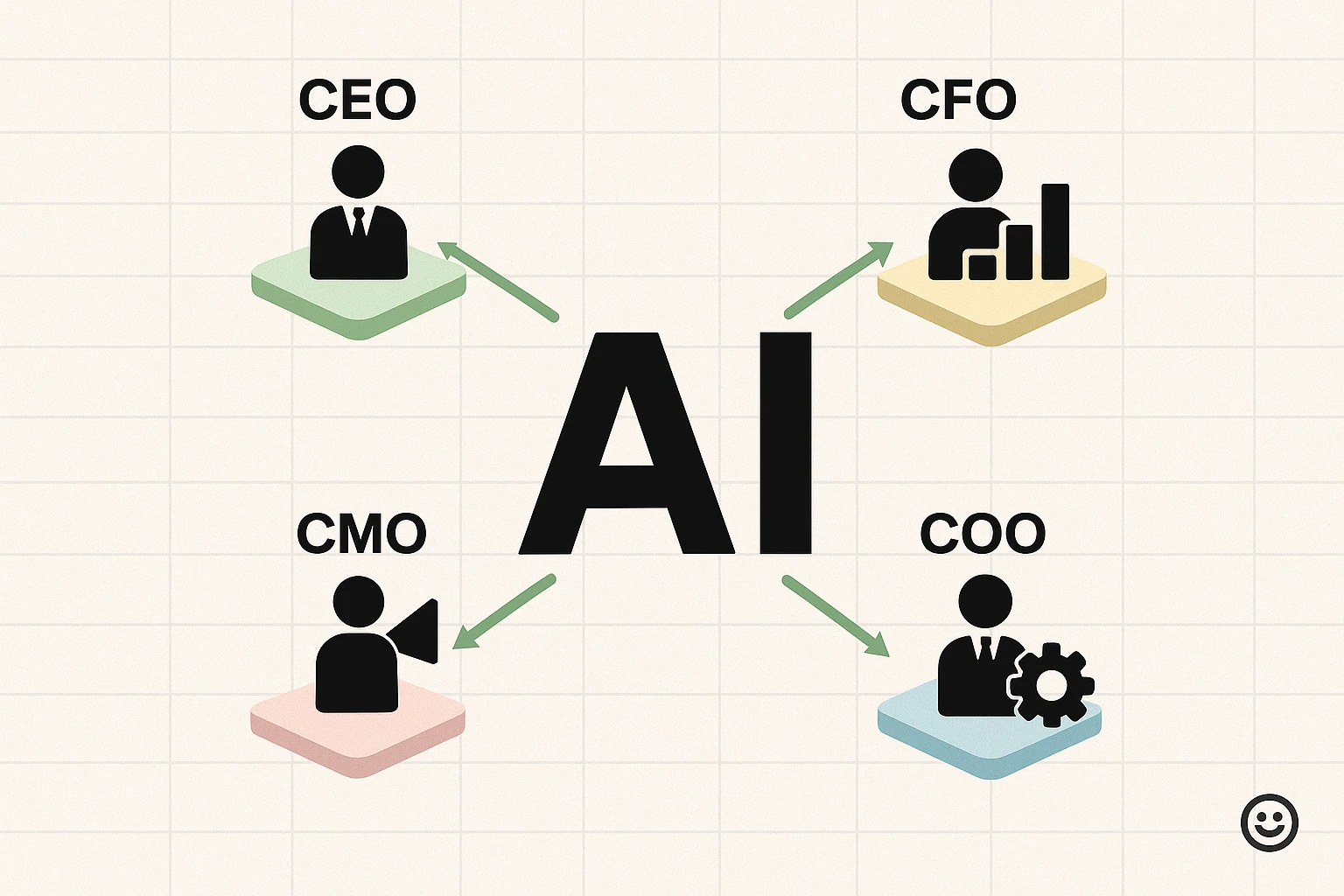
Visualizing this alignment is crucial. Think of your AI vision as the central hub, with each executive role acting as a spoke, translating that vision into their specific domain's priorities and measurable outcomes.

Crafting a Unified AI Vision for the C-suite
Many executives are wary of AI projects that feel like science experiments rather than strategic investments. To win them over, your AI vision must be:
- Business-Centric: Focus on solving core business problems and driving measurable outcomes, not just implementing cool tech. What strategic goals does AI enable?
- Concise and Clear: Avoid jargon. Your executive summary of the AI vision should be understandable by anyone in the organization, from the CEO to frontline staff.
- Ambitious yet Achievable: Inspire future growth while also outlining pragmatic, short-term wins that build momentum and trust.
- Inclusive: Show how AI will empower, not replace, employees, and enhance their capabilities. Address concerns about job impact head-on.
Executive Pitfall Alert: A common mistake is presenting AI as a standalone initiative. Instead, weave it into your existing digital transformation goals. How does AI accelerate or enhance what you're already trying to achieve through other technological shifts?
From Technical Metrics to Business Outcomes: The KPI Translation
This is where many AI projects falter. Data scientists often measure success by metrics like model accuracy, precision, or recall. While vital for development, these don't resonate with an executive's world of revenue, profit, customer satisfaction, or market share.
The challenge is to translate these technical nuances into Key Performance Indicators (KPIs) that speak the C-suite's language.
Executive ConcernTechnical AI Metric (Internal)Translated Business KPI (Executive)CFO: ROI, Cost SavingsModel Inference Time, Data Processing CostsReduced Operational Costs (e.g., % reduction in manual invoice processing)CMO: Revenue, Marketing PerformanceCTR, Conversion Rate, Lead Score AccuracyIncreased Lead-to-Opportunity Conversion Rate, Higher Customer Lifetime ValueCOO: Efficiency, QualityPrediction Accuracy, Anomaly Detection RateReduced Production Downtime, Improved Quality Control Rate (learn more about AI-driven quality control)CHRO: Talent Acquisition, Employee ExperienceCandidate Matching Accuracy, Turnover PredictionShorter Time-to-Hire, Increased Employee Retention
Strategies for Securing Executive Buy-in
Gartner emphasizes that defining AI vision and collaborating with C-level peers is paramount. Convincing a skeptical board requires more than just a compelling presentation; it demands a structured approach to engagement and education.
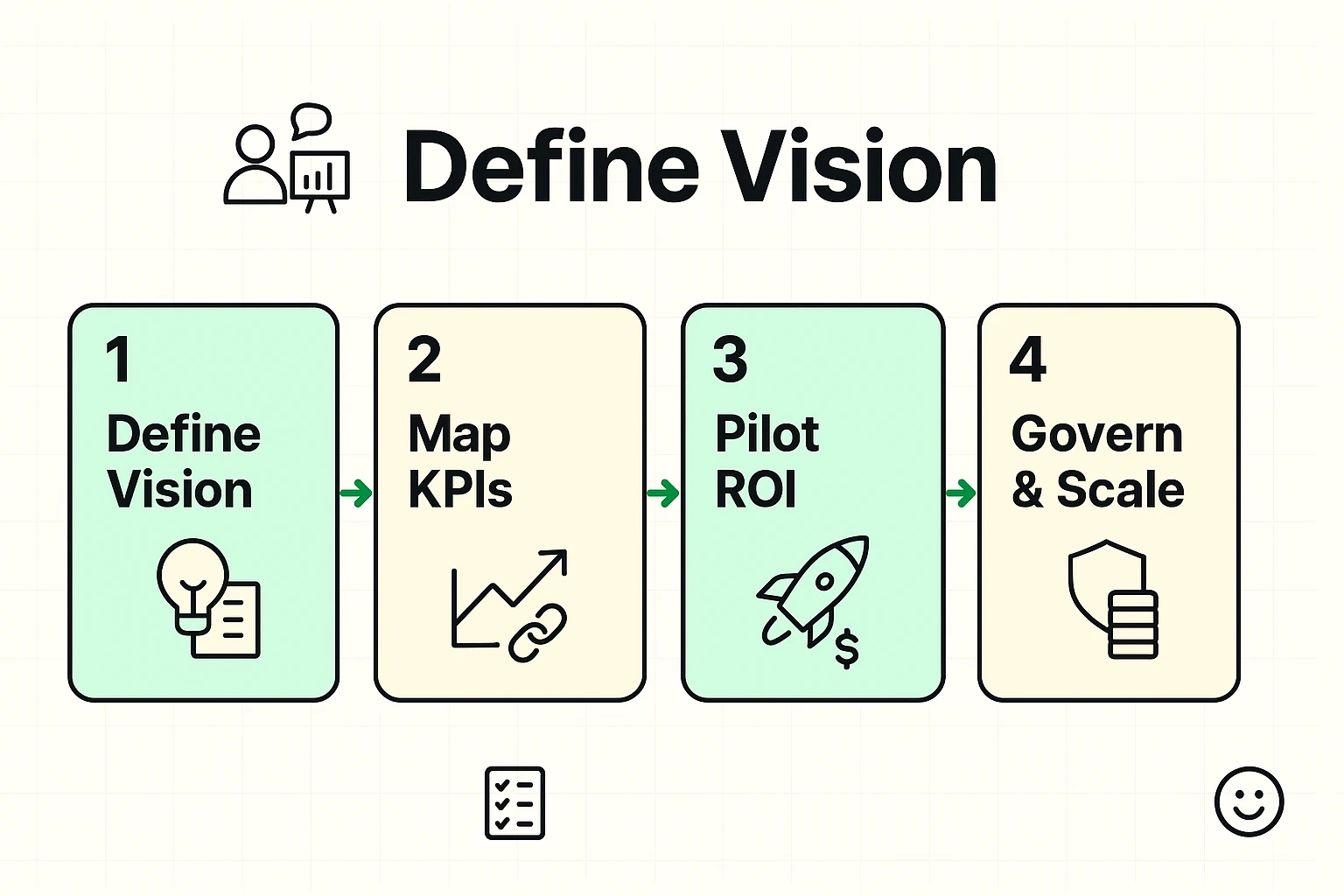
Here's a 4-step action plan to effectively align your leadership:
- Define and Socialize the Vision: Work with key stakeholders to craft a unified AI vision. Hold workshops, not just presentations, to get active participation. Focus on how AI directly supports existing strategic objectives.
- Map KPIs to Business Objectives: For each AI initiative, clearly articulate the expected business outcomes and the corresponding KPIs. Show the clear lineage from a technical metric to a financial or operational impact.
- Pilot for Measurable ROI: Start with small, impactful pilot projects. Demonstrating tangible, early wins builds confidence and provides concrete data to prove AI's value. Think about an AI-powered LinkedIn outreach pilot to boost sales leads, for example. You can learn more about AI LinkedIn campaign optimization here.
- Govern and Scale: Once initial successes are achieved, establish clear governance structures to manage ethical considerations, data quality, and responsible scaling.
Measuring AI's True ROI: Beyond the Tangible
While initial sprints might focus on obvious cost savings or revenue generation, the long-term value of AI extends beyond easily quantifiable metrics. How do you measure improved decision-making, enhanced innovation capacity, or greater market responsiveness? These intangible benefits often compound over time, creating a competitive advantage.
Productive Edge's "6-Step Roadmap" for Agentic AI emphasizes ROI modeling, even for advanced AI. It’s about linking the output of your AI agents to how they contribute to broader business objectives. For instance, an AI tool that assists product development might not immediately show a direct revenue uplift but can significantly reduce time-to-market for new products, a critical strategic KPI.
AI Maturity and Evolving KPIs
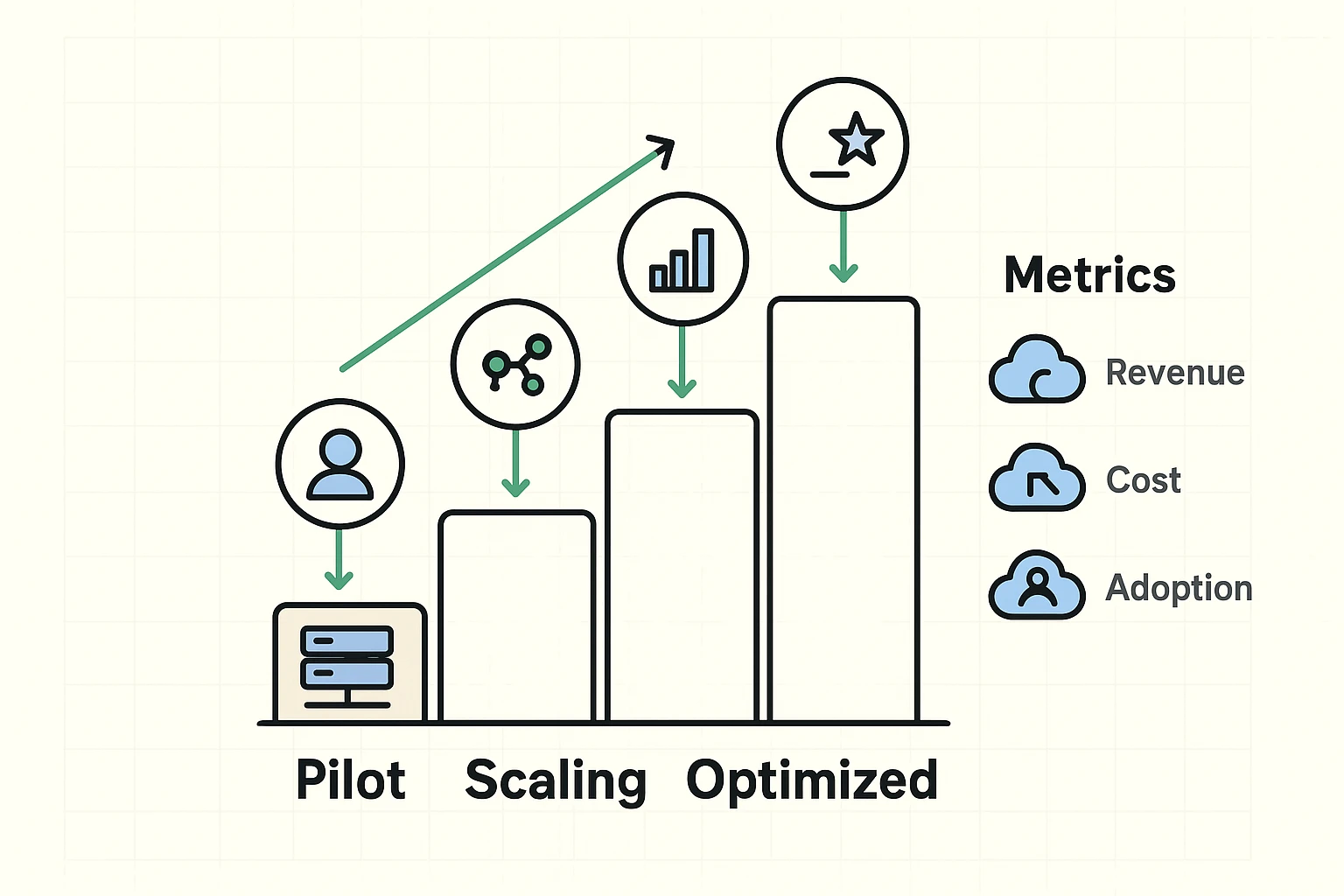
Your KPIs shouldn't be static. As your organization's AI maturity grows, so too should the sophistication and breadth of your success metrics.
In the early stages, focusing on foundational metrics (e.g., data quality, model performance, adoption rates) is key. As you advance, shift towards strategic outcomes (e.g., market share increase, new product innovation, enhanced customer experience).
Cultivating an AI-First Culture from the Top Down
OpenAI's leadership guide highlights the critical role leaders play in communicating purpose. An enterprise AI vision isn't just a document; it's a living commitment. Executives must champion AI by:
- Leading by Example: Showcase how they use AI tools in their own workflows.
- Investing in Training: Empowering employees at all levels with AI literacy and skills.
- Celebrating Successes: Publicly recognize teams and individuals who innovate with AI.
- Addressing Concerns: Create open channels for feedback and address fears about AI transparently.
Building an AI-first culture isn't just about technology; it's about people, process, and leadership.
Common Executive Misconceptions About AI Debunked
Many executives hold understandable, but often limiting, views on AI. Let's address some of the most common "Executive Pitfall Alerts":
- "AI is a plug-and-play solution." Reality: While pre-built tools exist, true enterprise value comes from custom solutions integrated into specific workflows. It's a journey, not a destination, requiring continuous refinement.
- "AI will replace all our jobs." Reality: AI is more likely to augment human capabilities, automate repetitive tasks, and create new roles. The focus should be on upskilling and reskilling the workforce to collaborate with AI.
- "AI is only for tech giants with massive budgets." Reality: The rise of no-code/low-code AI platforms and the availability of expert consulting services make AI accessible to businesses of all sizes. Smart, targeted implementations can yield significant ROI.
- "We need perfect data before starting any AI project." Reality: While data quality is crucial, waiting for perfection can lead to paralysis. Start with "good enough" data, iterate, and use AI to help improve data quality over time.
- "AI is too complex for me to understand." Reality: As an executive, you don't need to be a data scientist. You need to understand the strategic implications, how to ask the right questions, and how to measure business impact. Focus on the "why" and the "what," not necessarily the "how" of the algorithms.
What's Next? Your 90-Day Executive AI Alignment Action Plan
You've absorbed a lot of information, now it's time to act. Here’s a pragmatic plan to kickstart executive alignment on AI in your organization:
- Week 1-2: Vision Workshop: Schedule a dedicated session with your executive team. Facilitate a discussion to collectively define a concise, business-centric AI vision. Don't focus on tools yet, focus on strategic outcomes.
- Week 3-4: KPI Blueprinting: Translate your agreed-upon AI vision into preliminary, high-level business KPIs. For instance, if the vision includes "enhance customer experience," the KPIs might relate to NPS scores or customer churn reduction. Identify which C-suite member "owns" each KPI.
- Month 2: Pilot Identification: Brainstorm 1-2 small, high-impact AI pilot projects that directly address a critical business problem and can deliver measurable ROI within 3-6 months. These pilots should be designed to validate your KPI assumptions. Consider how automation could free up your team for more strategic work, rather than adding headcount.
- Month 3: Governance & Communication Framework: Begin establishing a lightweight AI governance framework. This includes defining roles and responsibilities, ethical guidelines, and a communication plan to keep the broader organization informed and engaged. Don't forget to leverage your Free Community & Templates for resources here.
Remember, successful enterprise AI adoption is a marathon, not a sprint. It begins with a shared vision at the executive level, defined by clear, business-focused KPIs, and sustained by continuous communication and learning.
Frequently Asked Questions (FAQ)
Q1: What is "Enterprise AI Vision" and why is it important for executives?
A1: An Enterprise AI Vision is a clear, strategic statement outlining how AI will be leveraged across the entire organization to achieve specific business objectives. It’s important for executives because it aligns all AI initiatives with overarching company goals, secures necessary resources, prevents fragmented efforts, and ensures AI investments deliver tangible value rather than just being technical experiments. It helps answer the "why" behind AI adoption for every stakeholder.
Q2: How do AI KPIs differ from traditional business KPIs?
A2: AI KPIs often start with technical metrics (like model accuracy or data processing speed), but for executive alignment, these must be translated into traditional business KPIs (like revenue growth, cost reduction, customer satisfaction, or operational efficiency). The key difference is the direct linkage: AI KPIs explicitly demonstrate how AI systems contribute to the strategic business outcomes traditionally measured by the C-suite.
Q3: What if my executive team is skeptical or doesn't understand AI?
A3: This is a common challenge. Start by demystifying AI, focusing on problem-solving rather than technology. Use relatable, real-world examples from your industry. Emphasize the ROI and competitive advantages. Engage them through interactive workshops rather than passive presentations. Highlight the risks of not adopting AI. You might even consider starting with simple, immediate-impact AI automation for sales and marketing to build confidence.
Q4: How do we measure the ROI of AI when many benefits are intangible?
A4: While direct financial ROI is ideal, you can quantify intangible benefits by linking them to other business metrics. For example, improved employee satisfaction (intangible) due to AI automating mundane tasks can be linked to reduced turnover rates (measurable). Enhanced decision-making (intangible) can be linked to faster time-to-market or reduced error rates. Over time, these contribute to overall business value, even if not immediately visible on a balance sheet.
Q5: What role does an AI strategy roadmap play after executive alignment?
A5: An AI strategy roadmap is the detailed plan of how you will execute your executive-aligned AI vision. It outlines specific initiatives, timelines, resource allocation, technology choices, governance structures, and the metrics you'll track at each stage. Executive alignment provides the "north star," and the roadmap provides the detailed navigation. Learn more about effective AI content strategies and semantic search optimization as part of a robust AI roadmap.
Join Our Growing AI Business Community
Get access to our AI Automations templates, 1:1 Tech support, 1:1 Solution Engineers, Step-by-step breakdowns and a community of forward-thinking business owners.
Latest Blogs
Explore our latest blog posts and insights.