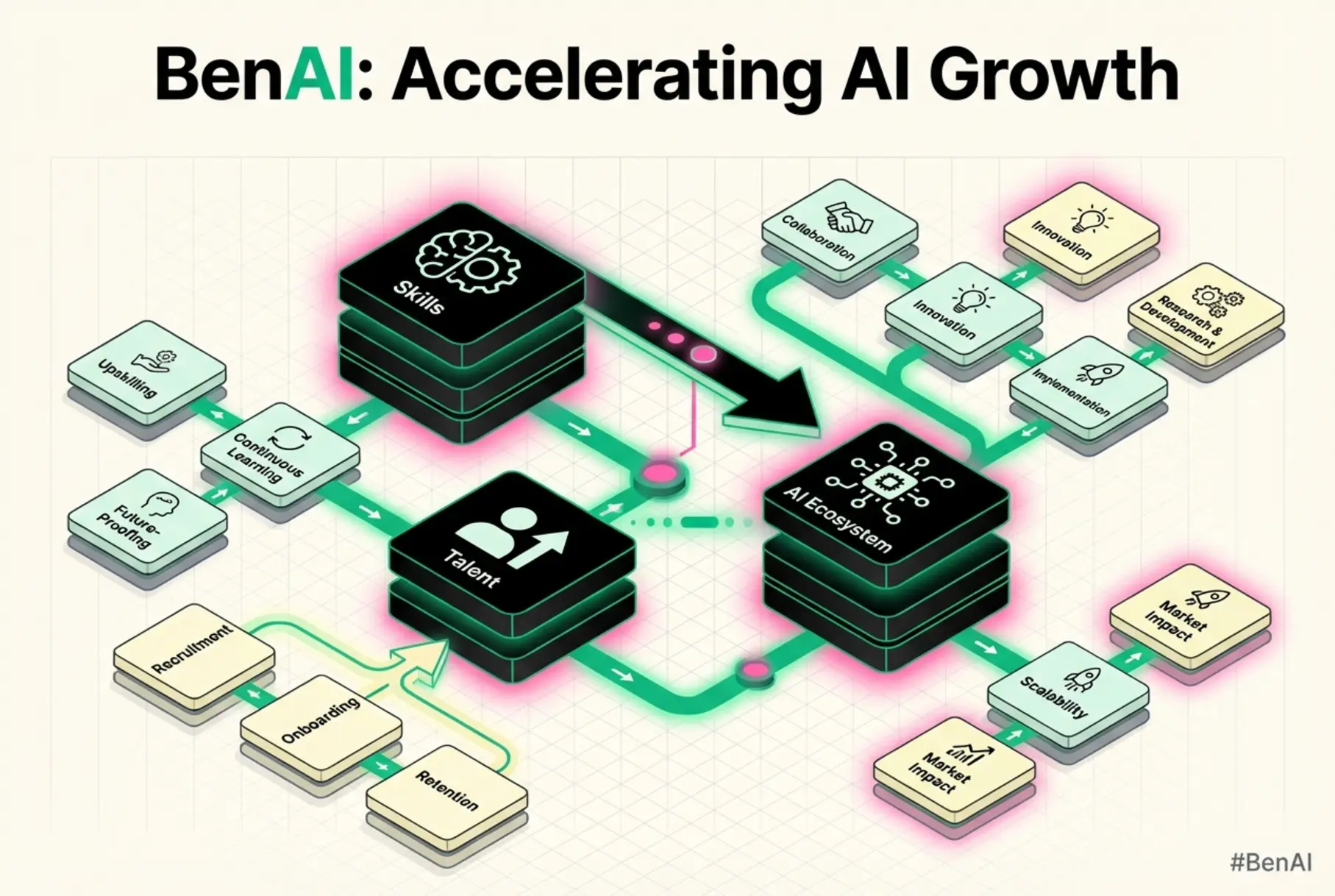
Navigating the complexities of modern content strategy, particularly with the integration of artificial intelligence (AI), presents significant evaluation challenges for businesses aiming to establish digital authority. Integrating AI into content strategy and cluster development provides a systematic approach to planning, structuring, and generating comprehensive topical content, ensuring that businesses can build robust topical authority. This method leverages AI to analyze existing content, identify critical gaps, recommend new content topics aligned with user intent and Search Engine Results Pages (SERP) analysis, and assist in meticulously mapping content to the customer journey. This underpins a strategic framework for generating organic traffic and achieving higher rankings in AI search, ultimately transforming content creation into a scalable, data-driven process. BenAI specializes in integrating robust AI content strategies.
The Strategic Imperative of AI in Content Strategy
Traditional content strategies often struggle to keep pace with the dynamic nature of search engine algorithms and the increasing sophistication of user queries. AI-powered content strategy offers a solution addressing these challenges by automating and optimizing key processes. This allows businesses to move beyond scattered, keyword-focused articles toward integrated content clusters that cover topics comprehensively. The foundation of this approach involves semantic understanding, entity recognition, and advanced natural language processing (NLP) to ensure content is not only relevant but also contextually rich and inherently valuable.
How AI Elevates Content Clustering
Content clustering, a methodology that organizes individual pieces of content around a central "pillar page," benefits significantly from AI integration. AI facilitates this by identifying core themes, related subtopics, and semantic connections that human strategists might overlook. For example, AI algorithms can process vast amounts of data to uncover nuanced relationships between seemingly disparate keywords, transforming them into cohesive content plans. A study by the Content Marketing Institute shows that 68% of content marketers report their organizations have a defined content strategy. AI further refines these strategies, allowing for precise structuring and efficient execution.
Accelerating Pillar Page Development with AI
Pillar pages, the cornerstones of content clusters, require comprehensive coverage of a broad topic. AI streamlines the development of these pages by:
- Analyzing Existing Content: AI tools can audit current content libraries, identifying what topics are already covered, the depth of coverage, and opportunities for consolidation or expansion.
- Identifying Content Gaps: By comparing existing content against top-ranking pages and user intent data, AI highlights specific subtopics and questions that are not adequately addressed. This directly informs the creation of new supporting content for the pillar. As detailed in a Moz analysis, addressing content gaps can lead to a 15-20% increase in organic traffic.
- Topic Ideation: AI leverages SERP analysis, keyword research, and audience insights to recommend new content topics that align with evolving user queries and emerging trends. This ensures constant relevance and forward-looking content planning.
Why Topical Authority is Non-Negotiable in Evolving Search
Topical authority is a measure of a website's overall expertise and comprehensiveness on a particular subject, directly influencing search engine rankings. Google's algorithms, particularly with advancements like RankBrain and MUM, prioritize content that deeply understands and thoroughly covers a topic, rather than merely mentioning keywords. Establishing topical authority demonstrates to search engines that a business is a reliable and exhaustive source of information. This leads to higher rankings not just for specific keywords but for a wide range of related queries, generating increased organic traffic. An SEMrush study indicated that websites with strong topical authority often see a 200-300% increase in organic visibility over time.
By systematically building content clusters around pillar pages, businesses convey a clear signal of expertise. AI assists in this by ensuring every piece of content within a cluster is semantically linked and addresses a specific aspect of the overarching topic, creating a cohesive and authoritative knowledge base.
The AI-Driven Content Creation Process
Implementing an AI-powered content strategy involves several critical stages, from initial research to content mapping and performance evaluation. Each stage leverages AI's analytical capabilities to enhance precision, efficiency, and effectiveness.
Diagnostic Analysis: Unveiling Content Gaps with AI
A comprehensive content strategy begins with a thorough diagnostic analysis of existing content performance and market opportunities. AI plays a pivotal role in this phase by conducting large-scale content audits and competitive analyses.
At this stage, AI algorithms scan existing content, evaluating its quality, relevance, and alignment with target keywords and user intent. Concurrently, AI analyzes competitor content, identifying their strengths, weaknesses, and areas where they have established topical authority. This dual analysis enables AI to pinpoint specific content gaps—topics or subtopics that are either missing from a business's content portfolio or are not covered with sufficient depth to compete effectively. A recent study published in the Journal of Marketing Research highlighted that AI-driven content audits improve content gap identification by 45% compared to manual methods.
AI can also perform sophisticated entity extraction, identifying key concepts and entities within high-ranking content to ensure that new content aligns with these semantic structures. This diagnostic process is crucial for understanding the current landscape and formulating a data-driven plan for improvement.
The image below illustrates how AI can visualize missing topical coverage, offering priority recommendations based on aggregated gap scores. This diagnostic tool is essential for planning strategic content investments.
Topic Ideation and Semantic Content Generation
Once gaps are identified, AI shifts to generating new content ideas and structuring them semantically. This involves using advanced NLP models to understand user intent behind search queries, going beyond simple keywords to grasp the underlying meaning and context. AI can analyze millions of search queries to identify common questions, related concepts, and emerging trends. This enables the generation of high-potential content topics that directly address audience needs. For additional context, explore our insights on AI Keyword Content Gap Analysis.
Semantic content generation with AI ensures that the newly created content is not just keyword-rich but also contextually relevant and comprehensive. AI assists in outlining articles, structuring headings, and suggesting key entities to include, leading to content that Google’s algorithms can more easily understand and rank. This proactive approach to content creation facilitates the development of a fully optimized site, as discussed in Automated On-Page SEO AI. This advanced capability in content structuring automates strategic elements, as detailed in AI Automation Content Structuring.
Mapping Content to the Customer Journey
Effective content doesn't just inform; it guides potential customers through their decision-making process. AI is instrumental in mapping content topics to specific stages of the customer journey, ensuring that each piece of content serves a clear purpose.
- Awareness Stage: Content focuses on broad topics that address common problems or questions, attracting a wide audience. AI identifies these high-level queries and suggests pillar pages.
- Consideration Stage: Content delves deeper into potential solutions, offering comparisons, "how-to" guides, and detailed explanations. AI helps identify specific subtopics that address pain points and present product or service benefits.
- Decision Stage: Content provides direct solutions, case studies, testimonials, and product specifications, helping customers make their final choice. AI identifies content types that convert at this critical stage.
By aligning content with the customer journey, businesses can create a seamless experience that nurtures leads and drives conversions. This mapping process ensures that content is not only relevant to search engines but also valuable to the target audience at every touchpoint. For detailed examples, see our analysis of AI Marketing Stack Integration in broader AI applications.
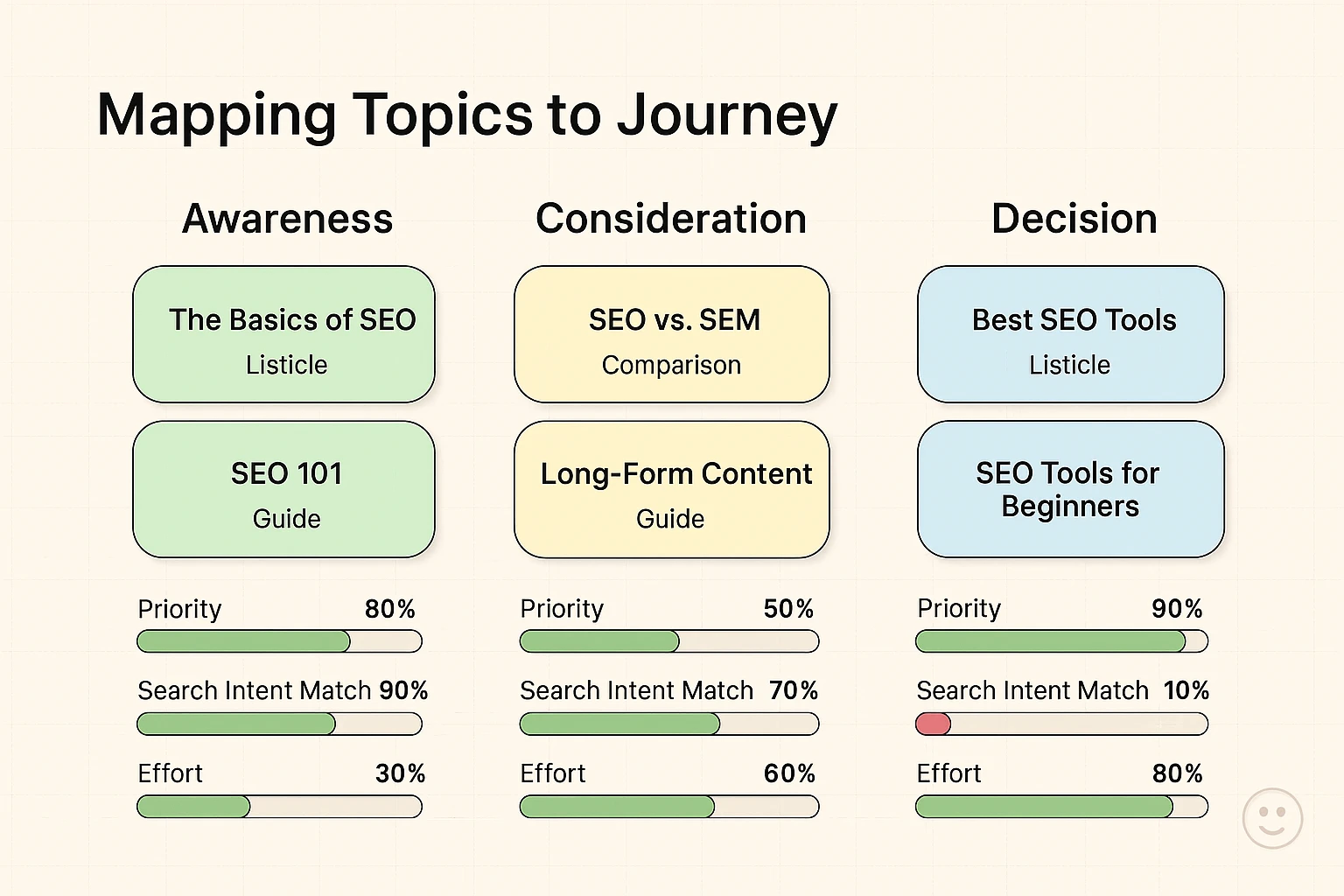
The image below demonstrates how AI can map suggested topics to buyer stages, providing insights into priority, intent alignment, and estimated effort to formulate a pragmatic content cluster roadmap.

Evaluating AI-Powered Content Solutions
When considering an AI-powered content solution, businesses must evaluate several key factors to ensure alignment with their strategic goals. These include the solution's ability to provide comprehensive coverage, its integration capabilities, and the potential return on investment.
Comprehensive Coverage and Intent Alignment
A superior AI content solution delivers comprehensive coverage for target topics and accurately aligns content with user intent. This goes beyond keyword matching to semantic understanding, ensuring that every piece of content within a cluster contributes to overall topical authority. A 2023 study by Forrester found that solutions offering deep semantic analysis and intent matching led to 30% higher organic search visibility compared to those relying solely on keyword metrics.
A solution should offer detailed historical performance data, coverage scores, and a clear breakdown of content components (e.g., related entities, concepts, questions) to facilitate thorough evaluation. The most effective systems provide comparative analytics that highlight the potential gains from each content piece or cluster. This includes comparing new content ideas against existing high-performing content or competitor strategies.
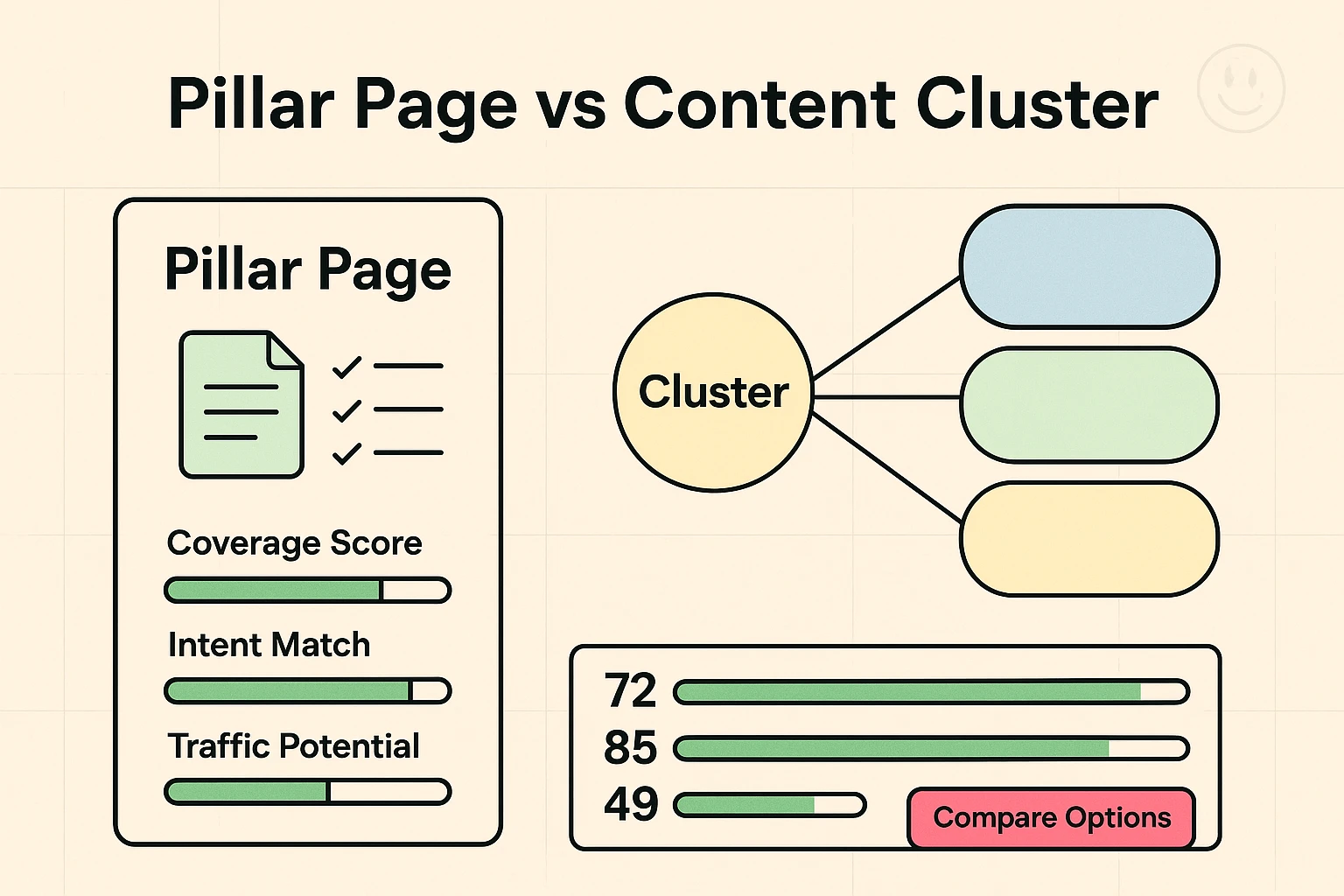
The image below offers a comparative glance at pillar pages and content clusters, allowing for quick evaluation of coverage, intent alignment, and traffic potential to decide where to invest content efforts.
Scalability and Integration
The chosen AI solution must integrate seamlessly with existing content workflows and marketing technologies. Scalability is also paramount; the system should handle growing content demands without significant manual intervention. Solutions capable of integrating with Content Management Systems (CMS), analytics platforms, and SEO tools offer the most value by automating data flow and reducing friction in content production. For example, a system that automatically suggests automated internal linking strategies or aids in the creation of AI newsletter content generation can significantly boost efficiency.
ROI and Performance Metrics
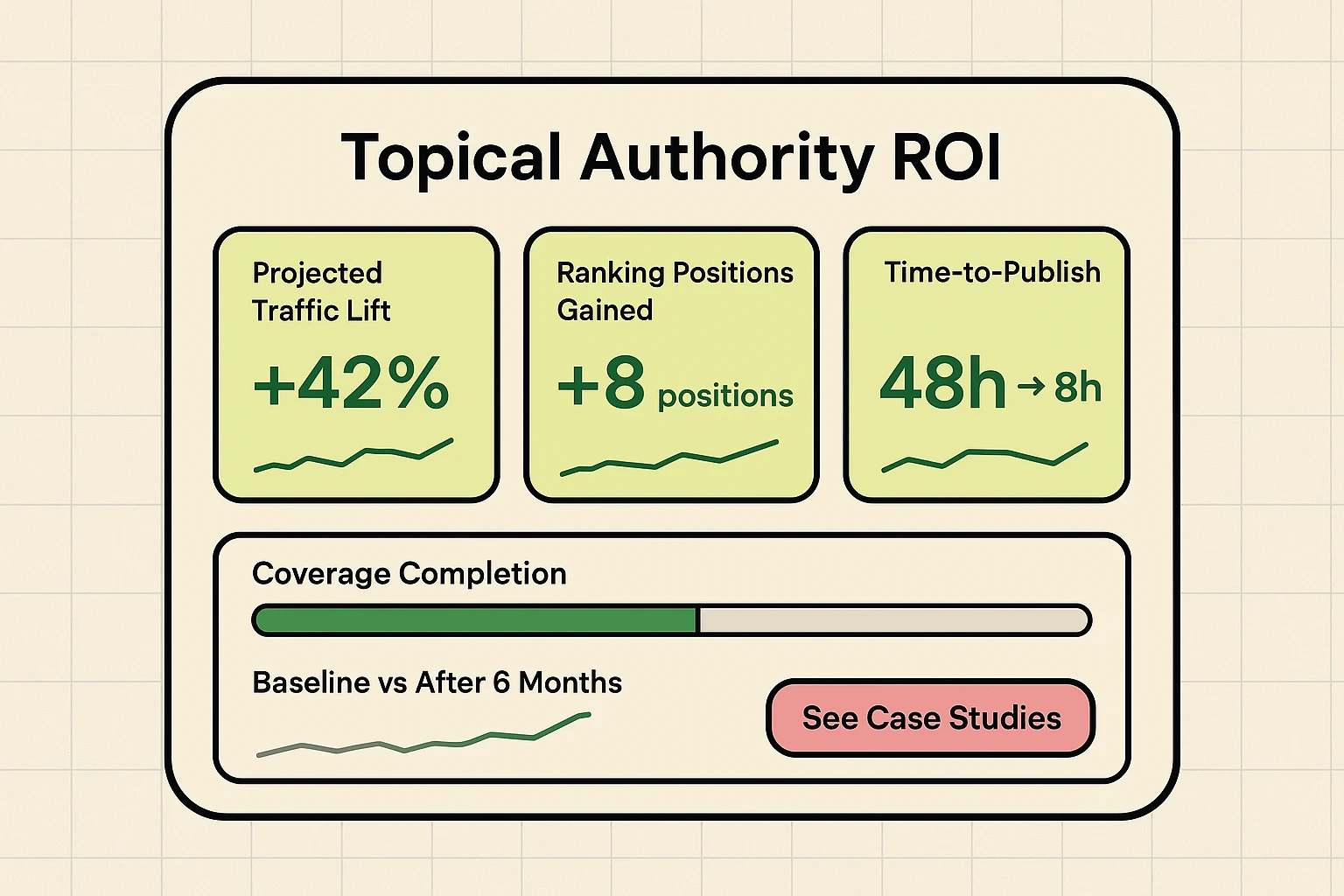
Quantifying the business case for AI content strategy involves assessing projected traffic, ranking improvements, and time savings. A robust AI solution should provide clear metrics and forecasts for these key performance indicators (KPIs). According to Gartner, businesses adopting AI for content generation and strategy report an average 25% reduction in content production time while achieving higher engagement rates.
The ability of AI to automate repetitive tasks—such as keyword research, content auditing, and basic content generation—frees up human strategists to focus on higher-value activities. This leads to substantial operational efficiencies and cost savings, particularly for large-scale content operations.
The image below helps quantify the business case, showing projected traffic and ranking improvements alongside time savings, which are crucial for validating investment in topical authority.
Frequently Asked Questions
What constitutes a content cluster, and why is it important for SEO?
A content cluster is a group of interlinked content pieces, comprising a central "pillar page" and several supporting "cluster content" articles, all focused on a broad topic. Its importance for SEO lies in establishing topical authority with search engines. By thoroughly covering a subject, it signals to algorithms that a website is an expert source of information, leading to higher rankings for a wider range of related keywords and improved organic visibility. Consistent application improves a site's crawlability, a key factor in search engine optimization as outlined in AI Crawlability Indexation.
How does AI identify content gaps in existing content?
AI identifies content gaps by analyzing a business's existing content against the search behavior of its target audience and the content of top-ranking competitors. It uses natural language processing (NLP) to understand the semantic intent behind user queries and evaluates whether existing content adequately addresses these intents. A 2022 study by Accenture revealed that AI-driven content analysis tools can identify specific missing subtopics and entities with over 90% accuracy, providing a precise roadmap for new content creation.
Can AI genuinely recommend new content topics that align with user intent?
Yes, AI can genuinely recommend new content topics that align with user intent by performing sophisticated SERP analysis, semantic keyword research, and audience behavior pattern recognition. AI algorithms analyze millions of data points, including search queries, click-through rates, and competitor content structures, to identify patterns and unmet information needs. This allows AI to suggest topics that directly answer the evolving questions and interests of a target audience, creating opportunities to attract and engage new users.
What role do pillar pages play in an AI content strategy?
Pillar pages serve as the foundational, comprehensive guides for broad topics within an AI content strategy. They address a wide array of user intents related to the core subject and link to more specific "cluster content" articles that delve into subtopics. In an AI content strategy, AI assists in optimizing pillar pages by ensuring they are semantically complete, cover all essential facets of the topic, and are structured for maximum indexing and search engine understanding. This creates a strong internal linking structure that reinforces topical authority.
How does BenAI ensure that AI-generated content is accurate and authoritative?
BenAI ensures that AI-generated content is accurate and authoritative through a multi-faceted approach involving advanced AI models and human oversight. Our AI systems are trained on vast, high-quality datasets to ensure factual consistency and semantic precision. Furthermore, all AI-generated content undergoes human review by subject matter experts to verify accuracy, enhance nuance, and ensure alignment with brand voice and tone. This hybrid approach leverages AI's efficiency for data synthesis and content generation, combined with human expertise for critical evaluation and refinement, ensuring the output is both factual and authoritative. This meticulous process helps businesses achieve their desired outcomes, analogous to how we've Built an Entire Marketing Team with 37 AI Agents.
Drive Your AI-First Content Transformation
The strategic integration of AI into your content strategy and cluster development is no longer optional; it is fundamental for establishing and maintaining topical authority in the competitive digital landscape. BenAI offers proven AI systems, implementations, training, and consulting services designed to transform your content production into an AI-first operation. By leveraging our expertise, you can overcome content evaluation challenges, identify critical gaps, and generate high-performing content that resonates with your target audience and drives organic growth.
Ready to build a content strategy that establishes undeniable topical authority? Partner with BenAI to unlock the full potential of AI in your content efforts.
Join Our Growing AI Business Community
Get access to our AI Automations templates, 1:1 Tech support, 1:1 Solution Engineers, Step-by-step breakdowns and a community of forward-thinking business owners.

Latest Blogs
Explore our latest blog posts and insights.