The world of search is undergoing a fundamental transformation. If you're a business leader or marketer evaluating your SEO strategy, you’ve likely felt the ground shifting from traditional keyword tactics towards something more complex, yet more powerful. It’s no longer just about optimizing for what users type; it’s about understanding what they mean. This shift is driven by semantic search and entity optimization—the new frontiers for digital visibility. The challenge isn't just to keep up, but to lead. You need a trusted partner who understands this evolution and can translate it into tangible growth for your business.
Beyond Keywords: Mastering Semantic Search and Entity Optimization for the AI Era
For years, SEO was a game of keywords. Stuff the right phrases into your content, build enough backlinks, and you’d climb the ranks. That world is gone. Today's search engines, powered by sophisticated AI, are far more intelligent. They interpret intent, understand relationships between concepts, and prioritize authoritative, structured information. The data confirms this: Google's Knowledge Graph now indexes over 5 billion entities, and entity-rich content can deliver a 50% average SERP lift and 2x higher conversions (Digital One Agency).
This means your evaluation of an SEO solution needs to move beyond simple keyword tools to platforms and strategies that fundamentally understand how AI interprets the web. You need to transition from focusing on "what users search for" to "what users mean when they search."
The Evolution of Search: From Strings to Sense
The journey from rudimentary keyword matching to advanced semantic understanding has been profound. Early search engines were essentially digital librarians, matching query strings to document strings. Think of it like looking for a specific book by its title word-for-word.
However, Google's algorithms have matured significantly. This evolution isn't just about indexing more content; it’s about making sense of it. The integration of Natural Language Processing (NLP) and machine learning allows search engines to decipher the nuances of human language. This means they can grasp synonyms, related concepts, and the context of a query. For instance, a search for "best way to get a new car" isn't just parsed for "best," "new," and "car." The search engine understands the user's intent to purchase a vehicle, possibly requiring information on financing, dealerships, or research.
This foundational shift has led to an emphasis on entities. An entity is a distinct, well-defined thing or concept—a person, a place, an organization, a product, or even an abstract idea. When Google understands your content in terms of these entities and their relationships, it can connect your information to a vast web of knowledge, far beyond what simple keyword matching ever allowed. Traditional SEO focused on keywords; modern SEO, especially for AI search, goes deeper. It's about optimizing your content for context and relationships, much like explaining how artificial intelligence transforms specific business processes by discussing core concepts like generative AI and large language models.
Deconstructing Entities: Your Path to AI-First Relevance
To truly excel in semantic search, you must first master the art of entity optimization. This isn't just a buzzword; it's a strategic imperative. Identifying, modeling, and structuring information around key entities relevant to your business allows search engines—and critically, AI Overviews—to understand your authority and relevancy.
Think about the entities central to your business. For BenAI, key entities include "AI business solutions," "AI implementation," "AI training," "AI marketing," and "AI recruiting." For your business, these might be specific products, services, industry leaders, or core concepts. Once identified, you need to model their attributes and relationships. For example, BenAI provides "AI Marketing Solutions" (entity) which offers "scalable growth" (attribute) to "marketing agencies" (related entity).
This process can feel abstract, but it's entirely actionable. It involves creating a detailed map of your domain's knowledge. BenAI assists businesses in this critical phase, helping to clarify their core offerings and how they relate across the semantic web.
Here's an interactive way to envision this:

An interactive entity-mapping visualization to plan entity models, inspect attributes, and export structured data for implementation teams.
BenAI helps you craft content that naturally integrates these entities, using synonyms and related concepts that signal deep understanding to search algorithms. This method ensures your content doesn't just rank for a keyword, but becomes part of a broader, authoritative knowledge graph. It's an essential part of effective AI SEO content generation and optimization.
Structured Data & Knowledge Graphs: The Technical Backbone
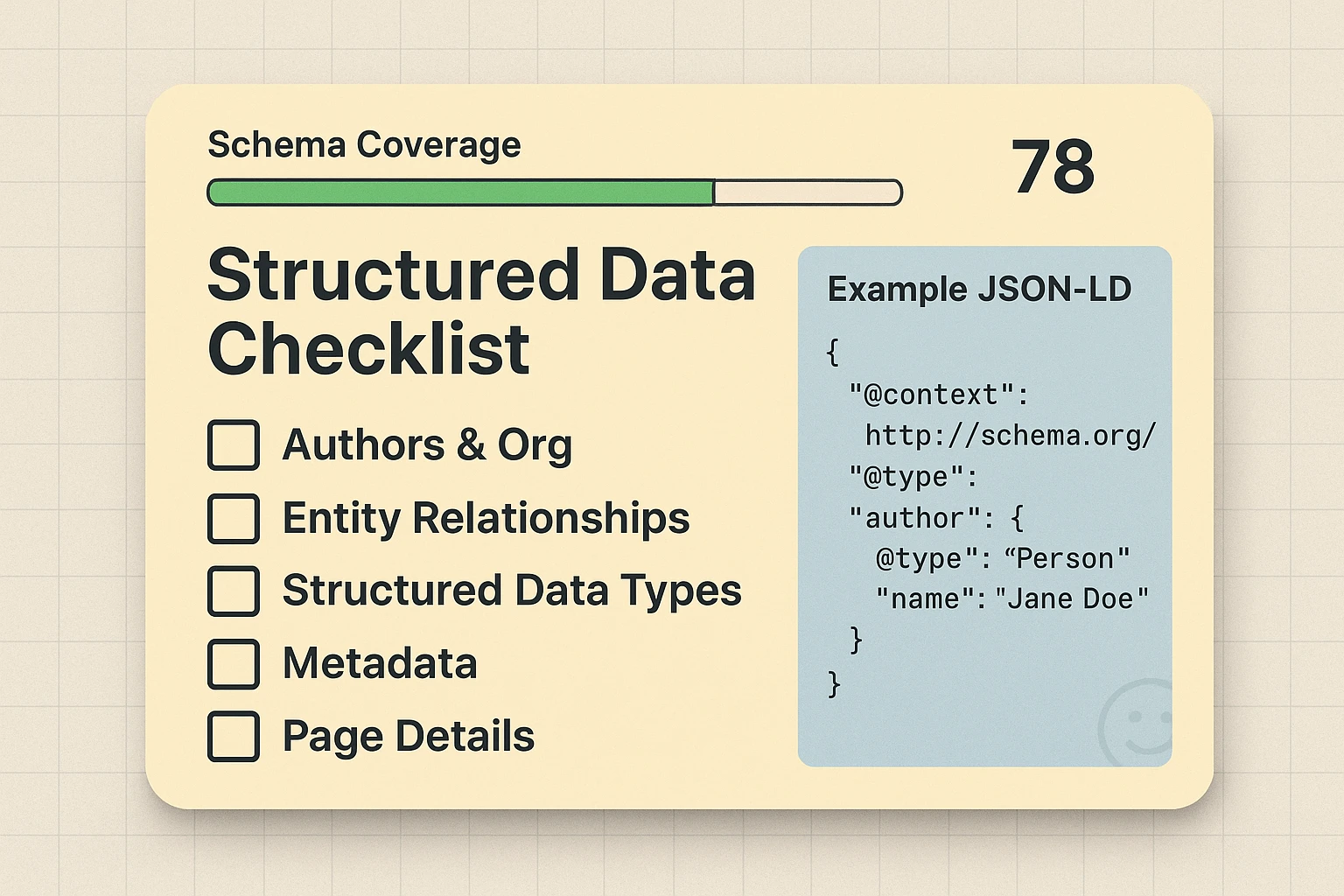
Understanding entities is one thing; making sure search engines understand them is another. This is where structured data and knowledge graphs become your technical backbone. Schema.org markup, particularly in JSON-LD format, acts as a universal language that explicitly tells search engines about the entities on your page, their attributes, and their relationships.
Consider the role of schema in helping search engines resolve ambiguities. A query for "Apple" could mean the fruit, the company, or even a person named Apple. By providing schema markup, you eliminate this ambiguity, directly communicating to programs like Google's Knowledge Graph that you're discussing "Apple Inc." (an Organization entity) and its "iPhone" (a Product entity). This precision is vital for your content to appear in rich snippets, featured snippets, and "People Also Ask" sections.
For businesses aiming for enterprise-level visibility, this is non-negotiable. It allows you to build a robust brand presence in knowledge panels, becoming an authoritative source directly recognized by Google. You need a partner that goes beyond basic schema recommendations to provide granular technical details for implementation, including specific scenarios and code snippets for advanced entity-based structured data configurations. We apply this robust technical approach to ensure optimal AI crawlability and indexation for all content.
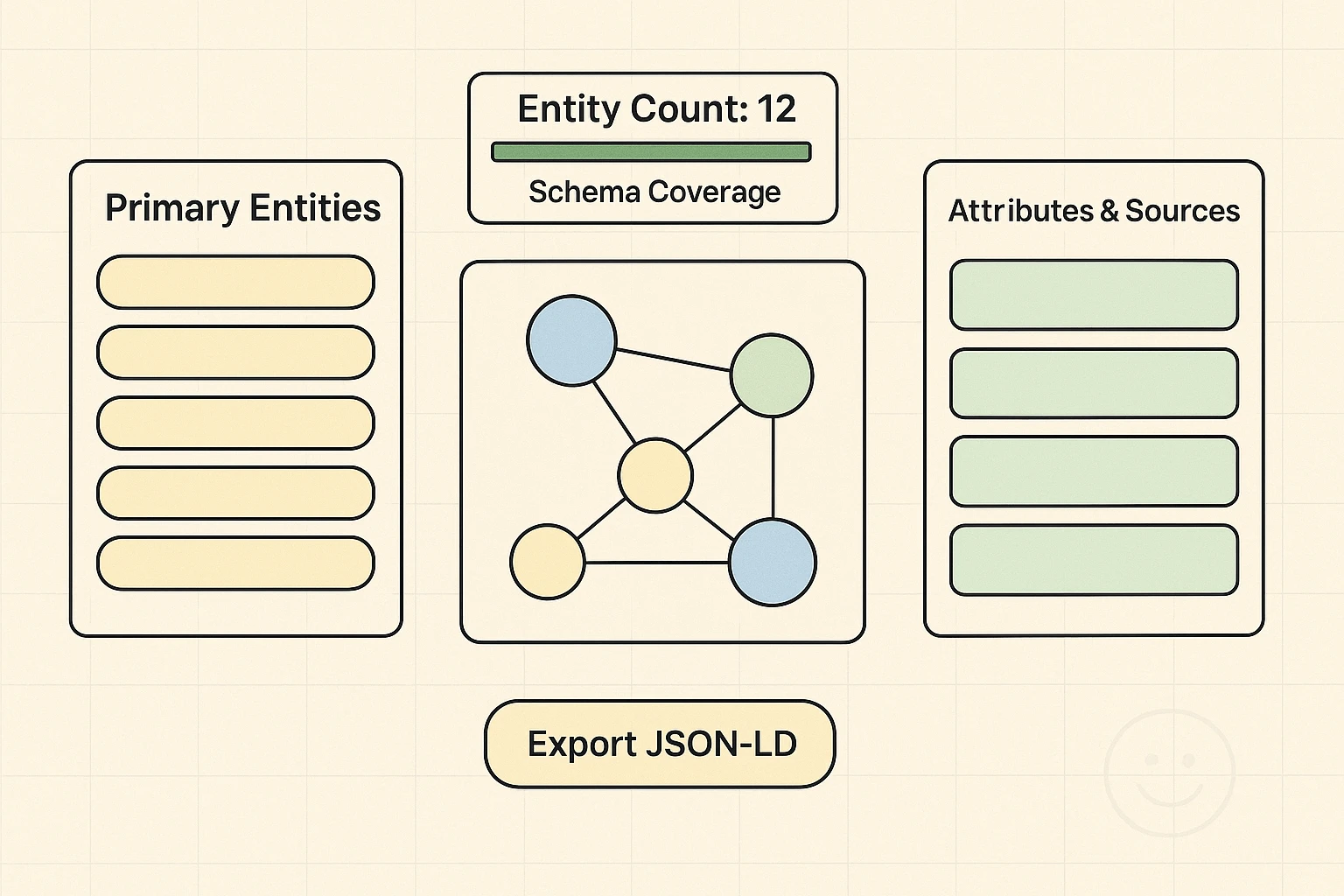
A technical verification card that teams can use to confirm schema coverage and review a sample JSON-LD snippet before deploying knowledge-graph-ready markup.
This level of technical sophistication is crucial. While competitors might offer high-level explanations, our commitment to detail ensures your content is not just understood, but explicitly recognized by search engine algorithms. Our insights into AI schema markup automation can provide a significant advantage.
AI Citation & Answer Engine Optimization: Becoming the Authority
Perhaps the most critical aspect of modern search optimization is preparing your content for AI Overviews and answer engines. The era of "zero-click" searches and AI-generated summaries is here, and it demands a new approach to content. 97.2% of AI citations are not explained by backlink profiles, and 95% are not explained by traffic metrics (SEOMator, DMI Digital Marketing, Stan Ventures). This means traditional SEO signals, while still important, don’t fully capture what makes content quotable by AI.
AI models prefer content that is:
- Direct and concise: Offering clear answers without excessive fluff.
- Factually accurate: Supported by data and credible sources.
- Structured for easy ingestion: Using headings, bullet points, and summaries.
- Authoritative: Demonstrating deep topical understanding and experience.
This requires a strategic shift. You’re not just writing for human readers; you’re writing for large language models (LLMs) that will summarize and present your information. This includes optimizing for unique phrases and providing original insights that make your content inherently quotable. We focus on enhancing content formatting through AI automation and content structuring to maximize this.
Furthermore, AI engines heavily value user-generated content. Perplexity.ai, for example, heavily cites Reddit, which accounts for 46.7% of its citations (SEOMator). This suggests that authentic, diverse perspectives and discussions are seen as valuable signals of authority. This means cultivating an online brand presence even through "unlinked mentions" across diverse platforms and forums contributes to AI's perception of your authority, even without traditional backlinks. BenAI empowers you not just to create content, but to establish yourself as an unassailable authority in your niche. By building a strong and authoritative presence online, including our community hub, we are able to provide continuous strategic insights to our clients.
Evaluating Your Options: What to Look for in an AI SEO Partner
As you evaluate solutions, it’s critical to distinguish between providers who offer rudimentary keyword tools and those who genuinely understand and implement advanced semantic and entity optimization.
Here’s a snapshot of what to expect from a leading solution like BenAI:
Side-by-side comparison of entity-optimization capabilities to help marketing teams choose the right tools based on schema support, AI citation readiness, and entity modeling maturity.
The graphic illustrates key differentiators:
- Schema Support & Custom Entities: Basic tools often provide generic schema, but advanced partners like BenAI enable custom schema for your unique business concepts and niche entities.
- AI Citation Readiness: We go beyond traditional SEO to specifically optimize content for LLM summarization and direct answer attribution, helping your content become "quotable."
- Entity Modeling Maturity: Our approach includes proactive entity identification, relationship mapping, and consistent entity usage across platforms, not just basic term matching.
- Measuring AI Visibility: We provide metrics to track AI citation counts and quotation rates, moving past traditional rankings to prove your AI ROI.
Ultimately, your goal is to appear as the definitive source of information for your niche. This requires a partner focused on making your content not just visible, but inherently authoritative and quotable by the most advanced AI systems.
Measuring Semantic Performance: Beyond Traditional Ranks
In the semantic and AI-driven search era, traditional ranking reports are no longer sufficient. You need new metrics to truly understand the impact of your entity optimization efforts. This includes tracking "answer attribution"—how often your content is cited by LLMs, not just traditional rankings or traffic. Metrics like AI citation counts and quotation rates will become standard.
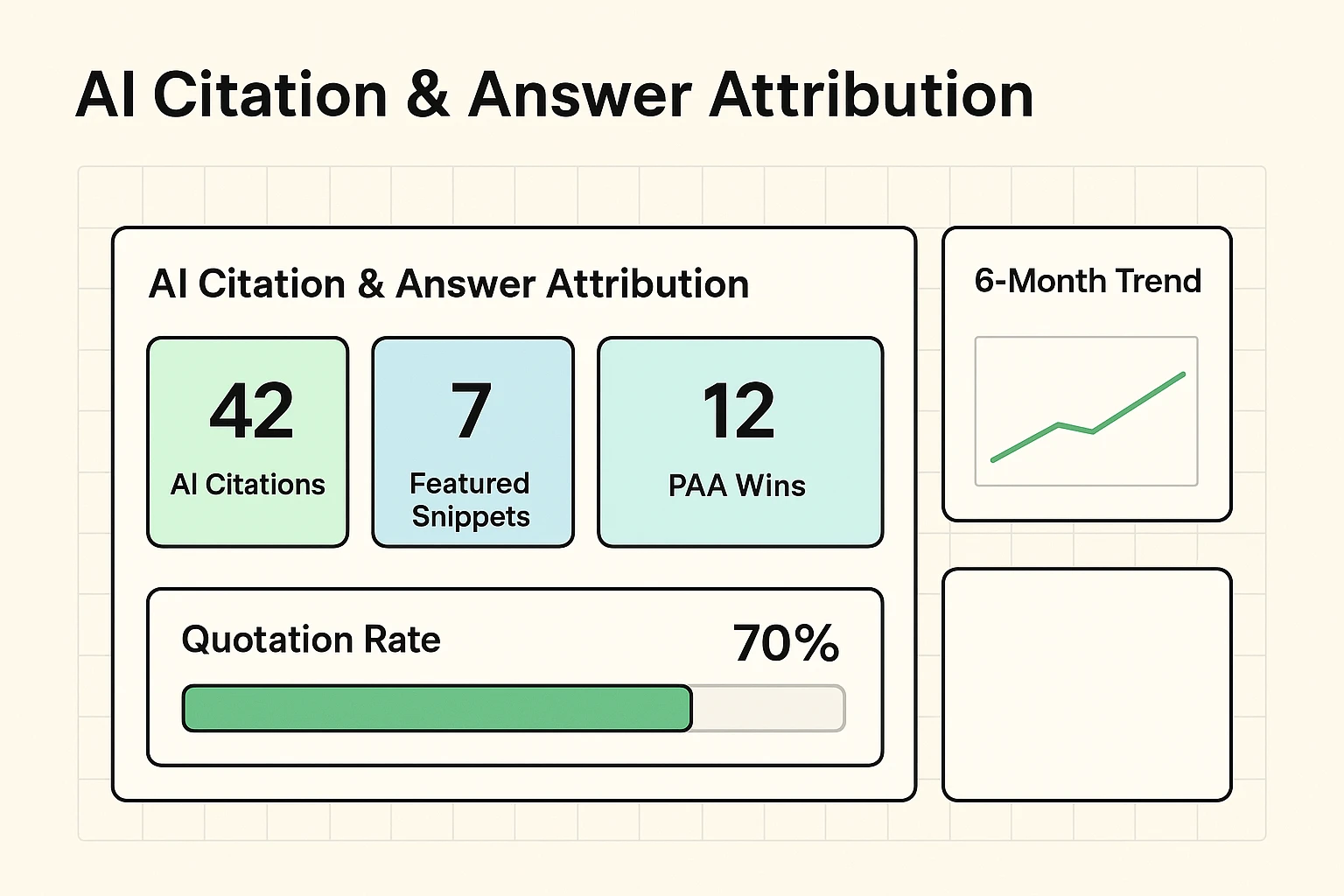
Performance dashboard highlighting AI citation counts and quotation rate to demonstrate how entity-optimized content converts into AI visibility and direct-answer placements.
This new approach to measurement is something BenAI actively monitors and helps clients adapt to. It’s part of our commitment to provide a proactive approach to success in the AI era.
Frequently Asked Questions
What exactly is Semantic Search?
Semantic search is a type of search that focuses on understanding the meaning and context of a user's query, rather than just matching keywords. It uses AI and natural language processing to interpret intent, identify entities (people, places, things, concepts), and understand relationships between them to return more relevant and accurate results.
Why is Entity Optimization so crucial now?
Entity optimization is crucial because modern search engines rely heavily on understanding entities and their relationships to build knowledge graphs and deliver informed answers. By explicitly defining and structuring information around entities, you help search engines grasp the full context and authority of your content, leading to better visibility, especially in AI Overviews and direct answer snippets. Digital One Agency reports entity-rich content boosts performance, showing a 50% average SERP lift and even 2x higher conversions.
How does this differ from traditional Keyword SEO?
Traditional keyword SEO focused on specific words or phrases and their density. Semantic search and entity optimization go much deeper, prioritizing the overall meaning, context, and relationships between concepts. It’s about building a comprehensive knowledge base that answers user intent, rather than just matching query strings. While keywords still play a role, their context within entities is what truly matters. This requires a different approach to content than just performing an AI keyword content gap analysis.
What role does Structured Data (Schema Markup) play?
Structured data, such as Schema.org markup (e.g., JSON-LD), is essential. It provides explicit, machine-readable information about the entities on your page. This helps search engines confidently identify your content's entities, attributes, and relationships, enhancing your chances of appearing in rich results, knowledge panels, and being understood by AI Overviews. It's the technical language you use to communicate with search engines and LLMs.
How can I make my content "quotable" by AI Overviews?
To make your content quotable by AI Overviews, focus on providing concise, direct answers to common questions. Structure your content with clear headings, bullet points, and summaries. Ensure factual accuracy and support claims with data. Most importantly, offer unique insights and authoritative perspectives that make your content stand out as a definitive source. Remember that AI often values user-generated content and authentic insights, making strong, expert-driven content vital.
Is Entity Optimization only for large enterprises?
While enterprise-level companies often have the resources to implement comprehensive entity optimization, its principles apply to businesses of all sizes. Even small businesses can gain a competitive edge by strategically identifying and optimizing for core entities relevant to their niche. The market for semantic web technologies is projected to grow from $2.71 billion in 2025 to $7.73 billion by 2030 (MarketsandMarkets), indicating widespread adoption.
How does BenAI help with Semantic Search and Entity Optimization?
BenAI specializes in transforming businesses into "AI-first" entities. We provide tailored AI growth systems that include custom implementations, training, and consulting for semantic search and entity optimization. This means we help you identify key entities, structure your content for knowledge graphs and AI Overview citation, implement advanced schema markup, and measure your performance in this evolving landscape—not just with traditional metrics, but with a focus on AI visibility and answer attribution.
Your AI-First Business Starts Here
The future of search is here, and it's powered by a deep understanding of meaning, entities, and intent. To win in this new landscape, you need a partner who sees beyond keywords to unlock the full potential of AI-driven visibility.
BenAI doesn't just talk about semantic search; we implement it. We transform complex concepts into actionable strategies that make your content authoritative, quotable, and highly visible. If you're ready to move beyond traditional SEO and lead the way in AI adoption, it's time to build an AI-first business.
Ready to transform your search strategy? Book a call with BenAI today to explore how our custom AI implementations, training, and consulting can make your business an unassailable authority in the AI era.
Join Our Growing AI Business Community
Get access to our AI Automations templates, 1:1 Tech support, 1:1 Solution Engineers, Step-by-step breakdowns and a community of forward-thinking business owners.
Latest Blogs
Explore our latest blog posts and insights.