The shift to becoming an "AI-first business" is no longer a futuristic concept—it's today's strategic imperative. Yet, as you navigate the rapidly evolving AI landscape, the real challenge isn't just if you should integrate AI, but how to do it strategically, ethically, and profitably across every department. You're past the introductory articles; you need a blueprint for comprehensive transformation, one that addresses the nuanced application of AI in operations, finance, product development, and customer service while mitigating the inherent risks.
This isn't about piecemeal automation. We're talking about a fundamental redesign, moving beyond adding AI as a mere feature to embedding it as the core operating system of your business. As Kearney points out, becoming an "AI-First enterprise" requires a foundational shift, not just an add-on. This comprehensive approach is critical for unlocking competitive advantage and achieving tangible ROI.
Your journey to an integrated, AI-first enterprise begins here.

The Imperative of Ethical Strategic AI Across Functions
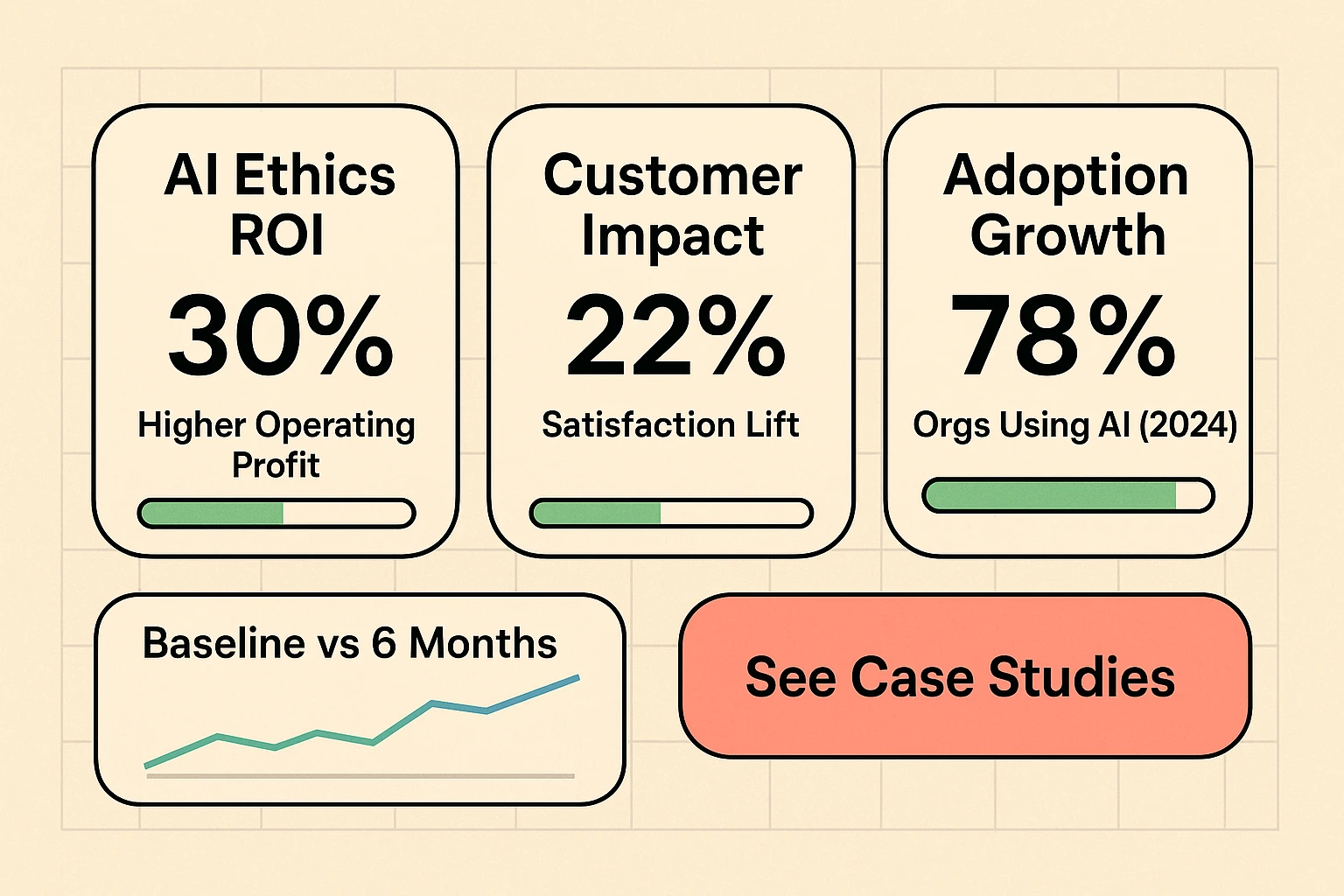
The market for AI ethics in business is projected to surge by $1.6 billion annually at a compound annual growth rate of 29.5% between 2024 and 2029. This isn't just about compliance; it's about competitive advantage. Organizations that dedicate over 10% of their AI budgets to ethics report a remarkable 30% higher AI-related operating profit and a 22% improvement in customer satisfaction and retention. These numbers, from IBM and PwC respectively, underscore a crucial truth: ethical AI isn't a cost center; it's a value driver.
With 78% of organizations now deploying AI, up from 55% in 2023, the question isn't whether to adopt, but how to adopt intelligently and responsibly. The challenge lies in translating high-level ethical principles—fairness, transparency, accountability, privacy—into practical, department-specific applications. This is where many businesses falter, leading to the "transparency paradox" and the "black box" problem outlined by RSM Global. BenAI bridges this gap, guiding you through the complexities of:
- Ethical Frameworks: Moving beyond generic principles to provide actionable tools and best practices tailored for each business function.
- "AI-First" Implementation: Detailing the intricate steps required for each department to deeply embed AI, ensuring maximum ethical advantage and efficiency.
- Risk Mitigation: Proactively identifying and addressing ethical risks before they escalate into legal or reputational crises, focusing on continuous monitoring and early detection.
- Human-Centric AI Collaboration: Fostering AI literacy, upskilling your workforce, and redefining roles to ensure ethical oversight while preventing job displacement concerns.
- Technical Deep Dives: Operationalizing complex ethical requirements into concrete technical implementations like continuous lifecycle risk management, multi-level human oversight, and robust auditability.
Let's explore how strategic, ethical AI transforms each core business function.
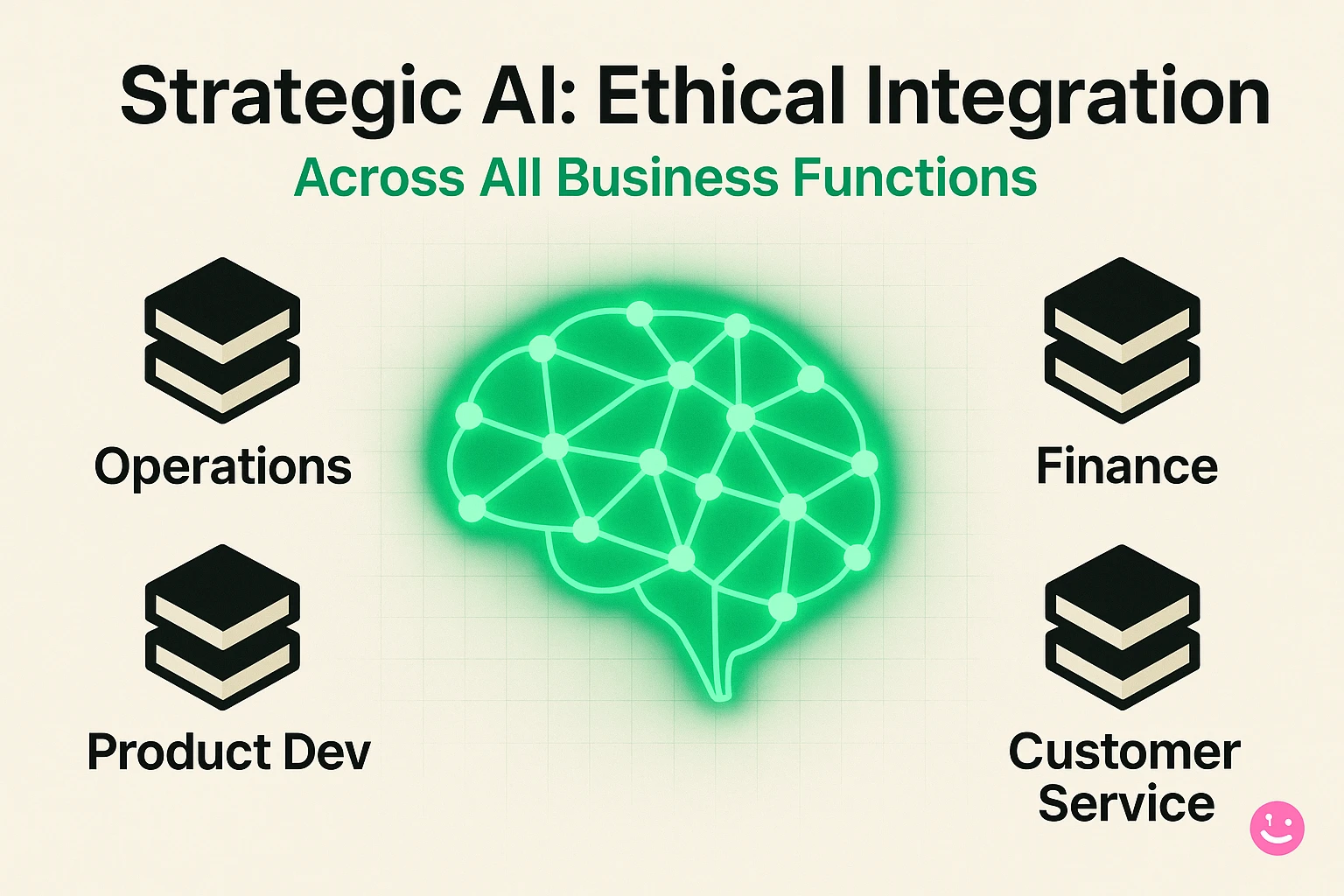
Department Deep Dives: Ethical AI in Practice
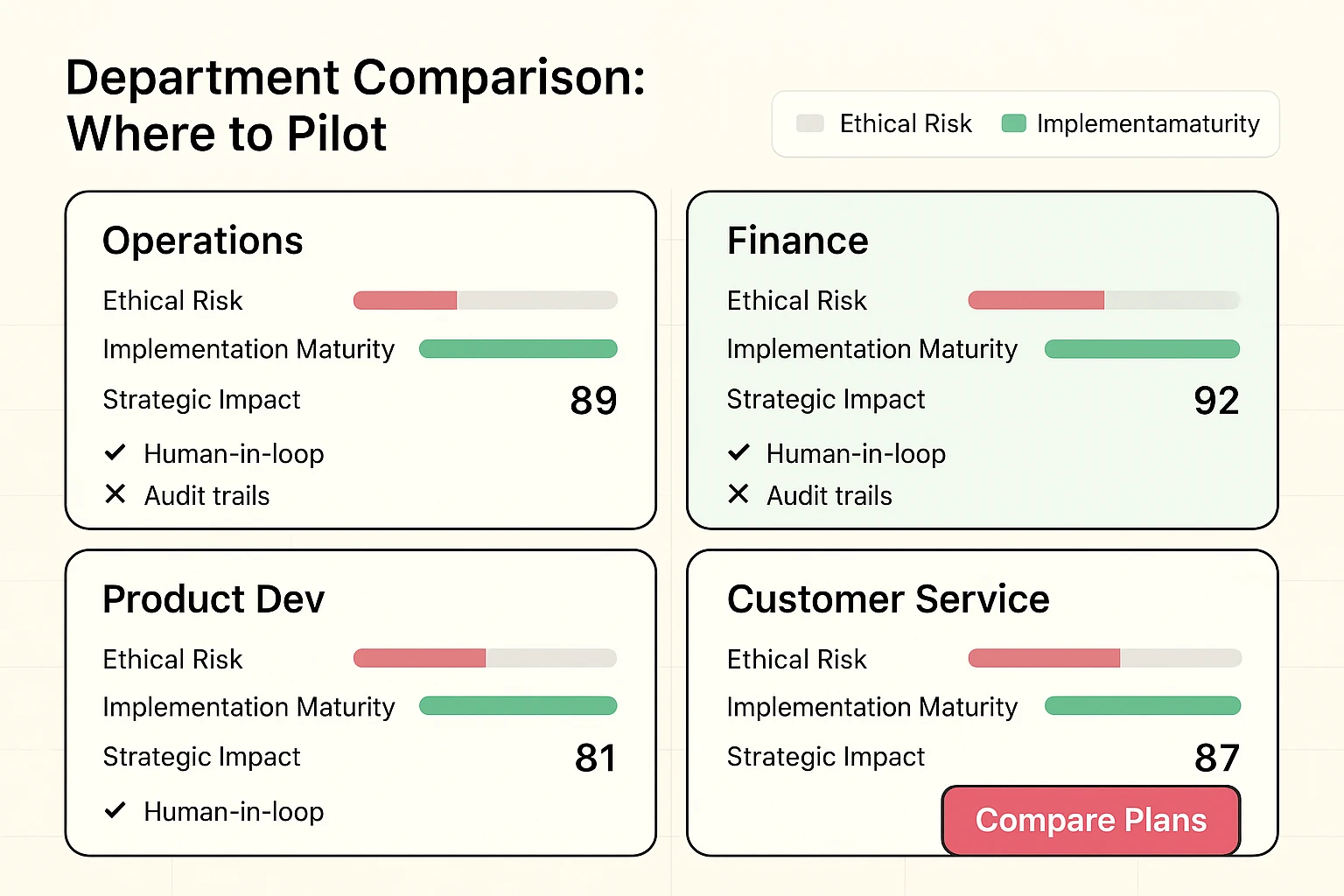
Integrating AI effectively means understanding its specific implications and opportunities within each department. This goes beyond understanding an enterprise AI vision and KPIs at a high level; it requires tangible strategies.
1. Operations: Building Resilient and Responsible Supply Chains
For operations, AI offers unprecedented capabilities in demand forecasting, logistics optimization, and resource allocation. However, these applications come with significant ethical considerations:
- Data Privacy: How is sensitive operational data, potentially including employee or partner information, collected, processed, and secured within your supply chain analytics?
- Algorithmic Bias: Does your AI inadvertently favor certain suppliers, routes, or employee schedules, leading to unfair practices or inefficiencies?
- Human Oversight: Where are the critical human-in-the-loop decision points to validate AI recommendations and prevent automated errors?
BenAI helps you implement an "Ethical AI in Supply Chain Checklist" to ensure transparent data usage, mitigate bias in allocation models, and establish clear human intervention protocols, ensuring your operations are both efficient and equitable.
2. Finance: AI-Powered Decisions with Integrity and Trust
In finance, AI is revolutionizing fraud detection, credit scoring, and financial forecasting. The ethical stakes here are particularly high:
- Bias in Credit Scoring: Are your AI models perpetuating historical biases in credit decisions, unfairly disadvantaging certain demographic groups?
- Transparency in Financial Predictions: Can you explain why your AI made a particular investment recommendation or detected a specific anomaly? The "black box" problem can erode trust.
- Data Security: How are you protecting the highly sensitive financial data processed by AI systems from breaches and misuse?
- Accountability: Who is ultimately responsible when an AI-driven financial decision results in adverse outcomes?
BenAI designs frameworks for "Fair Lending AI" and "Transparent Financial Forecasting," incorporating auditability and explainability to build trust. We guide you through data management automation that prioritizes security and privacy, minimizing risk while maximizing financial intelligence.
3. Product Development: Building AI-Driven Innovations Ethically by Design
As you integrate AI into your products, ethical considerations must be baked in from conception. From generative AI features to personalized user experiences, the risks are substantial:
- Privacy-by-Design: Is user privacy considered at every stage of product development, ensuring data minimization and consent?
- Bias Testing: Are your AI-powered features being rigorously tested for bias against diverse user groups before launch?
- Explainability for Users: Can users understand how your AI features work, especially when critical decisions or recommendations are made?
- IP Concerns with Generative AI: How are you managing intellectual property risks when leveraging generative AI for content or code creation within your products?
BenAI helps you integrate a "Product Ethics Impact Assessment" template and a "Responsible AI Feature Development Workflow" to ensure your innovations are not just groundbreaking but also ethical and trusted.
4. Customer Service: Fostering Trust with AI-Enhanced Human Connections
AI is transforming customer service through chatbots, personalized support, and predictive analytics. The ethical line between efficiency and genuine connection is crucial:
- Transparency in Interactions: Are customers clearly aware when they are interacting with an AI versus a human agent?
- Preventing Deceptive AI: How do you guard against the misuse of AI, such as deepfakes in voice or video support, which can damage trust?
- Data Privacy: How is sensitive customer data handled by AI systems during interactions, and what are the protocols for data retention and usage?
- Human Escalation Paths: Are clear and easy paths available for customers to escalate to a human agent when AI cannot resolve an issue or when ethical concerns arise?
We help you develop a "Transparent AI Customer Interaction Policy" that emphasizes human oversight and clear handoff protocols, fostering trust without sacrificing efficiency. Our solutions extend to refining automated interactions ethically, whether it's AI-driven LinkedIn message personalization or broader customer engagement.
Elevating Your Organization with Comprehensive Ethical AI Integration
The path to becoming a truly AI-first enterprise involves navigating complex technical and ethical terrains. Businesses need to consider the practical implementation challenges with multi-modality AI deployment and how an AI agent ecosystem guide can facilitate this. BenAI provides the expertise to move beyond theoretical discussions to actionable strategies.
Beyond simply defining ethical principles, we operationalize them through technical rigor that many competitors overlook. We focus on:
- Continuous Lifecycle Risk Management: Implementing robust systems for mapping, measuring, managing, and governing AI risks throughout their operational lifespan.
- Multi-Level Human Oversight: Designing human-in-the-loop and human-on-the-loop mechanisms that ensure appropriate human intervention and decision-making at critical junctures.
- Auditability and Traceability: Building AI systems with inherent features that allow for clear audit trails and transparent decision-making processes, crucial for accountability.
- Integrating Sustainability and Societal Impact: Embedding measurable technical requirements that ensure your AI solutions contribute positively to sustainability and broader societal well-being.
This detailed, technical approach ensures your AI implementations are not just compliant, but genuinely responsible and future-proof.
The ROI of Ethical AI: Proven Impact
The benefits of prioritizing ethical AI integration are quantifiable and profound. As PwC research highlights, 55% of executives believe Responsible AI enhances customer experience and innovation, while nearly 60% see a direct boost in ROI and efficiency. This isn't theoretical; it's a direct outcome of building trust and avoiding costly ethical missteps.
Organizations investing in ethical AI are not just mitigating risks; they are actively driving growth and innovation. This ethical leadership translates into:
- Increased Customer Trust: 57% of consumers would trust AI more with greater visibility into its use. Ethical transparency fosters loyalty.
- Enhanced Operational Efficiency: By designing AI systems with clear guidelines and continuous monitoring, you minimize errors and streamline processes, especially within operations.
- Superior Innovation: Ethical guardrails encourage thoughtful, responsible development, leading to more resilient and widely accepted AI products and services.
- Stronger Talent Attraction & Retention: A commitment to responsible AI positions your company as a forward-thinking employer, attracting and retaining top AI talent.
Preparing for Ethical AI Audits: A Proactive Approach
With the rapid expansion of AI, regulatory scrutiny and the need for accountability are growing. Only 44.2% of companies have well-established AI ethics and data governance policies, leaving a significant gap. BenAI helps you get ahead of the curve by developing a robust framework for ethical AI audit readiness.
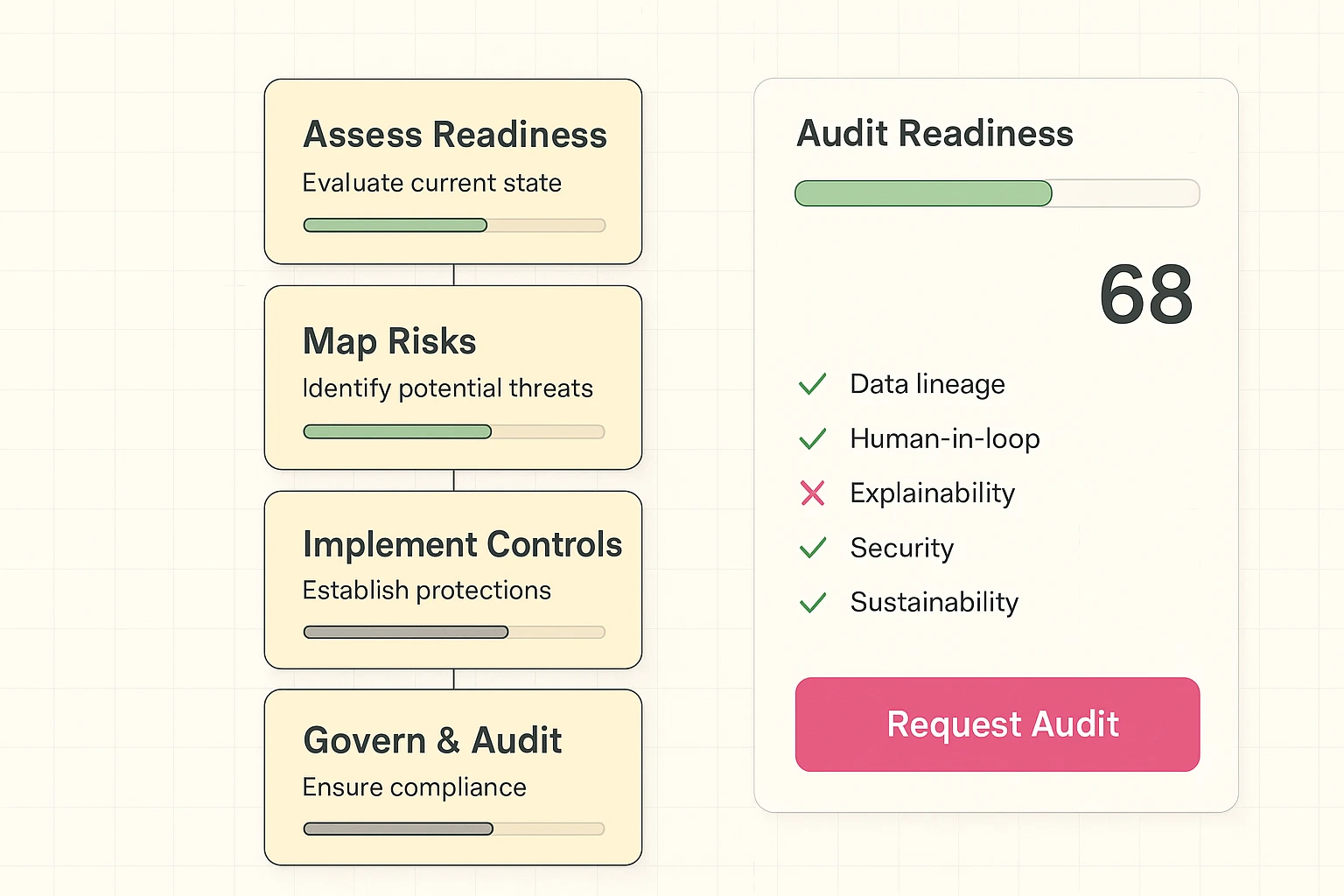
Our approach provides a tactical roadmap and checklist to prepare your teams for ethical AI audits, ensuring phased controls, readiness scoring, and clear next-step actions for deployment. This proactive stance isn't just about avoiding penalties; it’s about building a reputation as a responsible AI leader. It’s also about ensuring your organizational context is fully understood before embarking on an AI journey, which you can further explore in our guide on how to assess AI readiness and strategic planning.
Common Questions About Strategic AI Integration
Q: How does BenAI define an "AI-first enterprise?
An "AI-first enterprise" is an organization that fundamentally rethinks its processes, products, and services with AI at its core. It's not about merely adopting AI tools but embedding AI principles and capabilities throughout its strategic planning, operations, and cultural fabric, ensuring ethical considerations are central to innovation. This transforms the business model and enhances overall efficacy.
Q: What are the primary ethical concerns when integrating AI across various departments?
The main concerns revolve around fairness (preventing algorithmic bias), transparency (understanding AI's decision-making), accountability (assigning responsibility for AI-driven outcomes), and privacy (protecting sensitive data). These concerns manifest differently across departments, from bias in financial algorithms to data misuse in customer service chatbots, and even IP infringement with generative AI in product development.
Q: How does BenAI help mitigate these ethical risks?
We provide practical frameworks, such as department-specific "ethics sheets" and "impact assessment" templates. Our solutions focus on continuous lifecycle risk management, multi-level human oversight, and building systems with inherent auditability and traceability to ensure proactive risk identification and mitigation. This also involves guiding clients on AI governance to ensure business context is paramount.
Q: Can BenAI help integrate AI beyond marketing and recruiting?
Absolutely. While we offer specialized solutions in AI marketing and recruiting, our core expertise lies in custom AI implementations, training, and consulting for broader enterprise solutions. This includes strategic integration in operations, finance, product development, customer service, supply chain, R&D, and more. Our approach is tailored to your unique business needs and challenges.
Q: What kind of ROI can we expect from investing in ethical AI integration?
Research indicates significant ROI, including up to 30% higher AI-related operating profit and 22% improvement in customer satisfaction and retention. Ethical AI also leads to increased customer trust, enhanced operational efficiency, superior innovation, and stronger talent attraction and retention, transforming risk mitigation into a strategic differentiator.
Q: Is BenAI's approach suitable for both large enterprises and growing businesses?
Yes. For large enterprises, we offer custom AI implementations, comprehensive training, and strategic consulting to lead the way in AI adoption. For growing businesses, our structured courses and 1:1 coaching through the Ben AI Accelerator, along with free community resources, provide the guidance needed to build an AI-first business from the ground up.
Your AI-First Future Starts Now
The opportunity to transform your business into an "AI-first enterprise" is immense, but the journey demands a strategic, ethical, and technically sound approach. BenAI is your trusted partner to navigate this complexity, providing world-class AI implementations, training, and consulting tailored to your specific needs. From optimizing operations to building trust in finance, developing ethical products, and enhancing customer service, we empower you to harness the full potential of AI responsibly.
Don't just adopt AI; integrate it strategically and ethically to unlock unparalleled growth and competitive advantage. Your AI-first business truly starts here.
To discuss how BenAI can help your organization lead the way in ethical AI adoption across all business functions, we invite you to connect with our experts.
Join Our Growing AI Business Community
Get access to our AI Automations templates, 1:1 Tech support, 1:1 Solution Engineers, Step-by-step breakdowns and a community of forward-thinking business owners.

Latest Blogs
Explore our latest blog posts and insights.