The promise of AI for business growth is undeniable, yet many leaders evaluating solutions find themselves at a crossroads. They understand the "what" and the "how" of AI tools, but a nagging question often remains: how do we prepare our people for this transformation? It's a critical evaluation point, because for AI to truly thrive, the foundational shift isn't just technological—it's profoundly cultural.
The Human Algorithm: Why AI-First is Culture-First
You're likely deep in the process of assessing AI platforms, consultants, and integration strategies. You’ve seen the projections—McKinsey predicts 92% of companies will increase AI investments, yet only 1% are truly "mature" in their AI deployment. That’s a staggering gap, and the disconnect often lies not in the tech itself, but in the human element. The core challenge isn't just adopting AI; it's cultivating a company culture where AI can genuinely flourish. This is where your AI-first journey truly begins.
Beyond the Hype: Reimagining the Workplace in an AI Era
We’re past the initial buzz. Leaders worldwide recognize AI’s potential to automate tasks, reduce manual work, and create capacity without increasing headcount. But this isn't simply about plugging in a new tool. It’s about a fundamental reimagining of how work gets done, how decisions are made, and how people interact with technology.
The AI Paradox: High Investment, Low Maturity – Why Leaders are Missing the Mark
The data is clear: 92% of companies are increasing their AI investments, but only a tiny fraction—1%—have achieved maturity in their AI deployment (McKinsey, 2025). This paradox highlights a crucial oversight. While companies pour resources into technology, they often neglect the critical cultural groundwork essential for successful integration. The biggest barrier isn't employee readiness—it's leadership failing to steer fast enough (McKinsey, 2025). If your organization is hitting a wall with AI adoption despite significant investment, it's likely a cultural, not a technological, hurdle.
The 30% Rule of Augmentation: How AI Frees Humans for Higher-Value Work
Forget the fear of AI replacing jobs entirely. The true power lies in augmentation. NBER research in 2023 showed that AI tools increase productivity by 14% on average, with a remarkable 34% improvement for novice or low-skilled workers. AI isn't just about efficiency; it's about amplifying human potential. It takes on repetitive, time-consuming tasks, freeing your team to focus on creativity, strategy, and complex problem-solving. This isn't about replacing; it's about elevating.
The Unseen Challenge: Navigating Employee Fears and Fostering Acceptance
Despite the benefits, the human element of AI adoption often faces resistance. PwC data, while from 2019, remains highly relevant: 90% of C-suite executives believe their company considers employee needs when introducing new tech, yet only 53% of staff agree. This disconnect breeds skepticism. Employees aren't just concerned about job displacement; 56% feel technology can take them away from human interaction. Addressing these fears isn't a soft skill—it's a critical strategic imperative for successful AI integration.
Pillar 1: Building Foundational Trust – Psychological Safety in the Age of AI
Successful AI adoption begins with trust. Without it, even the most cutting-edge solutions will face an uphill battle. This means creating an environment where employees feel safe to engage with, learn about, and even critique AI without fear of reprisal.
Addressing the "Doomers" and "Gloomers": Empathetic Communication Strategies
McKinsey categorizes employee attitudes toward AI into "Zoomers" (optimists wanting fast deployment), "Bloomers" (optimists), "Gloomers" (skeptical), and "Doomers" (fundamentally negative). While only 4% are "Doomers," a significant 37% are "Gloomers." The good news? 80% of "Gloomers" and nearly 50% of "Doomers" are comfortable using Generative AI at work, showing high latent receptiveness (McKinsey, 2025). The key is empathetic communication. Instead of dismissing concerns, acknowledge them. Explain how AI will augment roles, not replace them, and provide clear pathways for skill development. This transparency is crucial.
The "Why" Before the "How": Transparently Communicating AI Strategy and Ethical Guardrails
Trust isn't built in a vacuum. It requires clear, consistent communication. Only a third of employees report receiving proper AI training, and less than 25% say their organization has a clear AI strategy or formal policies (Gallup, 2025). This lack of clarity fuels uncertainty. Develop a transparent AI strategy that outlines:
- The purpose: Why is your organization adopting AI?
- The benefits: How will it make work easier, more efficient, or more impactful for employees?
- The guardrails: What ethical principles will govern AI use?
- The support: What training and resources will be provided?
By addressing the "why" with honesty and ethical considerations, you reduce anxiety and foster buy-in. BenAI helps organizations define their enterprise AI vision, complete with KPIs, ensuring everyone understands the direction and metrics of success.
Creating "Safe-to-Fail" Environments: Promoting Experimentation Without Penalty
Innovation thrives on experimentation, but fear of failure can stifle it, especially with new technologies like AI. For employees to truly embrace AI, they must feel empowered to explore and experiment without fear of making mistakes. This means:
- Dedicated "Innovation Hours": Inspired by concepts like Google's 20% time, allocate specific time for employees to experiment with AI tools relevant to their roles.
- "Show and Tell" Sessions: Encourage employees to share their AI applications, both successes and learning opportunities.
- Leadership Modeling: Leaders openly discussing their own AI experiments and learnings normalizes the process.
This fosters a culture where mistakes are seen as learning opportunities, not failures, which is vital for continuous improvement in AI adoption.
Case Studies: Navigating Psychological Safety Right
Consider companies that have successfully integrated AI by prioritizing psychological safety. NBER research highlights how AI assistance not only improves customer sentiment but also increases employee retention and promotes worker learning, especially for less experienced staff (NBER, 2023). This demonstrates a positive feedback loop: when employees feel supported and see AI as a tool for growth, they become more engaged and productive.
Actionable Checklist: Build Foundational Trust & Psychological Safety
You can start fostering a culture of trust and psychological safety today with these actionable steps:
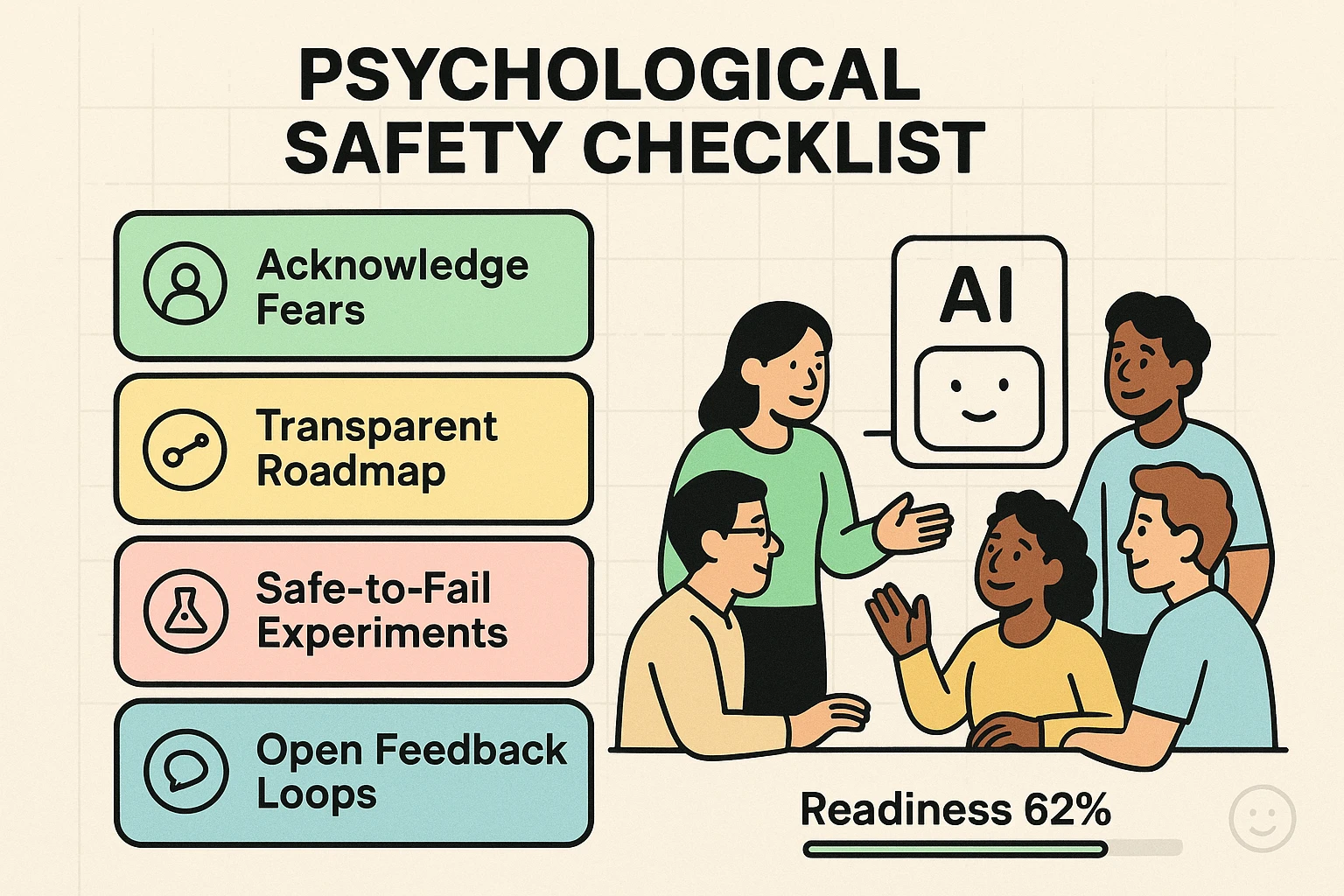 Actionable checklist to build psychological safety for AI adoption, with a readiness progress indicator to guide immediate next steps.
This checklist provides a practical framework that you can start implementing right away, transforming high-level strategic goals into daily actions.
Pillar 2: Empowering the AI-Fluent Workforce – Cultivating Data Literacy & a Growth Mindset
Beyond trust, an AI-first culture requires a workforce equipped with the right skills and the right attitude. This means moving beyond basic AI literacy to genuine AI fluency, fostering adaptability, and a relentless commitment to learning.
From Data Illiterate to Data-Driven: A Step-by-Step Guide to Organizational Data Literacy
AI runs on data. Therefore, an AI-first culture must be a data-literate one. This doesn't mean everyone needs to be a data scientist, but every employee should understand the basics of data collection, quality, interpretation, and ethical use. This includes:
- Foundational Training: Workshops on basic data concepts, common metrics, and the importance of data quality.
- Role-Specific Application: Tailored sessions demonstrating how AI uses data in their specific roles (e.g., how AI analyzes customer data for sales, or optimizes a LinkedIn campaign for marketing).
- Data Governance & Ethics: Education on data privacy, bias prevention, and responsible data handling.
- Hands-on Practice: Providing sandbox environments where employees can interact with AI dashboards and interpret simple data visualizations.
Measuring Mindset: Practical Tools and Metrics for Nurturing AI Adaptability
A growth mindset is the belief that abilities can be developed through dedication and hard work. In the rapidly evolving AI landscape, this mindset is non-negotiable. It reframes challenges as opportunities for learning and adapting. To foster and measure this:
- Self-Assessment Tools: Regular anonymous surveys measuring employees' openness to new technologies, resilience in learning, and belief in their ability to acquire new skills.
- Training Completion & Application Rates: Track participation in AI upskilling courses and the subsequent application of those skills in projects.
- Innovation Challenges: Organize internal hackathons or problem-solving initiatives using AI, rewarding participation and creative application.
By proactively addressing and measuring mindset shifts, you turn potential resistance into enthusiastic engagement.
Upskilling for Superagency: Tailored Training Programs for Every Role
With 72% of roles likely to be significantly augmented by AI (BCG, 2025), comprehensive and tailored training is paramount. McKinsey reports that 47% of C-suite leaders believe AI development is too slow due to talent skill gaps (2025). This isn't just about general AI courses; it’s about providing relevant, practical training that empowers employees to leverage AI in their specific contexts. BenAI specializes in custom AI implementations and training for enterprises, ensuring that staff develop practical skills.
Incentivizing the Learning Journey: Beyond Monetary Rewards
While financial incentives can play a role, fostering an AI-first culture requires more than just bonuses. Consider:
- Career Pathing: Clearly connect AI skill development to career advancement opportunities within the organization.
- Recognition Programs: Acknowledge and celebrate employees who successfully adopt and innovate with AI.
- Internal Mentorship: Pair AI-savvy employees with those learning, creating a supportive knowledge-sharing environment.
- Access to Cutting-Edge Tools: Provide access to advanced AI tools and resources as a perk for continuous learning.
This creates a self-sustaining cycle of learning and innovation, where employees are intrinsically motivated to engage with AI.
Compare Workforce Readiness Metrics
To effectively track and improve AI fluency and growth mindset, it's crucial to have clear metrics. This includes measuring data literacy, AI adoption rates, and sentiment towards new technologies.
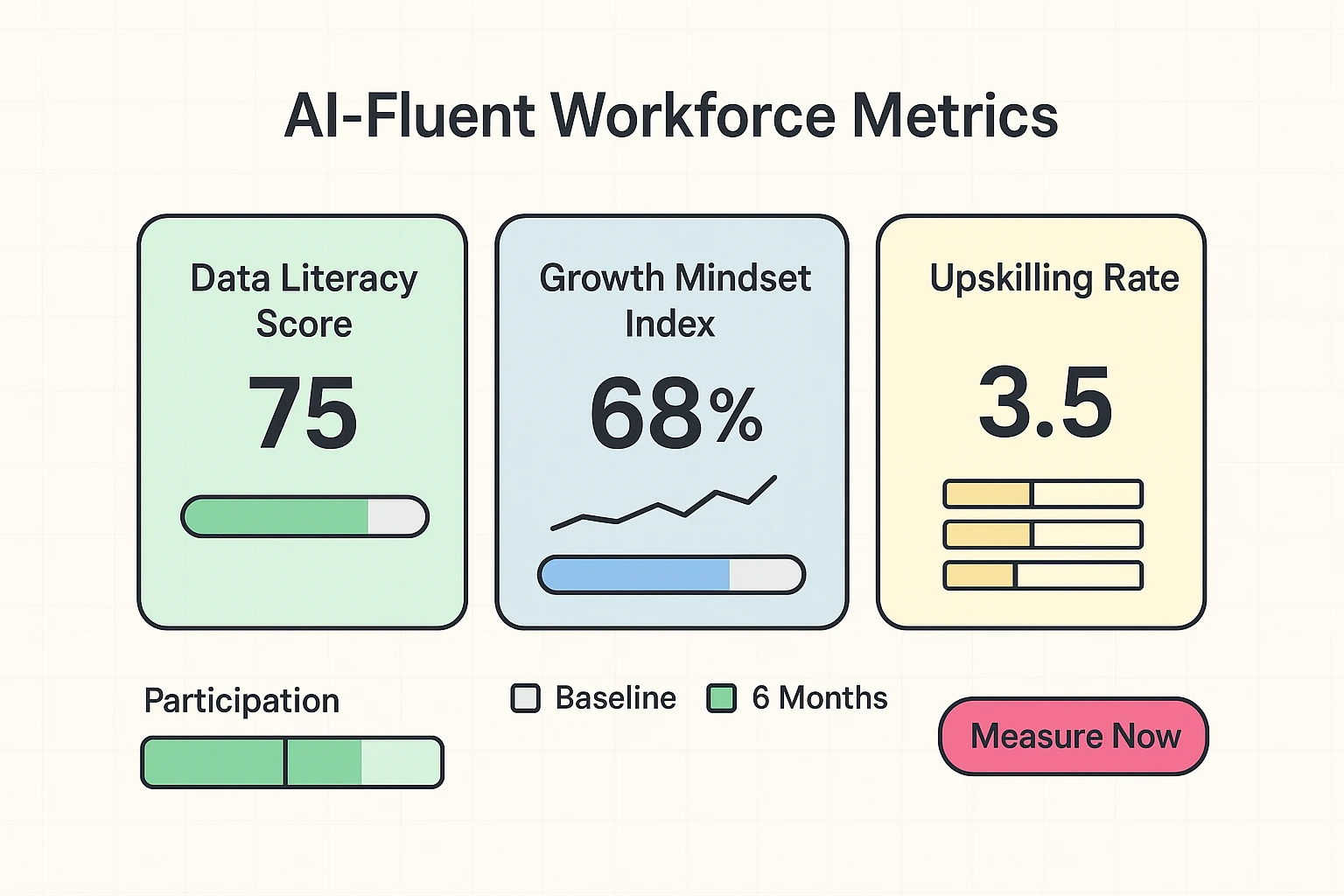 Compare workforce readiness with three clear metrics and progress indicators to prioritize training and interventions.
This visual aid helps prioritize where to focus your training efforts and resources, turning abstract concepts into measurable progress.
Pillar 3: Leading with Foresight – The Role of Leadership in Cultural Transformation
Ultimately, cultural transformation is a top-down initiative. Leaders aren't just sponsoring AI initiatives; they're actively shaping the environment in which AI will operate. Their choices—from vision setting to resource allocation—will determine the success or failure of an AI-first transformation.
From Pilot to Maturity: Overcoming the 1% Barrier
The statistic persists: only 1% of companies are mature in AI deployment (McKinsey, 2025). This isn't a tech problem; it's a leadership challenge. Scaling AI from pilots to enterprise-wide integration requires leaders to:
- Champion Change: Actively articulate the vision and benefits of AI, showing genuine enthusiasm.
- Model Behavior: Leaders should use AI tools themselves and share their experiences.
- Remove Roadblocks: Proactively identify and eliminate bureaucratic or organizational barriers to AI adoption.
- Allocate Resources: Ensure adequate budget, time, and personnel are dedicated to AI training and integration.
BenAI provides expert AI consulting to help leaders navigate this journey, ensuring strategic alignment and practical execution.
Millennials as AI Champions: Empowering the Next Generation of AI Leaders
Don't overlook the power of internal champions. Engage diverse groups of employees in early AI tool development; currently, less than half of C-suite leaders (48%) involve non-technical employees in ideation and requirement gathering (McKinsey, 2025). Empowering these advocates can create organic adoption. McKinsey’s "Superagency" report highlights that "Zoomers" (those eager for fast AI deployment) are most likely to be millennials and Gen Z. Actively engage these tech-native employees, turning them into internal AI evangelists and mentors. They can bridge the gap between leadership vision and ground-level adoption.
Redefining Value Cases: Measuring Human Outcomes, Not Just Productivity
Deloitte argues that new technology investments, including AI, demand a shift beyond traditional ROI metrics. While "enabling a workforce to do more, faster" and "decreasing cost" are important, the focus should also be on "enabling workers and machines to create value together," "creating new types of value," and "improving worker well-being" (Deloitte, 2025). This means actively incorporating metrics related to:
- Innovation Output: Number of new ideas, products, or processes developed with AI assistance.
- Employee Engagement & Satisfaction: Surveys measuring how AI impacts job satisfaction and reduced burnout.
- Skill Development: Tracking the acquisition of new AI-related skills across the workforce.
- Quality of Output: Measuring improvements in accuracy, creativity, or decision-making.
By focusing on these "human outcomes," leaders demonstrate a commitment to employees, reinforcing trust and showing that AI is truly a tool for augmentation.
Building the "AI Listening Tour": Incorporating Employee Feedback into AI Strategy
PwC’s research highlighted a significant disconnect: 90% of C-suite executives believe their company considers employee needs when introducing new tech, but only 53% of staff agree. This gap is a fertile ground for resistance. Leaders must actively seek, listen to, and act on employee feedback regarding AI. This can include:
- Regular Pulse Surveys: Short, frequent surveys to gauge sentiment and identify pain points.
- Focus Groups: Dedicated sessions for employees to share their experiences and suggestions.
- Direct Feedback Channels: Anonymous suggestion boxes or dedicated AI feedback portals.
- Cross-Functional AI Committees: Involve employees from various departments in shaping AI strategy, making them part of the solution.
This "AI Listening Tour" ensures that AI strategies are grounded in reality and co-created, leading to greater acceptance and more effective implementation.
Operational Framework for Safe Experimentation
For AI to become truly embedded, teams need a concrete framework for safe experimentation. This ensures that ideas can be tested, refined, and scaled effectively.
 Operational pipeline for safe experimentation, showing how to move ideas from ideation to scalable practice with risk/impact context.
This framework provides a structured approach for teams to explore new AI applications, managing both risk and potential impact effectively. BenAI helps build advanced systems like AI agent ecosystems that support such experimentation and scalability.
Your Roadmap to a Thriving AI-First Culture
Cultivating an AI-first company culture is a multi-faceted journey that combines advanced technology with a deep understanding of human psychology and organizational dynamics. It demands empathetic leadership, a commitment to continuous learning, and robust communication. By building foundational trust, empowering your workforce, and leading with foresight, you can move your organization beyond mere AI adoption to becoming a truly AI-first entity. This isn't just about efficiency; it's about building a Future of Work that benefits everyone.
We understand that navigating this complex landscape can be challenging. That's why BenAI specializes in providing tailored AI growth systems, custom implementations, and comprehensive training to help your business transform into an AI-first entity. Your AI-first business truly starts here.
Leadership Decision Aid: Strategic Levers for Cultural Transformation
Making strategic decisions about AI adoption requires understanding the impact of various leadership levers. This comparison helps in prioritizing efforts for maximum cultural and operational impact.
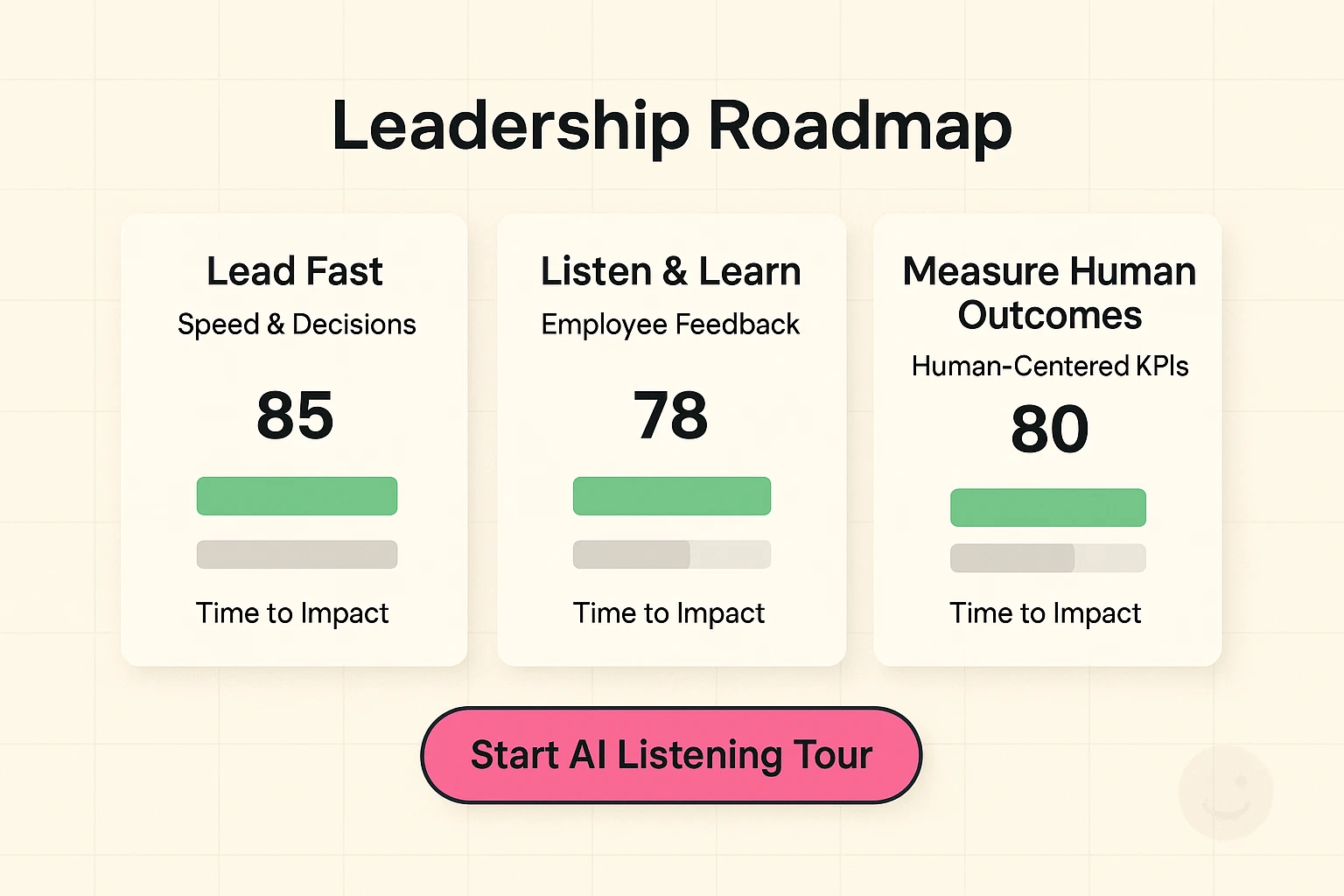 Compare leadership levers side-by-side to decide where to focus effort for cultural transformation and measurable results.
This decision aid helps leadership visualize how different strategic investments contribute to cultural transformation, ensuring a balanced and effective approach.
Frequently Asked Questions About Cultivating an AI-First Culture
Q1: What does "AI-first culture"
really mean?An "AI-first culture" means that an organization consciously integrates AI into its core processes, decision-making, and employee skill sets. It's not just about using AI tools, but about fostering a mindset where AI is seen as an augmentation to human capabilities, driving innovation, efficiency, and growth. It emphasizes continuous learning, data literacy, and ethical considerations.
Q2: How do we measure if our company culture is "AI-first"?
Measuring an AI-first culture goes beyond tool adoption rates. Key metrics include:
- Employee AI Sentiment: Surveys on comfort, perceived value, and willingness to experiment with AI (addressing "Gloomers" and "Doomers").
- Data Literacy Levels: Assessments of employees' understanding and application of data principles in their roles.
- AI Skill Development: Tracking participation in training programs and certification rates.
- Innovation Metrics: Number of AI-driven projects initiated, completed, and scaled, and the impact on business outcomes.
- Ethical AI Adherence: Employee understanding and application of ethical AI guidelines.
Q3: What is the biggest challenge in shifting to an AI-first culture?
The biggest challenge isn't the technology itself, but managing human resistance and the lack of a clear, empathetic strategy. As McKinsey notes, the primary barrier to scaling AI is often leadership not steering fast enough, rather than employee readiness. Additionally, a disconnect between C-suite perception of tech needs and actual employee experience (PwC) can breed distrust. Transparent communication and psychological safety are crucial.
Q4: How can we overcome employee fear of job displacement due to AI?
Overcoming job displacement fears requires empathetic communication, not just rational arguments.
- Focus on Augmentation: Emphasize how AI will enhance roles, not eliminate them, freeing up time for higher-value, more creative work.
- Skill Development Pathways: Provide clear opportunities for employees to upskill and reskill, demonstrating commitment to their career growth.
- Success Stories: Share internal examples of how AI has made colleagues' jobs more rewarding or efficient.
- Transparency: Be honest about evolving roles and provide support for transitions where necessary.
Q5: Is data literacy important for non-technical employees too?
Absolutely. While non-technical employees may not process complex data, they need to understand data's importance, how it's collected, its quality issues, and ethical uses. This understanding fosters better collaboration with AI systems, improves decision-making, and ensures responsible data handling across the organization. You can explore how BenAI helps with AI data management automation to streamline these processes.
Q6: How long does it take to cultivate an AI-first culture?
Cultural transformation is a continuous journey, not a one-time event. It can take several months to years, depending on the organization's size, existing culture, leadership commitment, and investment in training and infrastructure. Consistent effort in communication, education, and fostering psychological safety will accelerate the process.
This content serves as a foundational resource for decision-makers grappling with the cultural complexities of AI. If you're ready to move beyond theoretical discussions and implement practical strategies for cultivating a thriving AI-first culture, BenAI is here to help. We provide the expertise, tools, and bespoke solutions to guide your organization through this transformative journey. Contact us today to discuss how we can tailor a program for your unique needs.
Join Our Growing AI Business Community
Get access to our AI Automations templates, 1:1 Tech support, 1:1 Solution Engineers, Step-by-step breakdowns and a community of forward-thinking business owners.

Latest Blogs
Explore our latest blog posts and insights.