You're evaluating what it truly means to become an "AI-first" company, not just in technology, but in people and processes. The challenge isn’t just adopting AI tools; it’s about fundamentally reshaping your organization and talent strategies to thrive in an AI-driven world. This isn't a minor adjustment, it's a strategic imperative that transforms your competitive landscape.
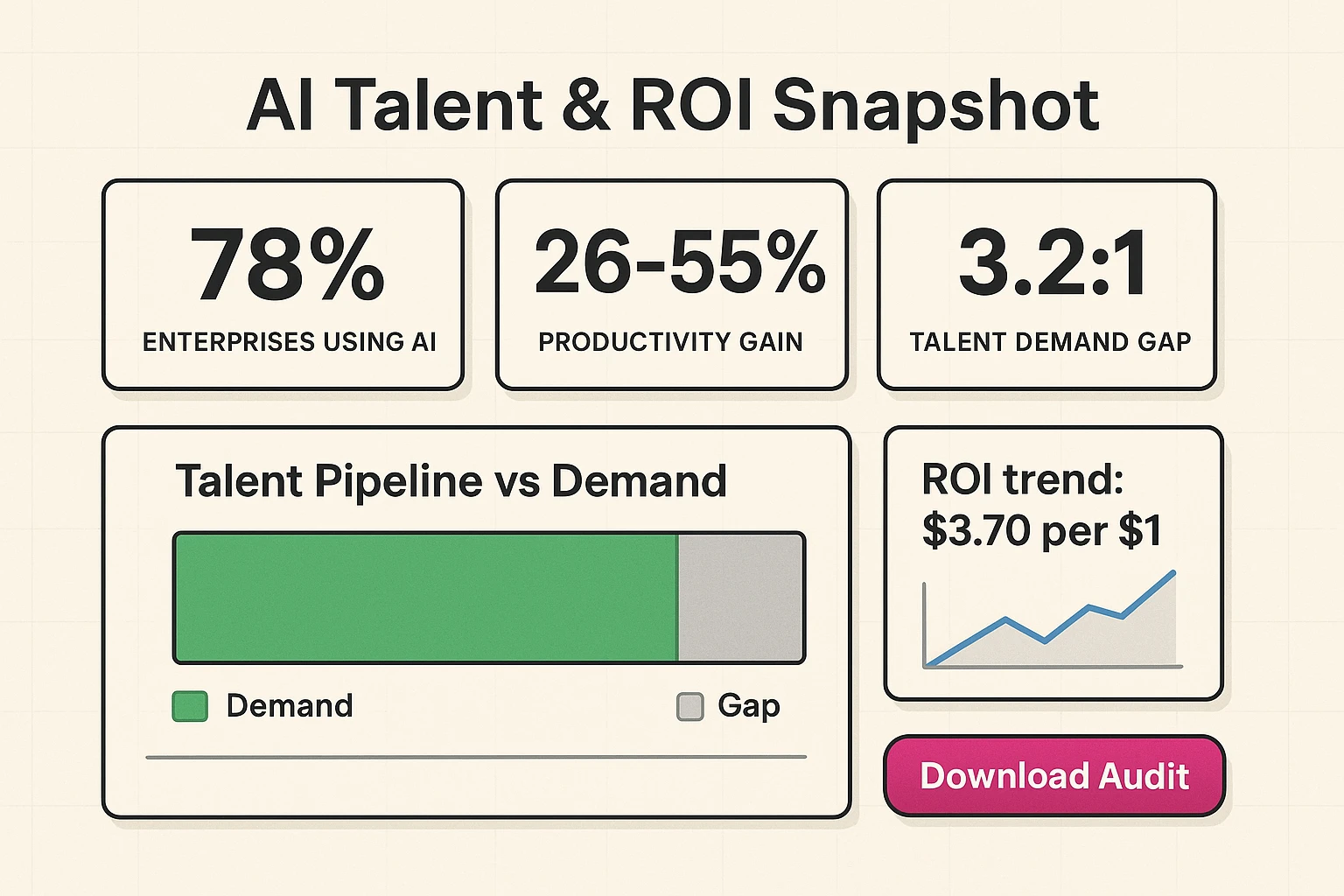
The shift is monumental. Nearly 78% of enterprises now use AI in at least one business function, with 71% regularly using generative AI. This widespread adoption isn't just about efficiency; it's driving significant productivity gains—between 26-55%—and an impressive ROI of roughly $3.70 for every dollar invested. Yet, even with these compelling numbers, up to 85% of AI projects still fall short. Why? Often, it’s not the tech; it’s the lack of an aligned organizational structure and the right talent strategy.
This guide is for leaders like you, actively comparing solutions to build a future-proof, AI-first enterprise. We’ll cut through the noise, providing a prescriptive framework to address the critical talent gaps, structural shifts, and cultural transformations necessary for sustained AI success.
The Imperative: Why Go AI-First Now?
The question isn't if you'll adopt AI, but how comprehensively and strategically. The window for simply dabbling in AI is closing. The market is rapidly bifurcating into those led by AI and those left behind by it.
Consider the data: AI's impact on productivity and ROI is undeniable, yet the high failure rate for implementations signals a deeper, systemic issue beyond the technology itself—human readiness and organizational design. Becoming AI-first means integrating AI not just as a tool, but as a core orchestrator of your operations, decisions, and strategic direction. It's about designing an organization where human and AI capabilities amplify each other, creating synergistic value that competitors operating within traditional structures simply can't match.
Decoding the AI Talent Equation: Gaps, Demand, and New Roles
The current AI talent landscape is a paradox of intense demand and severe scarcity. Globally, AI talent demand outstrips supply by a staggering 3.2:1, with over 1.6 million open positions and only 518,000 qualified candidates. Projections by Bain & Company suggest that by 2027, one in two AI jobs in the US could remain unfilled. This isn't just a skills gap; it's a strategic chasm.

Key Data & Statistics:
- AI Adoption: 78% of enterprises use AI in at least one business function; 71% use generative AI regularly.
- Productivity & ROI: AI has driven 26-55% productivity gains, with an ROI of ~$3.70 per dollar invested.
- AI Talent Gap: AI talent demand exceeds supply by 3.2:1 globally. 1 in 2 AI jobs could be left unfilled by 2027 in the US.
- Skill Gaps: 94% of leaders face shortages in AI-critical roles, with about one-third reporting gaps of 40-60%. 46% of leaders cite skill gaps as a major barrier to AI adoption.
- AI Fluency: Demand for AI fluency—the ability to use and manage AI tools—has grown sevenfold in two years, faster than any other skill.
The critical insight here is that 46% of leaders cite skill gaps as a major barrier to AI adoption. This means addressing talent isn't secondary to AI strategy; it is the AI strategy.
The Rise of New AI Roles
Beyond traditional data scientists and machine learning engineers, a new class of roles is emerging, signaling the maturity of AI integration:
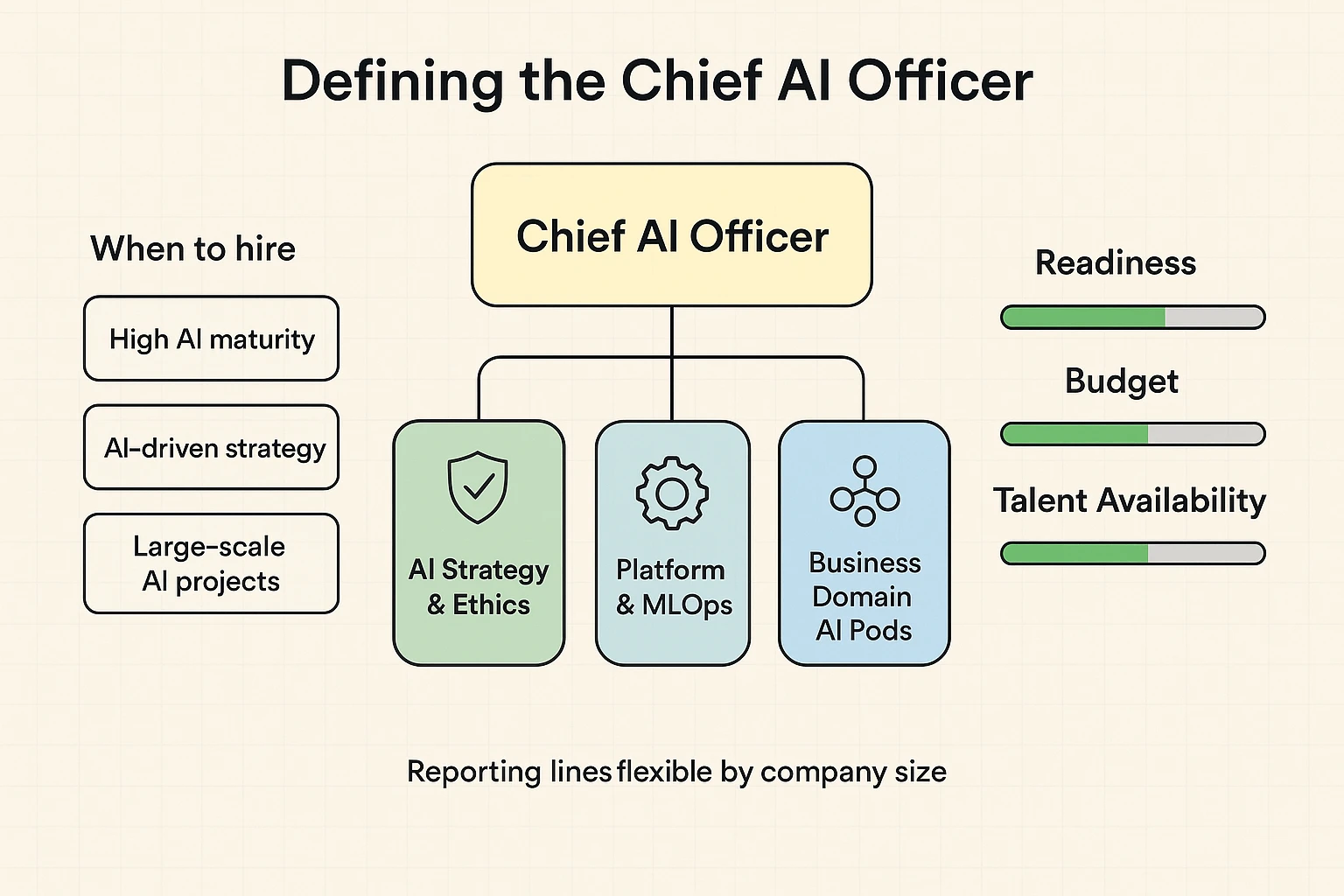
- Chief AI Officer (CAIO): This executive-level position, now present in 11% of mid-to-large companies and actively recruited for by 21%, is pivotal. The CAIO defines and implements the enterprise AI strategy, ensures ethical AI practices, and drives AI innovation across all departments. Their reporting structure often puts them side-by-side with CIOs or CTOs, emphasizing AI's strategic importance.
- Prompt Engineers: As AI agents become more sophisticated, the skill of crafting precise and effective prompts to guide their output is invaluable. This role bridges human understanding with AI capabilities, as detailed in our guide to Mastering Prompt Engineering for AI Agents and Automation Systems.
- AI Ethicists: With AI's growing influence, specialists ensuring fair, transparent, and unbiased AI systems are crucial, particularly in areas like talent acquisition where bias can have significant repercussions.
- AI UX Designers: Focused on creating intuitive interfaces for human-AI interaction, ensuring that AI tools are not just powerful but also user-friendly and integrated seamlessly into workflows.
- AI Fluency for All: The demand for "AI fluency"—the ability to use and manage AI tools—has grown sevenfold in just two years. This isn't about everyone becoming an AI developer; it's about empowering every employee to leverage AI in their daily tasks, transforming their roles and making them more productive.
Architecting for Agility: Organizational Structures for an AI-First World
Traditional hierarchical structures stifle AI adoption. They're too slow, too rigid, and too siloed to accommodate the rapid, iterative nature of AI development and deployment. AI-first organizations demand fluidity.
Early evidence suggests AI-first organizations are "flattening structures by eliminating over half of middle management roles," with some examples showing "up to 85% reduction in headcount" through automation and optimization. This isn't about job elimination; it's about role transformation and resource reallocation towards higher-value, strategic work.
Transitioning to Modular, Cross-Functional AI Teams
The core of an AI-first structure is the cross-functional AI team, often styled as "pods," "squads," or "centers of excellence." These teams bring together diverse expertise—AI engineers, domain specialists, data scientists, and business leaders—to collaborate on specific AI initiatives. This approach ensures:
- Faster Decision-Making: Proximity of expertise reduces bottlenecks.
- Holistic Problem Solving: Different perspectives lead to more robust AI solutions.
- Seamless Integration: AI is built with direct business context in mind, ensuring it solves real-world problems.
These teams are complemented by widespread integration of AI agent ecosystems, where AI automates routine tasks, frees human capacity, and creates more time for strategic thought.
The Evolution of Leadership
In an AI-first organization, leadership shifts from command-and-control to enablement and oversight. Leaders become orchestrators of human-AI collaboration, fostering a culture of continuous learning, experimentation, and ethical AI use. Their role is to set the vision, remove roadblocks, and empower autonomous teams, trusting in their expertise amplified by AI.
Strategic Talent Acquisition for AI-First Companies
Hiring for an AI-first company demands a rethink of your talent acquisition strategy. You’re not just filling roles; you’re building a new kind of workforce.
Beyond Traditional Recruiting
- Leverage AI-Powered Tools (Ethically): While AI can speed up resume screening and candidate matching, it's crucial to implement these tools with a keen eye on potential biases. Ensure your AI talent tools are ethical and transparent to avoid perpetuating or amplifying existing human biases.
- Employer Branding for AI Talent: Top AI talent is in high demand. Your employer brand must reflect a forward-thinking, innovation-driven culture that values continuous learning and offers challenging AI projects. Showcase your commitment to cutting-edge AI, ethical practices, and a collaborative environment.
- Diverse AI Workforce: Actively mitigate bias in hiring. A diverse team brings diverse perspectives, which is crucial for building robust and fair AI systems. This isn’t just good ethics; it’s good business.
Cultivating Internal AI Power: Upskilling, Reskilling, and Retention
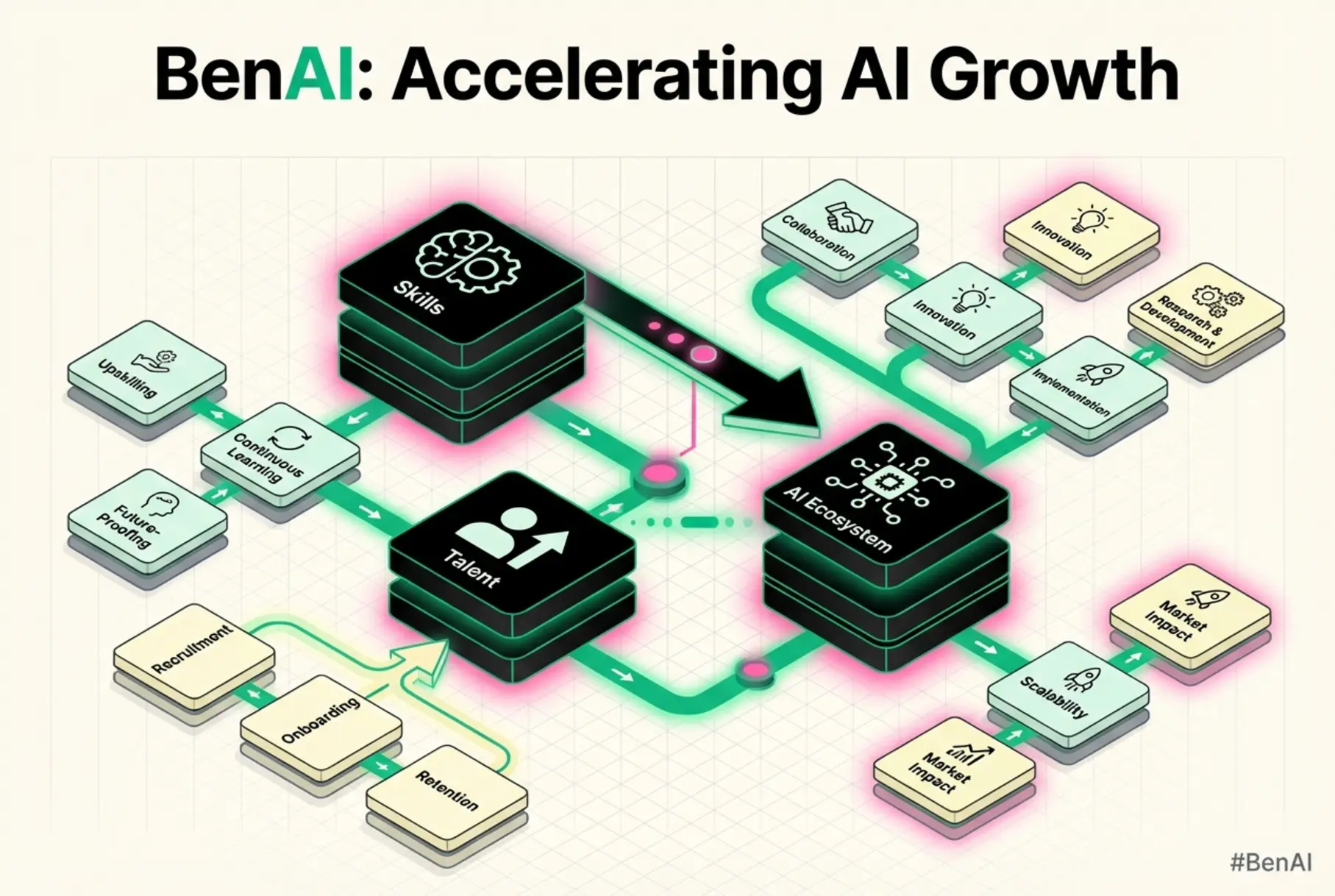
Given the sheer scale of the AI talent gap, relying solely on external hiring is unsustainable. Therefore, internal capability building is paramount. More than 94% of leaders report shortages in AI-critical roles, with around a third facing gaps of 40-60%. Upskilling your existing workforce is not optional; it’s a strategic imperative.
Building an Internal AI Champions Network
Identify, train, and empower internal advocates. These "AI champions" become your lieutenants in driving adoption, sharing knowledge, and demonstrating practical AI applications across departments. They can help address resistance by showing the practical benefits and alleviating fears.
Designing Effective AI Literacy Programs
Every employee needs a baseline understanding of AI, even those in non-technical roles. This "AI fluency" is critical. Implement tiered training programs:
- General AI Literacy: For all employees, focusing on what AI is, its potential, and how it will impact their roles.
- Functional AI Upskilling: Tailored training for specific departments (e.g., AI Marketing Solutions, talent management using AI for recruiters) on how to leverage specific AI tools and techniques relevant to their work.
- Specialized Reskilling: For employees whose roles might be significantly automated, offering intensive programs to transition them into new, AI-enabled positions.
Retaining High-Performing AI Talent
Once nurtured, AI talent is a hot commodity. Retention strategies must include:
- Continuous Learning: Investment in ongoing education and access to cutting-edge tools.
- Challenging Projects: Opportunities to work on high-impact AI initiatives that offer growth and learning.
- Clear Career Paths: Defined trajectories for advancement within AI roles.
- Competitive Compensation: AI expertise commands premium salaries, and your compensation structure must reflect this.
Fostering an AI-First Culture: Overcoming Resistance & Building Trust
The human element is often the biggest hurdle. Challenges in establishing an AI-first culture include "resistance to change, lack of leadership buy-in, cultural fears and distrust, skills gaps," and "the gap between AI capability and human readiness."
Addressing Fears of Job Displacement
AI's potential for automation often triggers anxiety about job losses. Leaders must proactively communicate a vision where AI augments human capabilities, automates drudgery, and creates capacity for more creative, strategic work. This involves:
- Transparency: Clearly explain which tasks AI will handle and why.
- Upskilling Opportunities: Offer concrete pathways for employees to acquire new, highly valuable AI skills.
- Role Redefinition: Help employees understand how their roles will evolve, not disappear.
Ethical AI Principles and Governance
Integrate ethical AI principles directly into your talent processes. This includes governance frameworks that address bias, privacy, and accountability, especially when using AI in sensitive areas like recruitment and performance management. A culture of ethical AI isn't just about compliance; it's about building trust within your organization and with your customers.

Creating a Culture of Experimentation
Encourage a mindset where AI is seen as an experimental partner. Not every AI initiative will succeed, and that's okay. What matters is the learning. Create safe spaces for teams to experiment with AI tools, learn from failures, and iteratively improve. This continuous learning with AI, coupled with the ability to manage AI data management automation, is what ultimately drives lasting innovation.
The Road Ahead: Measuring Success and Adapting to the Future of AI
Becoming an AI-first company is not a destination but a continuous journey. You need clear metrics to track progress and a flexible strategy to adapt to the rapidly evolving AI landscape.
Key KPIs for AI-First Talent and Organization:
- AI Skill Adoption Rate: Track the percentage of employees completing AI literacy and upskilling programs.
- AI Project Success Rate: Evaluate the ROI and impact of AI initiatives.
- Employee AI Fluency Scores: Develop assessments for practical AI tool usage.
- Time-to-Fill AI Roles: Monitor your efficiency in acquiring critical AI talent.
- Employee Engagement & Satisfaction: Specifically measure sentiment around AI adoption and its impact on roles.
By regularly assessing these metrics and monitoring emerging AI trends, you ensure your organizational structure and talent strategy remain agile and aligned with your AI-first vision.
Frequently Asked Questions
Q1: What is the most critical first step to becoming an AI-first company?
The most critical first step is a strategic assessment of your current organizational capabilities and identifying key AI opportunities. This informs the design of your AI strategy and the subsequent talent and structural changes. This often involves a deep dive into existing processes to spot areas ripe for AI automation.
Q2: How can we address the AI talent shortage effectively without breaking the bank?
Focus on a multi-pronged approach: upskill existing employees through targeted training and internal AI champions networks, redefine roles to incorporate AI fluency, and develop strong employer branding to attract specialists. Consider using remote talent pools and engaging with specialized AI consulting firms for high-level guidance and implementation.
Q3: What is "AI fluency" and why is it important for all employees?
AI fluency is the ability to understand, use, and manage AI tools effectively in one's daily work. It's crucial because AI will touch almost every job function. Empowering all employees with AI fluency transforms them into more efficient and strategic contributors, freeing them from repetitive tasks and allowing them to focus on higher-value activities.
Q4: How does BenAI help companies with their organizational and talent AI strategies?
BenAI provides tailored AI growth systems, custom implementations, and strategic consulting for businesses looking to become "AI-first." We work with you to analyze your current structure, identify ideal AI roles, develop upskilling programs, and implement integrated AI solutions—from AI Marketing Solutions to broader enterprise solutions—ensuring your people and processes are aligned for AI success. Our expertise spans building robust AI agent ecosystems that automate tasks and integrate seamlessly.
Q5: Will AI-first transformation lead to mass layoffs?
While AI will undoubtedly automate many tasks, the goal of an AI-first transformation is typically not mass layoffs but rather role redefinition and capacity creation. AI handles the repetitive, lower-value work, allowing existing employees to pivot to more strategic, creative, and human-centric tasks. Companies that address fears transparently and invest in reskilling see higher retention and a more engaged workforce.
Your AI-First Journey Starts Here
Navigating the complexities of organizational change and talent development in an AI-first era requires a trusted partner. BenAI specializes in transforming businesses into AI-first entities, offering the expertise, systems, and training needed to succeed. From custom AI implementations and strategic consulting for enterprises to specific solutions for marketing and recruiting, we guide you through every step.
Don't just adapt to the AI revolution—lead it. Connect with BenAI today to discuss how we can help you build an organizational structure and talent strategy that’s truly AI-first.
Join Our Growing AI Business Community
Get access to our AI Automations templates, 1:1 Tech support, 1:1 Solution Engineers, Step-by-step breakdowns and a community of forward-thinking business owners.

Latest Blogs
Explore our latest blog posts and insights.