You're likely evaluating how artificial intelligence can truly impact your business—beyond just customer service. The conversation around AI often starts and ends with external-facing chatbots, but for decision-makers like you, the real strategic advantage lies in transforming internal operations. This isn't about replacing human interaction; it's about empowering your teams, streamlining workflows, and unlocking efficiencies that directly impact your bottom line.
Forget the rudimentary chatbots of the past. Today's conversational AI and virtual assistants are sophisticated, autonomous agents capable of performing complex tasks with minimal human intervention. They represent a paradigm shift, moving AI from reactive tools to proactive, integral operational partners embedded in core business processes like HR onboarding, finance automation, and IT ticket resolution (Binary Semantics).
So, how do you harness this power? This guide will walk you through the strategic applications, implementation best practices, and critical considerations for integrating conversational AI into your enterprise, ensuring you make an informed decision that drives tangible value.
Why Internal Conversational AI Matters: Unlocking Hidden Efficiencies & Employee Potential
The shift from simple chatbots to advanced conversational AI and virtual assistants is critical because it directly addresses the inefficiencies that plague modern enterprises. Internal users expect contextual understanding, personalization, and task completion from their AI tools (Twilio, arXiv, PMC). When implemented strategically, internal conversational AI delivers significant benefits:
- Boosted Employee Productivity: By automating repetitive queries and tasks, employees can focus on higher-value work. For instance, Palo Alto Networks saved 351,000 employee productivity hours with an internal AI assistant (Moveworks).
- Reduced Operational Costs: Automating internal support functions, such as IT and HR, can significantly cut down the resources spent on manual responses, freeing up staff and budgets.
- Faster Information Retrieval: Employees spend less time searching for answers, accessing critical knowledge instantly.
- Streamlined Workflows: From onboarding to procurement, AI agents optimize processes, reducing bottlenecks and accelerating completions.
- Improved Employee Experience: Providing instant, accurate support enhances job satisfaction and reduces frustration, contributing to a more engaged workforce.
Core Internal Applications of Conversational AI
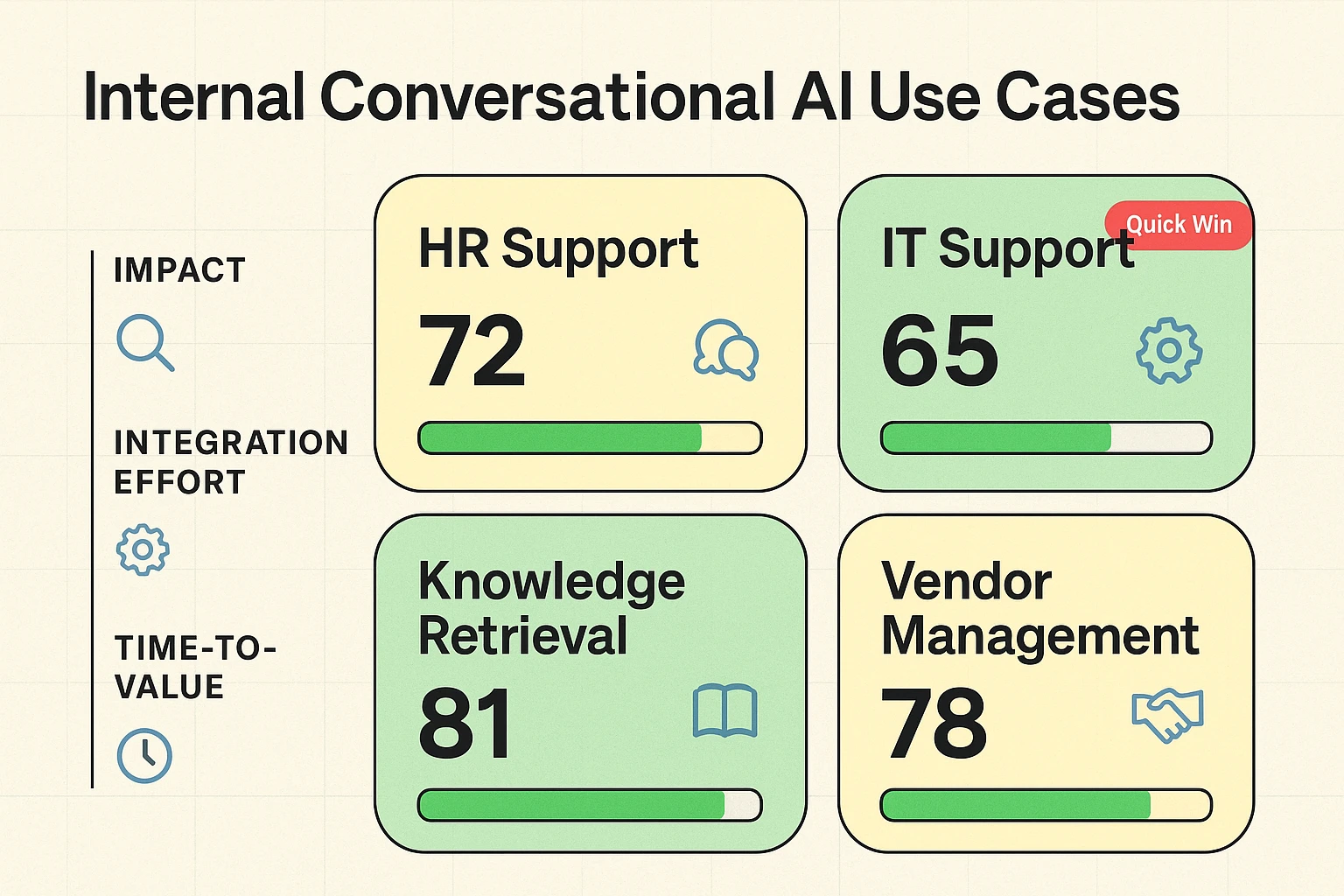
The true power of conversational AI emerges when integrated across various internal functions. Here are the key areas where it can turn friction into fluidity:
Employee Support (HR & IT)
This is often one of the first and most impactful areas for internal AI deployment. Imagine an AI assistant that can:
- Automate HR Inquiries: Instantly answer FAQs about company policies, benefits, payroll, and leave requests. It can guide new hires through the onboarding process, providing personalized information and reducing the load on HR teams.
- Resolve IT Tickets: Provide immediate assistance for common IT issues like password resets, network connectivity troubleshooting, or software installation guides, often resolving issues without human intervention. This significantly reduces ticket volume and resolution times.
Internal Knowledge Management
Enterprises are rich with information, but accessing it can be a nightmare. Conversational AI serves as an intelligent layer over your existing knowledge bases:
- Intelligent Knowledge Base Retrieval: Employees can ask questions in natural language and receive precise, relevant information from internal documents, wikis, and databases, cutting down research time.
- Document Q&A: An AI can analyze and summarize lengthy internal reports, legal documents, or project specifications, providing quick answers to specific questions without extensive reading. This ensures everyone has access to the most up-to-date and accurate information.
Vendor Management & Procurement
Streamlining interactions with external partners and internal purchasing processes:
- Automated Vendor Communication: Manage routine queries regarding contract terms, payment status, or delivery schedules. AI agents can send automated updates and reminders, freeing up procurement specialists.
- Procurement Workflow Optimization: Guide employees through purchasing requests, approve standard orders, and track order statuses, ensuring compliance and efficiency.
Internal Communication & Collaboration
Enhancing how your teams communicate and work together:
- Facilitating Cross-Functional Teams: Provide quick access to project details, team member contacts, and shared resources.
- Meeting Summaries & Scheduling: AI can transcribe meetings, summarize key decisions and actions, and even assist with scheduling future events.
- Personalized News Feeds: Tailor internal announcements and company news to individual roles and interests, ensuring relevant information reaches the right people.
Designing for Success: Best Practices for Internal CAI
Deploying internal conversational AI isn't just about technology; it's about thoughtful design and strategic implementation. Getting this right ensures high adoption and maximum ROI.
User-Centric Design with Purpose
Before building, deeply understand your internal users' needs and pain points. Define a clear purpose for each AI agent to avoid the pitfalls of early chatbots. Guided interactions, with buttons, quick replies, and clear prompts, enhance usability. Your AI assistant should always have a clear scope and purpose.
Contextual Understanding & Personalization
Modern AI goes beyond simple keywords. It maintains conversation history, understands user roles, and adapts interactions based on past preferences. This personalization ensures more relevant and efficient responses. Consider how your AI can understand and adapt to the unique "lingo" of your organization, a key step in contextual refinement (BenAI).
Robust NLU & Multi-Turn Dialogue
Effective internal AI seamlessly handles varied phrasing, complex queries, and follow-up questions. Natural Language Understanding (NLU) allows the AI to grasp intent, even with nuanced or informal language. The ability to manage multi-turn dialogues is crucial for resolving complex issues without human intervention.
Seamless Integration with Enterprise Systems
Your AI won't operate in a vacuum. For maximum effectiveness, it must integrate deeply with your existing infrastructure—HRIS, ERP, CRM, and collaboration tools like Slack or Teams. This integration allows AI agents to pull and push information, automating tasks end-to-end. Think about integrating with sales automation systems you might be using (BenAI).
Trust & Transparency
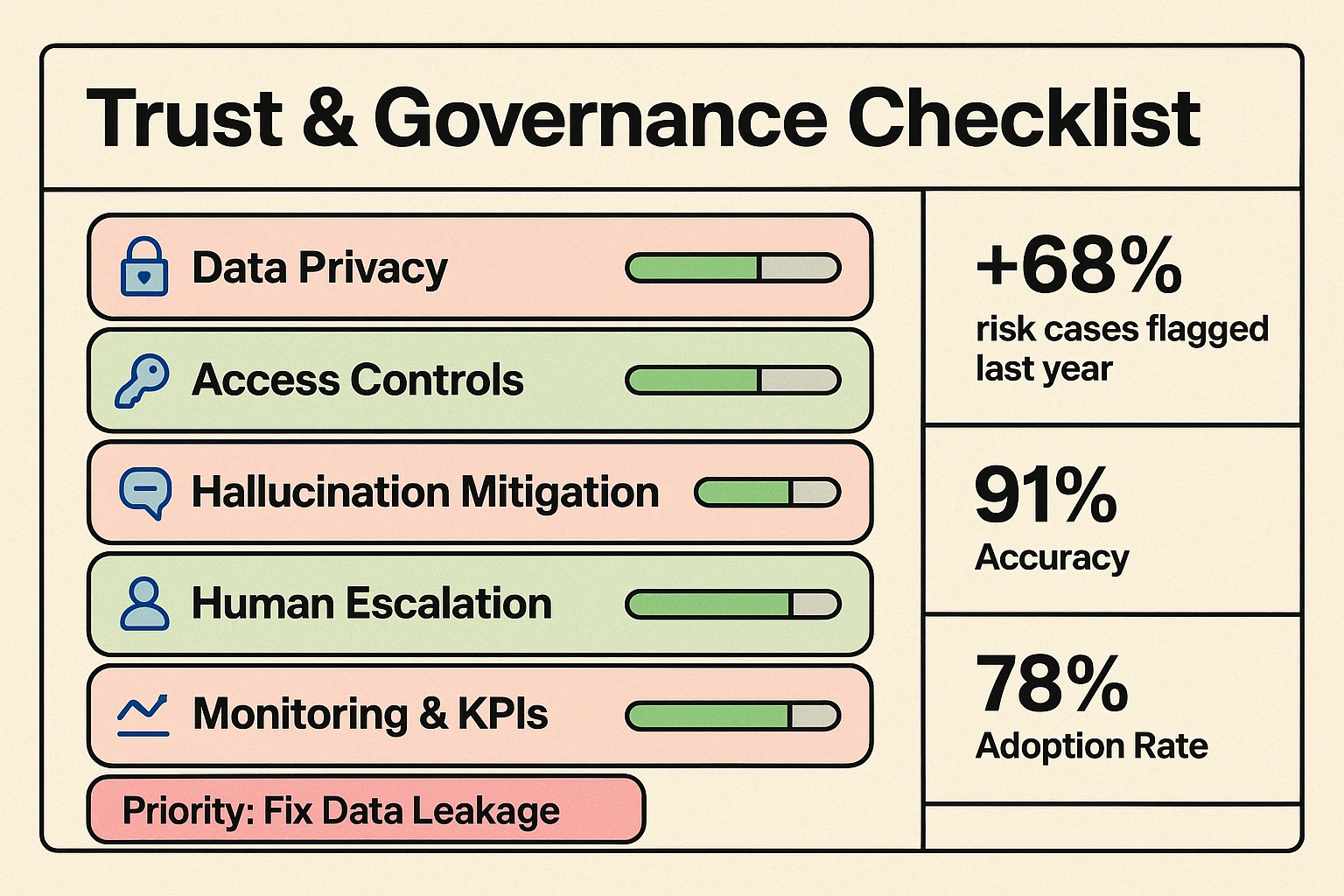
Given that 68% of enterprises faced performance or security issues with conversational AI in the past year (Kanerika), fostering trust is paramount. Clearly delineate when users are interacting with AI versus a human. Transparent data privacy policies and compliance with regulations like GDPR are non-negotiable, especially for sensitive internal information.
Overcoming Implementation Hurdles: Technical & Organizational Challenges
While the benefits are clear, successful internal AI implementation requires navigating common obstacles. We help clients confront these directly.
Data Quality & Integration
One of the biggest technical challenges is integrating siloed internal data (Teneo). Your AI's effectiveness hinges on the quality and accessibility of your data. Strategies for cleaning, structuring, and integrating diverse datasets are essential, especially when dealing with legacy systems. This is why having a robust AI data strategy is non-negotiable.
Security & Compliance
Internal AI often handles sensitive employee and company data. Addressing concerns around data leakage, unauthorized access, and regulatory compliance (GDPR, CCPA) is critical. Robust security protocols and adherence to internal governance frameworks are absolute musts.
Managing Expectations & Preventing Hallucinations
AI, especially generative AI, can "hallucinate"—produce confident but incorrect information. Continuous training, rigorous monitoring, and clear communication about AI's limitations are crucial. Design your AI to know its boundaries and escalate complex queries to human experts.
Change Management & Employee Adoption
Employee resistance can be a significant hurdle. Fears of job displacement, lack of trust in AI, or simply unfamiliarity require a proactive change management strategy (McKinsey). This includes comprehensive training, highlighting how AI augments roles rather than replaces them, and showcasing real-world benefits to employees.
Scalability & Maintenance
An internal AI solution must grow with your company. Plan for long-term scalability and ongoing maintenance, including regular updates to NLU models, knowledge bases, and integrations. The AI landscape evolves rapidly, so your solution must too.

Measuring Effectiveness: Key Metrics for Internal CAI Success
To justify investment and demonstrate value, you need clear metrics to track the success of your internal conversational AI.
- Productivity Gains: Quantify the time saved—for example, the reduction in time spent by HR or IT on routine tickets, or the shortened duration of information searches.
- Cost Reduction: Calculate operational savings through reduced manual effort, lower support costs, and optimized resource allocation.
- Employee Satisfaction: Use surveys and qualitative feedback to gauge improvements in employee experience, morale, and satisfaction with internal support systems.
- Adoption Rates & Engagement: Track how many employees are using the AI, the frequency of use, and which features are most utilized.
- Accuracy & Resolution Rates: Measure the percentage of queries correctly answered by the AI and the proportion of issues fully resolved without human intervention.
- Escalation Rate: Monitor how often the AI needs to hand off a conversation to a human. A lower escalation rate often indicates higher AI effectiveness.

Future Outlook: The Agentic AI Enterprise
The evolution of conversational AI is leading towards "agentic AI"—systems that can perceive, understand goals, plan, execute, and adapt (Medium.com). These aren't just intelligent interfaces; they are proactive "doers."
In the near future, we'll see AI agents becoming integral parts of the workforce, forming a "superagency" (Master of Code). This means conversational AI won't just answer questions; it will execute tasks across different systems, initiate workflows, and even learn from interactions to improve continually. This future emphasizes human-in-the-loop and human-AI collaboration, where AI augments human capabilities, leading to unprecedented levels of efficiency and innovation.
Conclusion: Building Your Custom Internal AI Strategy
The decision to integrate conversational AI internally is a strategic one, offering a clear path to improving operational efficiency, reducing costs, and significantly enhancing the employee experience. This isn't a one-size-fits-all solution; it requires a tailored approach that considers your unique business needs, data infrastructure, and organizational culture.
By focusing on internal applications beyond traditional customer service—from HR and IT support to knowledge management and vendor relations—you can transform your business into an AI-first entity. The key is to start with well-defined problems, design with the user in mind, and meticulously plan for both technical integration and organizational change.
If you're ready to explore how custom-built conversational AI solutions can generate substantial ROI and create capacity within your organization, reach out to us. We specialize in designing, deploying, and optimizing AI-powered interfaces for the most critical internal functions.
Frequently Asked Questions
Q1: What's the main difference between a traditional chatbot and the conversational AI you're describing?
Traditional chatbots often rely on rigid, rule-based scripts, offering limited functionality and context. The conversational AI we focus on utilizes advanced Natural Language Processing (NLP) and machine learning to understand complex queries, maintain context across multi-turn dialogues, interact with various enterprise systems, and even perform tasks autonomously. It's about moving from simple question-answering to intelligent task execution, evolving into true "AI Agents" that can understand your users beyond surface-level keywords (BenAI).
Q2: Is internal conversational AI only for large enterprises?
While large enterprises often have more complex needs that benefit greatly from custom AI solutions, small to medium-sized businesses can also leverage internal conversational AI to achieve significant efficiencies. The key is to start with clear, high-impact use cases, such as automating HR FAQs or IT support queries, which can free up valuable resources regardless of company size.
Q3: How long does it take to implement an internal conversational AI solution?
Implementation timelines vary widely depending on the complexity of the solution, the number of integrations required, and the quality of your existing data. Simple, narrowly scoped solutions might be deployed in a few weeks, while comprehensive, enterprise-wide systems can take several months. It's a phased approach, starting with a pilot, gathering feedback, and then iteratively expanding.
Q4: What about the security of our sensitive internal data?
Data security and compliance are paramount, especially for internal AI handling sensitive employee or company information (Kanerika). We prioritize robust encryption, strict access controls, and adherence to relevant data privacy regulations like GDPR and CCPA. Our solutions are designed with privacy by design principles, ensuring your data remains secure. Learn more about developing a strong AI data strategy.
Q5: Will internal AI replace my employees?
The goal of internal conversational AI is augmentation, not replacement. It's about automating repetitive, low-value tasks to free up your employees to focus on more strategic, creative, and fulfilling work. For instance, AI in recruiting solutions frees up recruiters from mundane tasks, allowing them to focus on candidate engagement and relationship building, as we highlight in our AI recruiting solutions. Similarly, AI marketing agents enhance productivity without replacing the need for human strategy and creativity (BenAI).
Q6: How do you handle "AI hallucinations" or incorrect information?
We mitigate hallucinations through several strategies: rigorous training of AI models on your specific, validated internal data; implementing clear escalation paths for complex or ambiguous queries; and employing a "human-in-the-loop" approach for reviewing and correcting AI responses. Transparency with users about the AI's capabilities and limitations is also crucial.
Q7: What's the best way to get started with internal conversational AI?
The best starting point is a thorough assessment of your current internal processes and identifying the biggest pain points or areas of inefficiency. Focus on a single, high-impact use case (e.g., HR service desk automation) to pilot the technology. This allows you to demonstrate quick wins, gather feedback, and build a strong foundation for future expansion. We can guide you through this initial assessment and strategy development.
Join Our Growing AI Business Community
Get access to our AI Automations templates, 1:1 Tech support, 1:1 Solution Engineers, Step-by-step breakdowns and a community of forward-thinking business owners.
Latest Blogs
Explore our latest blog posts and insights.