Navigating the AI Paradox: Identifying and Prioritizing Business Use Cases for Real ROI
You're likely looking at AI with a mix of excitement and apprehension. On one hand, the promise of automation, efficiency, and growth is compelling. On the other, the landscape feels vast and complex, filled with buzzwords and unfulfilled hype. You know your business needs to embrace AI, but the crucial question remains: where do you start to ensure it delivers tangible value, not just another costly experiment?
This isn't an uncommon dilemma. Despite approximately 78% of organizations globally engaging with AI, a staggering 95% of AI initiatives are failing to deliver expected financial returns, according to MIT research. Only 31% of AI use cases ever reach full production, leaving a significant gap between aspiration and actual impact. This AI paradox—widespread adoption with limited scaled success—highlights a critical need for a systematic approach to identifying and prioritizing AI business use cases.
This guide is designed for decision-makers like you, actively evaluating how to bridge that gap. We'll provide a clear, actionable framework that moves beyond theoretical concepts to practical implementation, helping you confidently identify, evaluate, and prioritize AI initiatives that genuinely align with your strategic goals and deliver measurable ROI.
Understanding the AI Paradox: Why Most AI Initiatives Fall Short
The high failure rate isn't due to a lack of innovation in AI itself. Instead, it often stems from a fundamental misstep at the earliest stages: a haphazard approach to identifying which problems AI can—and should—solve. Many businesses jump to solutions without a clear understanding of the underlying business challenge or the true potential for impact.
Key challenges include:
- Lack of AI Expertise: A significant barrier, with 42% of organizations citing a lack of internal AI expertise as a hurdle.
- Data Readiness: Issues with data accuracy and bias affect 45% of initiatives.
- Integration with Legacy Systems: This is a challenge for 35% of companies, complicating AI deployment.
- Managing Risk and Compliance: Critical for 60% of businesses, highlighting the need for robust governance frameworks.
These aren't just technical hurdles; they're strategic ones that directly influence your ability to see a return on your AI investment. The good news is that organizations with mature AI governance frameworks show a 28% increase in AI utilization across multiple business areas. This underscores the power of a structured approach—exactly what we'll dive into.
Phase 1: Identifying High-Potential AI Use Cases (The "Discovery" Layer)
Before you can prioritize, you need a robust pipeline of potential AI use cases. This discovery phase isn't about identifying every possible application of AI; it's about uncovering the areas where AI can generate the most strategic value for your specific business.
1.1 Strategic Alignment: Where Does AI Fit in Your Vision?
True AI impact begins with core business objectives, not with technology looking for a problem. Start by asking: What are your company's overarching strategic goals for the next 1-3 years? Are you aiming for:
- Increased revenue through new products or services?
- Significant cost reduction in operations?
- Enhanced customer experience and retention?
- Faster time to market for innovations?
- Improved decision-making capabilities?
Translate these high-level goals into potential AI opportunities. For example, if "increased customer retention" is a goal, AI might offer solutions in personalized outreach, predictive churn analysis, or automated support. This ensures every AI idea is tethered to a clear business outcome.
1.2 Pain Point Pinpointing: The "Bottleneck" Approach
Once strategic alignment is clear, look inward. Where do your teams spend excessive time on manual, repetitive tasks? What are your most significant operational inefficiencies? Where are bottlenecks creating delays, errors, or missed opportunities? These are often the richest veins for AI intervention.
Consider your core business functions:
- Marketing: Can AI automate content creation, personalize campaigns, or optimize ad spend? (For example, our insights on AI-powered LinkedIn campaign optimization or AI tools for schema markup automation show how AI addresses marketing bottlenecks directly.)
- Operations: Could AI streamline supply chain logistics, predict equipment failures, or optimize resource allocation?
- HR: Can AI accelerate candidate screening, personalize employee training, or automate onboarding processes?
- Finance: How about AI for fraud detection, financial forecasting, or invoice processing?
By focusing on these "bottlenecks," you're identifying areas where AI can create capacity without increasing headcount, a key value proposition for many businesses.
1.3 Industry & Competitive Scan: Learning from What Works (and What Doesn't)
While internal analysis is crucial, don't operate in a vacuum. Research how competitors and industry leaders are leveraging AI. This isn't about blind imitation, but intelligent adaptation. If a competitor is using AI for advanced analytics to predict market shifts, consider how similar capabilities could offer you a strategic advantage.
Look for trends like:
- Agentic AI: Companies buying specialized AI applications, particularly agentic AI that automates entire workflows, report a 67% success rate compared to 33% for those building in-house with limited expertise. This suggests a strong lean towards outcome automation.
- Industry-Specific Solutions: What are the common AI use cases emerging in your sector (e.g., predictive maintenance in manufacturing, diagnostic assistance in healthcare)?
Phase 2: Evaluating Feasibility & Business Value (The "Scrutiny" Layer)
Now that you have a list of potential AI use cases, it's time for rigorous evaluation. This phase filters out ideas that are either impractical or unlikely to deliver meaningful returns.
2.1 The AI Feasibility Framework (Technical & Data Readiness)
An AI idea might sound brilliant, but if you lack the necessary data or infrastructure, it's a non-starter. This framework helps you assess two critical dimensions:
- Data Readiness:
- Availability: Do you have the data needed? Where does it live?
- Quality: Is it clean, accurate, and consistent? Garbage in, garbage out applies acutely to AI.
- Accessibility: Can your AI systems access this data securely and efficiently? Are there privacy implications?
- Technical Feasibility:
- Infrastructure: Do you have the computing power, storage, and cloud capabilities?
- Tools & Platforms: Do current AI tools support this use case, or does it require significant custom development?
- Integration: How well will new AI solutions integrate with your existing legacy systems? This is a common challenge that needs careful planning.
- Internal Expertise: Do you have the in-house talent to build, deploy, and maintain this AI solution, or will external partners be required?
2.2 Quantifying ROI: The Financial & Strategic Lens
This is where the rubber meets the road. "Show me the money" is a valid question from stakeholders, and a robust ROI analysis is your answer. Go beyond vague promises to concrete estimations of both hard and soft ROI.
***
Early decision point — comparing and prioritizing candidate use cases
***
- Hard ROI (Tangible Benefits):
- Cost Savings: Reduced labor costs (e.g., through automation), optimized resource utilization, lower operational expenses.
- Revenue Generation: Increased sales through personalized recommendations, new AI-powered products or services, improved lead conversion.
- Risk Mitigation: Reduced fraud, fewer compliance breaches, better security.
- Soft ROI (Intangible Benefits, but Still Measurable):
- Improved Customer Satisfaction: Higher ratings, better retention.
- Enhanced Employee Productivity: Time saved from repetitive tasks, allowing focus on strategic work.
- Better Decision-Making: Deeper insights from data, faster response to market changes.
- Competitive Advantage: Differentiation in the market, improved brand perception.
Consider developing an "AI Business Case Canvas" (a downloadable template we can provide) to structure your ROI calculations. This helps you factor in initial investment, ongoing maintenance, and expected returns over a defined period. Remember, agentic AI, which focuses on automating entire workflows, tends to yield superior ROI by completely replacing manual efforts with intelligent agents.
***
Middle of the guide — quantifying and comparing expected ROI across shortlisted use cases
***
2.3 Organizational Impact & Change Management: The Human Factor
AI isn't just about technology; it's about people. Overlooking the human element is a common reason for AI project failure.
- Workforce Readiness: How will AI affect current roles? Will employees need reskilling or upskilling?
- Potential Resistance: Anticipate and address concerns about job displacement, new workflows, or the black-box nature of some AI.
- Executive Sponsorship & Cross-Functional Collaboration: Strong leadership buy-in is crucial. AI initiatives often require collaboration across departments (IT, operations, marketing, sales) to succeed.
Phase 3: Prioritizing for Impact (The "Decision" Layer)
With identified use cases evaluated for strategic alignment, feasibility, and potential ROI, it's time to make strategic decisions.
3.1 The Prioritization Matrix: Visualizing Opportunities
A visual matrix helps categorize and prioritize your AI opportunities. A common approach is a 2x2 grid plotting "Business Value/Impact" against "Feasibility/Effort."
- High Value, Low Effort (Quick Wins): These are your immediate priorities. They offer significant returns with manageable implementation. Prioritize these to build internal momentum and prove AI's value early on.
- High Value, High Effort (Strategic Bets): These are long-term, transformative projects. They require significant investment but promise substantial, sustainable advantage. Plan these carefully, perhaps breaking them into smaller phases.
- Low Value, Low Effort (Research/Monitor): Keep an eye on these. They might become more valuable or feasible in the future, but aren't priorities now.
- Low Value, High Effort (Avoid): These are unlikely to deliver sufficient ROI for the resources required. Deprioritize or eliminate them.
This matrix provides a clear roadmap, ensuring resources are allocated to projects with the highest potential returns and the greatest likelihood of success.
3.2 Rapid Prototyping & Validation: From Idea to Proof
For high-value, promising use cases, don't wait for a perfect, full-scale solution. Rapid prototyping helps you quickly test assumptions, validate the concept, and gather feedback before committing extensive resources.
- Minimum Viable Products (MVPs): Develop a basic version of the AI solution with just enough features to satisfy early users and demonstrate value.
- Pilot Programs: Implement the MVP in a limited environment (e.g., one department, a small customer segment) to gather real-world data and testimonials.
- Clear Metrics: Define what success looks like for the prototype in terms of measurable outcomes (e.g., a specific percentage reduction in processing time, an uplift in conversion rate).
This iterative approach reduces risk and allows for agile adjustments, ensuring your AI initiatives are constantly refined for maximum impact.
Our team has experience in developing and implementing customized AI agents, including those that help with AI keyword cannibalization audits and identifying manual action identification for SEO, allowing for rapid validation of these types of use cases.
***
Mid-to-late section — a structured canvas for evaluating individual business cases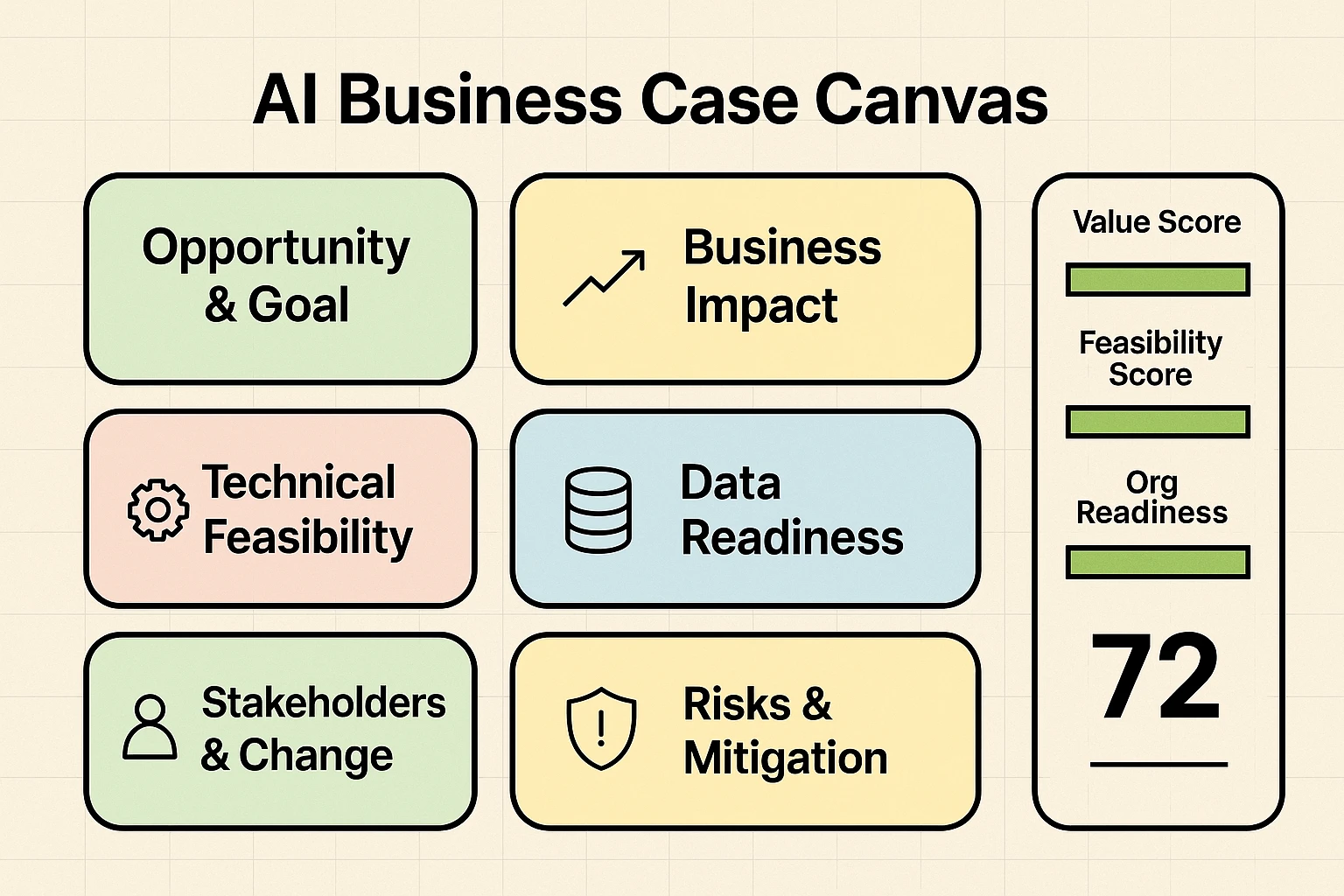
***
Case Studies: Real-World AI Success
Seeing is believing. Businesses across various sectors are successfully leveraging AI for significant ROI.
- Sparex: Implemented AI-powered forecast automation, leading to increased inventory accuracy and reduced stock-outs.
- ACI Corp: Utilized AI to automate customer service inquiries, improving response times and customer satisfaction.
- Prudential: Leveraged AI for personalized insurance product recommendations, boosting sales and client engagement.
What these success stories have in common is a clear understanding of their business problem, a systematic approach to identifying AI's role, and thorough planning for implementation and impact measurement. They didn't just adopt AI; they strategically integrated it.
Your Action Plan: Implementing an AI Use Case Identification & Prioritization Strategy
Successfully navigating the AI landscape requires a pragmatic, results-oriented approach. Whether you're a marketing agency owner looking to scale, a recruiting firm aiming for efficiency, or an enterprise leader charting a digital transformation, identifying the right AI use cases is your first, most critical step.
Here’s your immediate action plan:
- Define Your Top 3 Strategic Business Goals: What absolutely must improve in your business?
- Brainstorm AI Opportunities: For each goal, identify 3-5 ways AI could contribute, focusing on tasks or processes that are repetitive, data-heavy, or high-impact.
- Conduct an Initial Feasibility Assessment: Using the framework above, give each idea a quick "green/yellow/red" light for data readiness, technical feasibility, and organizational impact.
- Estimate Potential ROI: Even a rough estimate of cost savings or revenue generation can help.
- Plot on a Prioritization Matrix: Identify your "Quick Wins" and "Strategic Bets."
***
Final decision/validation section — guiding rapid prototyping and go/no-go decisions
***
If you're eager to transform your business into an AI-first entity and move beyond the experimentation phase to tangible, measurable results, our expertise can guide you. We specialize in custom AI implementations, training, and consulting for marketing, recruiting, and broader enterprise solutions.
Frequently Asked Questions
Q1: How do I know if my business is "ready" for AI?
Your business is ready for AI if you have identified clear pain points or strategic opportunities that AI could address, and you have at least some accessible data. You don't need to be a data science powerhouse from day one. Readiness is more about having a problem to solve than having perfect data or a massive budget. Our expert guidance can help you assess your current state and build an AI readiness roadmap.
Q2: What's the biggest mistake companies make when trying to identify AI use cases?
The biggest mistake is starting with the technology ("We need AI!") instead of the business problem ("How can we reduce X cost or increase Y revenue?"). This often leads to solutions in search of problems, resulting in costly, low-impact AI experiments. It's crucial to align AI initiatives with strategic business objectives from the outset.
Q3: How important is data quality in identifying viable AI projects?
Critically important. As the saying goes, "garbage in, garbage out." AI models are only as good as the data they are trained on. Poor data quality (inaccuracies, inconsistencies, bias) can lead to flawed insights, unreliable predictions, and ultimately, wasted investment. A robust data strategy and data cleansing processes are often prerequisites for high-impact AI projects.
Q4: We have limited internal AI expertise. Does that mean we can't adopt AI?
Absolutely not. A lack of internal AI expertise is a common barrier (cited by 42% of organizations), but it doesn't preclude AI adoption. Many businesses successfully leverage external partners for AI consulting, custom implementations, and training. This allows you to tap into world-class expertise without the overhead of building a large in-house team from scratch. BenAI excels at providing this external expertise, helping you build an "AI-first" business system-by-system.
Q5: How can I measure the ROI of my AI projects effectively?
Measuring AI ROI involves both tangible and intangible benefits. For tangible ROI, focus on quantifiable metrics like cost savings (e.g., reduced labor, optimized processes), revenue generation (e.g., increased sales, new product lines), and risk reduction. For intangible ROI, track metrics like improved customer satisfaction, employee productivity gains, and faster decision-making. Develop an "AI Business Case Canvas" to systematically track these metrics before, during, and after implementation. Remember, companies buying specialized (increasingly agentic) AI applications have a 67% success rate in achieving ROI, due to their focus on automating entire workflows.
Join Our Growing AI Business Community
Get access to our AI Automations templates, 1:1 Tech support, 1:1 Solution Engineers, Step-by-step breakdowns and a community of forward-thinking business owners.
Latest Blogs
Explore our latest blog posts and insights.