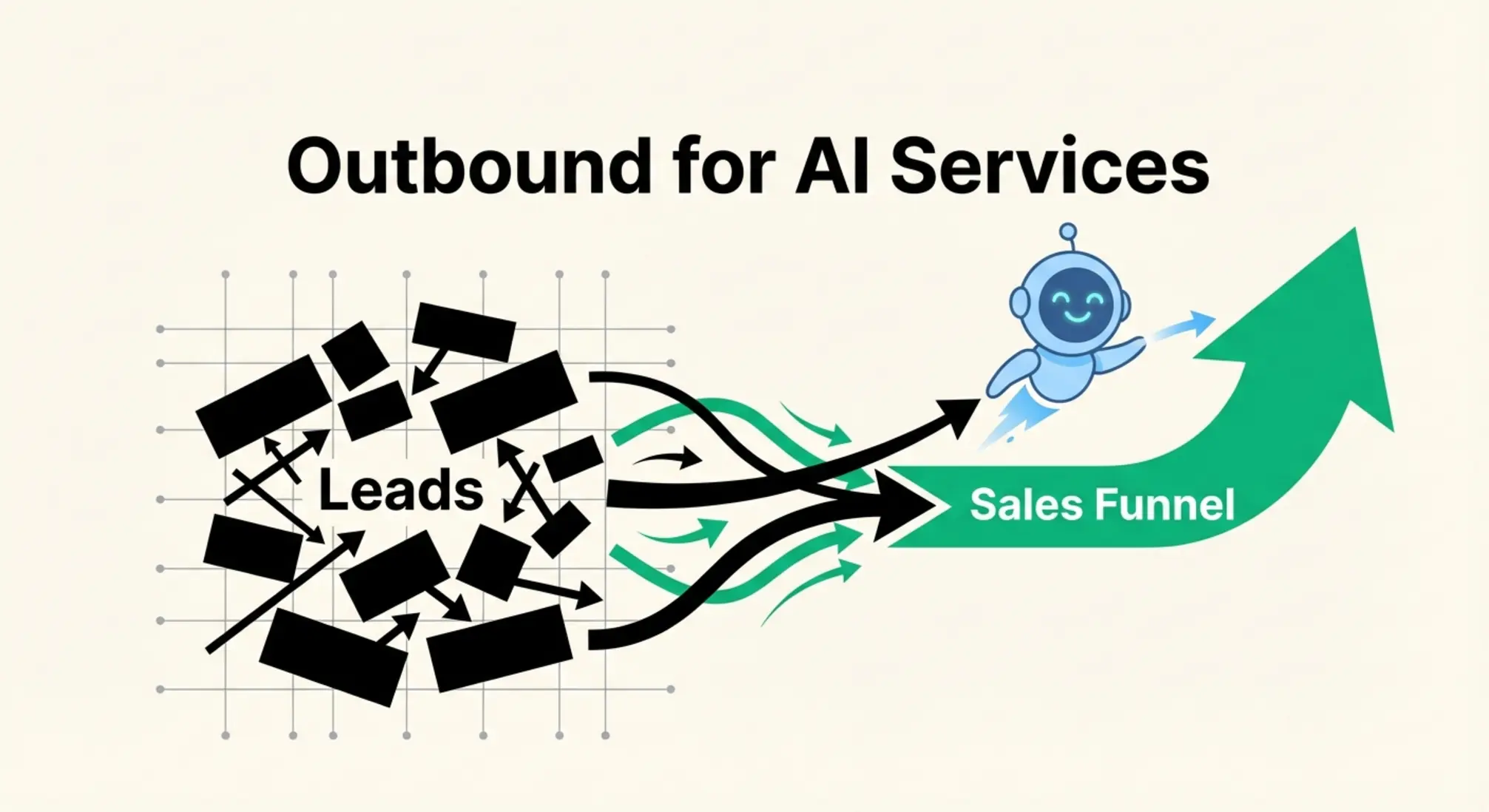
The promise of AI for business growth is undeniable, but are you finding yourself stuck when it comes to actually selling these transformative services? Many businesses recognize the staggering potential—the AI services market is projected to reach over $91 billion by 2035 with a CAGR exceeding 26%—yet struggle with the critical step of consistently attracting and converting clients. It’s a paradox: the more groundbreaking the service, the harder it can be to articulate its value and differentiate it in a crowded, often skeptical market.
You're likely evaluating endless strategies, trying to cut through the noise of generic sales advice that simply doesn't fit the unique complexities of AI solutions. This isn't about selling a simple product; it's about guiding prospects through a significant operational shift. We understand that your challenge isn't just finding leads; it's about genuinely educating potential buyers, overcoming deeply ingrained skepticism, and proving measurable ROI for services that fundamentally change how a business operates. This guide is built to cut through that complexity, providing you with battle-tested frameworks to confidently navigate the unique terrain of outbound prospecting for B2B AI services.
Decoding the AI Buyer: Understanding Skepticism, Needs & Decision Factors
Selling AI services means confronting a specific set of buyer behaviors and concerns. Unlike traditional services, AI solutions often face resistance rooted in uncertainty, fear of the unknown, and a natural skepticism towards emerging technology. Your prospects, whether they’re marketing agencies, recruiting firms, or enterprise leaders, aren't just looking for a tool; they're looking for a partner who can demystify AI and deliver tangible business outcomes.
Key challenges include:
- The "Black Box" Problem: Many buyers perceive AI as an inscrutable black box, making it difficult for them to trust the outcomes or understand the underlying processes.
- Data Quality Concerns: Prospects often worry about the quality of their own data and its suitability for AI integration. This is a significant barrier, as ethical concerns (data privacy, algorithmic bias) and poor data quality are high on their list of objections.
- Integration Headaches: The fear of complex, disruptive integration with existing legacy systems can halt deals before they even begin.
- Job Displacement Anxiety: Decision-makers are acutely aware of employee concerns about AI replacing human roles, rather than augmenting them.
- Lack of Internal Expertise: Many organizations simply don't have the in-house AI literacy to evaluate solutions effectively, making them reliant on trusted external guidance.
To overcome these, your prospecting efforts must move beyond generic features and focus on understanding their specific pain points. Are marketing agencies struggling to scale content creation without increasing headcount? Are recruiting firms overwhelmed by inefficient candidate monitoring and the high cost-per-hire? Enterprises need custom implementations and comprehensive training to truly lead the way in AI adoption. You need to speak directly to these challenges, not just the capabilities of your AI.
Foundation First: Building Your Ideal ICP & Buyer Persona for AI Services
Effective outbound prospecting for AI services isn't about sending mass emails; it's about precision targeting. Before launching any campaign, you must define your Ideal Customer Profile (ICP) and detailed Buyer Personas with AI-enhanced clarity. This is where AI itself becomes your ally, not just your product.
1. Define Your ICP with Data:Start by analyzing your most successful past clients. What industries are they in? What's their company size, revenue, and growth stage? For instance, for AI Marketing Solutions, your ICP might be marketing and growth agencies with 5-50 employees struggling to scale service delivery, while for AI Recruiting Solutions, it's likely recruiting agencies aiming to streamline hiring processes.
2. Develop Granular Buyer Personas:Within your ICP, identify specific roles that influence or make buying decisions. For enterprise solutions, this could be a Chief Digital Officer grappling with a lack of clear AI strategy, or a VP of Operations focused on reducing manual, repetitive work. For smaller agencies, it's often the owner or a director of growth who directly feels the pain of operational inefficiencies. Map out their:
- Professional Goals: What are they trying to achieve in their role this quarter or year?
- Business Challenges: What specific problems are keeping them up at night that AI could solve?
- Attitudes Towards AI: Are they enthusiastic early adopters, cautious evaluators, or outright skeptics?
- Key Decision Criteria: What factors do they weigh most heavily when evaluating a new solution (ROI, ease of integration, vendor reputation, security)?
By understanding these nuances, you can tailor your messaging far beyond "we offer AI." You can speak to their exact problems, positioning your solution as the answer to their most pressing needs, rather than a speculative investment. This deep understanding enables you to address hidden intents and mitigate risks before they arise.
Crafting High-Converting Outbound Strategies for AI Services
With a clear understanding of your buyer, it’s time to move into execution. Remember, generic sales advice won't cut it. Your outbound strategies must be specifically designed to educate and convert skeptical buyers of complex AI services. Companies employing advanced AI outbound prospecting services report 10-25% pipeline growth and significantly higher lead volume and quality.
1. High-Converting Cold Email Campaigns for AI Solutions
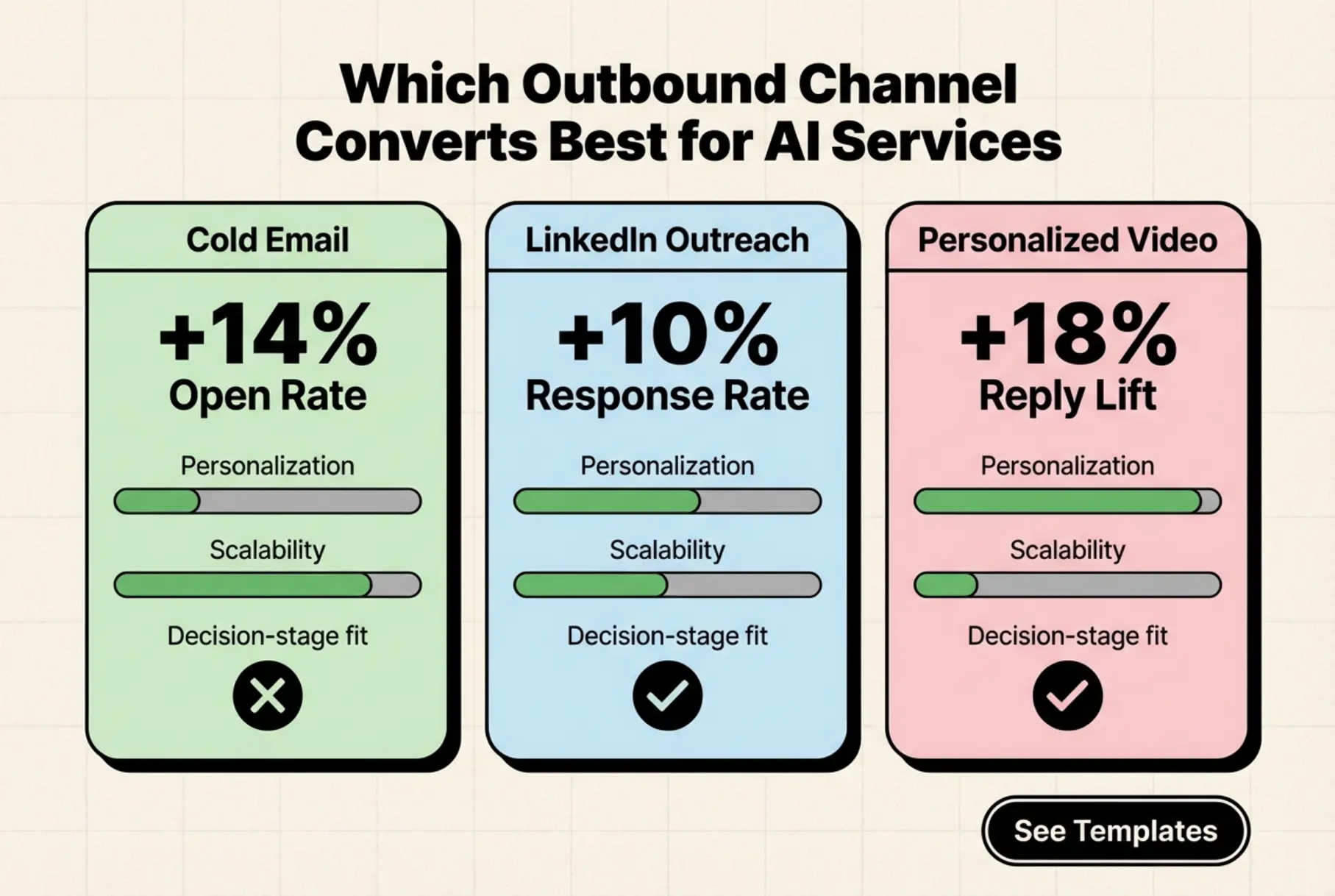
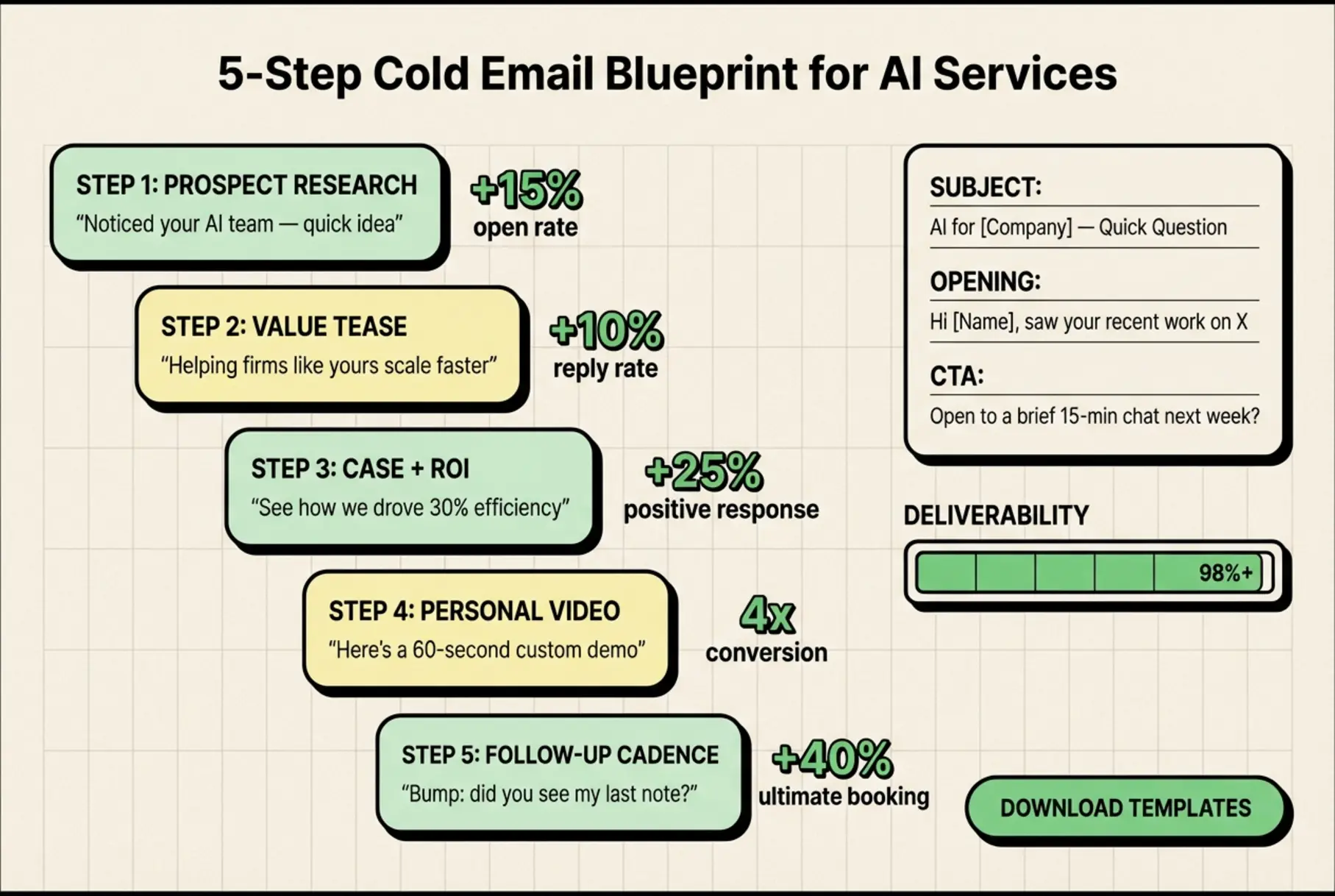
Cold email for AI services requires a delicate balance of personalization, value, and clarity. The goal isn't just an open; it's a reply that indicates genuine interest. Advanced cold email personalization using AI can lead to 14% higher open rates and 10% higher response rates.
a. Hyper-Personalization with AI:Go beyond basic merge tags. Use AI to analyze a prospect's public data (social posts, company news, case studies, job postings) and identify specific challenges or goals. For example, if a marketing agency recently posted about scaling their content team, your email can address that directly with how AI Marketing Solutions automate content creation.
b. Problem-Centric Messaging:Don't lead with "What we do." Lead with "What problem we solve for you." Frame your AI service as the solution to their most pressing business pain.
c. Clear, Concise Value Proposition:Immediately communicate the core benefit. For a recruiting firm, this isn't just "AI hiring tools," it's "AI Hiring Manager & Candidate Monitoring Systems to cut time-to-hire by X%."
d. Call to Value, Not Call to Action:Instead of "Book a demo," try "Would you be open to a 15-minute chat to explore how [specific problem] could be addressed?" or "Here's a quick case study on how we helped a similar company achieve [tangible result]."
Example Cold Email Script (Marketing Agency Owner):
Subject: Scaling [Agency Name]'s Content Output with AI?
Hi [Prospect Name],
Noticed [Agency Name] is focused on [mention a specific challenge or goal from their LinkedIn/website, e.g., "growing content team" or "expanding service offerings"].
Many agencies hitting this stage find themselves grappling with the manual grind of content creation, preventing them from taking on more clients without a proportional increase in headcount.
We help agencies like yours implement proven AI marketing systems that automate tasks like content generation, SEO optimization, and LinkedIn outreach. This frees up your team to focus on strategy and client relationships, ultimately scaling service delivery 10x faster.
Would you be open to a brief 15-minute conversation next week to see a quick example of how this applies to [Agency Name]'s current operations?
Best,[Your Name]
2. LinkedIn Outreach Strategies for B2B AI Services
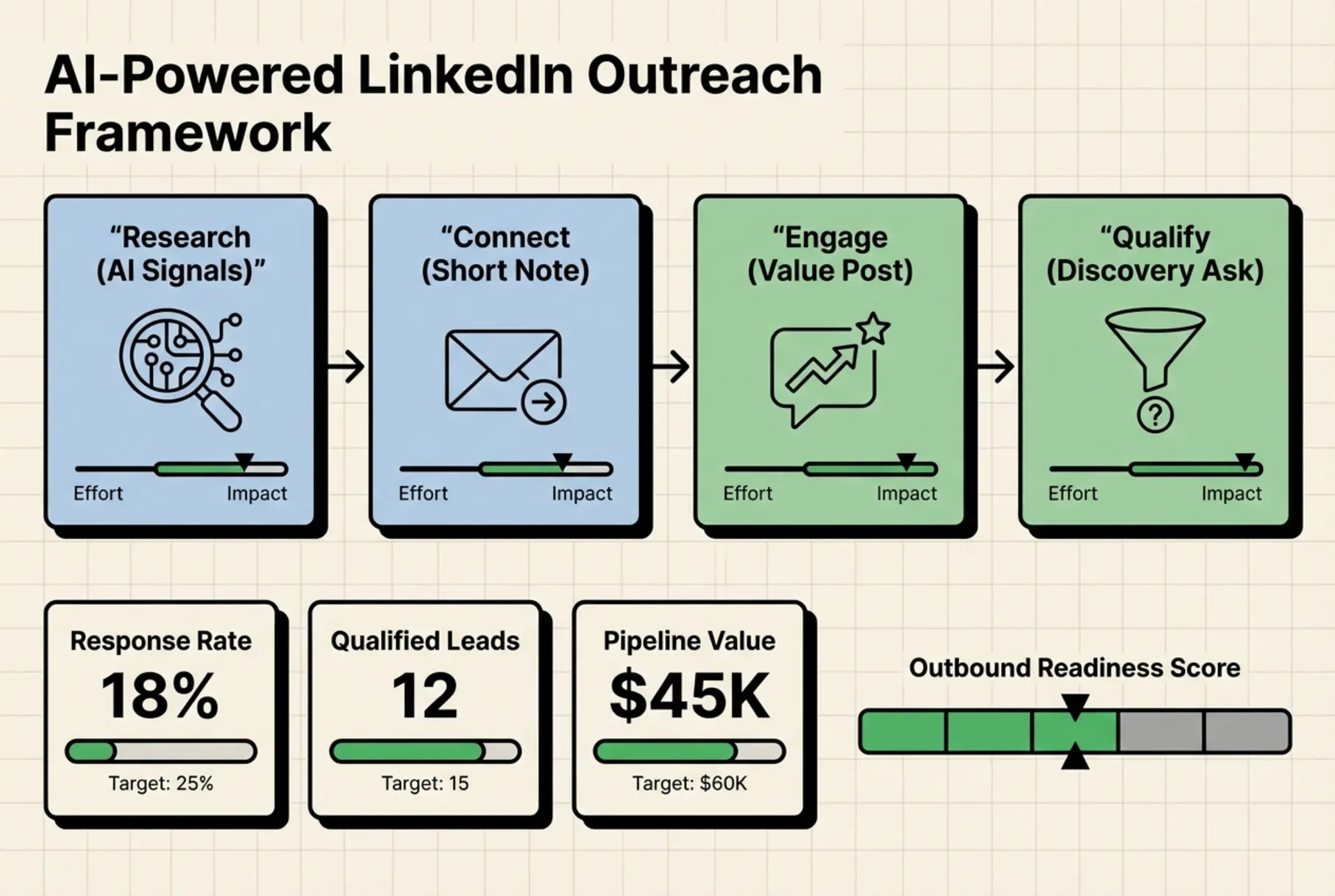
LinkedIn is a goldmine for B2B AI service prospecting, but it requires a sophisticated approach beyond simple connection requests.
a. Thought Leadership & Value First:Share valuable insights about AI trends, practical applications, or common pitfalls. This positions you as an expert, not just a seller. Link to relevant blog posts, like those on AI-powered content marketing strategy or AI-driven LinkedIn outreach best practices.
b. Personalized Connection Requests:Mention a shared connection, a recent post of theirs, or a common interest related to AI and their business. Avoid sales pitches in the initial request.
c. Engage with Their Content:Before even connecting, comment thoughtfully on their posts. Show genuine interest in their work and insights.
d. Strategic Follow-Up Sequence:Once connected, send a personalized message referencing a specific pain point an AI solution could address. For example, if they're a recruiting firm owner, ask: "I noticed your firm often hires for [specific role]. Many recruiting firms find [AI Recruiting Solutions] dramatically streamline the initial candidate screening process. Curious to hear your thoughts on leveraging AI to reduce time-to-hire?"
For more advanced strategies on how to effectively scale your LinkedIn lead generation using AI automation, read our in-depth guide on scaling LinkedIn lead generation with AI automation.
3. Personalized Video Messages: Breakthroughs in AI Service Prospecting
Personalized video is a powerful, underutilized channel that cuts through email clutter and builds immediate rapport.
a. Short & Sweet:Keep videos under 60-90 seconds. Prospects are busy.b. Highly Personalized:Use their name, company name, and reference a specific detail you noticed about their business.c. Focus on a Single Pain Point:Address one major problem your AI service can solve for them.d. Visual Aids:Briefly show their website, LinkedIn profile, or a quick, relevant screenshot while you're talking.e. Clear Call to Value:End with a subtle but direct suggestion for the next step, such as "If this sparked any thoughts on how AI could impact [specific area], I'd love to connect for 15 minutes."
Channel Prioritization for AI Services Outbound
Understanding which channel works best for which stage of the sales cycle or type of prospect is critical.
Consider your ICP, their preferred communication methods, and the complexity of the message you need to convey. While cold email offers scalability and measurable results, personalized video adds a human touch essential for building trust with skeptical buyers, and LinkedIn allows for professional networking and thought leadership.
Discovery Call Frameworks for AI Problem Identification: Qualifying the Unconvinced
The discovery call isn't just about selling; it's about understanding. For AI services, it's particularly about identifying if their declared problem is an AI problem you can solve, or if it's a foundational issue to be addressed first. This stage helps qualify prospects and build trust by demonstrating genuine understanding.
1. The "Current State" Exploration:Start by asking open-ended questions about their current processes and challenges.
- "Walk me through your current process for [specific task, e.g., content generation, candidate screening]."
- "What are the biggest bottlenecks or frustrations you encounter in this process?"
- "What impact do these challenges have on your team's efficiency or your business's bottom line?"
2. The "Desired Future State" Vision:Help them articulate what success looks like, even before AI is explicitly mentioned.
- "If you could wave a magic wand, what would an ideal [process] look like?"
- "What kind of results would truly move the needle for your business?"
3. The "Impact & Implications" Deep Dive:This is where you connect their current pain to the future gain, often subconsciously introducing how AI could bridge the gap.
- "What would it mean for your agency/firm if you could [achieve desired future state]?"
- "How would that impact your capacity, profitability, or competitive edge?"
4. Introduce AI as a Solution (Not the Solution):Once you have a clear picture of their needs and desired outcomes, gently introduce how AI could be a strategic lever.
- "Based on what you've shared, it sounds like [problem A] and [problem B] are significant. We've seen AI systems address these by [brief, relevant example]. Does that resonate with what you're seeing?"
5. Qualification & Next Steps:Assess their budget, authority, need, and timeline (BANT). If there's a strong fit, propose a clear next step—e.g., a deeper dive into a specific enterprise solution or a tailored proposal.
Overcoming Common Objections to AI Service Adoption: A Sales Playbook
Objections aren't rejections; they're requests for more information. For AI services, these requests are often rooted in legitimate concerns. Having a systematic approach to address them builds confidence and reduces perceived risk.
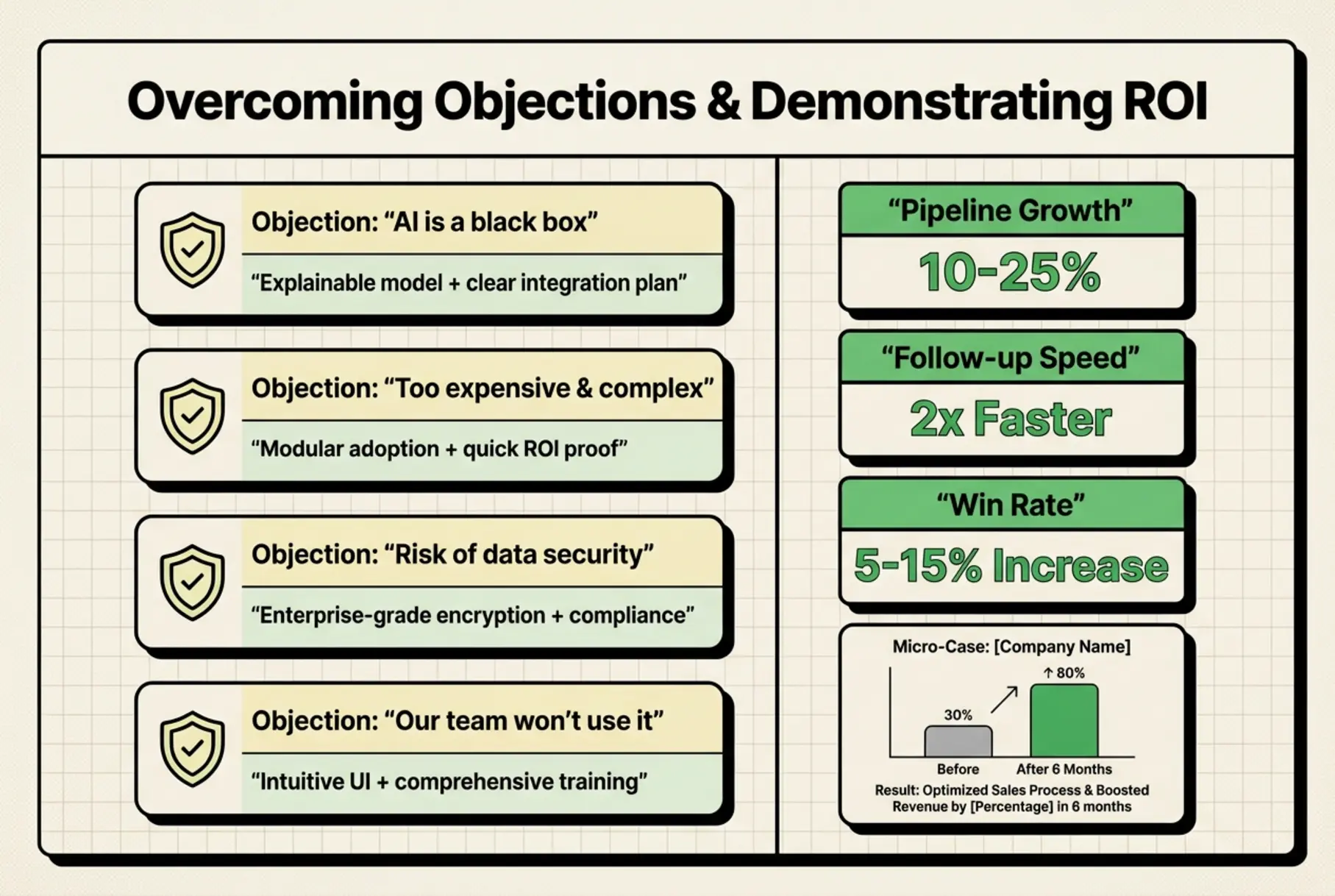
Common Objection 1: "AI is too expensive/We don't have the budget."
- Response: "I completely understand budget concerns. However, many clients find that the upfront investment in AI is quickly offset by significant operational savings and revenue growth. For example, our AI Recruiting Solutions typically reduce time-to-hire costs by X% and increase recruiter productivity by Y%, leading to a [Case Study Link, e.g., similar to https://www.benai.co/case-studies/why-seo-is-not-dead] ROI within [timeframe]. Can we look at what a similar outcome would mean for your specific budget and scale?"
- Data Point: AI-driven sales tools can improve lead follow-up times by 60%, increase conversion rates by 30%, and boost win rates by 30%. This translates directly into revenue lift that far exceeds costs.
Common Objection 2: "Our data isn't good enough for AI."
- Response: "That's a very common and valid concern. The good news is that we specialize in custom AI implementations, which includes thoroughly assessing your existing data and, if necessary, implementing strategies to clean, structure, and enrich it. Our world-class AI implementations ensure your data becomes a robust asset for AI, not a barrier. We even have frameworks for initial pilots that use smaller datasets to demonstrate value quickly."
- Data Point: Ethical concerns (data privacy, algorithmic bias, transparency) and poor data quality are significant barriers to AI adoption in sales. Acknowledging this and providing a solution is key.
Common Objection 3: "We already have too many tools/Integration will be a nightmare."
- Response: "Integrating new technology is always a consideration. Our approach focuses on seamless integration with your existing tech stack. We don't just 'drop in' AI; we custom-build solutions that complement your current systems, ensuring minimal disruption and maximum efficiency. In fact, many clients find our solutions streamline their tool stack by automating tasks previously spread across multiple platforms. We often start with non-disruptive pilot projects to demonstrate compatibility."
Common Objection 4: "Our employees will resist AI/Fear of job displacement."
- Response: "This is a critical point, and one we address proactively. Our AI solutions are designed to augment human intelligence, not replace it. By automating repetitive, manual tasks, we create significant capacity, freeing your team to focus on higher-value, strategic work that requires human creativity and critical thinking. We also provide comprehensive training and consulting to help your staff confidently adopt and leverage AI, transforming them into 'AI-first' employees. [Refer to Ben AI Accelerator or Enterprise Solutions for training]."
- Data Point: Fragmented sales tasks mean sellers spend only ~25% of their day actively selling; AI can help double this. This narrative of augmentation and capacity creation is crucial.
Measuring Success: Metrics, KPIs & ROI for Your AI Sales Funnel
No outbound strategy is complete without rigorous measurement. For AI services, demonstrating tangible ROI is paramount given the investment.
Key Metrics to Track:
- Response Rates: Track the percentage of prospects who reply to your cold emails, LinkedIn messages, or video outreach.
- Meeting Booked Rate: The conversion rate from initial outreach to a scheduled discovery call.
- Qualified Lead Rate: Percentage of discovery calls that result in a qualified lead ready for the next stage of the sales pipeline.
- Pipeline Contribution: The value of deals in your pipeline directly attributable to outbound efforts.
- Win Rate: Percentage of qualified outbound leads that convert into paying clients.
- Customer Lifetime Value (CLTV): Understand the long-term value of clients acquired through outbound, especially for recurring AI services.
Demonstrating ROI with Confidence:When presenting ROI, always tie back to the prospect's original pain points. If reducing manual work was a key motivator, quantify the time savings or headcount reduction. If increased efficiency was the goal, show the improved throughput or faster time-to-market. Companies employing advanced AI outbound prospecting services report 10-25% pipeline growth, alongside significantly higher lead volume and quality. Always reinforce this with relevant case studies.
The Future of AI Sales: Emerging Trends & Maintaining Your Edge
The AI landscape is constantly evolving, and so must your sales strategies. Staying ahead means embracing emerging trends:
- Generative AI for Personalized Content at Scale: Leverage generative AI not just for initial drafts, but for hyper-personalized message variations across channels, dynamically adapting to prospect preferences and behaviors.
- AI-Powered Sales Coaching: Tools that analyze sales calls and emails to provide real-time feedback and training for your sales team, improving their objection handling and discovery skills.
- Predictive Analytics for ICP Refinement: AI models that identify ideal prospects with higher accuracy, by analyzing vast datasets of market trends and existing client successes.
- Ethical AI in Sales: As AI adoption grows, so does the scrutiny. Ensuring your AI tools and processes for prospecting are transparent, fair, and privacy-compliant will be a significant differentiator and trust-builder.
Conclusion & Next Steps: Implementing Your AI Services Outbound Strategy
Mastering outbound prospecting for B2B AI services demands a shift from generic sales tactics to a deeply strategic, AI-informed approach. It requires understanding the unique psychology of the AI buyer, leveraging advanced personalization, and systematically addressing skepticism with data-backed conviction. By adopting a framework that values education, transparency, and tailored solutions, you won't just find prospects—you'll build lasting partnerships.
Your AI-first business truly starts here. Our expertise isn't just in building AI systems; it's in enabling you to effectively bring those systems to the businesses that need them most. If you're ready to transform your outbound prospecting from a challenge into a predictable growth engine, it's time to build a robust, AI-driven strategy.
FAQs: Addressing Common Buyer Objections About AI Service Sales
Q1: How can I differentiate my AI services in a rapidly growing market?
Differentiation comes from specificity and proven results. Instead of generic "AI solutions," focus on niche applications (like AI Marketing Solutions or AI Recruiting Solutions), quantifiable ROI, and world-class, custom implementations. Emphasize your ability to integrate with existing legacy systems and provide comprehensive training, rather than just off-the-shelf software.
Q2: Is it challenging to find decision-makers open to AI solutions?
While skepticism exists, decision-makers are increasingly aware of AI's strategic importance. The challenge isn't finding them, but engaging them effectively. Focus on their specific business problems—like reducing manual, repetitive work or scaling operations without increasing headcount—and show how your AI service directly addresses those with measurable outcomes. This strategy helps overcome the initial "black box" perception.
Q3: How do I prove the ROI of AI services to a skeptical CFO?
Focus on hard data and specific KPIs. Highlight projected cost savings (e.g., reduced operational expenses, fewer hours spent on manual tasks), revenue uplift (e.g., increased lead conversion, faster time-to-market), and efficiency gains (e.g., throughput improvements, faster decision-making). Back these claims with case studies of similar clients and industry statistics; for instance, AI-driven sales tools can boost win rates by 30%.
Q4: What if a prospect is concerned about data privacy or security with AI?
This is a critical and valid concern. Proactively address it by describing your robust data handling protocols, adherence to compliance standards, and the security measures embedded within your AI architectures. Emphasize that custom implementations allow for greater control and tailored security specific to their environment, establishing trust before it becomes an objection.
Q5: How can BenAI help my business with this outbound prospecting strategy?
BenAI offers tailored AI growth systems, custom implementations, and consulting to transform your business into an "AI-first" entity. We provide the expertise to define your ICP, craft high-converting campaigns, and train your team. Through our [Ben AI Accelerator] program and [Enterprise Solutions], we deliver structured courses, 1:1 help, and expert guidance to build the precise AI-native frameworks you need for proactive client acquisition.
Join Our Growing AI Business Community
Get access to our AI Automations templates, 1:1 Tech support, 1:1 Solution Engineers, Step-by-step breakdowns and a community of forward-thinking business owners.
Latest Blogs
Explore our latest blog posts and insights.