Making confident decisions about your international SEO strategy in today's volatile landscape is tougher than ever. You’re evaluating complex solutions, balancing prevention with recovery, and trying to protect your global digital footprint from a barrage of new threats. It's not just about traffic; it's about revenue, brand reputation, and maintaining a competitive edge across diverse markets.
This guide provides the authoritative insights you need to evaluate and implement robust strategies for international SEO crisis prevention and recovery. We'll cut through the noise, offering actionable frameworks and real-world solutions that transform your international SEO challenges into opportunities for growth.
The New Reality: Why International SEO Crises Are Inevitable (and Preventable)
The global search landscape has fundamentally shifted. We’re beyond static keywords and basic translations. Today, businesses face a perfect storm of AI-driven changes, complex technical requirements, and intense market pressures.
Consider these critical shifts:
- Zero-Click Dominance & AI Overviews: As much as 60% of all Google searches globally now end without a click-through, leading to a median website traffic decline of about 10% year-over-year in H1 2025 across industries. This is exacerbated by AI Overviews, which affect 13.14% of search queries and cause organic CTRs to plummet by approximately 61% where they appear. For international sites, this impact isn't uniform; widespread adoption in the US and UK contrasts with slower transitions in European countries, demanding differentiated strategies.
- The Technical Tightrope: International sites inherently juggle more complexity—multiple languages, regional nuances, and an intricate web of technical directives. A single misstep can cascade into a global crisis.
- The Cost of Inaction: The global SEO market is projected to reach $147 billion in 2025, confirming that investment in SEO is not an option, but a necessity. Organic search still drives 53% of overall website traffic and is 5 times more cost-effective than paid ads, with SEO leads converting 8.5 times higher than outbound leads. Yet, an international SEO crisis can erode these gains overnight.
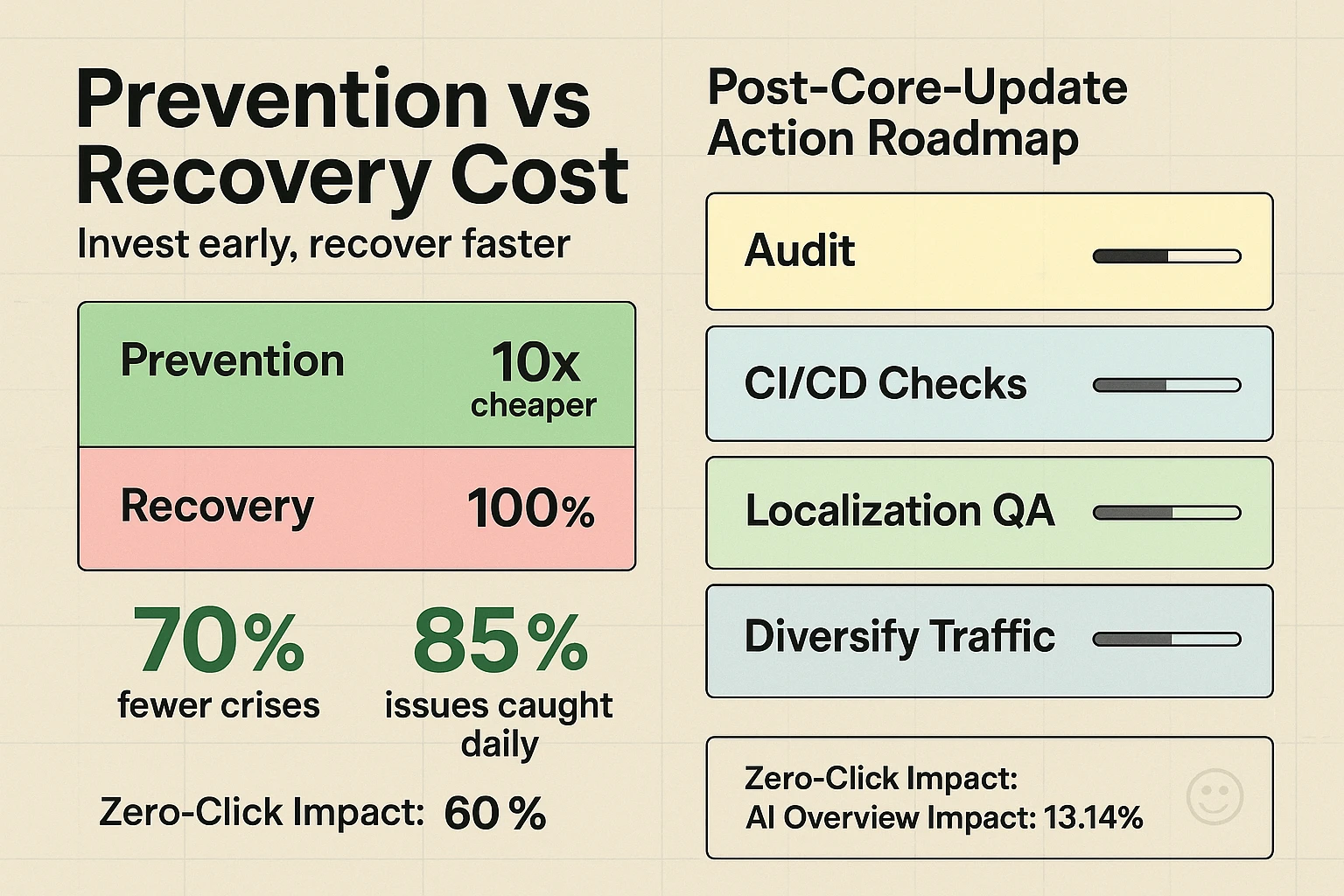
The message is clear: proactive prevention is not just a best practice; it's a financial imperative. Prevention can reduce crises by 70% and allow for 2x faster recovery, costing roughly 1/10th of crisis recovery efforts.
Building Your Global Early Warning System: The PROBE Framework
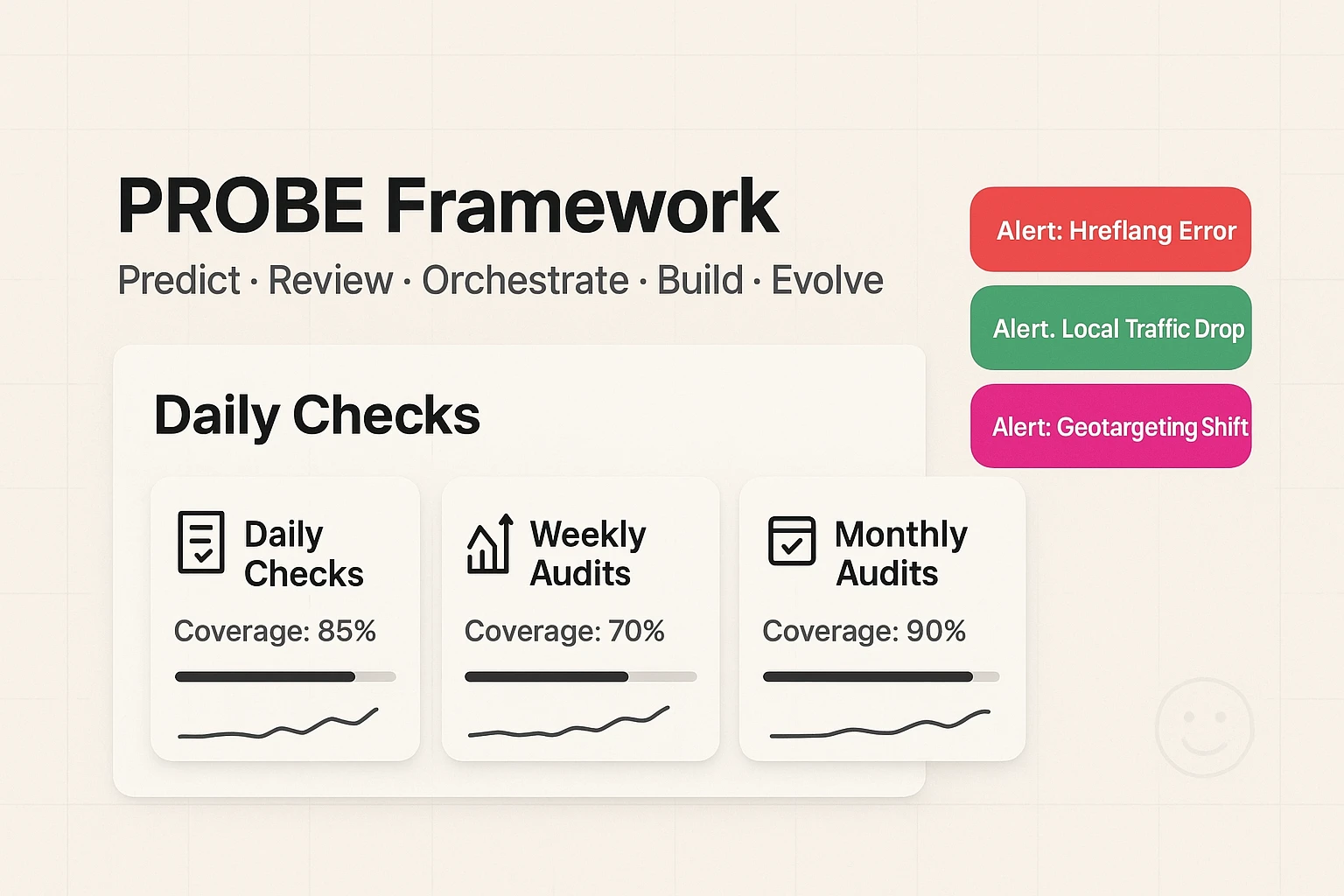
To safeguard your international SEO, you need more than reactive fixes. You need a structured, proactive framework—a strategic approach that allows you to anticipate, detect, and neutralize threats before they escalate. We advocate for the PROBE Framework: Predict, Review, Orchestrate, Build, and Evolve.
This continuous cycle ensures your global digital assets are constantly monitored and optimized.
Three-Tier Monitoring for International Resonance
A robust international SEO monitoring system operates on daily, weekly, and monthly rhythms, integrating AI and automation for unparalleled vigilance.
Daily Checks: Micro-Vigilance for Macro-Impact
- International Google Search Console (GSC) Monitoring: Daily checks for crawl errors, indexed pages (by locale), and sudden traffic drops or increases specific to different language versions. Utilize the URL inspection tool across locales.
- Core International Keyword Rankings: Monitor fluctuations in your most critical keywords in target markets to spot immediate shifts in visibility.
- Automated Alert Systems: Implement custom alerts for hreflang errors, geotargeting shifts, localized traffic drops, and non-Google international SERP changes. This can include monitoring schema markup effectiveness globally to ensure local entities are correctly recognized. Learn more about schema automation here.
Weekly Audits: Deep Dives into Technical Health
- Hreflang Validation: Manually and automatically validate hreflang tags across your international pages. Around 75% of hreflang implementations contain errors, with missing return links being the most common issue. A weekly audit catches these before they delist entire language versions.
- International Backlink Analysis: Monitor new and lost links specific to each market. Identify toxic links by locale that could trigger penalties. AI-powered tools can automate significant portions of this, allowing you to focus on strategic outreach and link profile management. Discover how AI can streamline link building here.
- Localized Content Scraping & SERP Movements: Use tools to scrape localized SERPs for your target keywords. Look for unexpected competitors, algorithm update impacts, or AI Overview dominance in specific markets that could be affecting visibility.
- Compliance & Data Privacy: Ensure your localized content and data collection practices adhere to regional data privacy laws (e.g., GDPR, CCPA), preventing legal crises.
Monthly Comprehensive Audits: Strategic Overhauls & Future-Proofing
- Full Technical International SEO Crawl: A thorough crawl reveals broken links, redirect chains, Core Web Vitals issues (critical for global user experience), and indexability problems across all international versions.
- E-E-A-T Assessment for Localized Content: Evaluate your translated and localized content against Google's Experience, Expertise, Authoritativeness, and Trustworthiness guidelines. This is crucial for "Your Money or Your Life" (YMYL) topics and ensures your content resonates with local audiences and demonstrates local authority.
- Security Vulnerability Scanning: For multi-regional setups, regular scans protect against hacking attempts that can lead to de-indexing or penalties.
- Algorithm Update Preparedness: Review new algorithm announcements (especially core updates) and assess their potential localized impact. Develop contingency plans.
Here's how a decision-ready monitoring panel can look, helping your team prioritize early detection for international sites:
Diagnosing & Recovering from Specific International SEO Crises
While prevention is paramount, every international SEO professional will eventually face a crisis. Understanding its specific nature is the first step to recovery.
Hreflang Implementation Errors: The Silent Traffic Killer
Hreflang is notoriously complex. Errors often go undetected until traffic plummets, yet a study found 31% of international websites have conflicting hreflang directives, and 16% are missing self-referencing tags.
Common Hreflang Catastrophes:
- Missing Return Links: If page A links to page B in another language, page B must link back to page A. Without this, your hreflang tags are ignored.
- Incorrect ISO Codes: Using the wrong language (
lang) or region (x-default) codes. - Canonical Conflicts: Pointing a canonical tag to a different language version. Google gets confused.
- Self-Referencing Errors: The current page must also have an hreflang tag pointing to itself.
- Broken URLs in Hreflang: Tags pointing to 404 pages.
Diagnosis & Recovery Playbook:
- GSC International Targeting Report: Your first stop. Look for any warnings or errors.
- Screaming Frog SEO Spider: For large sites, crawl your entire international site. Look for hreflang tag issues, canonical conflicts, missing return tags, and incorrect ISO codes.
- Semrush Site Audit: Another powerful tool that flags common hreflang errors.
- Prioritization: Start with pages experiencing the most significant traffic drops.
- Automated Validation: Integrate hreflang validation into your CI/CD pipeline for new international page deployments. This prevents future errors at scale.
Here's a step-by-step hreflang diagnosis and recovery visual that helps technical teams prioritize remediation:

Incorrect Geotargeting Penalties: Steering Google to the Right Audience
Misconfigured geotargeting can lead to your content appearing in the wrong regions, resulting in high bounce rates and poor performance, eventually leading to a drop in rankings or even a manual penalty.
Identifying Geotargeting Issues:
- Google Search Console: Check for manual actions related to cloaking or sneaky redirects. Review international targeting settings.
- Server Location: If your server is in a different country than your target audience, it can send conflicting signals.
- IP Redirection: Automatically redirecting users based on IP address without offering a choice can be problematic.
- ccTLDs vs. Subdomains/Subfolders: Understand the signals: ccTLDs (.de, .fr) are the strongest geotargeting signal. Subdomains (es.example.com) and subfolders (example.com/es/) are strong when supported by GSC settings and other signals.
Recovery Playbook:
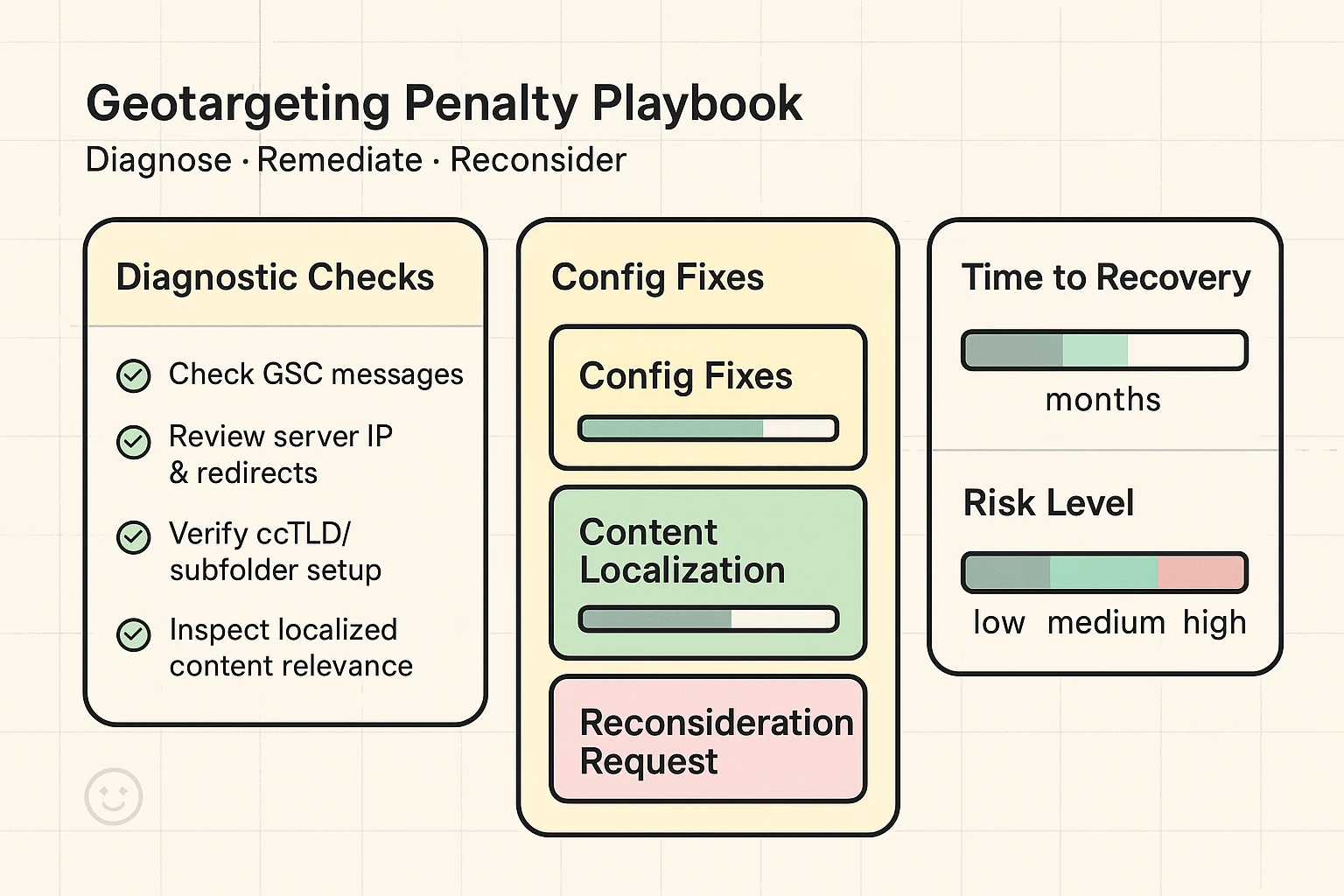
- Verify GSC Settings: Ensure your target country is correctly set for appropriate site sections.
- Harmonize Signals: Align your ccTLD, server location, GSC settings, and hreflang annotations. Consistency is key.
- Review Content Relevance: Does your content truly cater to the target locale? Is the currency, address, and local references accurate?
- Remove Aggressive IP Redirection: If you must redirect, offer users a clear option to switch back to their preferred country/language.
- Reconsideration Request: If it’s a manual penalty, submit a detailed reconsideration request after fixing all issues.
This practical playbook outlines diagnostic checks, prioritized fixes, and expected time-to-recovery for incorrect geotargeting penalties. It's useful for stakeholder alignment and efficient resource allocation.
Localized Content Quality Issues: The E-E-A-T Imperative
Google’s emphasis on Experience, Expertise, Authoritativeness, and Trustworthiness (E-E-A-T) extends to localized content. Machine translation without human review, or content that simply isn't culturally relevant, can cripple your international rankings. Google's quality guidelines suggest content quality issues cause more traffic drops than technical problems.
Issues to Address:
- Machine Translation Pitfalls: While efficient, raw machine translation often lacks cultural nuance, appropriate tone, and can misunderstand local idioms or search intent.
- Lack of Local Expert Input: Content that doesn't demonstrate local experience or expertise will struggle to gain traction and trust.
- Duplicate Content Across Locales: Generic content slightly tweaked for different regions can be seen as low quality or even duplicate, especially without proper hreflang and canonicalization strategies.
Strategies for Scalable Content Quality Assurance:
- Native Speaker Review: Employ native speakers for every target language to review and localize, not just translate, your content.
- Localized Keyword Research: Conduct thorough AI-powered keyword and content gap analysis for each market. What resonates in France might not in Quebec.
- E-E-A-T Signals: Integrate local testimonials, author bios with relevant regional expertise, and local brand mentions to boost perceived quality and authority.
- Continuous Localization Process: Implement workflows for ongoing content updates that involve local teams, ensuring your content stays fresh and relevant. AI tools can significantly aid in generating and optimizing SEO content at scale.
Adapting International SEO Strategy Post-Core Updates
Core algorithm updates are a regular occurrence, but their impact on international sites can be disproportionate. What works for one market might penalize another.
Analyzing Localized Impact:
- Traffic Disparities: Post-update, observe which language versions or regional subdomains experience the most significant traffic and ranking shifts. This helps pinpoint specific localized issues.
- E-E-A-T Audit: Core updates often reinforce E-E-A-T. Re-evaluate your localized content for quality, author credentials, and trustworthiness.
- Technical Health: Ensure Core Web Vitals are strong across all international versions, as performance can vary by region due to server locations or CDN configurations.
Recovery & Adaptation:
- Content Refinement: Focus on enhancing the helpfulness and E-E-A-T of your localized content. This might mean adding specific local examples, expert quotes, or integrating local data.
- Improve User Experience: Optimize for mobile-first indexing in all markets and ensure fast loading times through CDNs optimized for global users.
- Diversify Traffic Channels: In an era of AI Overviews, where organic CTRs can plummet, diversifying your traffic sources (email, social, direct local outreach) becomes even more critical.
Ensuring Consistent International SERP Visibility: Beyond Google
While Google dominatesmany markets, a truly global strategy means extending your visibility beyond a single search engine and considering the nuances of regional search behavior and local regulations.
Multi-Engine Optimization:
- Baidu (China), Yandex (Russia), Naver (South Korea): Each has unique ranking factors, content preferences, and technical requirements. Your strategy for these engines will differ significantly from Google.
- AI Overviews vs. Traditional SERPs: As AI Overviews roll out unevenly, optimize for both. For markets with high AI Overview adoption, structure your content to be "answer-ready." For others, focus on traditional organic tactics. For insights on AI-driven SEO automation, read our full AI SEO Automation Guide.
Leveraging Local Signals:
- Local Link Building: Build authority through local partnerships, .gov or .edu links specific to each target country.
- Local Directories & Citations: Ensure consistent NAP (Name, Address, Phone) across local business listings. Explore AI for local SEO visibility to enhance this.
- Cultural Content Adaptation: Truly localized content connects with users, increasing engagement and signalling relevance to search engines.
Here's a cost-and-action dashboard illustrating prevention's ROI versus recovery and a clear post-update roadmap for auditing and traffic diversification:
The ROI of Prevention: Why Proactive International SEO Wins
The decision to invest in proactive international SEO isn't just about avoiding disaster; it's about maximizing return on investment.
- Cost Savings: Websites with daily monitoring catch 85% of negative SEO attacks within 48 hours. Businesses with documented response plans experience 50% less downtime and recover 40% faster. Simply put, prevention costs about 1/10th of what recovery does.
- Competitive Advantage: While competitors are scrambling to recover from preventable crises, you'll be leveraging consistent international SERP visibility and expanding into new markets.
- Sustainable Growth: A resilient international SEO strategy supports long-term revenue growth and reduces the risk of sudden, catastrophic traffic declines.
Frequently Asked Questions
Q1: With AI Overviews, is international SEO still worth the investment?
Absolutely. While AI Overviews present challenges, organic search continues to be a cornerstone of digital strategy, driving 53% of overall website traffic and offering 5x better cost-effectiveness than paid ads. International markets often have different AI adoption rates, making a diversified, localized SEO strategy crucial for capturing both AI-driven and traditional search traffic.
Q2: How can I convince my stakeholders to invest in proactive international SEO?
Focus on the financial impact. Share research showing that prevention reduces crises by 70%, leads to 2x faster recovery, and costs 1/10th of reactive fixes. Highlight the median 10% traffic decline seen by companies without proactive measures, and the potential 61% CTR drop from AI Overviews. Position proactive SEO as risk mitigation and a driver of sustainable international revenue. Using AI for SEO reporting dashboards can also help visualize this ROI.
Q3: What's the biggest international SEO crisis I should prioritize preventing?
Hreflang implementation errors. With 75% of implementations containing issues, this is a rampant problem that can silently delist entire language versions. A robust monitoring system and automated validation for hreflang should be a top priority.
Q4: How do I manage localized content quality at scale for many regions?
Invest in a continuous localization workflow that goes beyond simple translation. This includes native speaker review, localized keyword research, and ensuring your content demonstrates E-E-A-T specific to each culture. AI can assist with content generation but requires human oversight for cultural nuance and quality assurance.
Q5: Is it possible to optimize for both Google and non-Google international search engines effectively?
Yes, but it requires a tailored approach. While some SEO principles are universal, engines like Baidu and Yandex have unique ranking factors. Your strategy must be diversified, understanding regional search behaviors, specific technical requirements, and local content preferences for each major engine in your target markets. Consider BenAI's holistic AI marketing solutions for this complexity.
Your Path to International SEO Resilience Starts Here
Navigating the complexities of international SEO in the age of AI requires expertise, advanced tools, and a proactive mindset. Simply reacting to problems is no longer a viable strategy for businesses aiming for global dominance.
At BenAI, we empower businesses to become AI-first, leveraging cutting-edge solutions to detect, prevent, and recover from international SEO crises with confidence. Whether it's custom AI implementations for enterprise-level challenges, specialized AI marketing solutions, or comprehensive training, we provide the systems and guidance to secure your global digital future.
Don't let preventable crises erode your international growth. Take the first step towards a resilient, AI-powered international SEO strategy. Contact us today to discuss your specific needs and let us help you build an international SEO fortress.
Join Our Growing AI Business Community
Get access to our AI Automations templates, 1:1 Tech support, 1:1 Solution Engineers, Step-by-step breakdowns and a community of forward-thinking business owners.

Latest Blogs
Explore our latest blog posts and insights.