The buzz around artificial intelligence is everywhere, but as you evaluate solutions for your business, you're likely asking a more critical question: How do we move beyond theory to achieve truly intelligent automation? It's not enough to simply automate — you need systems that can think, learn, and adapt, transforming your operations rather than just optimizing them.
This isn’t about replacing human effort with basic scripts; it’s about strategically integrating advanced AI with Robotic Process Automation (RPA) to build systems that scale, improve, and deliver measurable impact. At BenAI, we understand that bridging this gap requires a clear methodology, deep technical insight, and a partnership approach that ensures your AI investments translate into tangible growth and efficiency.
The Dawn of Truly Intelligent Automation
For years, Robotic Process Automation has been a game-changer for businesses, streamlining repetitive tasks and driving efficiency. But traditional RPA, while powerful, has its limits. It’s inherently rule-based, struggling with unstructured data, dynamic environments, and complex decision-making. This is where the convergence with advanced AI comes in, ushering in an era of Intelligent Automation (IA).
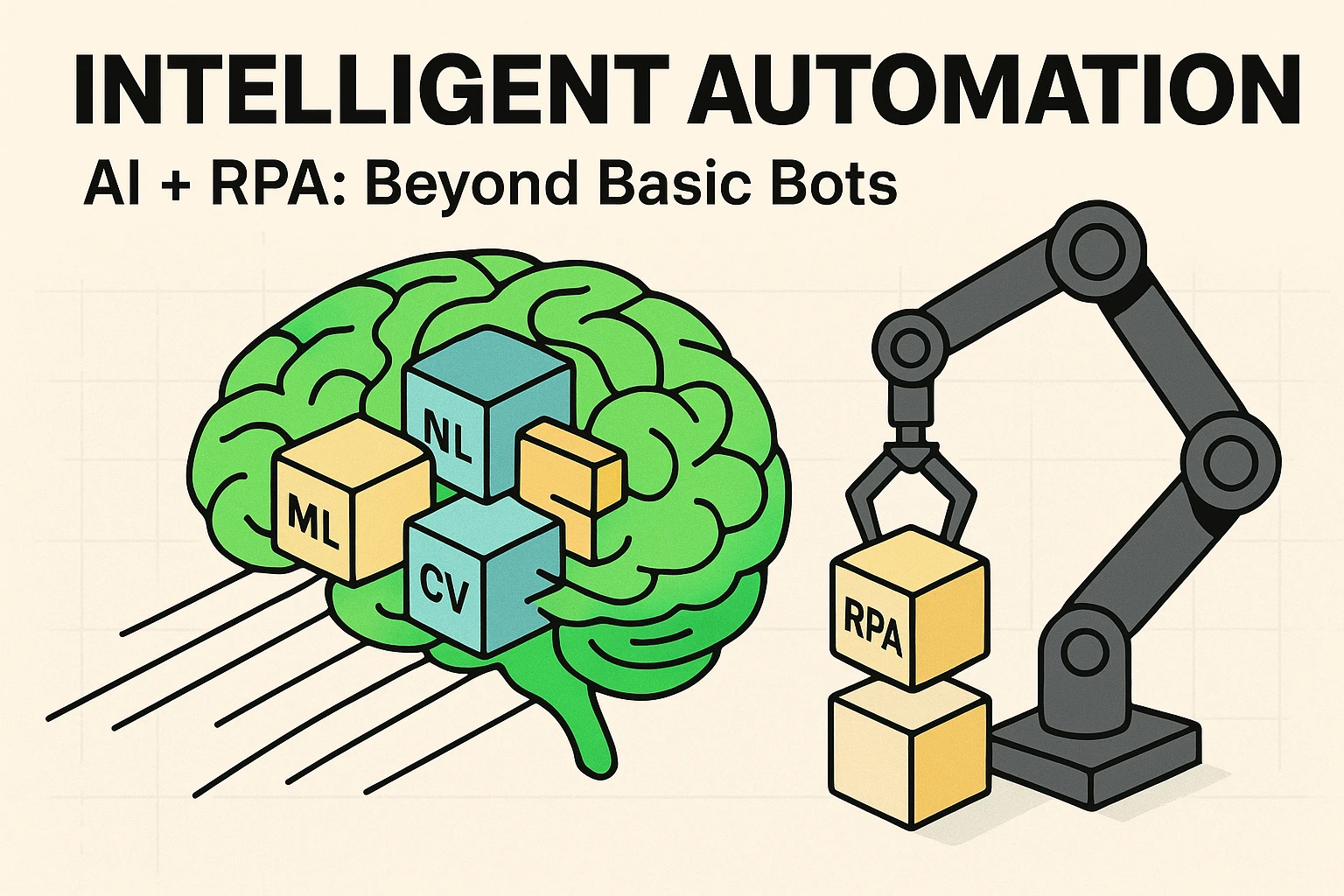
Intelligent Automation is the strategic fusion of RPA with cognitive AI capabilities like Machine Learning (ML), Natural Language Processing (NLP), and Computer Vision (CV). This powerful combination allows automation to move beyond simple, structured processes to tackle complex, cognitive tasks, understand context, and even learn from experience. The market reflects this shift: the Intelligent Process Automation (IPA) market is projected to reach an astounding $47.18 billion by 2033, while the broader Global Intelligent Automation market is expected to hit $115.17 billion by 2034. Meanwhile, the RPA market itself is anticipated to surge from $3.79 billion in 2024 to $30.85 billion by 2030, underscoring the massive investment and growth in this space. Businesses are seeing significant returns, with automated tasks leading to 50-70% reductions in processing time and 20-35% annual cost savings.
BenAI helps you harness this evolution, transforming your operations into an "AI-first" entity. We don’t just implement tools; we engineer comprehensive systems that learn, adapt, and drive continuous improvement, creating capacity without increasing headcount.
Decoding the "Brains" of Automation: AI Components in Synergy with RPA
The real power of intelligent automation lies in how specific AI components enhance and extend RPA's reach. It's not just about adding AI; it's about strategically integrating these cognitive abilities to create more robust, adaptable, and valuable automated workflows.
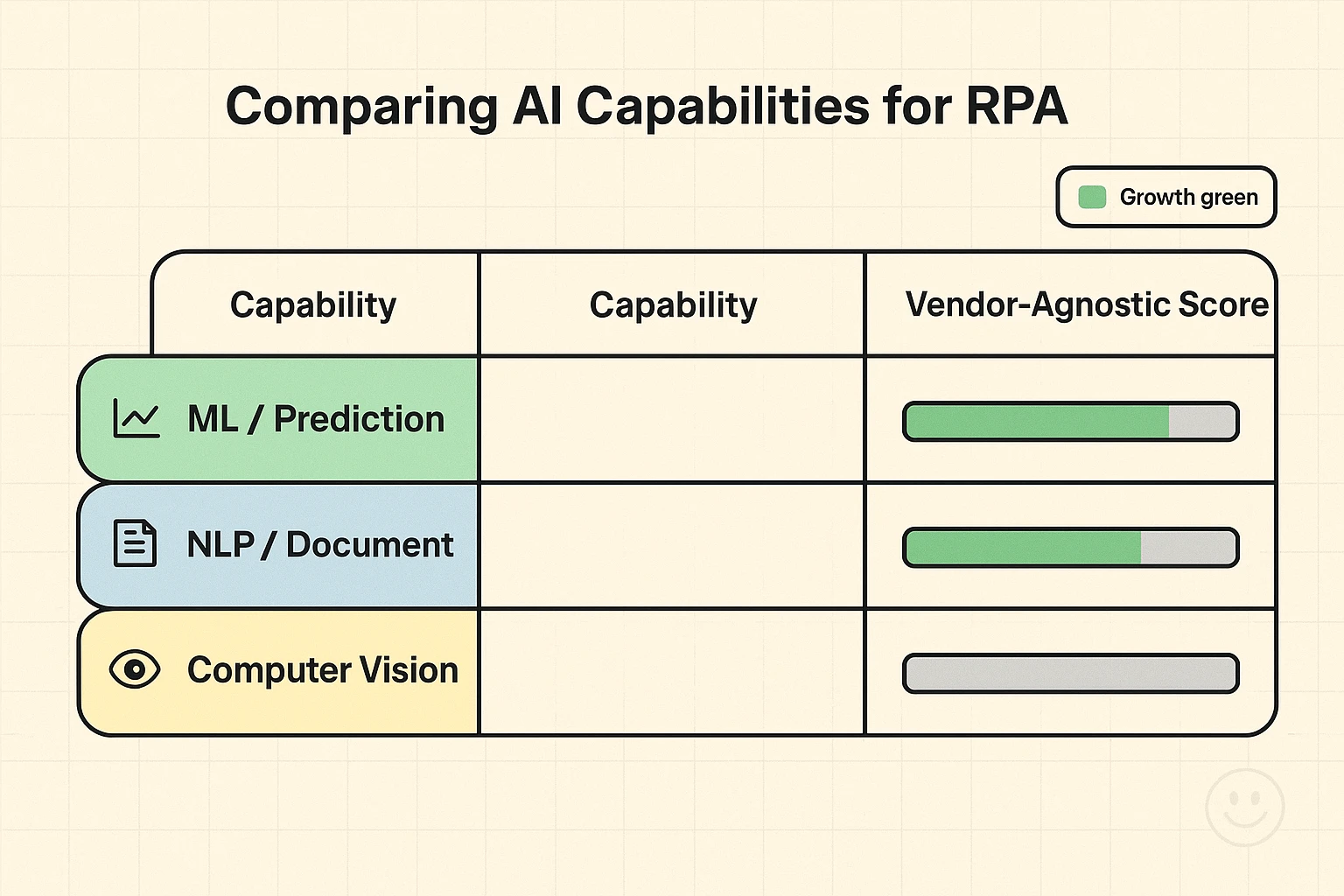
Machine Learning (ML): The Power to Predict and Adapt
Machine Learning gives your RPA bots the ability to learn from data, identify patterns, and make informed predictions. Historically, RPA could only follow predefined rules. With ML, it can:
- Predictive Maintenance: Automate monitoring of industrial equipment, predict potential failures based on sensor data, and trigger maintenance alerts.
- Fraud Detection: Analyze transaction patterns in real-time to flag unusual activity, enhancing financial compliance workflows.
- Dynamic Decision-Making: Adapt process steps based on evolving scenarios, for example, prioritizing customer support tickets based on predictive urgency.
This moves RPA from a reactive tool to a proactive, intelligent agent, significantly improving accuracy and efficiency.
Natural Language Processing (NLP): Understanding the Unstructured World
A significant limitation of traditional RPA is its inability to process unstructured data, which forms the vast majority of business information (emails, documents, voice notes). NLP bridges this gap by enabling RPA to:
- Intelligent Document Processing (IDP): Extract, classify, and validate information from invoices, contracts, and legal documents regardless of their format. This is a game-changer for finance, legal, and HR departments.
- Sentiment Analysis: Analyze customer feedback from emails or social media to prioritize responses or identify emerging trends.
- Dynamic Content Generation: Power AI agents to personalize communication, like tailoring LinkedIn messages based on recipient profiles, which can be seen in advanced automations for outreach.
Computer Vision (CV): Seeing is Automating
Computer Vision empowers RPA bots to "see" and interpret visual data, much like a human. This opens up automation possibilities in areas previously considered too complex:
- Visual Inspection and Quality Control: Automatically detect defects in manufacturing, monitor product quality, or verify compliance in retail displays. For instance, an AI-driven quality control guide can illustrate how this is implemented.
- Data Extraction from Screenshots/Images: Process information from legacy systems that lack APIs, by directly interpreting screen content.
- Biometric Verification: Enhance security protocols by using facial recognition or fingerprint scanning in automated access control systems.
Generative AI (GenAI): Creative and Contextual Content
Generative AI, especially large language models (LLMs), is the latest frontier, allowing automation to create original content and engage in more human-like interactions:
- Automated Content Creation: Generate marketing copy, product descriptions, or even internal reports based on provided prompts and data.
- Adaptive Communication: Create personalized email responses or customer service chat interactions that feel human and contextually relevant.
- Knowledge Base Augmentation: Automatically summarize complex documents or create FAQs, keeping knowledge bases up-to-date and improving internal resource accessibility.
By weaving these AI capabilities into RPA, businesses can transform their operations. For example, a marketing agency could leverage these components to build an entire marketing team with 37 AI agents, automating everything from content creation to engagement.
The Master Plan: Identifying & Prioritizing Tasks for Intelligent Automation
The success of intelligent automation hinges on applying these technologies to the right problems. Not every process needs advanced AI, and misidentifying opportunities can lead to wasted resources. Moving beyond simply "repetitive tasks," we consider critical factors like data variability, decision complexity, and business impact.
Framework for Task Suitability
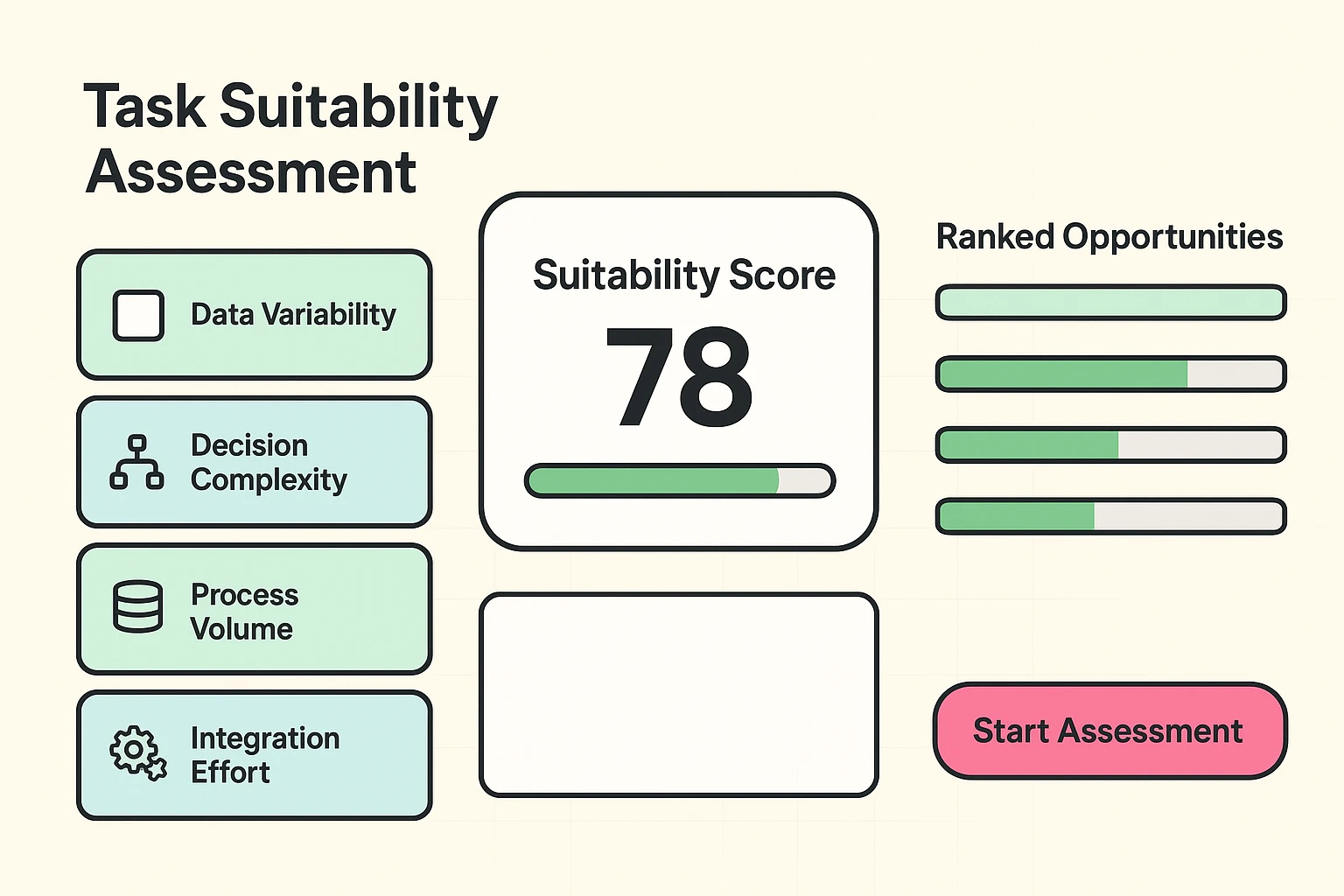
To effectively identify opportunities, consider a matrix that evaluates:
- Data Variability: How structured or unstructured is the data involved?
- Decision Complexity: Are decisions rule-based, or do they require judgment, pattern recognition, or prediction?
- Process Stability: How often does the process change? High change means higher maintenance for traditional RPA.
- Transaction Volume & Frequency: High volume, high frequency jobs are ideal candidates for efficiency gains.
- Business Impact: What's the potential ROI, compliance benefit, or customer experience improvement?
Process Mining & Discovery
Tools and methodologies like process mining are crucial here. They analyze system logs and user interactions to map existing workflows, identify bottlenecks, and pinpoint high-value automation opportunities. This objective data helps organizations prioritize pilots effectively.
Case Studies in Action
Consider these real-world examples:
- Finance: Rather than just processing invoices, IA can read, understand, and validate invoices (using NLP), match them to purchase orders (RPA), and flag discrepancies for human review (ML anomaly detection).
- HR: Automating candidate screening in recruiting firms can go beyond keyword searches. RPA can pull resumes, NLP can analyze content for fit and sentiment, and ML can predict candidate success based on historical data, significantly enhancing AI recruiting solutions.
- Supply Chain: AI-enabled RPA can monitor inventory levels, predict demand fluctuations (ML), and automatically reorder supplies, even processing complex supplier contracts (NLP).
Effectively identifying suitable tasks is crucial for realizing the significant benefits of intelligent automation, which often include substantial cost savings and accelerated processing times.
Building the Intelligent Workforce: AI-RPA Integration Methodologies
Integrating various AI components with RPA isn't a one-size-fits-all endeavor. It requires careful architectural planning and robust data governance to ensure seamless operation and trustworthy outcomes.
Architectural Patterns
Successful integration often involves one of the following approaches:
- API-first Integration: This is the most common and robust approach. AI services (like cognitive APIs for NLP or ML models) expose their functionalities via APIs, which RPA bots then call upon as part of their workflow. This ensures modularity and scalability.
- Microservices Approach: For more complex scenarios, specific AI functions (e.g., a custom ML model for sentiment analysis) can be deployed as standalone microservices. This allows for independent development, deployment, and scaling of these cognitive capabilities, invoked by RPA as needed.
- Low-Code/No-Code Platforms: Platforms like n8n or Make are emerging as powerful orchestrators, allowing users to visually build workflows that connect RPA tools with AI services without extensive coding. This accelerates development and democratizes sophisticated automation.
- Embedded AI: Some advanced RPA platforms now offer native AI capabilities (e.g., built-in computer vision or ML models). This simplifies integration but may limit customization.
Data Pipelines & Governance
Intelligence is only as good as the data it's fed. Establishing robust data pipelines is paramount:
- Data Collection & Cleaning: RPA can play a key role in collecting data from various sources and preparing it for AI models, but quality checks are essential to prevent "garbage in, garbage out."
- Secure Data Flow: Ensure data transfer between RPA and AI components is secure and compliant with data privacy regulations (e.g., GDPR, CCPA).
- Model Monitoring: Continuously monitor AI model performance and data drift. If inputs change, model accuracy can degrade, impacting automated decisions. Strong AI governance frameworks are critical for understanding the business context and ensuring contextual refinement.
Human-in-the-Loop (HITL) Design
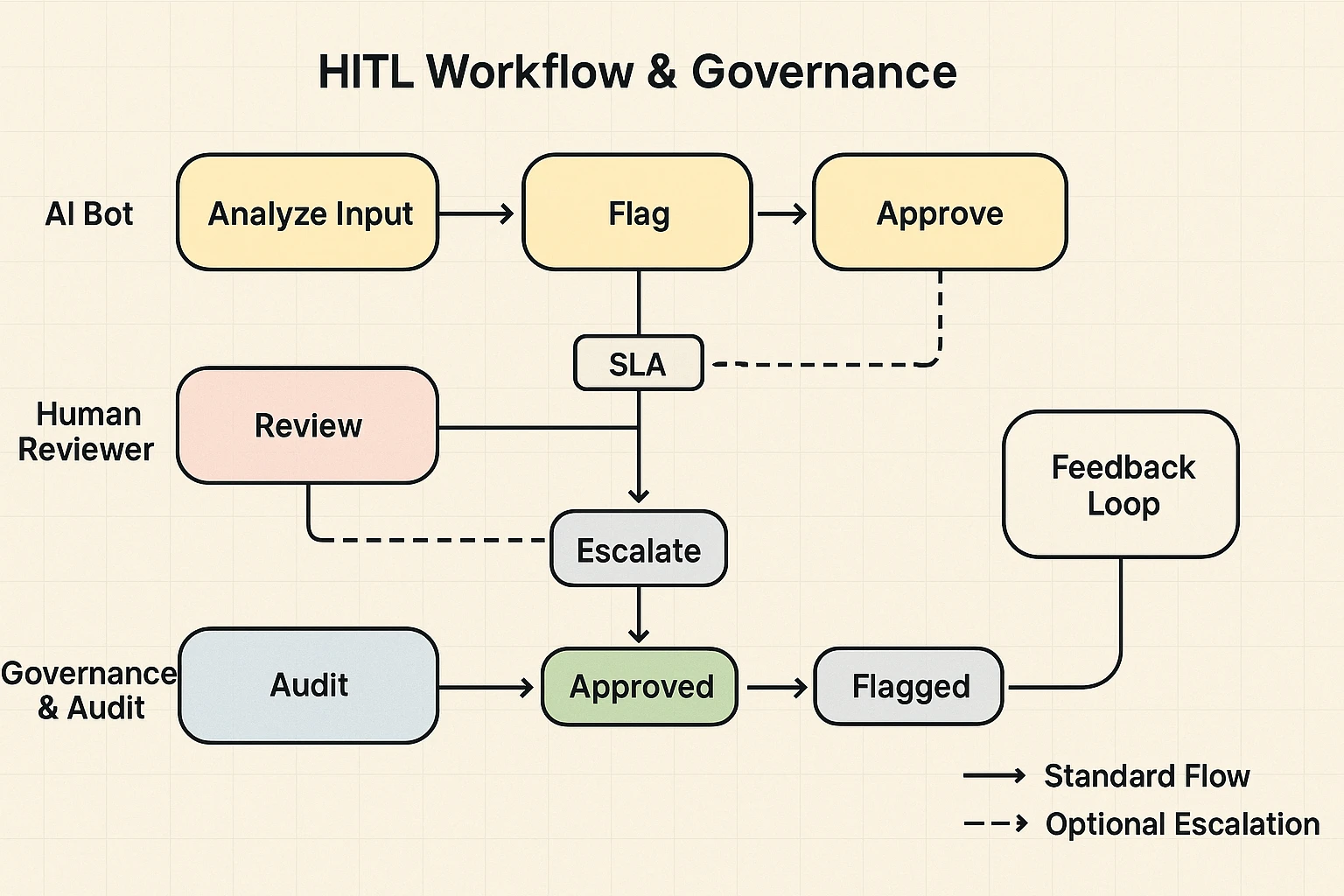
Even the most advanced AI needs human oversight, especially in critical or exception-handling scenarios. Human-in-the-Loop (HITL) processes are not a weakness but a strategic advantage, ensuring ethical AI decisions, continuous learning, and error rectification.
- When to Intervene: Design clear thresholds for human review. For instance, if an AI model's confidence score for a decision falls below a certain percentage, it flags the item for a human.
- Feedback Loops: Humans provide corrections or approvals, which are fed back into the AI model for continuous learning and improvement. This iterative process refines model accuracy over time.
- Augmentation, Not Replacement: Remember that AI automation, as highlighted by Salesforce, views generative AI as a tool to free up desk workers for more strategic tasks. Microsoft emphasizes hyperautomation empowering employees without replacing human judgment. This human-centric approach is key to successful long-term adoption.
Integrating these elements systematically creates an intelligent, resilient, and adaptive automation environment, ensuring that your AI investments deliver consistent value.
The Evolution of Automation: From RPA to Agentic AI and Hyperautomation
The landscape of intelligent automation is constantly evolving, pushing the boundaries beyond simple task execution. Understanding emerging concepts like agentic AI and hyperautomation is crucial for future-proofing your strategy.
Understanding Agentic AI
Traditional RPA and even basic AI-RPA integrations often follow defined workflows or respond to specific prompts. Agentic AI takes this a step further:
- Autonomous Decision-Making: AI agents are designed to pursue a goal autonomously, breaking down complex problems into smaller tasks, making decisions, and even correcting their own course. They move beyond simple scripts to dynamic, goal-oriented action, making them the "next frontier" according to UiPath.
- Orchestration of Tools: An agentic AI might orchestrate multiple specialized AI models, RPA bots, and external tools to achieve a complex objective. For example, an agent could manage an entire marketing campaign from conceptualization to execution, leveraging different AI services for content generation, scheduling, and performance analysis.
- Self-Correction & Learning: These agents are built to learn from their outcomes and adjust their strategies, developing a more sophisticated understanding of how to achieve their goals over time.
Hyperautomation Strategies
Hyperautomation isn't just about automating more processes; it's about a holistic, enterprise-wide approach to automate everything that can be automated, integrating various tools and technologies. Gartner predicts that hyperautomation will impact one-fifth of all business processes by 2025.
- Orchestrating Multiple Bots: This involves managing a fleet of RPA bots and AI agents that work together across different systems and departments.
- Process Mining for End-to-End Automation: Beyond individual tasks, hyperautomation focuses on optimizing entire workflows. Process mining uncovers inefficiencies and opportunities for complete end-to-end automation.
- Intelligent Workflows: These workflows use AI to make informed decisions at every stage, adapting to real-time changes and continuously optimizing process flow.
- Future Trends: As hyperautomation matures, we'll see more proactive problem-solving by automated systems and self-healing automations that can detect and resolve issues without human intervention. The shift is also towards cloud infrastructure, with over 20% of RPA initiatives moving to cloud by 2025, enabling greater scalability and flexibility.
By embracing agentic AI and hyperautomation, businesses can achieve a level of operational intelligence and efficiency that was previously unimaginable. This isn't just about incremental improvements; it's about fundamentally reshaping how work gets done.
Navigating the Landscape: Choosing the Right Platforms & Managing Challenges
Choosing the right intelligent automation platforms and effectively managing implementation challenges are critical for realizing your AI-driven vision. Many solution providers, like Salesforce, Microsoft, and UiPath, offer robust platforms, but a vendor-agnostic approach is essential for long-term success.
Evaluation Criteria for AI-RPA Tools
Beyond marketing claims, assess platforms based on:
- Scalability: Can the solution grow with your business needs without prohibitive costs or performance bottlenecks?
- Integration Capabilities: How easily does it integrate with your existing IT infrastructure (legacy systems, CRMs, ERPs)? API readiness is key.
- Ease of Use/Development: Does it offer low-code/no-code options for citizen developers, or is it exclusively for highly specialized engineers?
- Support Ecosystem: What kind of vendor support, community forums, and training resources are available?
- Security & Compliance: Does it meet your industry's data security and regulatory compliance standards? This is especially critical for sensitive data.
- Ethical AI Considerations: Does the platform offer tools for bias detection, explainability, and auditing of AI decisions?
Common Challenges & Solutions
Intelligent automation projects are complex, and challenges will arise. Being prepared helps mitigate risks:
- Data Silos & Quality: Disparate data sources and poor data quality cripple AI. Solution: Invest in unified data platforms and robust data governance policies early.
- Algorithm Bias: AI models can perpetuate or amplify biases present in training data, especially critical in HR automation. Solution: Implement diverse training data, bias detection tools, and human review for sensitive decisions; always incorporate a robust AI governance framework.
- Integration with Legacy Systems: Connecting modern AI/RPA with outdated systems can be difficult. Solution: Plan for API wrappers, screen scraping (where necessary), and potentially phased modernization.
- Skill Gaps: Your team may lack the expertise in AI, RPA, or data science. Solution: Invest in comprehensive training for your workforce, or partner with experts who can bridge these gaps.
- Cost Management: Initial investment can be significant. Solution: Start with pilot projects that demonstrate clear, measurable ROI, using the learnings to secure further investment.
- Vendor Lock-in: Over-reliance on a single vendor's proprietary tools can limit flexibility. Solution: Prioritize platforms with open APIs and support for open-source AI components.
Strategic Change Management
Technology alone won't deliver results. Organizational change management is paramount:
- Overcoming Resistance: Address employee fears head-on. Position AI as an "assistant" that augments human capabilities, freeing them for higher-value work, rather than a replacement.
- Fostering an "AI-Ready" Culture: Encourage experimentation, continuous learning, and collaboration between business and IT teams. Conducting an AI readiness assessment can help identify and address critical organizational context and strategic planning needs.
By proactively addressing these areas, you can turn potential obstacles into stepping stones toward successful intelligent automation.
Conclusion: Your Roadmap to Intelligent Automation Dominance
The convergence of RPA and advanced AI is no longer a futuristic concept; it’s a present-day imperative for businesses aiming for significant growth and efficiency. The market data is clear: intelligent automation is transforming industries, with organizations achieving substantial reductions in processing times and significant cost savings. However, realizing these benefits demands a strategic, well-planned approach that moves beyond simple automation to truly intelligent, adaptive systems.
At BenAI, we provide the expertise and proven systems to guide you through this complex landscape. We empower you to:
- Strategic Task Identification: Pinpoint the most impactful processes for intelligent automation.
- Seamless AI-RPA Integration: Design and implement robust architectures that blend RPA with ML, NLP, CV, and Generative AI.
- Effective Human-in-the-Loop Processes: Ensure ethical, compliant, and continuously improving automated workflows with the right level of human oversight.
- Scalable & Future-Proofed Solutions: Plan for agentic AI and hyperautomation, building systems that evolve with your business needs.
This isn't just about implementing new technology; it's about a fundamental shift in how your business operates, making it "AI-first" and ready for the future.
Ready to transform your business with Intelligent Automation?
We invite you to explore our specialized solutions:
- AI Marketing Solutions: Discover how to automate service delivery and scale your agency
- AI Recruiting Solutions: Streamline hiring processes with advanced AI
- Enterprise Solutions: For custom AI implementations, training, and consulting tailored to your large organization
Or, if you’re looking to dive deeper and build an AI-first business from the ground up, consider joining our Ben AI Accelerator for structured courses, unlimited 1:1 help, and networking.
Here's to your AI-first future.
Frequently Asked Questions (FAQs)
Q1: What's the core difference between traditional RPA and Intelligent Automation?
A: Traditional RPA is rule-based and performs repetitive tasks on structured data. Intelligent Automation, however, integrates RPA with cognitive AI (like ML, NLP, CV) to handle unstructured data, make complex decisions, learn from experience, and adapt to changing environments. It's the difference between doing a task mechanically and understanding/improving it.
Q2: Is Intelligent Automation only for large enterprises?
A: Not at all. While large enterprises lead in complex custom implementations, businesses of all sizes can benefit. For instance, small to medium-sized marketing agencies can use AI to reduce manual SEO workflows, personalize LinkedIn outreach, or automate international SEO expansion. Many low-code/no-code platforms make intelligent automation accessible for smaller teams.
Q3: How do we choose the right AI and RPA platforms for our needs?
A: The best approach is vendor-agnostic. Focus on your specific business problems, data types, and desired outcomes. Evaluate platforms based on scalability, integration capabilities (especially with legacy systems), ease of use, security features, and the availability of strong support. A comprehensive assessment should also consider ethical AI implications and the platform's ability to support human-in-the-loop processes.
Q4: What does "Human-in-the-Loop" (HITL) mean, and why is it important?
A: HITL refers to a system where human intervention is strategically incorporated into automated workflows. It's crucial for managing exceptions, validating AI decisions, ensuring ethical considerations, and providing feedback for continuous machine learning. Rather than replacing humans, HITL augments human capabilities, allowing AI to handle routine tasks while humans focus on complex problem-solving and strategic oversight.
Q5: How long does it take for businesses to see ROI from Intelligent Automation?
A: The timeframe for ROI varies based on the complexity of the implementation and the processes automated. However, businesses frequently report significant benefits quickly. Studies indicate that automated tasks can lead to 50-70% reductions in processing time and 20-35% annual cost savings. Starting with high-impact, well-defined pilot projects can quickly demonstrate value and accelerate investment in broader initiatives.
Join Our Growing AI Business Community
Get access to our AI Automations templates, 1:1 Tech support, 1:1 Solution Engineers, Step-by-step breakdowns and a community of forward-thinking business owners.
Latest Blogs
Explore our latest blog posts and insights.