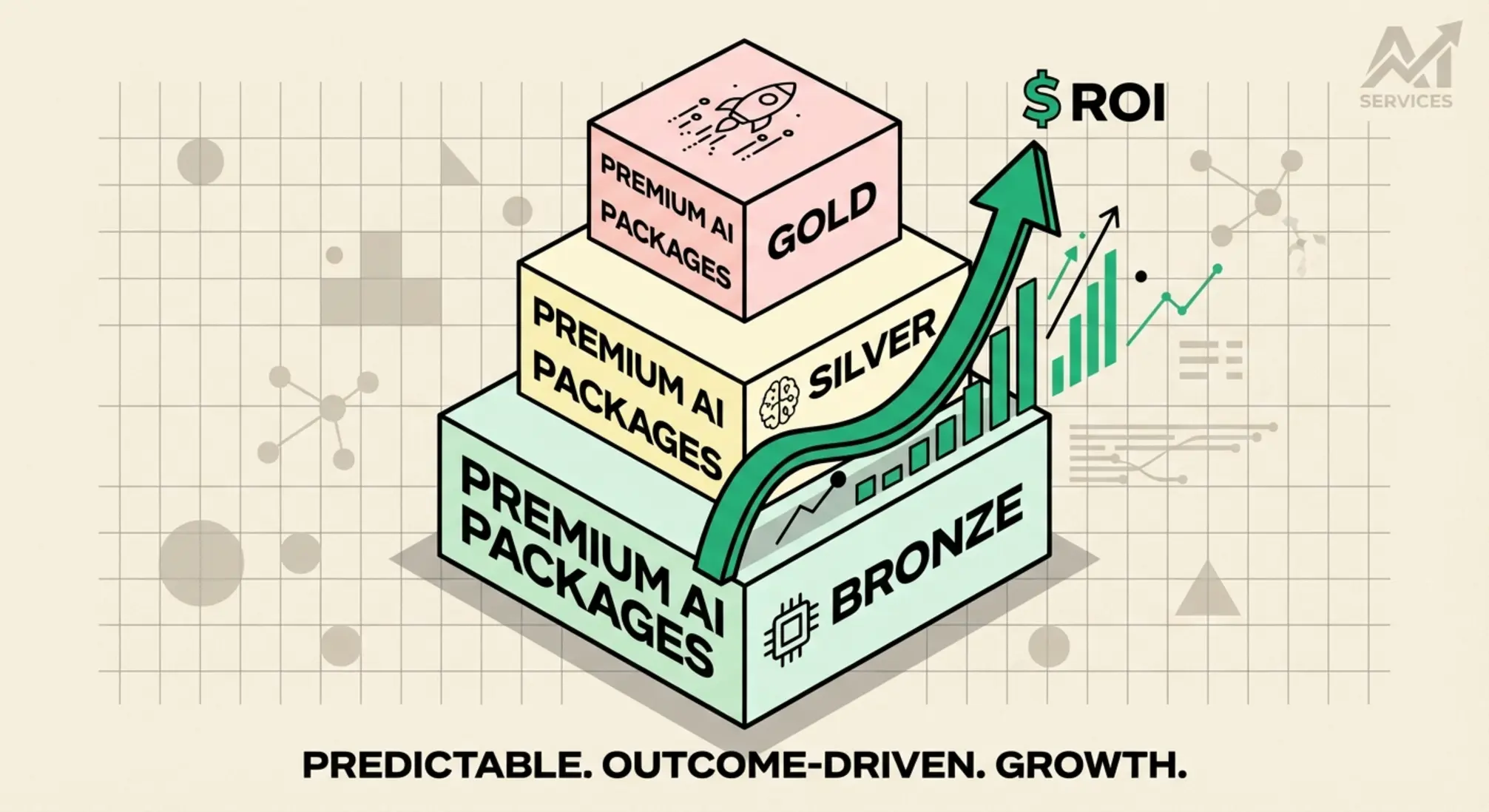
Unlocking the AI-First Future: A Blueprint for Transforming Concepts into Concrete Solutions
You’re past the initial hype of AI. You’ve grasped its potential to reshape your business, driving automation, efficiency, and growth without simply adding headcount. Now, you’re in the critical evaluation phase, grappling with the tangible challenge: how do you translate that vast potential into a practical, working AI solution tailored precisely for your needs? This isn't about theoretical discussions; it's about building.
This Middle-of-the-Funnel guide is designed for decision-makers like you, actively comparing solutions to design and prototype AI systems that truly deliver. We’ll cut through the noise, providing a clear blueprint for moving from an abstract business problem to a deployable, intelligent system.
Why Solution Design and Prototyping Are Non-Negotiable
The journey from an AI idea to a successful implementation is fraught with challenges. Data quality, integration complexity, and explainability are persistent hurdles [3]. Without a robust design and prototyping phase, you risk investing heavily in solutions that don’t align with your business objectives, perform poorly, or fail to integrate with existing processes. According to Deloitte, infrastructure integration (35%) and workforce skills/readiness (26%) are significant barriers to AI adoption, underscoring the need for meticulous planning [1].
Our focus here is on crafting a solution blueprint that minimizes these risks, ensuring your AI initiatives are built on a solid foundation. This is where strategic thinking meets practical execution.
The AI Prototyping Blueprint: From Business Need to Functional AI Solution
Building an AI solution isn’t merely about choosing a model; it's an iterative development process that demands continuous refinement [5]. It starts long before any code is written or tool is selected, by deeply understanding the problem you're trying to solve.
Phase 1: Requirements Gathering – Uncovering True Business Value
Before you can build an AI solution, you need to clearly define the problem it addresses and the value it will create. This phase is about strategic alignment, ensuring your AI investment targets actual business needs, not just technological fads.
How do you differentiate a good AI opportunity from a generic automation task? It starts with:
- Problem Definition: Articulate the business challenge in specific, measurable terms. What manual, repetitive tasks consume resources? Where are inefficiencies costing you time or money? For instance, in marketing, is it the laborious process of content structuring, or the need for more personalized LinkedIn outreach?
- Objective Setting: What are the quantifiable goals for your AI solution? Increased lead generation, reduced support tickets, faster onboarding? These objectives will form the basis of your success metrics later.
- Use Case Validation: Does AI genuinely offer the best solution, or could traditional software suffice? Identify where AI’s unique capabilities—like pattern recognition, prediction, or natural language understanding—add distinct value. Could an AI agent proactively manage parts of your sales funnel, or improve quality control with predictive analytics?
- Stakeholder Alignment: Involve key business owners, end-users, and IT teams from the outset. Their insights are invaluable, identifying hidden constraints or overlooked opportunities. This early alignment also fosters buy-in, critical for adoption.
This methodical approach prevents scope creep and ensures your efforts are directed towards solutions that truly move the needle. Building an effective AI solution always begins with a clear understanding of its purpose and impact. You can learn more about assessing your organization's readiness for AI and strategic planning in this comprehensive guide: Assess AI Readiness Strategic Planning.
Phase 2: AI Model Selection & Architecture Design – Choosing the Right Brain for Your AI
Once your requirements are clear, the next step involves making crucial technical decisions about the AI models and the overall system architecture. This phase balances performance needs with practical considerations like data availability, interpretability, and integration ease.
Here’s where careful evaluation comes into play:
- AI Model Proliferation: The AI landscape is vast, from traditional Machine Learning (ML) models for predictive analytics to Deep Learning (DL) for complex pattern recognition (e.g., image or speech), Natural Language Processing (NLP) for text understanding, and Computer Vision (CV) for visual data. Agentic AI, which goes beyond reactive tools to proactive partners, is a growing trend that demands specific models and architectural considerations [1].
- Architectural Patterns: Will your solution be cloud-native, on-premise, or a hybrid? How will it integrate with your existing systems? Seamless integration with enterprise environments requires concrete architectural patterns, something often overlooked in generic API advice [SerpScraper Data].
- Data Requirements: Your chosen model's effectiveness is directly tied to the quantity and quality of your data. Consider the types of data required, how it will be sourced, stored, and pre-processed. This leads directly into the next phase.
When selecting and designing your AI architecture, remember that "the right brain" for your AI isn't necessarily the most complex one. It's the one that best fits your specific problem, data, and integration landscape.

A clear visualization of model and architecture trade-offs—balance performance, interpretability, and integration risk when choosing your AI design.
Phase 3: Data Modeling for AI – Building the Foundation of Intelligence
Data is the lifeblood of AI. Without well-structured, high-quality data, even the most sophisticated models will underperform. This phase focuses on preparing your data to power your AI.
Key considerations in data modeling for AI include:
- Data Collection Strategies: Identify all relevant data sources, both internal (CRM, ERP, internal logs) and external (public datasets, market research). Define clear data collection protocols to ensure consistency and relevance.
- Data Cleaning and Pre-processing: Raw data is rarely ready for AI models. This involves handling missing values, standardizing formats, removing duplicates, and transforming data into suitable features. This directly addresses one of the most significant challenges in AI prototyping [3].
- Bias Audits: Critically important. Flawed design suggestions and discriminatory features can arise from biased training data [5]. Implementing bias audits early ensures fairness and ethical deployment.
- Data Labeling and Annotation: For supervised learning models, data needs to be accurately labeled. This can be a labor-intensive process, often requiring human-in-the-loop systems to ensure quality.
- Data Storage and Management: Develop a robust data infrastructure for storing, accessing, and versioning your datasets, respecting data privacy regulations.
Investing in meticulous data modeling upstream saves significant time and cost downstream, preventing rework and ensuring your AI solution delivers accurate, reliable results.
Phase 4: Prototyping Tools & Languages – Bringing Your Concept to Life
This is where your design starts to take physical form. The choice of prototyping tools and languages depends on your team's skillset, project complexity, timeline, and whether you're aiming for a "throwaway prototype" or a "deployable MVP."
Consider the spectrum of options:
- No-Code/Low-Code Platforms: Tools like Uizard or Framer AI allow rapid prototyping, often ideal for validating user interfaces or simple AI workflows without extensive coding. They cater to users who want to understand "how to create AI images" or "how to create AI avatars" visually and quickly [SerpScraper Data].
- Code-Centric Tools & Frameworks: For more complex, custom AI agents or software, platforms like Replit, Cursor, or frameworks like LangChain and AutoGen provide the flexibility and power needed. These are critical for those looking "how to build AI software" or "how to build AI agents" beyond basic functionalities [SerpScraper Data].
- Ethical Considerations and Licensing: Be mindful of the terms of use, data privacy implications, and potential biases inherent in pre-built models or platforms.
The goal of prototyping is to quickly validate assumptions and gather feedback. Therefore, choose tools that enable agility and allow for rapid iteration.

Side-by-side tool comparison to match team skills and timelines—pick the prototyping approach that aligns with your resources and production goals.
Phase 5: Human-in-the-Loop Design – Crafting Collaborative AI Experiences
The most effective AI solutions don't replace humans; they augment human capabilities [1]. Human-in-the-loop (HITL) design integrates human oversight and feedback throughout the AI lifecycle, ensuring accuracy, adaptability, and ethical operation.
Key aspects of HITL design include:
- Continuous Feedback Loops: Design systems where human experts can review AI decisions, correct errors, and provide training data. This is crucial for improving model performance over time.
- Explainability (XAI): Build AI models that can articulate their reasoning, allowing humans to understand why a particular decision was made. This is essential for building trust and for regulatory compliance, a common challenge in AI prototyping [3].
- Error Handling and Edge Cases: Humans are adept at handling situations where AI models fail or encounter unforeseen circumstances. Design workflows that seamlessly hand off complex cases to human review.
- Bias Mitigation: HITL systems are excellent for continuously auditing for and correcting algorithmic bias. This aligns with the necessity for regular bias audits during model training [5].
By embracing HITL, you create more robust, adaptable, and trustworthy AI systems that foster a collaborative partnership between human intelligence and artificial intelligence. For marketing operations, this could translate to more effective AI content refreshes or enhanced AI LinkedIn message personalization AI Content Refresh, AI LinkedIn Message Personalization.
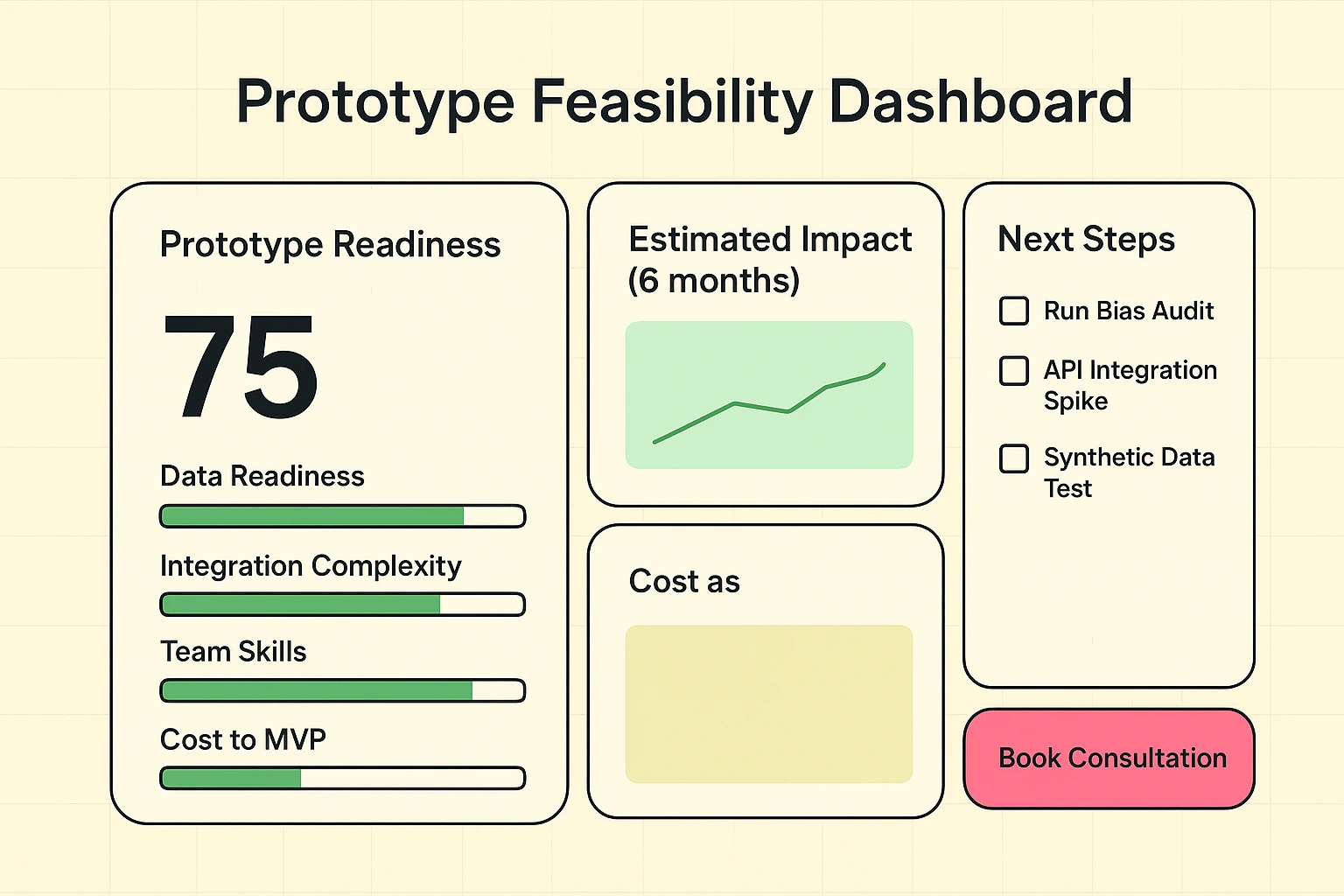
An iterative human-AI workflow that embeds bias audits and KPIs—designed to build trustworthy, measurable prototypes with human oversight.
Phase 6: Feasibility Studies & Risk Assessment – De-risking Your AI Investment
Before scaling up, it's crucial to conduct thorough feasibility studies and risk assessments. This phase helps de-risk your investment by evaluating the technical, data, and business viability of your prototype.
What should you assess?
- Technical Feasibility: Can your prototype be scaled to production? Does it meet performance, security, and integration standards?
- Data Feasibility: Is your data pipeline robust and scalable? Can you continuously feed high-quality data to your production model?
- Business Feasibility & ROI: Does the prototype demonstrate clear business value? What's the projected ROI of full implementation? Quantify the benefits in terms of cost savings, revenue generation, or increased efficiency.
- Risk Identification: Pinpoint potential risks—ethical concerns, data privacy issues, model drift, integration challenges, or stakeholder resistance. Develop mitigation strategies for each.
A robust feasibility study provides the insights needed to make informed go/no-go decisions, ensuring you commit resources wisely.
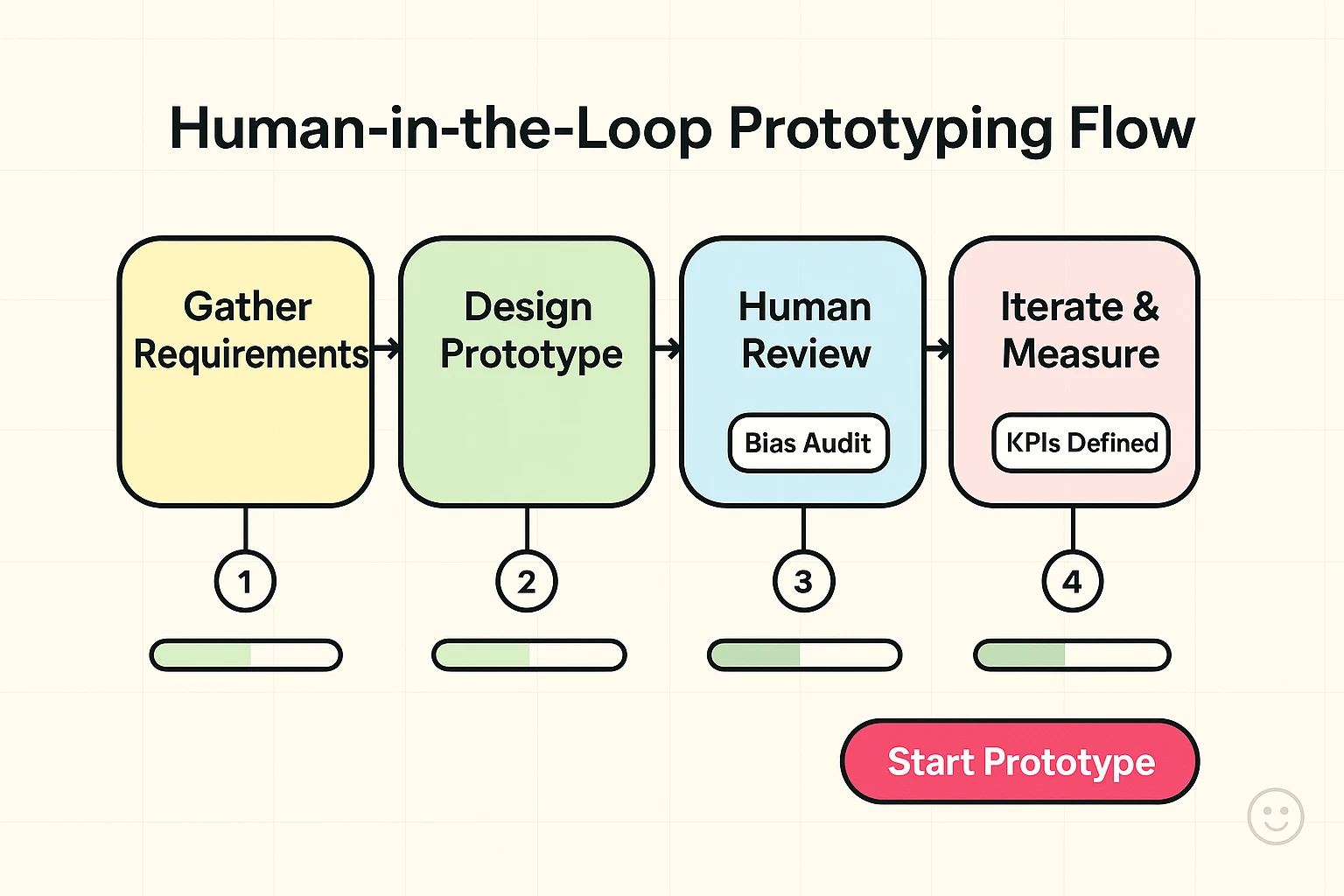
Quantify prototype readiness and risk—use this dashboard to prioritize fixes and make go/no-go decisions before committing resources.
Phase 7: Defining Success – Key Metrics for Early-Stage AI Model Evaluation
How do you know if your AI prototype is successful? Defining clear, measurable metrics from the outset is paramount. This connects your technical validation to your strategic business goals.
Key metrics to consider:
- Quantitative Metrics:
- Precision, Recall, F1-score: For classification tasks, these measure the accuracy of positive predictions and the model's ability to find all relevant instances.
- Mean Absolute Error (MAE), Root Mean Squared Error (RMSE): For regression tasks, these quantify prediction accuracy.
- Latency & Throughput: How fast does the model produce results? How many requests can it handle per second?
- Resource Utilization: How much compute, memory, and energy does the model consume?
- Qualitative Metrics & Business Impact:
- User Acceptance Testing (UAT): Do end-users find the solution intuitive and helpful?
- Business KPI Alignment: Does the prototype show promise in improving the previously defined business objectives (e.g., higher conversion rates, reduced churn)?
- Feedback Loops: Collect direct feedback from users and stakeholders for ongoing iteration.
Early-stage evaluation focuses on validating core functionality and demonstrating commercial viability. This ensures that you’re not just building a technically sound model, but a business asset.
Common MOFU Questions for AI Solution Design & Prototyping
Prospects in the middle of their evaluation journey often have specific concerns. Here are some of the most frequent questions we address regarding AI solution design and prototyping:
Q1: How do I ensure my AI design is truly innovative and not just automating existing inefficiencies?
Innovation starts with a deep understanding of your current workflows and pain points, coupled with knowledge of AI’s unique capabilities. Our process begins with rigorous requirements gathering, challenging assumptions, and identifying opportunities where AI can fundamentally transform processes, rather than just digitize them. We help you explore how agentic AI systems can move beyond reactive tools to proactive partners, driving entirely new efficiencies.
Q2: What is the biggest challenge in AI prototyping, and how do you help mitigate it
One of the biggest challenges is data quality and its impact on model performance. Competitors often assume clean data, leaving a practical gap. We address this head-on with best practices for data collection, robust cleaning, and crucial bias audits during the design phase to avoid flawed design suggestions from the start [5]. We also emphasize human-in-the-loop design to continuously monitor and refine data and model outputs.
Q3: How do you choose the right AI models and tools without getting overwhelmed by the options?
Our approach isn't about arbitrary tool selection; it's about matching the technology to your specific business need, data availability, and team's expertise. We provide structured decision frameworks that consider factors like project complexity, scalability, and ethical implications. For instance, we guide you on when to choose a lower-code rapid prototyping tool versus a more robust, code-centric framework like LangChain for complex AI agent development. The key here is a holistic view of your requirements.
Q4: How do you ensure our AI prototype can actually integrate with our existing legacy systems?
Integration is a critical concern, and we design for it from day one. In the architecture design phase, we prioritize concrete architectural patterns and examples for seamless integration into complex enterprise environments, moving beyond general advice on APIs. This includes strategies for API design, middleware consideration, and adherence to your existing IT governance.
Q5: What measures do you put in place to ensure the AI solution is ethical and unbiased, especially during the design phase?
Ethical AI is not an afterthought; it’s baked into our design process. This involves conducting bias audits during data modeling and training to prevent discriminatory features, implementing explainable AI (XAI) principles so model decisions are transparent, and integrating human-in-the-loop design methodologies for continuous oversight and feedback. Trustworthy AI is built consciously, not accidentally.
Q6: What's the typical timeline for an AI solution design and prototyping project?A6: The timeline varies significantly based on complexity, data availability, and the scope of the problem. However, our iterative approach, common in AI development, focuses on rapid prototyping and validation loops. This means we aim to deliver a functional proof-of-concept relatively quickly (weeks to a few months), allowing for early feedback and adjustments before significant resources are committed to full-scale development. This speed reduces risk and ensures agile adaptation.
Your Path Forward: Building Your AI-First Future
You’re not just looking for a vendor; you’re looking for a trusted partner who understands the complexities of translating business vision into tangible AI products. Our expertise lies in guiding you through each critical stage of AI solution design and prototyping, mitigating risks, and maximizing impact. We don't just provide solutions; we help you become an AI-first business.
If you are ready to move beyond conceptual discussions and build a concrete AI solution that drives real business value, let's connect. Explore our AI Marketing Solutions or AI Recruiting Solutions for tailored approaches, or consider our comprehensive Enterprise Solutions for custom implementations, training, and consulting.
We invite you to reach out for a personalized consultation where we can discuss your specific needs and outline a bespoke AI solution design and prototyping roadmap. Your AI-First business starts here.
Join Our Growing AI Business Community
Get access to our AI Automations templates, 1:1 Tech support, 1:1 Solution Engineers, Step-by-step breakdowns and a community of forward-thinking business owners.
Latest Blogs
Explore our latest blog posts and insights.