Ever found yourself staring at your Meta ad creative, wondering if "Shop Now" is truly better than "Get Offer"? Or perhaps you've launched a campaign only to see lackluster results, leaving you to manually tweak CTA after CTA in a desperate attempt to boost clicks. You're not alone. The struggle to craft the perfect call-to-action (CTA) for your Meta campaigns—one that truly resonates and compels action—is a universal marketing challenge.
But what if you didn't have to guess? What if an intelligent system could analyze billions of data points, understand audience psychology, and even generate numerous CTA variations to test automatically, identifying the exact phrasing and placement that drive the highest engagement?
Welcome to the future of advertising: Automated Call-to-Action (CTA) Optimization with AI for Meta Campaigns. This isn't just about throwing different words at a wall and seeing what sticks; it's about harnessing the power of artificial intelligence to transform your Meta ad performance from guesswork to precision science.
The Undeniable Power of a Perfect CTA
A call-to-action is the bridge between your ad and your desired outcome. It’s the moment of truth where a browser decides to become a clicker, a lead, or even a customer. A well-crafted CTA can significantly impact your click-through rates (CTR), conversion rates, and ultimately, your return on ad spend (ROAS).
Yet, perfecting CTAs has traditionally been a painstaking process:
- Manual A/B Testing: Marketers traditionally create two or more CTA variations and run them head-to-head. While effective, this is slow, resource-intensive, and limits the number of variables you can test.
- Intuition Over Data: Often, CTA choices are based on a marketer's "gut feeling" or industry best practices, which may not always align with a specific audience or product.
- Ad Fatigue: Even a perfect CTA can lose its luster over time, requiring constant refreshment and re-evaluation.
This is where AI steps in, transforming the CTA optimization process from a manual chore into a dynamic, data-driven advantage.
What is Automated CTA Optimization with AI?
At its core, automated CTA optimization with AI involves using artificial intelligence to suggest, generate, and test various call-to-action options within your Meta ad campaigns. The AI analyzes vast amounts of data – from audience demographics and past performance to real-time contextual signals – to pinpoint which CTA phrasing, placement, and even visual cues perform best for specific ad sets and audiences.
Essentially, AI becomes your tireless, hyper-analytical marketing assistant, constantly learning and adapting.
How AI Reimagines CTA Generation and Testing
Imagine an AI that doesn't just pick from a list of predefined CTAs, but actually generates novel phrasing based on its understanding of what motivates your target audience. It can suggest variations that human marketers might overlook, such as "Unlock Your Potential" instead of "Sign Up," or "Explore the Collection" versus "Shop Now."
This process can be broken down into steps:
- Data Ingestion: The AI consumes data from your Meta campaigns (clicks, conversions, impressions, audience engagement), your pixel, and potentially even CRM data.
- Contextual Analysis: It understands the nuances of your ad copy, creative, and target audience segments.
- CTA Generation: Using natural language processing (NLP) and machine learning algorithms, the AI generates multiple CTA variations. These can range from subtle tweaks in wording to entirely new messages.
- Dynamic Testing: These AI-generated CTAs are then automatically integrated into your ad creatives and served to different audience segments. Instead of simple A/B tests, AI facilitates complex multivariate testing on an unprecedented scale.
- Performance Monitoring & Learning: The AI continuously monitors the performance of each CTA variant, identifying which ones drive the highest CTR, conversion rates, or other key metrics. Based on this feedback, it learns and refines its future suggestions.
- Real-time Optimization: Winning CTAs are given preference, and underperforming ones are cycled out, often in real-time, to ensure your ads are always showing the most effective calls to action.
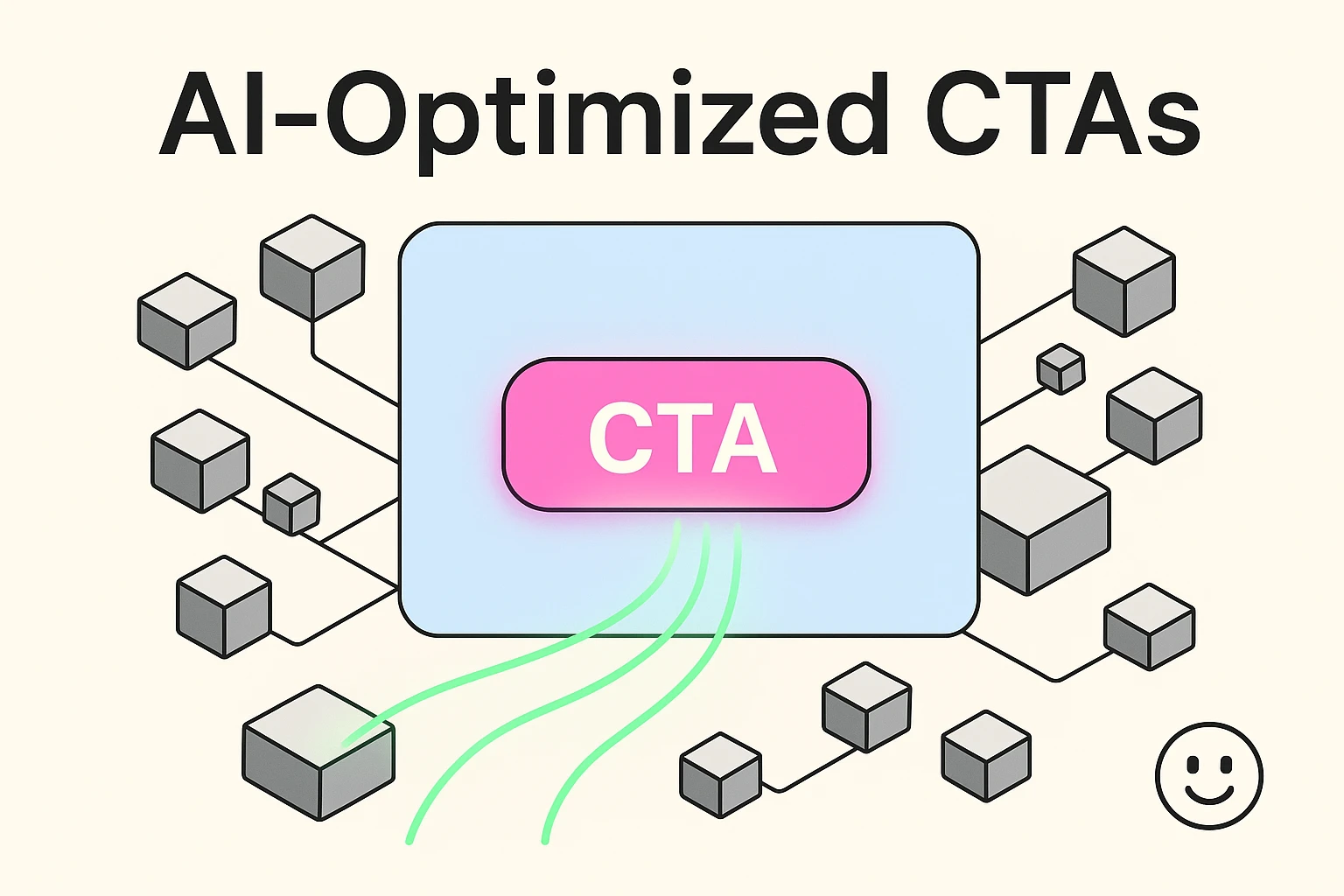
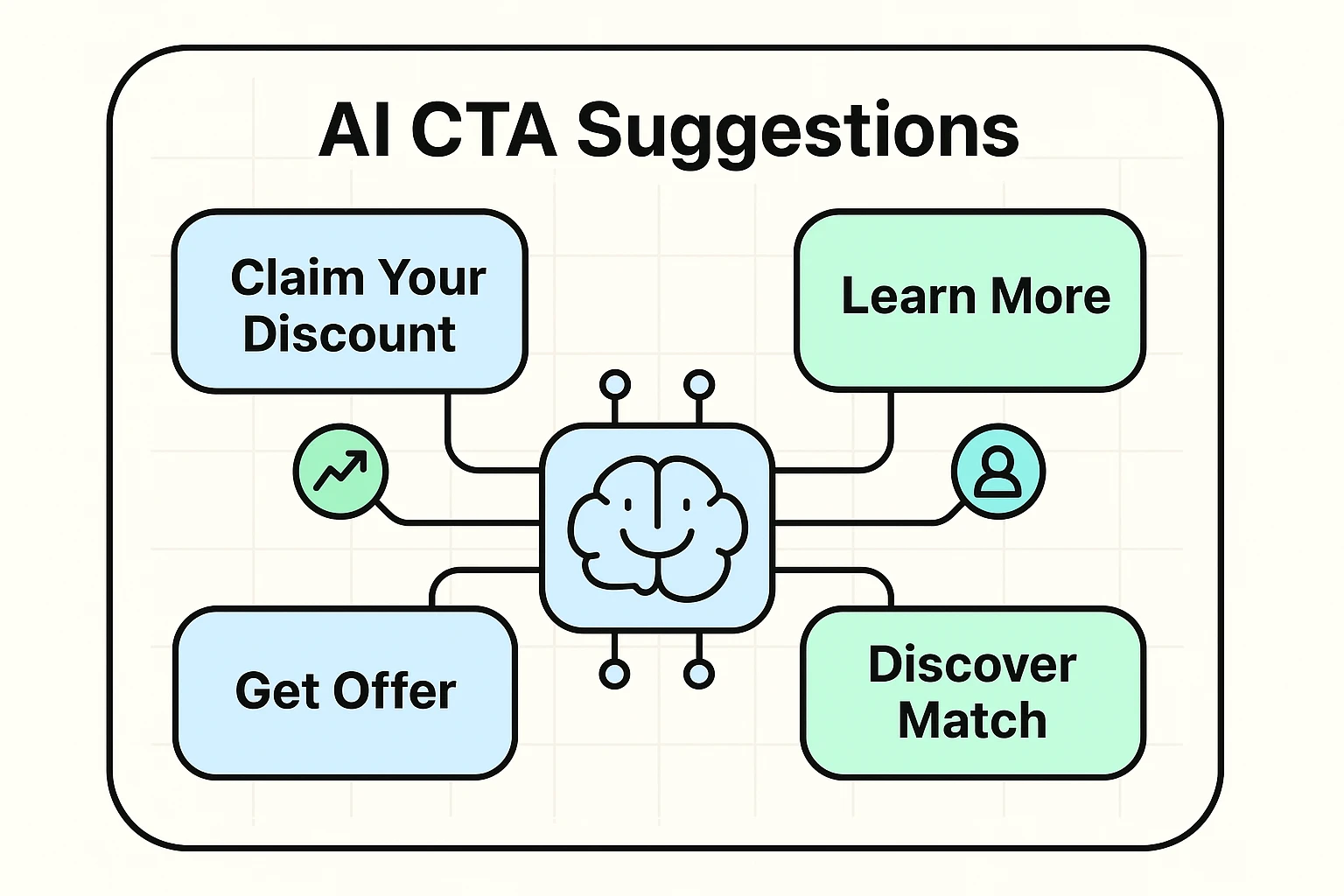
Shows how AI analyzes signals (audience, timing, context, performance) to generate short CTA phrasing variants marketers can test quickly.
Meta's Own AI Capabilities: Advantage+ Creative and Beyond
Meta itself is at the forefront of integrating AI into its advertising platform. Features like Advantage+ Creative allow advertisers to provide multiple versions of ad creative elements (images, videos, text, and yes, CTAs), and Meta's AI automatically determines the best combinations for each person it reaches. This extends to:
- AI Sticker CTAs: Within Ads Manager, Meta offers AI-powered suggestions for sticker CTAs to use in your stories and reels, aiming for higher engagement.
- Enhanced CTAs: Meta’s system can dynamically enhance your existing CTAs, perhaps by adding small visual cues or slightly altering their appearance based on predicted user response.
- Automated Rules & Dynamic Creative Optimization (DCO): While not exclusively for CTAs, DCO allows Meta's AI to assemble the best-performing combinations of ad components, including headline, description, image, and CTA, for each user. This functionality effectively tests countless CTA variations within different creative contexts.
These native features are powerful starting points for harnessing AI in your Meta campaigns. Many marketing agencies, including BenAI, then build on top of these foundational capabilities, developing deeper analytical frameworks and custom AI integrations to create truly tailored solutions. If you're looking to scale your marketing efforts with advanced AI systems, explore BenAI's AI Marketing Solutions.
The AI-Powered Testing Workflow
The beauty of AI in CTA optimization lies in its ability to manage a sophisticated testing process that would be impossible for humans to execute at scale.
- Initial Brainstorming (Human + AI): You define campaign goals, target audiences, and initial creative concepts. AI can then suggest a broader range of CTA ideas than a human team might conceive, offering novel angles.
- Variant Generation (AI): The AI generates dozens, even hundreds, of CTA phrasing options, factoring in brand voice, ad copy, and historical performance data for similar campaigns.
- Automated Distribution & Testing (AI): Meta's algorithms, often enhanced by third-party AI tools, distribute these CTA variations across different ad placements, devices, and audience segments. This isn't just A/B testing; it's true multivariate testing.
- Performance Analysis (AI): The AI meticulously tracks every impression, click, and conversion associated with each CTA variant, identifying statistical significance and emerging patterns.
- Real-time Adaptation (AI): As data rolls in, the AI dynamically reallocates budget and impressions, prioritizing the highest-performing CTAs and sidelining underperformers.
- Reporting & Insights (AI + Human): While the AI handles the heavy lifting, it provides marketers with clear, actionable insights into why certain CTAs work best, informing future creative strategies.
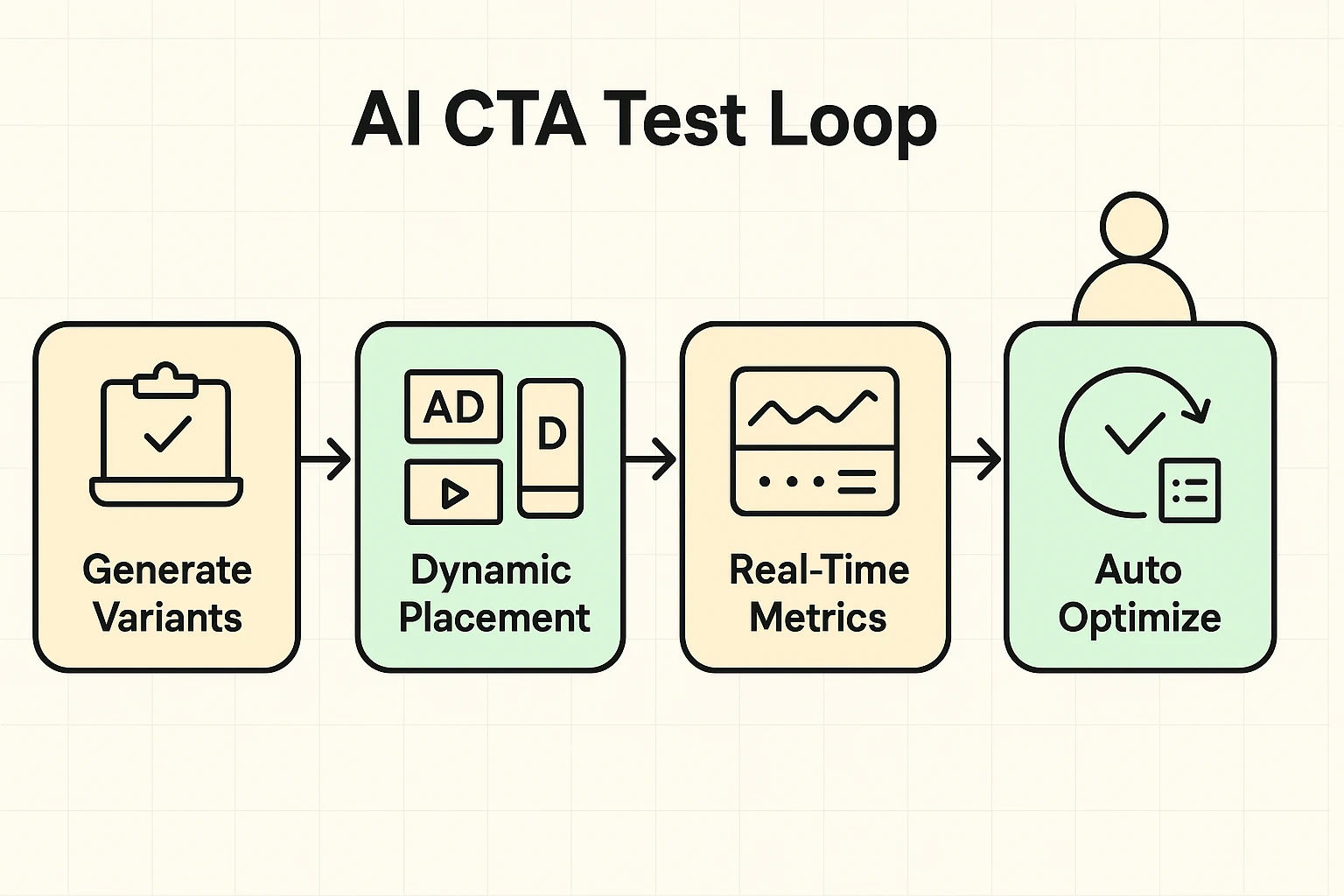
Illustrates the automated multivariate testing cycle—how AI generates CTA variants, places them across formats, measures performance, and iterates automatically.
This automated workflow ensures that your campaigns are always performing at their peak, minimizing wasted ad spend and maximizing engagement.
The Payoff: Tangible Results from Automated CTA Optimization
The benefits of integrating AI into your CTA strategy for Meta campaigns are significant and measurable:
1. Increased Click-Through Rates (CTR)
By constantly identifying and prioritizing the most compelling CTA phrasing and placement, AI can significantly boost the percentage of people who click on your ads. This means more traffic, more engagement, and ultimately, more opportunities for conversion.
2. Enhanced Conversion Rates
A higher quality click, driven by a more relevant CTA, often leads to a higher conversion rate on your landing page. AI ensures that the promise of the CTA aligns perfectly with the ad's content and the user's intent.
3. Deeper Audience Understanding
AI doesn't just tell you what works; it helps you understand why. By analyzing the performance of different CTAs across diverse audience segments, you gain invaluable insights into the psychological triggers, preferences, and pain points of your customers.
4. Reduced Ad Fatigue
AI can detect when a CTA's performance starts to wane and automatically cycle in fresher options. This keeps your ads dynamic and engaging, preventing your audience from becoming desensitized to your calls to action.
5. Time and Resource Savings
Imagine the countless hours spent brainstorming, implementing, and analyzing manual CTA tests. AI takes on this labor-intensive process, freeing up your team to focus on higher-level strategy and creative development. This allows agencies to scale their operations without needing to hire more staff, as explored in articles like How to Build a Multi-Channel Sales Agent.
6. Micro-Personalization at Scale
AI can tailor CTAs to individual user preferences and real-time context. For instance, a user who has previously browsed discount items might see "Claim Your Deal," while a new user might see "Explore Our Collections." This level of personalization drives significantly higher engagement.
A simple visual comparison of CTA types showing AI-optimized CTAs outperforming generic options, plus a before/after ad example demonstrating micro-personalization.
Navigating the Ethical Waters of AI-Driven CTAs
With great power comes great responsibility. As AI becomes more sophisticated in generating persuasive CTAs, it's crucial to consider the ethical implications. Marketers must ensure that AI-generated CTAs remain:
- Truthful and Transparent: Avoid manipulative or misleading language.
- Compliant: Adhere to Meta's advertising policies and all relevant legal regulations.
- Brand Aligned: Maintain your brand's voice and values, even when AI is suggesting variations.
Human oversight remains critical. AI is a powerful tool, but it should function as a co-pilot, not a replacement, allowing you to set guardrails and ensure your brand integrity is upheld. This blend of AI efficiency and human strategic control is the pinnacle of modern ad campaign management. For businesses looking to integrate AI strategically, BenAI offers comprehensive Enterprise Solutions for custom implementations, training, and consulting.
Common Questions About Automated CTA Optimization with AI
Got questions about diving into AI for your Meta CTAs? Here are some common inquiries:
Q1: Do I need to be a data scientist to use AI for CTA optimization?
Absolutely not. While the underlying technology is complex, most AI tools and Meta's native features are designed with user-friendly interfaces. The goal is to make AI accessible to marketers, streamlining tasks rather than adding technical hurdles. You're the strategist; AI is the executor.
Q2: Can AI really generate CTAs better than a human copywriter?
AI excels at scale and pattern recognition. It can generate and test an astronomical number of variations and identify subtle patterns in user behavior that a human might miss. However, human copywriters provide creativity, empathy, strategic brand alignment, and ethical oversight that AI currently cannot fully replicate. The optimal approach is a collaboration: AI for data-driven optimization and rapid testing, humans for strategic direction and creative spark.
Q3: What kind of data does AI use to optimize CTAs?
AI uses a variety of data points, including:
- Ad Performance Data: Click-through rates, conversion rates, impression data from your Meta campaigns.
- Audience Data: Demographics, interests, behaviors, custom audiences.
- Website/App Data: Interaction post-click, conversion events tracked by your Meta Pixel and Conversions API.
- Contextual Signals: Placement of the ad, device type, time of day.
- Historical Data: Past campaign performance, successful CTAs from similar campaigns.
Q4: Is this feature available natively within Meta Ads Manager?
Yes, Meta offers several AI-powered tools that contribute to CTA optimization, such as Advantage+ Creative, AI Sticker CTAs, and Dynamic Creative Optimization. These are excellent starting points. Many third-party AI platforms further augment these capabilities, offering more advanced generation and testing features.
Q5: How do I ensure AI-generated CTAs align with my brand voice?
This is a critical point! While AI can generate variations, it's up to you to provide the "guardrails." When setting up AI optimization, you can often input brand guidelines, tone-of-voice preferences, and even lists of forbidden words. Regular human review of the top-performing AI-generated CTAs is also essential to ensure they always reflect your brand accurately.
Q6: Can AI help with optimizing CTAs for specific industries or niches?
Yes, absolutely. The more data and context AI has about your specific industry, audience, and product, the better it becomes at generating highly relevant and effective CTAs. For example, an AI optimizing CTAs for a B2B SaaS company will learn to use different phrasing and appeals than one optimizing for a fashion e-commerce brand.
The Future is AI-Optimized
The era of guessing which CTA will perform best is rapidly fading. Automated Call-to-Action Optimization with AI for Meta Campaigns is not just a trend; it's a fundamental shift in how successful marketers operate. By embracing AI, you're not just improving a single element of your ad; you're unlocking a continuous, intelligent feedback loop that perpetually refines your communication, boosts your results, and frees you to focus on the strategic vision only human ingenuity can provide.
Ready to transform your Meta campaigns? The journey begins with understanding and integrating AI, moving beyond "learn more" to "achieve more."
Join Our Growing AI Business Community
Get access to our AI Automations templates, 1:1 Tech support, 1:1 Solution Engineers, Step-by-step breakdowns and a community of forward-thinking business owners.
Latest Blogs
Explore our latest blog posts and insights.