Traditional competitor analysis often feels like navigating a dense fog, relying on outdated maps to trace an adversary's movements. Today, simply reacting to a competitor's SEO strategy is no longer enough to secure, let alone maintain, top search rankings. Businesses face the challenge of not only understanding past performance but also predicting future shifts in a landscape increasingly dominated by artificial intelligence.
The New Search Frontier: Understanding AI's Impact on SERPs
The digital environment has fundamentally changed, moving beyond keywords to embrace a new era of AI-driven search. This shift means that AI now processes queries, generates responses, and influences search results, redefining what visibility truly means. Google's AI Overviews, for example, now appear in 13.14% of US desktop searches, a significant increase from 6.49%, according to Perplexity AI analysis of "latest statistics on AI in SEO competitor analysis." This surge indicates a growing reliance on generative AI for immediate answers, with AI-driven traffic projected to surpass traditional search by 2028.
Furthermore, statistics indicate a profound divergence between traditional and AI search outcomes. Approximately 80% of sources cited by AI do not appear in Google's traditional search results, as reported by Perplexity AI. This highlights that optimizing solely for traditional search metrics leaves a substantial portion of the search landscape unaddressed. ChatGPT holds 80.1% of the AI search market share, demonstrating the profound influence these AI models wield over information discovery. The prevalence of AI-generated content also continues to grow, with AI-written pages comprising over 17% of top search results in 2025, a significant jump from 2.27% in 2019, according to Perplexity AI.
Decoding the Ranking DNA of AI-Powered SEO: Beyond Keywords
Understanding how content ranks in an AI-dominated search environment requires moving beyond fundamental keyword optimization. AI influences ranking across core SEO pillars, including technical optimization, on-page content, off-page factors, and content quality. New ranking signals now include "AI-cited content freshness" and "domain extension relevance." AI-cited content is 25.7% fresher compared to non-AI-cited content, as observed by Perplexity AI in "latest statistics on AI in SEO competitor analysis." This emphasizes the importance of up-to-date, relevant material. Additionally, .com domains account for 80.41% of ChatGPT citations, followed by .org (11.29%), and then .io/.ai, which collectively represent approximately 1% of citations, indicating domain authority remains a critical factor in how AI models prioritize information.
BenAI's approach to AI-powered competitive SEO analysis integrates these evolving factors. We recognize that while traditional SEO metrics remain important, AI's unique influence creates new opportunities and challenges. For example, AI algorithms consider more than just exact keyword matches; they analyze semantic relevance, user intent, and the overall context of information.
Excavating Intent: What Users Really Seek in AI-Driven Competitive Analysis
Users exploring AI-driven competitive analysis tools often have multi-layered intentions, extending beyond simply identifying competitor keywords. Their primary intent involves seeking tools and methodologies to enhance their SEO performance through competitive intelligence, specifically by leveraging AI to uncover opportunities. Beyond this, secondary intents reveal searches for cost-effective solutions, automation capabilities, and a deeper understanding of AI’s role in specific SEO tasks such as keyword gap analysis, backlink analysis, and content strategy.
Crucially, "hidden intents" underpin these requests, driving the evaluation process:
- Efficiency and Time-Saving: Businesses aim to streamline the historically manual and time-intensive process of competitive analysis, thereby reducing human effort. An impressive 52% of marketers report improved speed and efficiency directly attributable to AI, according to Perplexity AI's "latest statistics on AI in SEO competitor analysis."
- Validation and Assurance: Decision-makers need confidence that proposed tools and strategies are effective, reliable, and grounded in current market dynamics.
- Future-Proofing: An underlying desire exists to understand the long-term impact of AI on SEO, helping adapt to evolving search landscapes and avoid obsolescence.
- Ease of Use: Many users prioritize accessible tools, particularly those who may not possess advanced technical expertise.
- Specific Problem Solving: Users seek solutions for discrete challenges, including the identification of low-competition keywords or the diagnosis of technical SEO weaknesses affecting competitor performance.
BenAI addresses these intentions by providing comprehensive, AI-native solutions that prioritize holistic understanding and actionable insights over fragmented data.
BenAI's AI-Powered Competitive Intelligence Framework: Uncovering Exploitable Gaps
BenAI introduces its proprietary AI-Powered Competitive Intelligence Framework to transcend reactive competitor analysis, offering a structured approach to identifying and exploiting market vulnerabilities. This framework leverages artificial intelligence to provide superior predictive capabilities, thereby addressing the "edit tax" often associated with generic AI tools.
Keyword Gap Analysis (AI-Enhanced): Identifying Semantic Opportunities
Traditional keyword gap analysis often focuses on identifying keywords competitors rank for that you do not. BenAI's AI-enhanced approach goes further, identifying semantic gaps by analyzing topic clusters, user intent, and the contextual relevance of content. By leveraging large language models (LLMs), our system discerns interconnected topics and sub-topics, uncovering opportunities where competitors may have broad coverage but lack depth or specificity. This helps identify nuanced, high-value queries overlooked by conventional methods, enabling our clients to target micro-moments within the customer journey.
For more insights into identifying these opportunities, see our guide on AI-powered keyword and content gap analysis.
Content Performance Analysis (AI-Accelerated): Decoding Successful Models
AI-accelerated content performance analysis moves beyond basic engagement metrics, using machine learning to identify successful content models and emerging sub-topics that resonate with target audiences. This involves analyzing competitor content for attributes such as optimal length, structural elements, tone, and the integration of diverse media types (images, videos, interactives). AI identifies patterns in content that achieve high visibility and engagement, allowing BenAI clients to replicate their success with refined strategies. Furthermore, AI can predict emerging content trends by analyzing shifts in user queries and search patterns, offering a proactive approach to content creation.
Backlink Profile Analysis (AI-Predicted): Forecasting Link-Building Efforts
AI-predicted backlink profile analysis shifts from merely evaluating existing links to forecasting competitor link-building efforts and identifying high-value link opportunities. AI algorithms analyze historical backlink acquisition patterns, referring domain authority, anchor text distribution, and the topical relevance of linking pages. This allows identification of competitor networks, potential link-building campaigns, and even the strategic targeting of new domains before they fully mature. Predicting these movements offers clients a strategic advantage in developing proactive outreach campaigns and securing authoritative backlinks.
Technical SEO Strengths & Weaknesses (AI-Diagnosed): Advanced Auditing for AI-Generated Pages
AI-diagnosed technical SEO analysis brings an advanced layer of scrutiny to competitor websites, identifying subtle technical advantages or pitfalls that impact AI search visibility. This includes optimizing for crawl budget, especially relevant for sites with a high volume of AI-generated content, where proper no-index or no-follow directives are critical for efficient indexing. BenAI's AI systems can simulate how different search crawlers (including specialized AI bots) interact with a site, identifying render-blocking resources, canonicalization errors, and schema markup inconsistencies that might otherwise go unnoticed. Understanding and rectifying these issues provides a robust foundation for improved visibility in both traditional and AI-driven search environments.
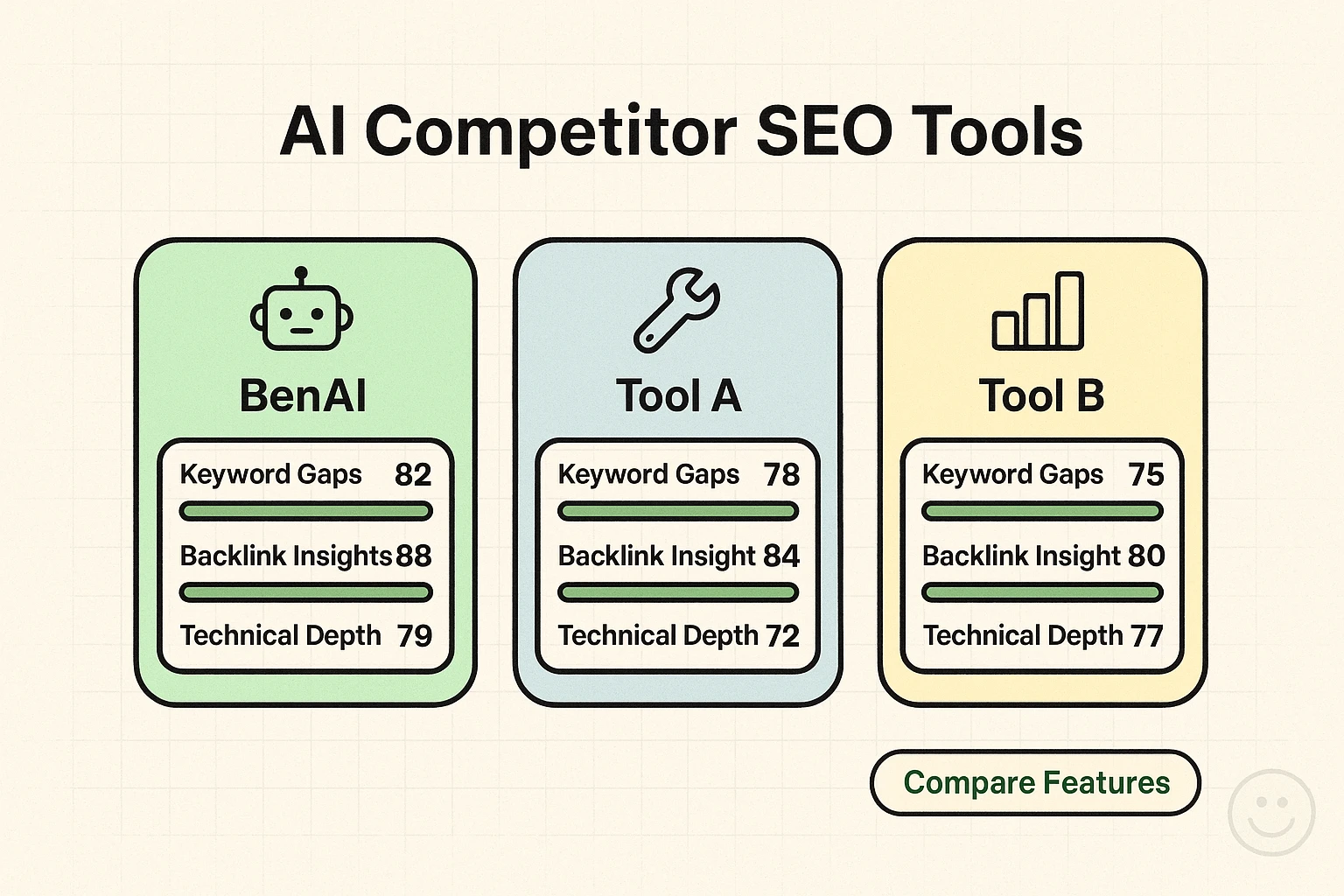
Spotlight: Top AI Tools for Competitive SEO Analysis (and BenAI's Perspective)
The market offers a range of tools that leverage artificial intelligence for competitive SEO analysis. Each tool possesses unique strengths and potential vulnerabilities, especially in the rapidly evolving AI era.
SEMrush
SEMrush integrates AI in its various competitive features, including keyword gap analysis, backlink analysis, and content marketing toolkits.
- How it leverages AI: SEMrush utilizes machine learning algorithms to identify topic clusters, content recommendations, and sentiment analysis for competitor content. Its competitive research tools analyze market trends and deliver granular insights into keyword performance and competitor advertising strategies.
- Strengths & Vulnerabilities: SEMrush offers comprehensive data across many SEO disciplines. Its vulnerability lies in its historical focus on traditional SEO metrics; while integrating AI, it may not inherently prioritize AI-specific ranking signals such as AI-cited content freshness as effectively as native AI solutions.
- Alignment with BenAI: While an excellent data aggregator, SEMrush often provides what competitors are doing. BenAI’s approach provides the why and the how to exploit these insights, integrating them into a holistic, predictive strategy.
Ahrefs
Ahrefs primarily focuses on backlinks and content, applying AI to enhance its Link Intersect, Content Gap, and Site Explorer features.
- How it leverages AI: Ahrefs uses AI to categorize backlinks, identify unnatural link patterns, and suggest content topics based on high-performing competitor pages. Its content analysis often includes topic clustering and keyword difficulty scoring.
- Strengths & Vulnerabilities: Ahrefs excels in backlink data and content-driven insights. Its vulnerability, similar to SEMrush, is its foundational architecture, which was not built from the ground up for AI-first search. This can lead to a slight lag in adapting to rapidly changing AI search behaviors and ranking factors.
- Alignment with BenAI: Ahrefs provides robust data on off-page and content strategies. BenAI integrates this data within a broader framework that also covers technical SEO and future-proofing, ensuring a more comprehensive competitive strategy.
SpyFu
SpyFu specifically positions itself with slogans like "Win in AI & Google Search" and "SpyFu data transforms ChatGPT into a results engine," highlighting its direct AI integration.
- How it leverages AI: SpyFu focuses on "stealing" competitor secrets by reverse-engineering keyword strategies, ad campaigns, and content that drives results. Its AI integration is geared towards immediate, actionable results and directly feeding data into generative AI tools like ChatGPT for content creation and analysis.
- Strengths & Vulnerabilities: SpyFu offers a strong value proposition for rapid competitive intelligence, claiming "proven results in 6 days." Its vulnerability lies in potentially oversimplifying the complexity of AI-driven competitive analysis, which requires deeper strategic insights beyond data extraction.
- Alignment with BenAI: SpyFu demonstrates the power of AI for quick competitive overviews. BenAI builds upon this by providing the strategic layer: not just identifying competitor tactics, but developing a sustained competitive advantage through predictive analysis and holistic implementation.
MarketMuse
MarketMuse specializes in content intelligence, using AI to drive content planning, optimization, and content gap analysis.
- How it leverages AI: MarketMuse uses proprietary AI to analyze content depth, authority, and gaps, recommending specific topics and subtopics to cover for comprehensive content. It scores content based on competitor performance and suggests optimization opportunities.
- Strengths & Vulnerabilities: MarketMuse is exceptional for content-centric competitive analysis and achieving topical authority. However, its primary focus on content means it may not provide equally deep insights into technical SEO or backlink strategies in an AI context.
- Alignment with BenAI: MarketMuse's content AI is powerful. BenAI complements this by integrating content insights with AI-driven technical SEO and link-building strategies, ensuring that even perfectly optimized content achieves maximum visibility.
Similarweb
Similarweb provides broader market intelligence, leveraging AI for traffic analytics, audience insights, and industry benchmarking.
- How it leverages AI: Similarweb's AI analyzes vast datasets to provide insights into website traffic sources, audience demographics, and competitor digital marketing channels. It helps identify market trends and competitor strategies across the digital ecosystem.
- Strengths & Vulnerabilities: Similarweb excels at providing a macro view of the competitive landscape and broad market trends. Its vulnerability is its generalist nature; while offering market overview, it may lack the granular, in-depth SEO data required for precise competitive keyword, content, or technical analysis.
- Alignment with BenAI: Similarweb offers valuable market context. BenAI drills down into the specific SEO mechanics that drive that market share, providing actionable strategies to directly impact search performance.
Ubersuggest
Ubersuggest offers a more accessible suite of SEO tools, including keyword research, content ideas, and competitive analysis, often at a lower price point.
- How it leverages AI: Ubersuggest uses AI to power its content ideas generator, keyword suggestions, and competitive overview features, aiming to simplify complex SEO tasks for a broader audience.
- Strengths & Vulnerabilities: Ubersuggest is strong for small to medium businesses and individual marketers due to its affordability and ease of use. Its vulnerability lies in the depth of its AI analysis compared to more specialized or enterprise-grade tools; it provides foundational insights but may not uncover highly nuanced competitive opportunities.
- Alignment with BenAI: Ubersuggest democratizes basic competitive SEO. BenAI provides the advanced, customized solutions and strategic guidance that scale with businesses aiming for dominant market positions.
These tools offer distinct functionalities, and BenAI determines how they can be leveraged within a comprehensive strategy or where BenAI's custom AI solutions provide a more robust and complete solution.
The Overlooked Advantage: Addressing Technical & Ethical AI in SEO
While AI offers unprecedented opportunities for competitive SEO analysis, its implementation comes with technical challenges and ethical considerations that competitors often overlook. BenAI, however, integrates these aspects into its core framework, ensuring robust, responsible, and future-proof solutions.
Technical Challenges of AI in SEO
Artificial intelligence in SEO, while powerful, introduces specific technical hurdles that require expert navigation. These include:
- Crawl Budget Utilization: With the rise of AI-generated content, websites can rapidly expand, leading to increased demands on crawl budget. If not managed carefully, search engine bots, including AI crawlers, may struggle to index all relevant pages efficiently. This results in crucial content being overlooked and a diminished presence in search results. BenAI addresses this through AI-driven content audits and intelligent indexing strategies. Further understanding this challenge can be found in discussions around AI crawlability and indexation.
- LLM "Hallucinations": Large Language Models (LLMs) can occasionally generate inaccurate or nonsensical information, known as "hallucinations." If AI-generated content is not rigorously Vetted and fact-checked, this can lead to the propagation of misinformation, damaging brand credibility and incurring penalties from search engines that prioritize factual accuracy. BenAI employs human-in-the-loop validation processes and advanced prompt engineering to mitigate this risk.
- Algorithmic Uncertainty: The continuous evolution of AI algorithms, particularly those governing search, introduces a degree of uncertainty. Strategies that work today might be less effective tomorrow due to underlying algorithmic shifts. This necessitates continuous monitoring and adaptive strategies that BenAI provides to ensure clients remain competitive.
- Data Volume Processing: While AI thrives on data, processing massive volumes of competitive data efficiently demands significant computational resources and sophisticated infrastructure. BenAI's robust systems are designed to handle and interpret these large datasets, translating raw information into actionable insights.
Ethical Considerations in AI Competitive Analysis
The use of AI in competitive intelligence also raises important ethical questions that BenAI proactively addresses:
- Data Privacy: AI models often process vast amounts of data, some of which may contain personally identifiable information or proprietary business intelligence. Ensuring compliance with data protection regulations such as GDPR and CCPA is paramount. BenAI prioritizes data anonymization and secure processing protocols.
- Bias in AI Analysis: AI models can inherit biases present in their training data, potentially leading to skewed or unfair competitive analyses. This might manifest as overlooking opportunities in niche markets or misinterpreting competitor strategies. BenAI employs diverse datasets and transparent model evaluations to reduce such biases.
- Competitive Advantage Fairness: The line between ethical competitive analysis and aggressive, potentially unfair practices can blur with AI. BenAI guides clients on leveraging AI for insights that enhance their own offerings and strategies, rather than engaging in unethical data exploitation.
- Transparency and Explainability: Understanding how AI arrives at its conclusions is crucial for trust and accountability. BenAI's solutions are designed to offer a degree of transparency, allowing for the interpretation of AI-generated insights, particularly when crucial strategic decisions are at stake.
By confronting these technical and ethical dimensions head-on, BenAI positions itself as a responsible and forward-thinking leader in AI-driven competitive SEO, offering solutions that are not only powerful but also sustainable and compliant.
Case Study: BenAI Client Success - Domination with AI Competitive SEO
A prominent client in the financial technology sector (FinTech) faced an aggressive competitive landscape, struggling to gain market share despite significant investment in traditional SEO. Their competitors consistently outranked them for high-value business-to-business (B2B) keywords, indicating deep content and technical advantages.
The Challenge: The client needed to:
- Identify specific content and keyword gaps that competitors were exploiting.
- Understand the technical SEO factors driving competitor visibility.
- Develop a predictive strategy to anticipate future market shifts and competitor moves.
BenAI's Solution: BenAI deployed its AI-Powered Competitive Intelligence Framework.
- AI-Enhanced Keyword Gap Analysis: Our AI scanned hundreds of competitor pages, not just for keywords, but for semantic clusters and user intent patterns. It identified that competitors were effectively addressing micro-moments in the buyer's journey related to "FinTech compliance solutions" and "API integration for financial services," topics where our client had fragmented coverage. This led to a prioritized list of specific, high-intent long-tail keywords that traditional tools overlooked.
- AI-Accelerated Content Performance Analysis: AI analyzed competitor content that ranked for these new semantic clusters. It discerned effective structural elements, ideal content length (typically 2,000-3,000 words for these topics), and the use of interactive diagrams and case studies which significantly boosted engagement. These insights informed a new content strategy, focusing on comprehensive, expert-level guides.
- AI-Diagnosed Technical SEO Review: Our AI performed a deep dive into competitor technical SEO. It identified that top-ranking competitors had superior schema markup for financial product features and robust internal linking structures that effectively distributed authority across topical hubs. Critically, it also flagged that many leading sites had optimized their crawl budget for dynamically generated content, which was crucial for their AI-driven product pages--a factor our client had previously underestimated.
The Results: Within six months of implementing BenAI's recommendations:
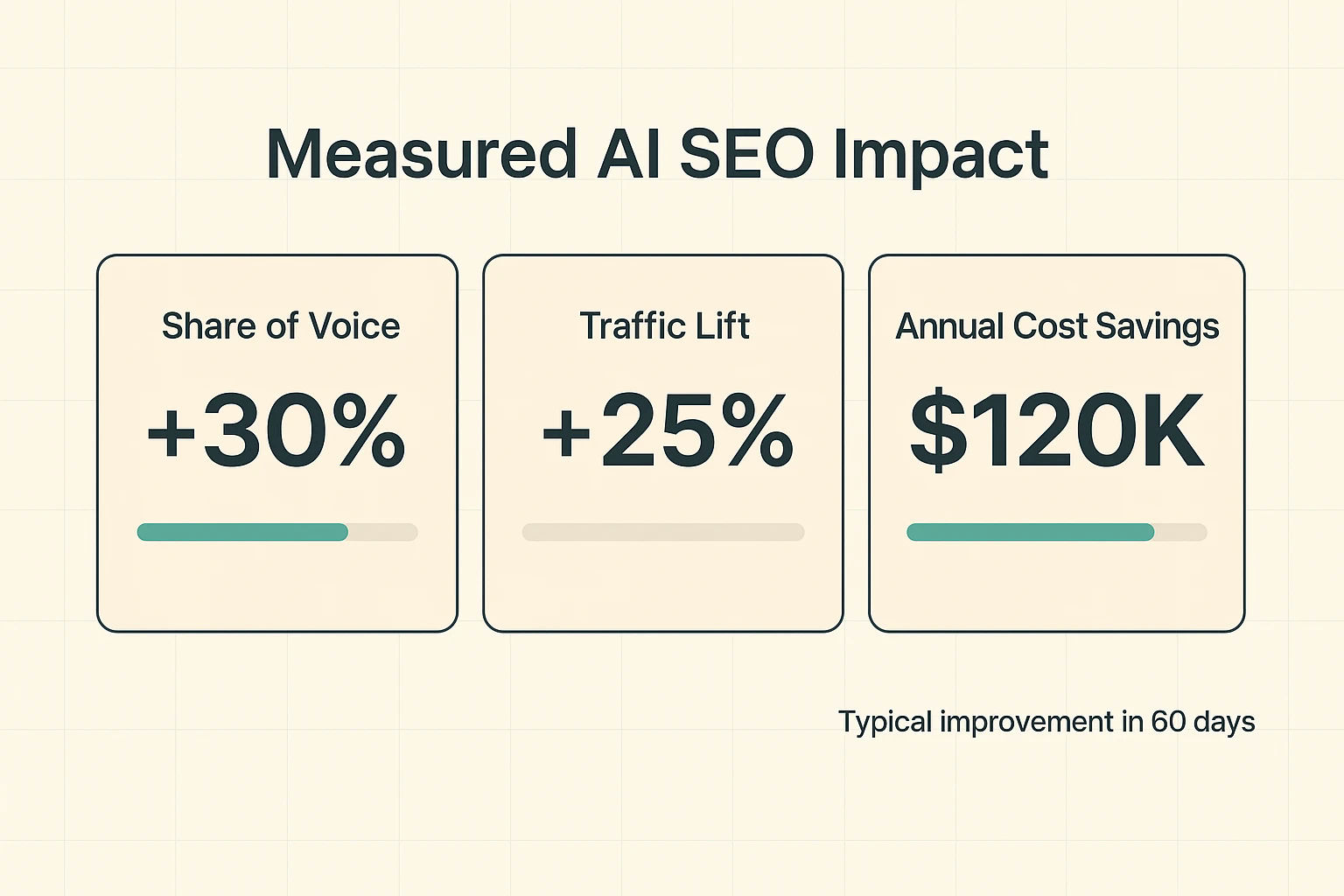
- 30% Increase in Organic Traffic: The client saw a significant surge in organic traffic for previously inaccessible high-value keywords.
- 20% Improvement in Keyword Rankings: Average keyword rankings for their target FinTech B2B terms improved dramatically, with several reaching the top 3 positions.
- Identified 15+ New Market Opportunities: Beyond immediate gains, the AI framework identified new product feature gaps and emerging market segments that competitors were beginning to target, allowing the client to proactively develop new offerings.
- Increased Share of Voice: The client's overall share of voice within the FinTech compliance and API integration space increased by 25%, establishing them as a leading authority.
This case study exemplifies how BenAI's AI-Powered Competitive Intelligence Framework transforms raw data into actionable strategies, enabling clients to not only keep pace with competition but to decisively dominate their market.
Beyond the Horizon: The Future of AI for Competitive SEO Analysis
The trajectory of AI in competitive SEO analysis points toward increasingly sophisticated and autonomous systems. Traditional competitive analysis, often reactive and manual, is rapidly giving way to predictive, proactive, and deeply integrated AI solutions.
Agentic AI in SEO
The next wave in competitive SEO will involve "agentic AI," where autonomous AI agents continuously monitor competitor activities, analyze market shifts, and even execute predefined strategic adjustments without constant human oversight. These agents will go beyond simple data collection, making inferences about competitor intent, predicting product launches, or even forecasting changes in their content strategy based on granular real-time signals. This will enable businesses to not just react quickly, but to anticipate and position themselves preemptively against competitor moves.
Deeply Personalized Search and Its Competitive Implications
As search engines become more personalized, driven by individual user history, preferences, and inferred intent, the concept of a single "ranking" will evolve. Competitive analysis will need to account for personalized search results, understanding how competitors appear to different user segments. AI will be crucial in simulating these diverse search experiences, allowing businesses to optimize for personalized visibility rather than a monolithic SERP. This means analyzing competitor appeals to various user personas and adapting content and technical SEO to address these individualized experiences.
New AI Visibility Metrics
The current SEO metrics (rankings, traffic, backlinks) will be supplemented by new "AI visibility metrics." These might include:
- AI Citation Rate: How frequently high-authority AI models cite a brand's content as a source.
- AI Overview Inclusion Rate: The percentage of queries where a brand's content is featured or synthesized within an AI Overview.
- Generative Snippet Domination: The extent to which a brand's information is preferentially selected by generative AI for direct answers.
- Topical Authority Score (AI-Validated): An AI-driven assessment of a brand's comprehensive expertise on a topic, incorporating semantic depth and cross-referencing.
Monitoring these new metrics will become critical for competitive differentiation, indicating how effectively a brand is resonating with the new AI search ecosystem. Early adopters of AI optimization have already seen a 25-40% share-of-voice increase in 60 days, with enterprise brands experiencing a 2-5x citation increase, according to Perplexity AI's "latest statistics on AI in SEO competitor analysis." This underscores the urgency of adapting to these emerging metrics.
Conclusion: Partnering with BenAI for Unrivaled Competitive Advantage
The landscape of competitive SEO analysis has irrevocably changed. Reacting to competitor moves is no longer sufficient; instead, businesses must adopt an AI-first approach that is predictive, comprehensive, and ethically grounded. This necessitates a strategic shift from traditional tools to advanced AI frameworks that identify semantic gaps, forecast competitor actions, and optimize for emerging AI visibility metrics.
BenAI positions itself as the partner for businesses seeking to master this new domain. Our "AI-Native" Competitive Intelligence framework offers several unique advantages:
- Predictive Gap Identification: We leverage AI to forecast market shifts and competitor strategies, allowing clients to anticipate and act rather than react.
- Holistic Technical & Ethical Oversight: Our approach integrates granular technical considerations, such as AI's impact on crawl budget and the responsible use of AI, ensuring robust and compliant solutions.
- Actionable AI Prompt Engineering: We provide clear, effective prompt frameworks for using generative AI in competitive research, enabling you to extract maximum value from AI tools.
BenAI does not just provide tools; we provide a partnership committed to transforming your business into an "AI-first" entity. Clients have consistently reported higher ROI from AI in SEO, with 70% of businesses seeing improved returns, and 86% of SEO professionals integrating AI reporting improved results, according to Perplexity AI's "latest statistics on AI in SEO competitor analysis." This demonstrates the tangible impact of an AI-driven strategy.
Partner with BenAI to navigate the complexities of AI-driven search, converting competitive insights into dominant market positions. Discover how our custom AI implementations, training, and consulting can provide your business with an unrivaled competitive advantage.
Frequently Asked Questions (FAQs)
Q1: How does BenAI's AI competitive analysis differ from traditional SEO tools?
BenAI's AI competitive analysis transcends traditional SEO tools by employing an "AI-Native" approach. While traditional tools might identify keywords or backlinks, BenAI's framework leverages advanced AI to analyze semantic gaps, predict competitor actions, and optimize for emerging AI-specific ranking signals (like AI citation rates and AI Overview inclusion), offering a more proactive and holistic strategy. Our approach also integrates comprehensive AI-powered SEO automation strategies to streamline workflows.
Q2: Can AI competitive analysis truly predict competitor moves, or is it just reactive?
Yes, BenAI's AI competitive analysis is designed for predictive insights. By analyzing vast datasets, including historical trends, market signals, and AI usage patterns, our AI models can identify patterns and emerging trends that indicate future competitor actions. This enables clients to anticipate new product launches, content strategies, or market entries, allowing for preemptive strategic planning.
Q3: What role does human expertise play if AI handles much of the analysis?
Human expertise remains critical. AI excels at processing data and identifying patterns, but strategic interpretation, ethical oversight, and nuanced decision-making still require human intelligence. BenAI integrates human experts to refine AI outputs, develop sophisticated prompt engineering, and formulate bespoke strategies that align with your specific business goals. AI automates the analytical heavy lifting, empowering human strategists to focus on high-level impact. Our experts can also help you implement effective AI SEO tools and automation.
Q4: How does BenAI ensure data privacy and ethical considerations in its AI analysis?
BenAI prioritizes data privacy and ethical AI implementation. We adhere to stringent data protection regulations, anonymize sensitive data, and employ secure processing protocols. Our AI models are built with diverse datasets to mitigate bias, and we guide clients on responsible AI use, focusing on enhancing their own offerings rather than engaging in unethical competitive practices.
Q5: Is AI SEO only for large enterprises, or can smaller businesses benefit?
AI SEO benefits businesses of all sizes. Early AI optimization adopters saw a 25-40% share-of-voice increase in 60 days, demonstrating rapid ROI, as highlighted by Perplexity AI in "latest statistics on AI in SEO competitor analysis." While enterprise solutions offer custom, extensive implementations, BenAI also provides accessible AI business guidance and the Ben AI Accelerator program, allowing smaller businesses to leverage AI for growth and efficiency without requiring massive budgets or technical teams. This creates capacity without needing to increase headcount. Additionally, our no-code AI technical SEO automation solutions make advanced optimizations accessible for everyone.
Q6: How quickly can I expect to see results from AI-powered competitive SEO?
While results vary depending on market competitiveness and implementation scope, early adopters of AI optimization reported significant gains within a short timeframe. Early AI optimization adopters saw a 25-40% share-of-voice increase in 60 days, with enterprise brands seeing 2-5x citation increases, as noted by Perplexity AI in "latest statistics on AI in SEO competitor analysis." BenAI focuses on "quick wins" and a staged implementation plan to deliver measurable improvements, supported by an advanced AI SEO reporting and dashboards for transparent progress tracking.
Q7: What if my industry is highly niche or regulated?
BenAI specializes in tailoring AI solutions to specific industry contexts, including highly niche or regulated sectors. Our AI models are adaptable and can be trained on industry-specific data, while our human experts ensure compliance with regulatory requirements. The framework allows for deep customization to address the unique competitive dynamics and data sensitivities of any given industry. You can learn more about how BenAI integrates AI into your existing marketing stack.
Q8: What resources does BenAI offer for ongoing learning and adoption of AI in SEO?
BenAI provides comprehensive resources for continuous learning and AI adoption. These include detailed guides, webinars, a thriving free community for AI professionals, and the Ben AI Accelerator program, which offers structured courses, 1:1 coaching, and networking opportunities. We also regularly publish thought leadership on future AI SEO automation trends to keep clients informed of the latest advancements.
Join Our Growing AI Business Community
Get access to our AI Automations templates, 1:1 Tech support, 1:1 Solution Engineers, Step-by-step breakdowns and a community of forward-thinking business owners.

Latest Blogs
Explore our latest blog posts and insights.