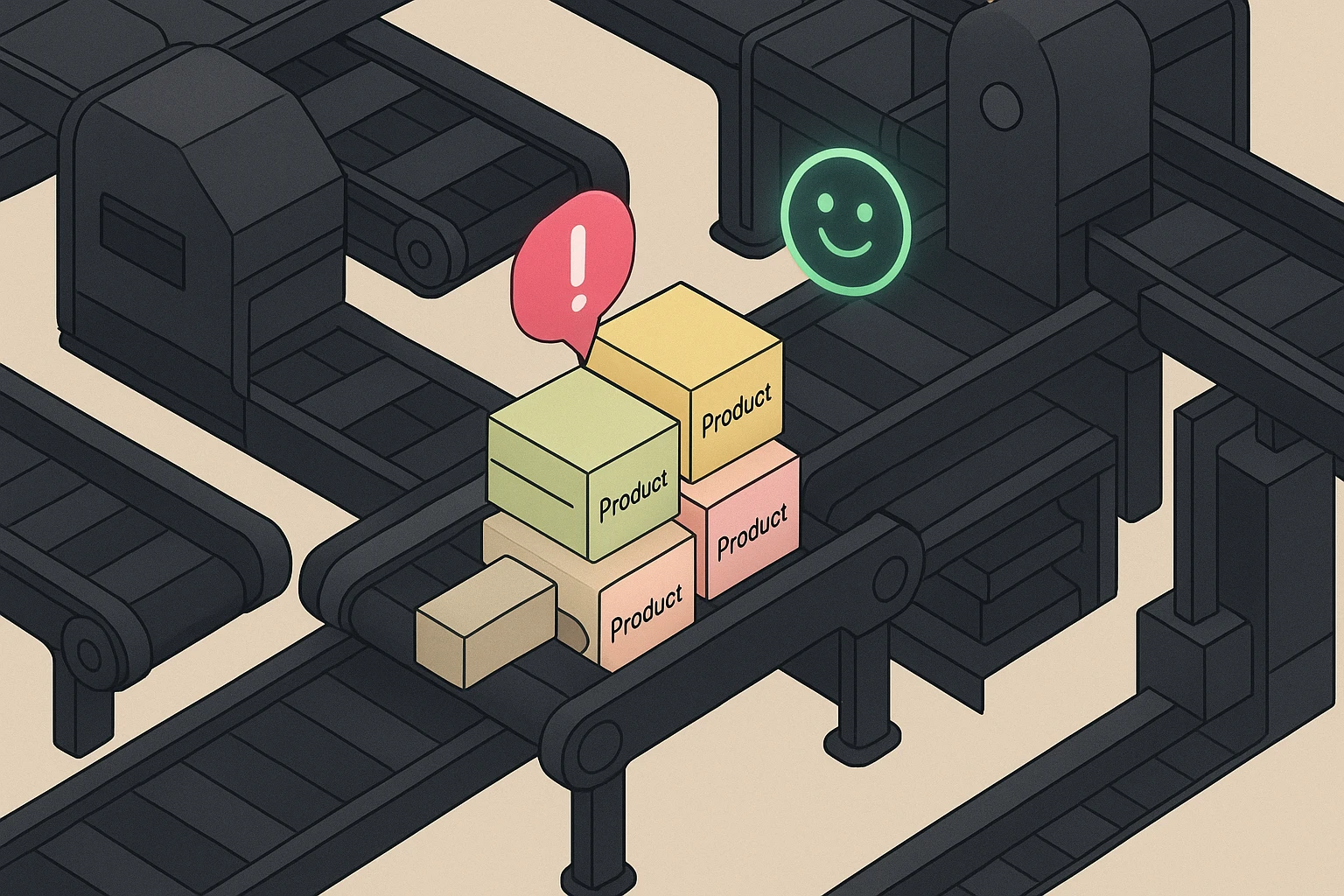
Imagine a bustling factory floor, a symphony of whirring machines, clicking parts, and skilled workers. Everything seems to be moving, yet something feels off. Products aren't flying off the line as fast as they should, deadlines are tightening, and costs are creeping up. You suspect there's a bottleneck, a choke point silently strangling your productivity, but where is it? And more importantly, how do you fix something you can't quite see?
For decades, identifying these invisible saboteurs in manufacturing workflows has been a painstaking, often reactive process. It involved endless observation, manual data logging, and educated guesses. But what if there was another way? A smarter way?
Enter Artificial Intelligence. Far from a futuristic fantasy, AI is rapidly transforming how manufacturers approach efficiency, offering unprecedented visibility and precision in identifying and eliminating those costly production bottlenecks.
The Invisible Enemy: Understanding Manufacturing Bottlenecks
Before we dive into AI, let's get clear on what we're fighting. A manufacturing bottleneck is any resource or process step that limits the overall output of a production line or supply chain. Think of it like a narrow section in a pipe – no matter how much water you pump in, only so much can get through that constricted space.
Bottlenecks aren't always obvious. They can hide in plain sight, masquerading as:
- Machine Downtime: A critical machine frequently breaks down or requires long setup times.
- Material Shortages: Delays in receiving raw materials or components.
- Quality Control Issues: An abundance of defects at a specific stage requiring rework or scrap.
- Labor Shortages/Inefficiency: Too few skilled workers, or inefficient allocation of tasks.
- Excessive Work-in-Process (WIP): Piles of unfinished products waiting at a particular station.
- Information Delays: Slow communication or approval processes that hold up production.
The consequences? Reduced throughput, increased lead times, higher operational costs, and ultimately, frustrated customers. The challenge isn't just knowing you have a bottleneck, but pinpointing its exact location, understanding its root cause, and anticipating where the next one might appear.
The AI Lens: Seeing What Humans Miss
This is where AI shines. Unlike traditional methods that rely on sampled data and human interpretation, AI systems can continuously gather and analyze vast amounts of data across an entire manufacturing operation. They don't get tired, they don't make assumptions, and they can sift through terabytes of information in seconds to uncover patterns and anomalies indiscernible to the human eye.
So, how does AI achieve this seemingly superhuman feat? It employs a range of specialized techniques, each offering a unique perspective on your production lines and supply chains.
Key AI Techniques for Bottleneck Identification
1. Process Mining: Unmasking the Real Workflow
Imagine trying to understand the actual path a product takes through your factory by only looking at a few snapshots. That's often what traditional process analysis feels like. Process mining, however, is like having a GPS tracker on every single part and worker, recording their exact movements and activities.
- How it works: Process mining algorithms analyze event logs from various IT systems (like ERP, MES, CRM). Each log entry represents an “event” – a step completed, a machine turned on, a product moved. By stitching these events together across millions of instances, AI reconstructs the actual journey, revealing hidden deviations, unnecessary loops, and most importantly, where things are consistently slowing down.
- What it uncovers:
- Deviations from ideal processes: Are workers taking shortcuts that cause quality issues or performing redundant steps?
- Rework loops: Where are products repeatedly returning for corrections?
- Idle times and handoffs: Where are products or data waiting unnecessarily between stages?
- “Spaghetti” processes: Complex, inefficient paths that don't conform to documented procedures.
- Example: A process mining system could reveal that a specific type of component consistently waits an average of 3 hours at Station B, even though the documented process allows only 30 minutes. This immediately flags Station B as a potential bottleneck, allowing you to investigate why the delay occurs.
2. Predictive Analytics: Foreseeing the Future Bottlenecks
Wouldn't it be incredible to know before a machine breaks down that it's going to happen? Or anticipate a material shortage days in advance? That's the power of predictive analytics. This AI technique uses historical data to forecast future events, turning reactive problem-solving into proactive prevention.
- How it works: AI models (often machine learning algorithms) are trained on vast datasets, including sensor data from machines, historical production records, maintenance logs, and even supply chain information. They learn to identify correlations and patterns that precede specific events.
- What it uncovers:
- Predictive Maintenance: Forecasts when a critical machine is likely to fail, allowing for planned maintenance before downtime occurs.
- Proactive Quality Control: Predicts potential quality defects based on upstream process parameters. For example, if a certain temperature fluctuation consistently leads to flawed parts, predictive analytics can flag this in advance. For a deeper dive into quality control, check out our guide on AI-Driven Quality Control.
- Demand Forecasting: Anticipates future product demand, helping optimize production schedules and prevent bottlenecks due to unexpected spikes.
- Supply Chain Risk Assessment: Predicts potential delays or shortages of raw materials, allowing for alternative sourcing or inventory adjustments.
- Example: By analyzing vibration sensor data from a critical robotic arm alongside historical maintenance records, an AI model might predict a 70% chance of failure within the next 48 hours. This allows your team to schedule maintenance during off-peak hours, preventing an unplanned shutdown.
3. Digital Twins: Simulating Solutions in a Virtual World
A digital twin is a virtual replica of a physical object, process, or system. In manufacturing, it's like creating a fully interactive, real-time computer model of your entire production line, machine, or even your supply chain. You can then run simulations and test scenarios without impacting the real-world operation.
- How it works: Data from physical sensors, MES, and other systems continuously feeds into the digital twin, ensuring it accurately reflects the real-time state of its physical counterpart. Engineers and AI models can then manipulate parameters within the twin to see the impact.
- What it uncovers:
- "What If" Scenarios: Test the impact of adding a new machine, changing a process step, or rerouting materials, revealing potential bottlenecks before implementation.
- Optimal Layout Design: Experiment with different factory floor layouts to identify the most efficient configuration.
- Predictive Performance: Monitor a machine's performance against its ideal model to spot early signs of inefficiency or potential failure.
- Example: Before investing millions in a new conveyor system, a manufacturer can create a digital twin of their factory. By simulating increased production volumes through the twin, they might discover the new conveyor creates a new bottleneck at the packaging station, allowing them to adjust plans proactively.
4. AI Agents: The Autonomous Problem Solvers
Moving beyond identification, AI agents are software programs designed to perceive their environment (your manufacturing data), make decisions, and take actions to achieve specific goals. They can operate autonomously or in collaboration with human operators.
- How it works: AI agents are equipped with capabilities from process mining and predictive analytics. They can monitor operations, detect anomalies, identify bottlenecks, and in some cases, even trigger automated responses or recommend specific actions to human supervisors.
- What it uncovers:
- Real-time Anomaly Detection: Agents constantly scan data streams for unusual behavior, signaling potential problems as they emerge.
- Automated Root Cause Analysis: Upon detecting a bottleneck, agents can analyze related data points to suggest the most likely root cause.
- Self-Correction (with human oversight): For minor, predictable issues, agents might even initiate automated adjustments to process parameters or machine settings.
- Example: An AI agent monitoring a welding station detects a slight but consistent decrease in weld quality, along with a minor temperature fluctuation in the welding equipment. It flags this as a potential quality bottleneck, recommends a specific maintenance check for the temperature sensor, and even suggests minor adjustments to welding parameters.
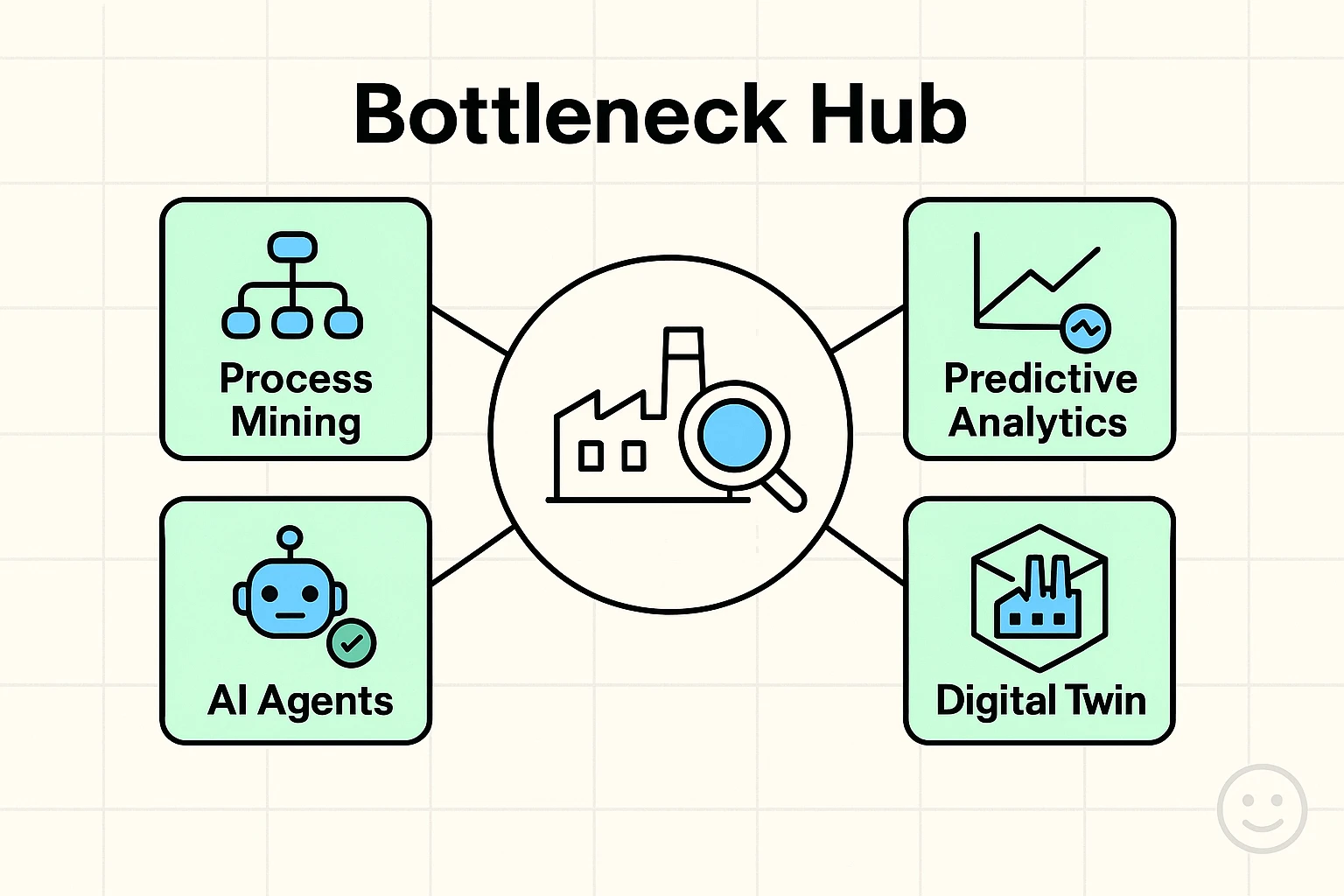
Now you can see how these powerful AI techniques work together to identify and prevent different types of bottlenecks.
Manufacturing Bottlenecks & Their AI Solutions
The Broader Context: Why This Matters to Your Business
Identifying bottlenecks with AI isn't just about tweaking machinery; it's about fundamentally rethinking how your manufacturing operations run. This critical first step sets the stage for broader AI-Driven Workflow Optimization. By accurately pinpointing inefficiencies, you unlock a cascade of benefits:
- Increased Throughput: More products made, faster.
- Reduced Costs: Less waste, fewer unplanned downtimes, optimized resource utilization.
- Improved Quality: Proactive detection prevents defects from escalating.
- Faster Time-to-Market: Efficient processes get products out the door quicker.
- Enhanced Decision-Making: Data-driven insights empower better strategic choices.
- Competitive Advantage: Outpace competitors with a leaner, more agile operation.
A recent study by Deloitte found that AI-powered solutions can lead to a 10-30% improvement in manufacturing efficiency. This isn't just theory; companies like Siemens and a major Japanese automaker have publicly shared their success stories, leveraging AI for predictive maintenance and quality control, leading to significant gains.
Getting Started: An Implementation Roadmap
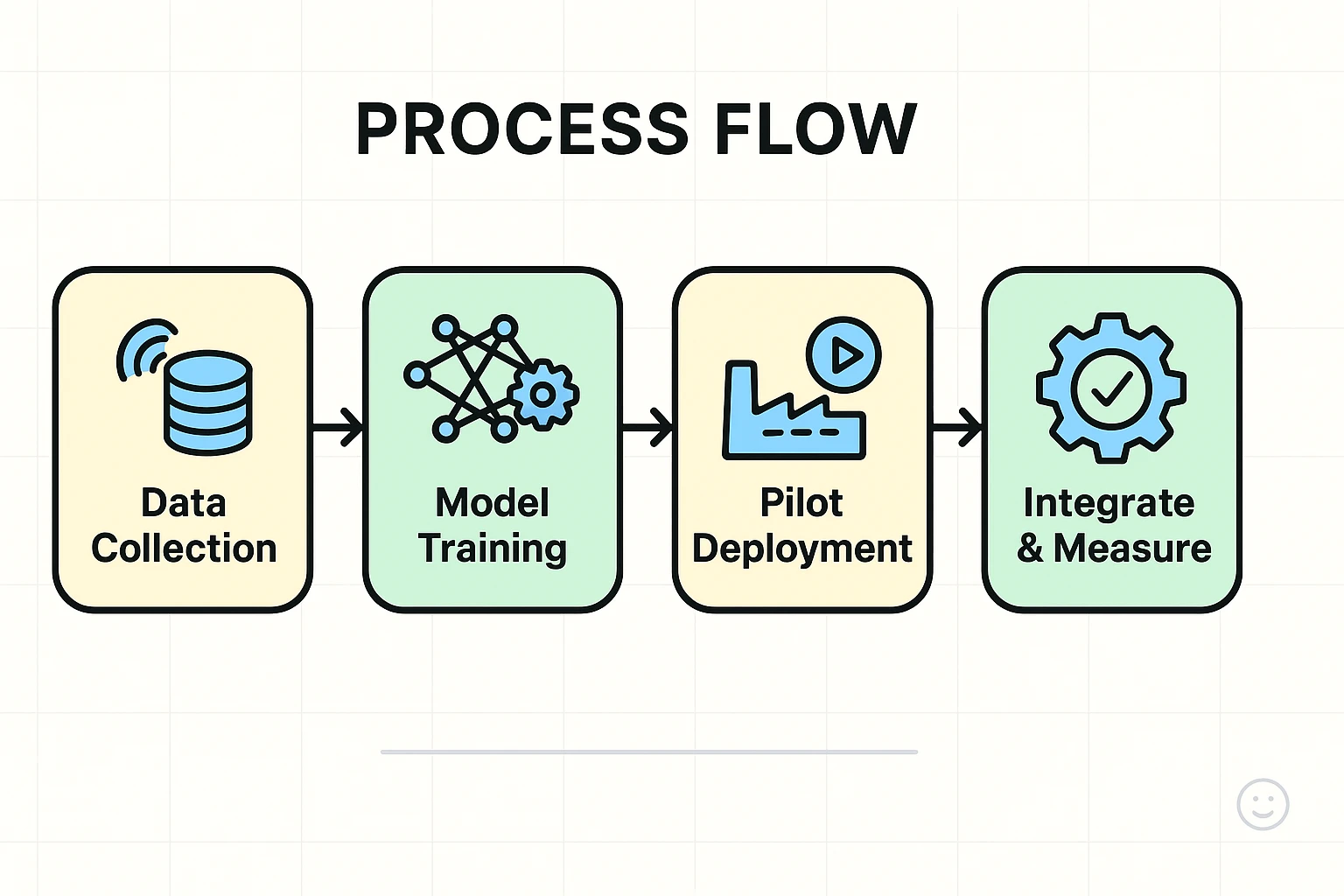
Implementing AI for bottleneck identification might sound daunting, especially in environments with existing legacy systems. However, a phased approach can make it manageable and deliver value incrementally.
- Define Your Goals: What specific problems are you trying to solve? Are you aiming to reduce machine downtime, improve quality at a particular station, or accelerate overall production speed?
- Assess Your Data Landscape: Where is your data? Is it structured or unstructured? What systems are currently collecting information (MES, ERP, SCADA, sensor data)? This is crucial, as the accuracy of AI depends heavily on the quality and availability of your data. (For example, clean event logs are essential for effective process mining).
- Start Small with a Pilot Project: Don't try to optimize everything at once. Choose one specific production line or a single type of bottleneck for a proof-of-concept. This allows you to learn, refine the AI models, and demonstrate ROI without overhauling your entire operation.
- Integrate and Scale: Once your pilot proves successful, integrate the AI solution with your existing systems and gradually expand its scope across more production lines or into interconnected supply chain elements.
AI for Manufacturing: A Phased Implementation Roadmap
The Data Driving the Insights
What kind of data are we talking about here? It's more pervasive than you might think. From every sensor reading to every log entry, your factory is a goldmine of information waiting to be unlocked.
Manufacturing Data Flow & AI Insights

As you can see, various data points are collected from the shop floor, channeled to different AI models, and then translated into actionable outputs that directly address bottlenecks.
Common Misconceptions to Avoid (and How AI Helps)
- "We need perfect data." While good data is crucial, focusing on "perfect" can lead to analysis paralysis. AI can often work with imperfect data and even help improve data quality over time by identifying inconsistencies. The key is starting with what you have and refining.
- "AI is just dashboards." Dashboards visualize data, but AI analyzes it, draws conclusions, and makes predictions. It's the difference between seeing a map and having a GPS tell you the fastest route.
- "This is an IT project." AI for manufacturing is a cross-functional initiative. It requires deep collaboration between IT, operations, engineering, and even supply chain teams to ensure the models are deployed effectively and provide relevant insights.
- "AI is too expensive and takes too long." While enterprise-wide AI can be a significant investment, starting with a focused pilot project with clear objectives can yield quick wins and demonstrate ROI faster than you might expect, building internal momentum.
Frequently Asked Questions About AI-Powered Bottleneck Identification
Q1: What's the biggest difference between human and AI bottleneck identification?
A1: Humans excel at intuition and complex problem-solving based on experience. AI, however, excels at scale, speed, and pattern recognition across massive datasets. AI can monitor every single variable 24/7, something impossible for humans. It provides an objective, data-driven view, often unearthing subtle correlations that human observation might miss.
Q2: Is AI going to replace my operations team?
A2: No, AI is a powerful tool designed to augment human capabilities, not replace them. It takes over the tedious, repetitive data analysis tasks, freeing up your operations team to focus on higher-level strategic decisions, creative problem-solving, and implementing the solutions AI identifies. It transforms roles, making them more analytical and impactful.
Q3: What kind of data do I need to start using AI for this?
A3: The more data, the better – but quality over quantity is key. You'll typically need data from:
- Manufacturing Execution Systems (MES): Production orders, job tracking, work-in-process.
- Enterprise Resource Planning (ERP) systems: Inventory levels, procurement, scheduling.
- Sensors: Machine health, temperature, pressure, vibration, energy consumption.
- Quality Control (QC) systems: Defect rates, inspection results.
- Historical Data: Past production runs, maintenance logs, downtime records.The specific data needed depends on the AI technique and the type of bottleneck you're targeting.
Q4: How quickly can I see results from implementing AI for bottlenecks?
A4: This varies depending on the complexity of your operation and the scope of your project. However, many pilot projects can start showing tangible results (e.g., a reduction in a specific type of downtime or defect) within 3-6 months. The faster you can collect and integrate relevant data, the quicker you'll see benefits.
Q5: Can AI really identify the root cause of a bottleneck?
A5: Yes, directly and indirectly. AI can highlight the problem location with precision (e.g., "Machine X is the bottleneck"). Then, by analyzing interconnected data points, it can often pinpoint the cause (e.g., "The consistently high vibration readings on Machine X indicate a failing bearing, leading to its frequent downtime"). This capability is a significant leap beyond simply knowing where the bottleneck is.
Q6: What's special about BenAI's approach to this problem?
A6: Our focus at BenAI is on practical, tailored AI implementation. We don't just offer off-the-shelf solutions; we build custom AI systems and provide expert consulting, training, and ongoing support to ensure that your AI-powered bottleneck identification system addresses your unique manufacturing challenges and delivers measurable business outcomes, helping you become an "AI-first" company. We guide you from strategy to deployment and beyond.
Your Path to a Leaner, Smarter Future
The future of manufacturing isn't just about making more products; it's about making them smarter, faster, and with less waste. AI-powered bottleneck identification is the cornerstone of this transformation, offering a clear path to unprecedented efficiency and profitability.
Ready to see how AI can unclog your production lines? Explore our comprehensive AI Business Guidance or learn more about building agile, AI-driven operations. Your "AI-First" business starts here.
Join Our Growing AI Business Community
Get access to our AI Automations templates, 1:1 Tech support, 1:1 Solution Engineers, Step-by-step breakdowns and a community of forward-thinking business owners.
Latest Blogs
Explore our latest blog posts and insights.