You're beyond the hype cycle of AI. You've seen the demos, understood the potential, and now you're actively evaluating how to move from scattered AI experiments to truly transformative, strategic implementation within your business. The challenge isn't if AI agents can help, but how to design, deploy, and manage them effectively to create a competitive advantage, rather than just another operational expense. This guide cuts through the noise, offering decision-makers like you a clear framework for building a robust, AI-first organization—one where custom AI agents act as intelligent, reliable digital employees.
Beyond Off-the-Shelf: The Rise of the Custom Digital Employee
For many businesses, the journey into AI agents begins with off-the-shelf tools. These can offer quick wins, automating simple, repetitive tasks. But you've likely realized that true transformation—the kind that delivers unique value and scales your operations 10x faster without increasing headcount—requires something more. This is where custom AI agents come in.
Unlike generic tools, a custom AI agent is designed from the ground up to operate as a specialized "digital employee" within your unique business context. It understands your specific workflows, leverages your proprietary data, and executes complex tasks with precision, mirroring the expertise of a human specialist. Take, for instance, a marketing agency. They might use an off-the-shelf tool for basic content generation, but a custom AI agent could build an entire marketing team with 37 AI agents, orchestrating complex campaigns from strategy to execution, far beyond what a generic tool could achieve. This isn't just augmentation; it's about creating a bespoke workforce that embodies your organizational intelligence.
The MOFU Imperative: Why Businesses Are Investing in Custom AI Agents
The shift towards custom AI agents isn't just a technical trend; it's a strategic imperative driven by the need for differentiation, efficiency, and scale. Businesses are struggling with broader deployment of AI agents beyond initial pilots, with less than 10% scaling AI agents significantly within any single business function, despite 79% already adopting them (McKinsey 2025). This highlights a critical pain point: an urgent need for solutions that enable strategic, scalable adoption.
Why are forward-thinking leaders like you evaluating custom solutions now?
- Competitive Edge: Generic AI tools often lead to commoditized outcomes. Custom AI agents, however, can provide proprietary advantages by optimizing workflows unique to your business, differentiating your services, and protecting your intellectual property. Imagine the advantage gained by a recruiting firm using custom AI to monitor candidates and predict hiring success with higher accuracy than competitors relying on standardized platforms.
- True Scalability: While off-the-shelf tools offer a baseline, custom solutions empower you to scale operations dramatically. By automating core processes like reducing manual SEO workflows with AI, you can take on more clients or projects without the proportional increase in human resources. This creates capacity, enabling your business to grow with agility.
- Precise Alignment with Business Goals: Custom AI agents are built to achieve specific operational goals and drive measurable business value. They move beyond general productivity gains to target and solve your most critical bottlenecks. For example, a custom AI agent designed for automated content structuring ensures every piece of content meets your brand's exact standards and resonates with your target audience, a level of precision difficult to achieve with basic tools.
The competitive landscape is pushing businesses to move beyond generic AI. While Harvard Business Review and McKinsey emphasize the strategic vision of an "agentic organization," and IBM, AWS, and Microsoft detail technical aspects or platform-specific tools, there's a vital gap. That gap is the actionable blueprint that synthesizes executive strategy with detailed, vendor-agnostic architectural and management frameworks for custom-built agents acting as "digital employees." This is precisely what BenAI delivers.
Custom vs. Commercial: Making the Right Investment
When considering AI agents, you're faced with a fundamental choice: off-the-shelf commercial products or custom-built solutions. Each has its place, but for strategic, long-term advantage, the distinction is crucial.
The image below offers a side-by-side comparison to help you evaluate which path aligns best with your strategic objectives:

Evaluation stage: vendor/solution comparison page (middle of article, side-by-side decision section)
The ROI takeaway is clear: while off-the-shelf tools offer immediate, limited benefit, custom AI agents deliver 10x ROI through strategic competitive advantage and scalable efficiency.
Phase 1: Strategic Blueprint - Designing Your Digital Workforce
Building a custom AI agent is like hiring and training a highly specialized employee. It requires a clear understanding of their role, their capabilities, and how they fit into your existing team structure. This begins with a strategic blueprint.
AI Agent Architecture: The DNA of Autonomy
At its core, an AI agent is a software entity capable of perceiving its environment, reasoning about its observations, planning actions, and then executing them to achieve specific goals. For custom agents, this architecture is paramount for scalability, robustness, and specialized functionality.
Every custom AI agent needs foundational components:
- Perception: How it gathers information from its environment (e.g., scraping websites, reading documents, listening to user queries).
- Reasoning: Its ability to interpret data, apply logical rules, and draw conclusions.
- Planning: Crafting a sequence of steps to achieve a goal based on its reasoning.
- Action: Executing tasks (e.g., sending an email, updating a database, generating content).
- Memory: Storing past experiences and learning to improve future performance.
Crucially, we advocate for a Reasoning-First Architecture. This design principle emphasizes the agent's ability to plan, reflect, and self-critique its actions before execution. This is a level of sophistication often overlooked by off-the-shelf tools. It enables agents to handle ambiguous situations, adapt to unforeseen challenges, and continuously refine their strategies, much like an experienced human professional. This deep reasoning capability is essential for operations like AI LinkedIn campaign optimization, where nuanced understanding of audience and context is key to success.
Defining Operational Goals & Use Cases
The most successful AI agent deployments start not with the technology, but with the specific business outcomes you need to achieve. As HBR wisely points out, the focus must shift from tasks to measurable outcomes.
Identify processes within your organization that are:
- Repetitive and high-volume: Ideal for automation where consistency is key.
- Data-intensive: Where AI can uncover patterns and insights humans might miss.
- Critical for scale: Bottlenecks that, once automated, unlock significant growth.
- Strategic but time-consuming: Freeing up human experts for higher-value activities.
Consider departments like marketing, where an AI SEO Automation Guide can revolutionize content creation and optimization, or recruiting, where AI Recruiting Solutions can streamline candidate sourcing and monitoring. These are areas where 66% of adopters already report increased productivity from AI agents (PwC).
Phase 2: Building & Orchestrating Your AI Agent Ecosystem
Once your strategic blueprint is solid, the next step is to build and orchestrate your custom AI agents. For many complex business challenges, a single AI agent isn’t enough. You need a team—a multi-agent system (MAS) — where various agents collaborate, much like departments within a firm.
Multi-Agent Systems (MAS): The Orchestra of Digital Employees
"Agent mesh architectures," as identified by McKinsey, represent a crucial evolutionary step for organizations aiming for comprehensive AI adoption. These aren't just disparate agents; they are interconnected systems designed for interoperability, efficiency, and resilience.
Here's how to visualize an effective MAS architecture:

Technical evaluation: architecture & solution design section (mid-late article, for architects and technical decision-makers)
This tactical architecture diagram illustrates how a central orchestrator manages communication protocols (e.g., sequential, concurrent, group chat, handoff) and task decomposition within a multi-agent system. This structured approach ensures that complex goals are broken down into manageable sub-tasks, dynamically allocated across specialized agents, and executed collaboratively—just as a human team would operate.
Human-AI Collaboration Frameworks: The Augmented Enterprise
The future isn't about replacing humans with AI, but augmenting human capabilities with intelligent agents. This means designing explicit frameworks for how human teams and custom AI agents will collaborate, share knowledge, and escalate issues. By 2028, 15% of daily work decisions will be made autonomously by AI agents (Datagrid), signaling an evolving partnership where humans often act as "M-shaped supervisors" over their digital counterparts (McKinsey).
This framework helps you define the optimal level of autonomy for your AI agents and establish clear decision points for human intervention:
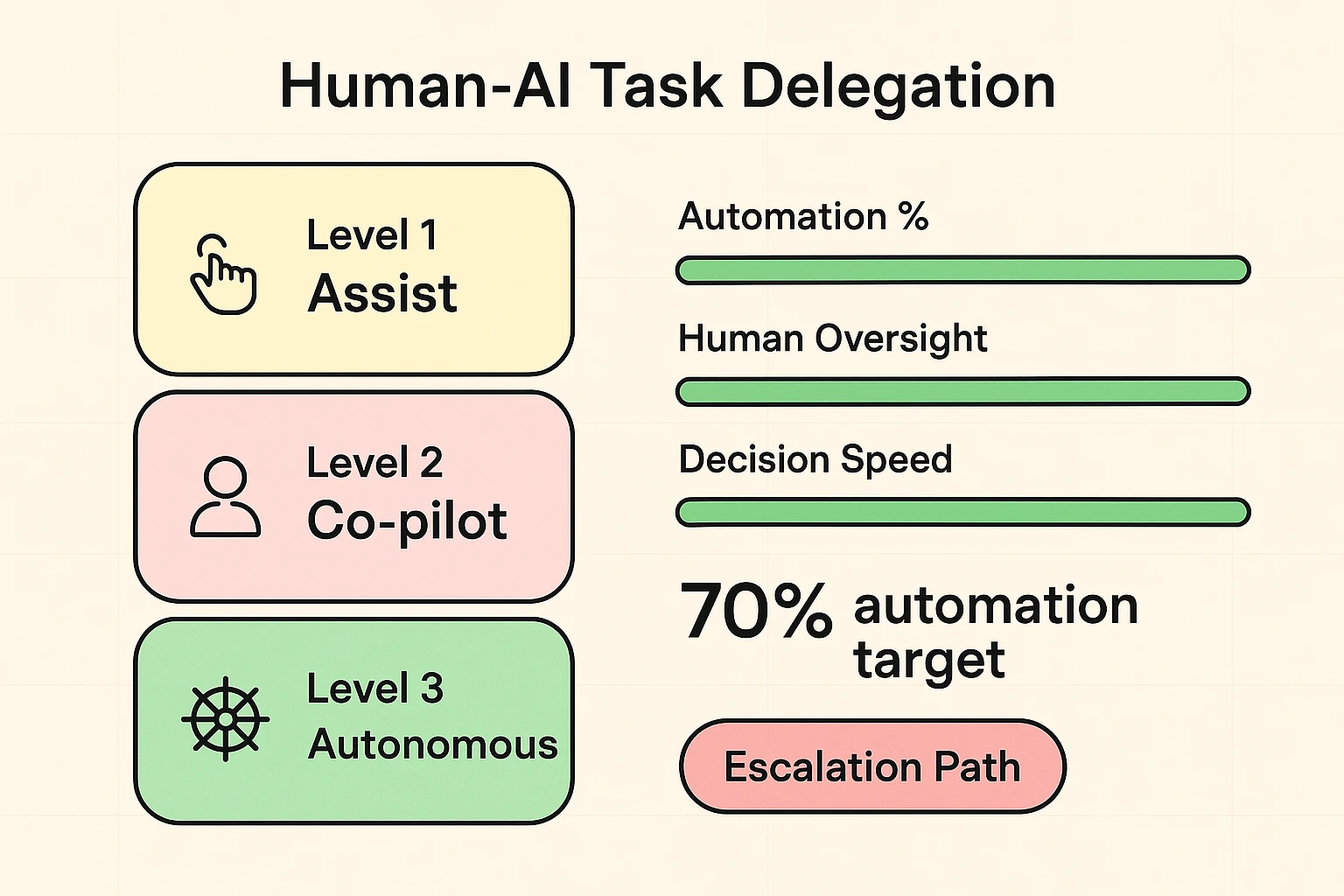
Human-AI collaboration section: operational decision aides (middle of guide for process owners and HR/ops leads)
Key considerations include:
- Autonomy Levels: Clearly define where agents can act independently ("above the loop") and where human oversight is required ("in the loop").
- Escalation Paths: Establish clear protocols for when an agent needs human input or approval, ensuring critical decisions are never made in a black box.
- Feedback Loops: Design continuous feedback mechanisms so both humans and AI agents learn from each other, adapting to new information and refining processes over time. This creates a dynamically improving workflow.
Phase 3: Governance, Security & Performance Management
The strategic value of custom AI agents is immense, but so is the responsibility of managing them. Governance, security, and performance monitoring are not optional add-ons; they are foundational design principles for any successful, scalable custom AI agent ecosystem.
"Safety by Design": Embedding Ethical & Compliance Guardrails
Unlike off-the-shelf tools with predefined security, custom AI agents require you to build "safety by design" from the ground up. This means integrating ethical and compliance guardrails directly into the agent's code and operational framework.
Key aspects include:
- Ethical Guardrails as Code: Hardcoding ethical parameters and values into the agent's reasoning module to prevent unintended biases or harmful actions.
- Threat Modeling: Proactively identifying potential vulnerabilities in autonomous agent behavior, data access, and decision-making processes.
- Data Provenance & Tracking: Maintaining meticulous records of all data an agent processes and using, especially critical for custom data flows, to ensure transparency and auditability. This also supports your broader AI data strategy.
- AI-Specific Regulations: Integrating compliance with emerging AI regulations and industry standards directly into agent behavior and reporting.
This proactive approach ensures that your custom AI agents operate not just efficiently, but responsibly and compliantly, building trust and mitigating risk.
Continuous Performance Monitoring & Optimization
Monitoring custom, multi-agent systems goes far beyond basic uptime checks. It's about understanding agent collaboration efficiency, decision quality, and detecting subtle 'drift' in autonomous behaviors that could impact your business outcomes.
A governance-first dashboard is crucial for maintaining oversight and proving accountability:
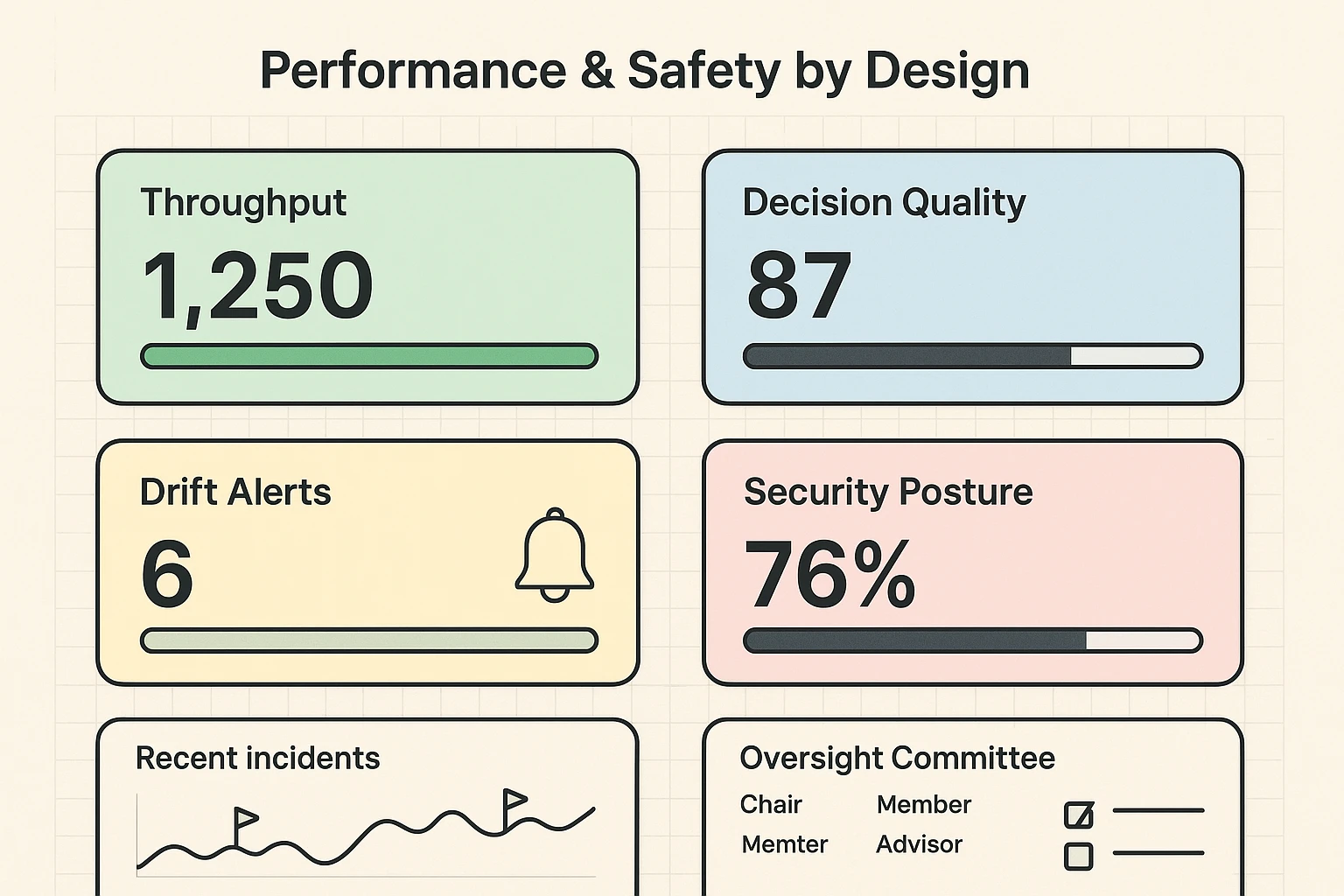
Governance & monitoring section: oversight and KPI evaluation (near governance chapter for compliance and executive sponsors)
This dashboard features:
- Key Performance Indicators (KPIs): Beyond just task completion, measure the quality of agent decisions, the efficiency of inter-agent communication, and the direct impact on business outcomes. For example, in our AI SEO automation efforts, we track not just content published, but search ranking improvements and organic traffic growth.
- Drift Detection: Continuously monitor agent behavior and outputs for any deviation from expected norms, which could indicate model degradation or emerging biases.
- Security Metrics & Incident Timelines: Real-time awareness of security events, alerts, and detailed logs for audit trails.
- Oversight Committee Interface: A clear overview for your strategic oversight committee to approve changes, review ethical concerns, and ensure alignment with high-level objectives.
Strategic Oversight Committee for AI Agents
For truly strategic AI agent ecosystems, a dedicated oversight function is indispensable. This goes beyond generic IT governance. This committee defines roles, decision-making hierarchies, ethical review processes, and resource allocation specifically for your custom AI initiatives. It ensures that your growing digital workforce remains aligned with your overall business strategy and values. This strategic oversight is essential to move beyond pilot projects to enterprise-wide AI-first transformation, as emphasized by McKinsey in their "agentic organization" concept.
Transforming Your Organization for the Agentic Era
Adopting custom AI agents is not just a technological upgrade; it's an organizational transformation. It requires strategic foresight, careful change management, and a commitment to upskilling your workforce. Your "AI-First Business" starts here by creating an ecosystem where humans and AI thrive together.
- Workforce Upskilling & Reskilling: As AI agents handle more routine tasks, your human employees will transition into roles requiring higher-order thinking, strategic oversight, and creativity. Investing in training to develop "M-shaped supervisors" (those with deep expertise in one area and broad understanding across others) and "T-shaped experts" is critical for success (McKinsey).
- Change Management for AI Adoption: Address legitimate concerns about job displacement by framing AI as a tool for augmentation and growth. Build trust through pilot programs, transparent communication, and involving employees in the design and deployment of AI solutions. Foster AI literacy across all levels of the organization.
- ROI Measurement for Custom AI Agents: While measuring the return on investment for off-the-shelf tools can be straightforward, custom AI agents require a more holistic approach. Beyond traditional efficiency metrics, consider the value of innovation, strategic differentiation, enhanced customer experience, and the capacity created for future growth.
FAQ: Strategic AI Agent Design & Management
Q: How do custom AI agents differ from ready-made AI tools?
A: Ready-made AI tools are designed for general applications, offering quick, basic automation. Custom AI agents, however, are built specifically for your unique business processes, leveraging your proprietary data and delivering specialized outcomes that generic tools cannot. They act as "digital employees" tailored to your exact needs, providing a distinct competitive advantage.
Q: Is building custom AI agents more expensive than buying off-the-shelf software?
A: The initial investment for custom AI agents can be higher. However, the long-term ROI is significantly greater due to precise alignment with strategic goals, unparalleled efficiency gains, IP protection, and the ability to scale operations uniquely. Custom agents eliminate inefficient workarounds often required with off-the-shelf solutions, saving significant maintenance and integration costs over time.
Q: How can I ensure my custom AI agents are ethical and comply with regulations?
A: Ethics and compliance must be "built-in" from the design phase, not added on later. This involves implementing ethical guardrails directly into the agent's code, performing proactive threat modeling, and establishing robust data provenance tracking. A dedicated strategic oversight committee, as we recommend, is also crucial for continuous review and alignment with evolving standards and regulations.
Q: What kind of internal team do I need to manage custom AI agents?
A: Successfully managing custom AI agents requires a multi-disciplinary approach. You'll need a core team of AI architects/engineers, data scientists, and business domain experts. Critically, you also need "M-shaped supervisors" – managers who understand both the technical capabilities of AI and the strategic business context – and human-AI collaboration specialists to manage the evolving interaction between your human and digital workforces.
Q: How long does it typically take to design and deploy a custom AI agent system?
A: The timeline varies significantly depending on the complexity of the agent, the number of agents in a multi-agent system, and the integration requirements. Simple custom agents might take a few months, while complex multi-agent systems for enterprise-wide transformation can take 6-12 months or longer to fully deploy and optimize. The process is iterative, focusing on continuous improvement post-deployment.
The Path to Agentic AI Dominance
The era of the "agentic organization" is here. Businesses like yours, navigating a world where 88% of organizations plan to increase their AI budgets (PwC), recognize that sustainable growth and competitive advantage come from strategic, thoughtful, and custom AI implementation. Moving beyond basic automation requires a partner who understands not just the technology, but your business. BenAI specializes in providing the proven systems, implementations, training, and consulting needed to transform your business into an AI-first entity.
Don't let the complexity of scaling AI agents hold you back. Let BenAI guide you in crafting your bespoke digital workforce. Ready to build your specific custom AI agents designed to achieve your key business outcomes? Book a call with BenAI today and start designing your future.
Join Our Growing AI Business Community
Get access to our AI Automations templates, 1:1 Tech support, 1:1 Solution Engineers, Step-by-step breakdowns and a community of forward-thinking business owners.
Latest Blogs
Explore our latest blog posts and insights.