Starting a new venture is exhilarating. You're building something from scratch, fueled by passion and ingenuity. But let's be honest, reality often bites, especially when it comes to resources. You juggle a million tasks, your team wears multiple hats (if you have a team at all!), and every dollar spent feels like a major investment.
Now, imagine hearing about the transformative power of AI. Big companies are automating, personalizing, and optimizing everything. You think, "That's great for them, but I don't have a team of data scientists or a bottomless budget." If this sounds familiar, you're not alone. Many founders believe AI is a luxury reserved for tech giants.
But what if AI could be your secret weapon, allowing you to do more with less? What if it could be the resource multiplier that helps your lean startup compete (and win) against better-funded rivals?
This guide isn't about turning your startup into Google overnight. It's about crafting an AI strategy specifically designed for you – the resource-constrained startup founder, the ambitious solopreneur, the small team punching above its weight. We’ll cut through the hype and show you how to leverage AI for rapid ROI, prioritize intelligently, and integrate powerful tools without draining your bank account or demanding a full-time AI expert.
Why Your Lean Startup NEEDS an AI Strategy (It’s Not What You Think)
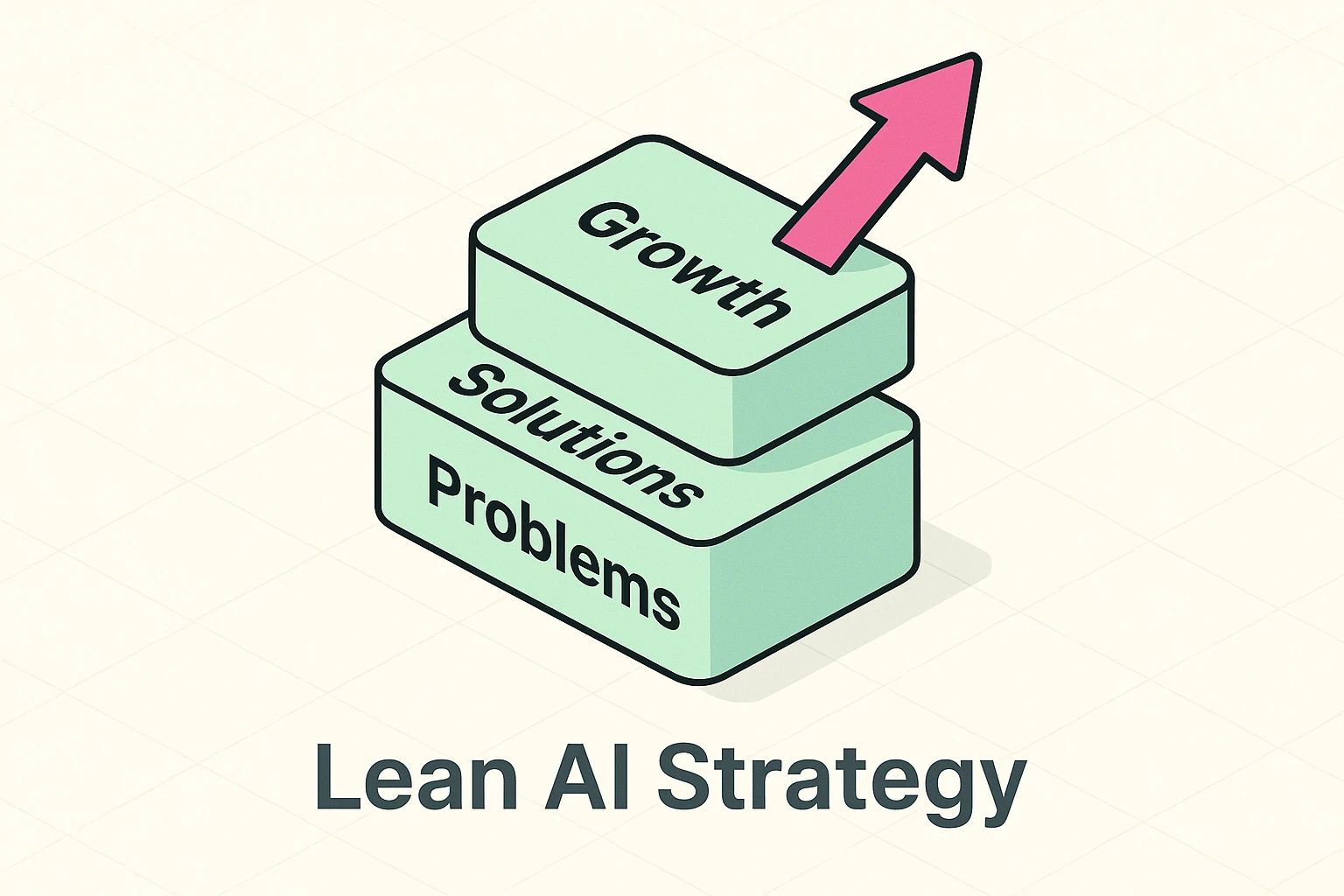
A common misconception is that an "AI strategy" means building complex machine learning models from scratch. For resource-constrained startups, this couldn't be further from the truth. Your AI strategy is simply a plan for how you’ll use artificial intelligence to solve your most pressing business problems, save time, reduce costs, and accelerate growth, all while operating within your tight constraints.
Think of AI not as a fancy, expensive toy, but as a suite of powerful co-pilots and automated assistants. According to research, businesses that strategically implement AI often see significant improvements in efficiency and decision-making, even with small-scale applications. For startups, this translates directly into survival and competitive advantage.
The real challenge isn't if you should use AI, but how to approach it intelligently. Many startups fail because they either ignore AI completely, or they dive in without a clear plan, wasting precious resources on initiatives that don't deliver.
The Resource-Constrained Mindset: Your Competitive Edge
Before we dive into specific tactics, let's recalibrate your thinking about AI. For lean startups, your "resource-constrained" status isn't a disadvantage; it's a built-in filter that forces smart decisions.
Here's how a resource-constrained mindset applies to AI:
- Problem-First Approach: Instead of chasing the latest AI fad, identify your biggest pain points. Is it tedious customer support, inefficient marketing outreach, or slow data analysis? AI should be a solution, not a quest for novelty.
- Rapid ROI: Every AI initiative must have a clear, measurable, and quick return on investment. You simply can't afford long, drawn-out projects with uncertain outcomes.
- Incrementalism: Start small. Implement AI in tiny, manageable chunks. Get a quick win, learn from it, and then expand. This minimizes risk and builds momentum.
- Leverage Existing Tools: You don't need to rebuild the wheel. The market is flooded with powerful, affordable (or even free) AI-powered tools and platforms. Your job is to integrate them smartly.
- Data as an Asset (Even Small Data): You might not have petabytes, but even small, structured datasets can be gold for AI. Learn to identify and utilize what you have, and how to gather more efficiently.
This lean approach to AI ensures that every effort directly supports your core business objectives, propelling you forward without unnecessary bulk.
Building Your Lean AI Strategy: A Step-by-Step Blueprint
Phase 1: Identify Your AI Sweet Spot
This is where many startups stumble. They see a cool AI tool and try to find a problem for it. Reverse that. Start with your business.
- List Your Biggest Pain Points:
- What tasks consume the most time for you or your small team?
- Where are you currently losing money due to inefficiency or errors?
- What customer frustrations could be alleviated?
- Where do you lack crucial insights from your data?
- Consider areas like customer support inquiries, content creation, social media management, lead qualification, or internal data analysis.
- Evaluate AI Feasibility & Impact:
- For each pain point, ask: Could AI realistically help here? How much time/money could it save? What’s the potential for increased revenue or customer satisfaction?
- Can you define a clear, measurable outcome? (e.g., "reduce customer support response time by 30%," "increase qualified leads by 15%").
- Assess Data Availability:
- Do you have the data needed to "feed" an AI? For example, to automate customer support, you'll need historical chat logs or FAQ documents. For lead qualification, you'll need data on past leads and their conversion rates.
- Don't fret if your data isn't perfect. We're looking for "good enough" to start.
- Prioritize for Quick Wins (High Impact, Low Effort/Cost):This is critical. You want to identify 1-3 opportunities that can deliver tangible results quickly, with minimal investment. Use a simple scoring matrix like the one below:
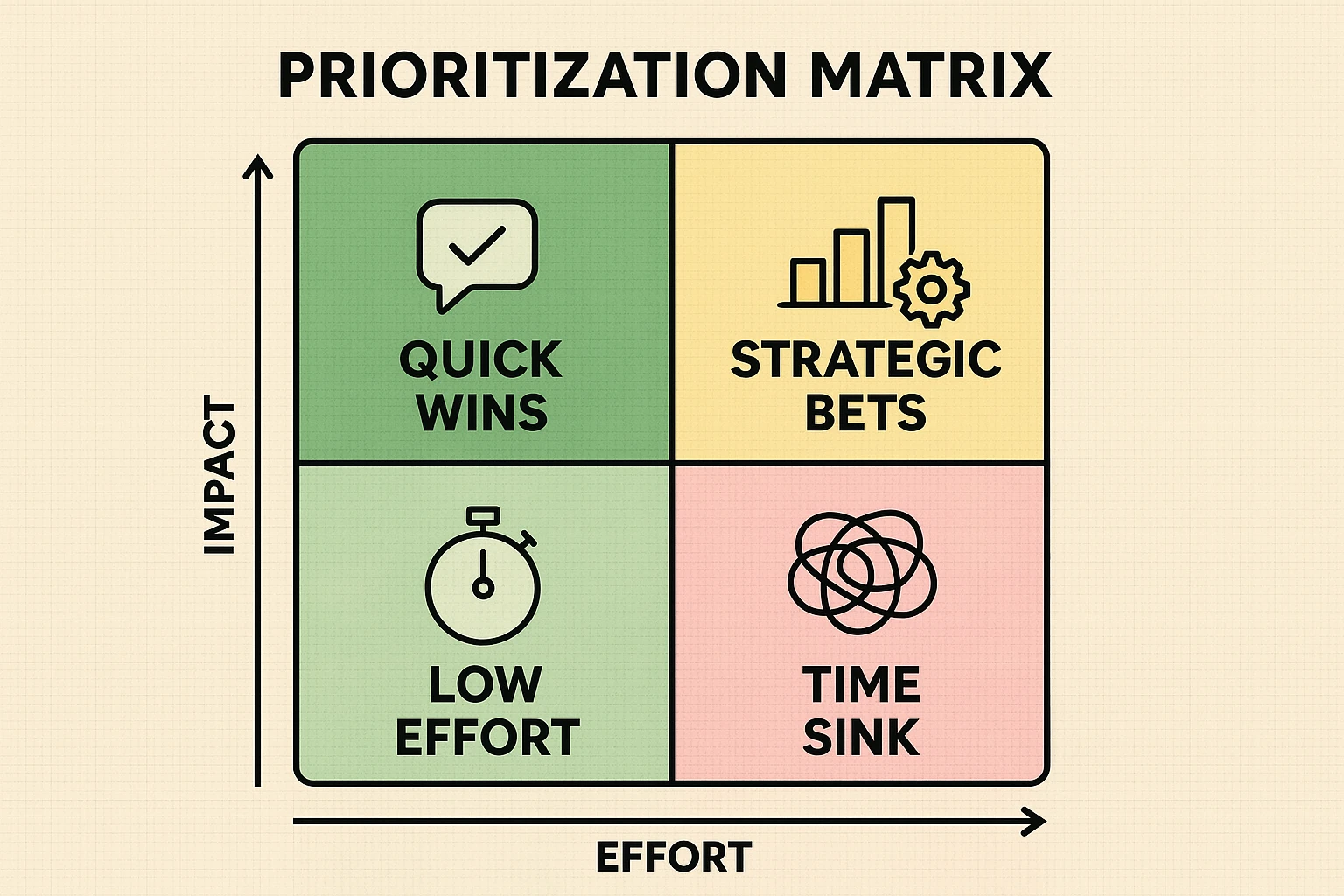
- A clear prioritization matrix helps resource-constrained startups pick AI projects with the highest impact and lowest effort first, highlighting 'quick wins'.Focus on the top-right quadrant: "High Impact / Low Effort." These are your "AI Sweet Spots."
- Example Sweet Spots for Startups:
- Automate FAQ Responses: Using a chatbot for common customer queries (often low effort, high impact on support efficiency).
- Content Generation: Generating blog post drafts or social media updates with AI writing tools (low effort, high impact on marketing output). Want to learn more about this? Check out our guide on AI newsletter content generation.
- Simple Data Analysis: Summarizing customer feedback or identifying trends from sales data using AI-powered analysis tools (medium effort, high impact on insights).
- SEO Automation: Leveraging AI for keyword research or generating meta descriptions. If you're interested in speeding up your SEO tasks, our AI SEO automation guide dives deep into this.
- Example Sweet Spots for Startups:
Phase 2: Build Your AI-Powered MVP (Minimum Viable Product)
Now that you've identified your sweet spot, it's time to build a Minimum Viable Product (MVP). The goal here is to get something working quickly, gather feedback, and validate your hypothesis with minimal cost.
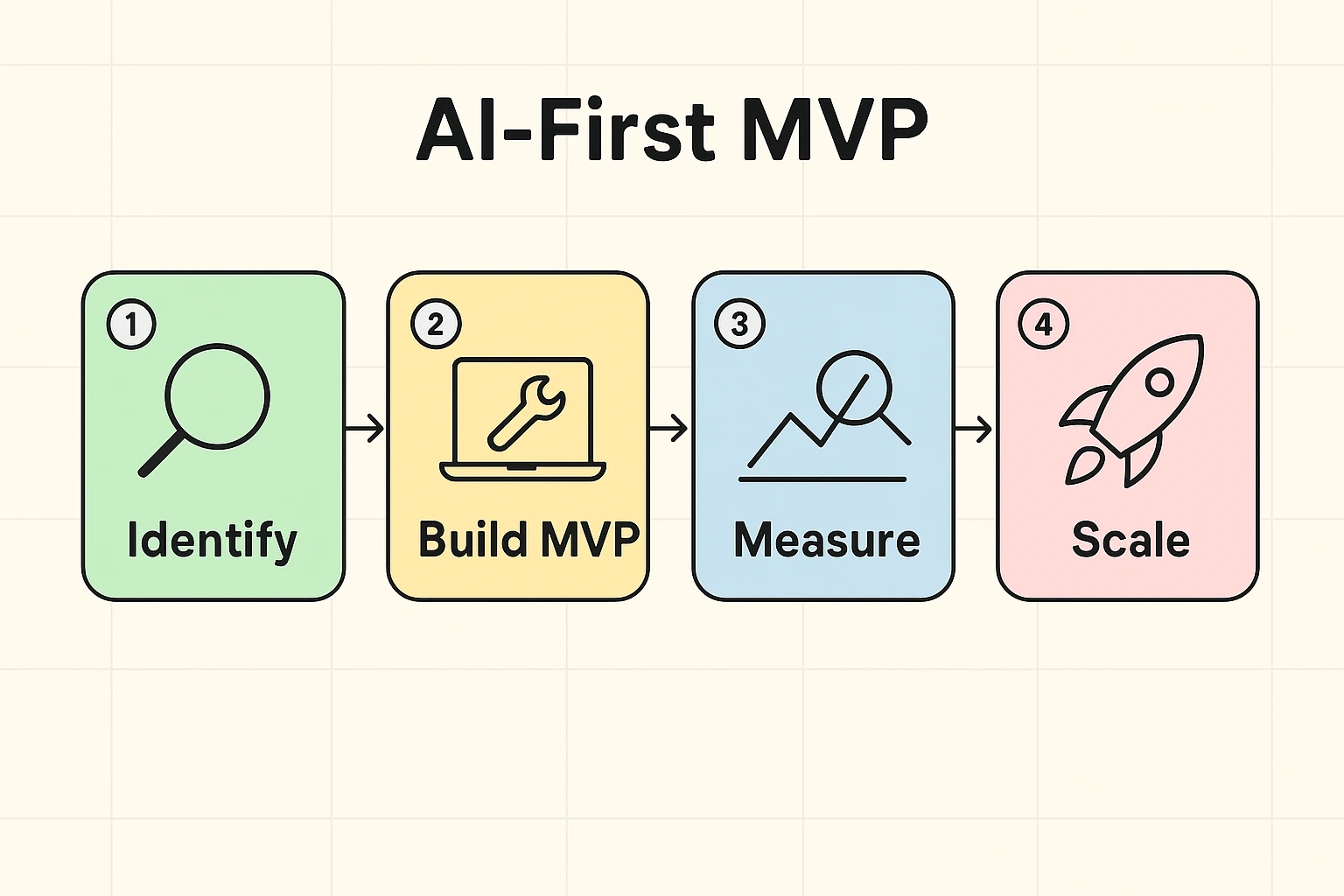
A concise four-step AI-MVP flow shows how startups move from identifying a problem to building, measuring, and scaling a lean AI solution with minimal resources.
- Choose Your "Build vs. Buy vs. Borrow" Strategy:This decision is paramount for resource-constrained startups.
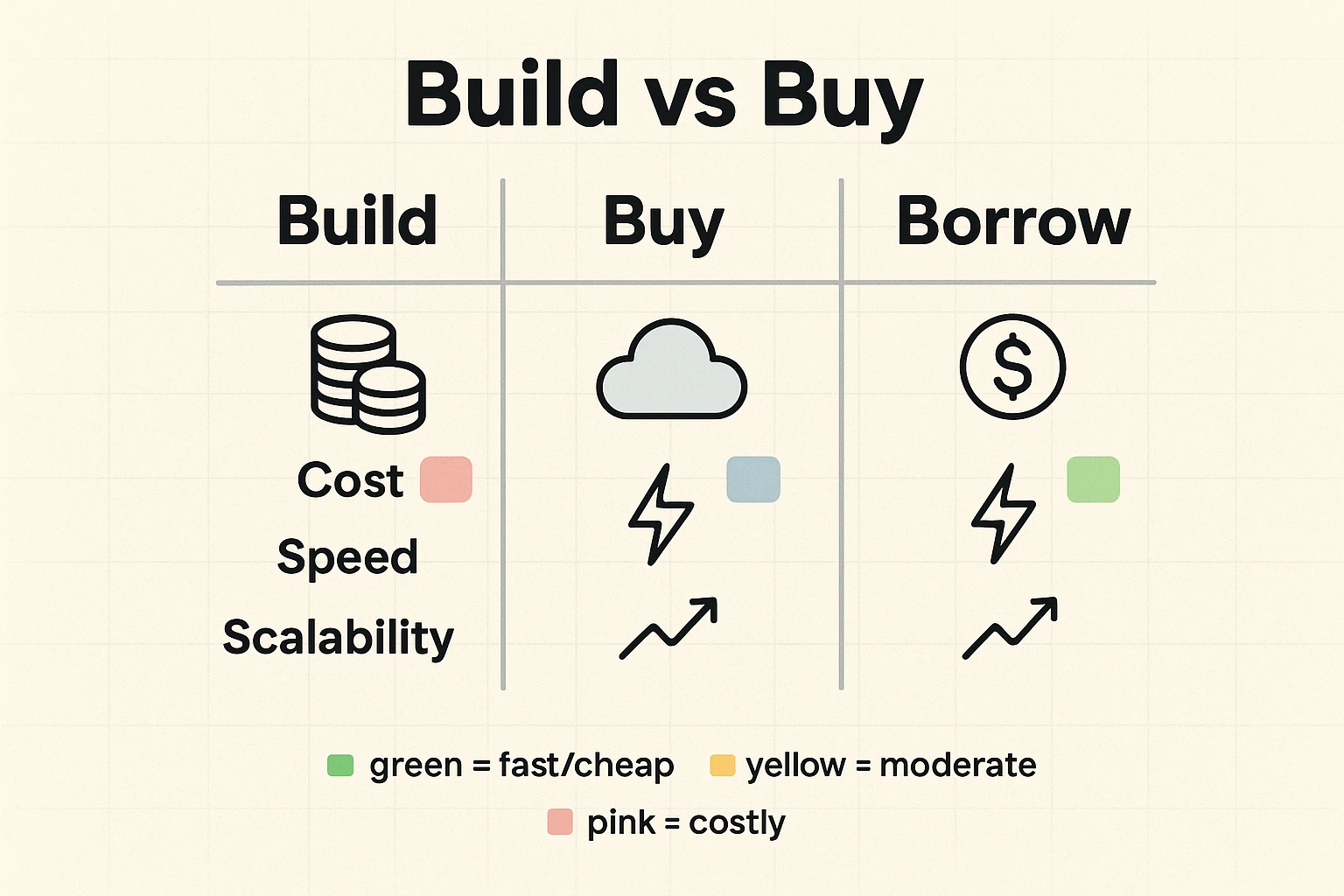
- A simple comparison grid helps founders quickly choose between building custom AI, buying tools, or borrowing integrations based on cost, speed, and scalability.
- Build (Custom AI): Generally NOT for lean startups. Requires significant development time, expertise, and cost. Avoid for your first AI MVP.
- Buy (Off-the-Shelf Tools): Your best friend for rapid deployment. These are pre-built AI solutions that solve specific problems.
- Examples: ChatGPT for content generation, HubSpot or Intercom for AI-powered chatbots, Zapier for connecting various tools with AI actions, Grammarly for writing assistance.
- Pros: Fast, affordable (often subscription-based), no coding required, immediate value.
- Cons: Less customizable, reliant on vendor.
- Borrow (APIs & Integrations): A middle ground. Use powerful AI models provided by tech giants (like OpenAI's API, Google Cloud AI) and integrate them into your existing workflows using no-code platforms (e.g., Make.com, Zapier) or light custom coding.
- Examples: Using OpenAI's API to generate personalized emails for lead outreach, or integrating a sentiment analysis API into your customer feedback system. Learning how to develop AI workflows using no-code methods, like no-code AI technical SEO automation, can get you started quickly.
- Pros: More flexibility than off-the-shelf, cost-effective for specific tasks, powerful AI capabilities.
- Cons: Requires some technical comfort and understanding of API documentation, costs can scale with usage.
- Data Strategy for Lean Startups:You often don't need "big data" to start. What you need is relevant data.
- Prioritize Internal Data: Leverage your existing spreadsheets, customer interactions, product usage data, and website analytics.
- External Data (Carefully): For competitive analysis or market trends, relevant public datasets or industry reports can supplement your internal data.
- Data Cleaning & Structuring: Even with small datasets, clean and structured data is crucial for AI performance. Basic spreadsheet hygiene can go a long way.
- The "Human in the Loop" Principle:Especially when you're starting, don't fully automate critical processes. Keep a human involved to review AI outputs, correct errors, and ensure quality. This helps you build trust in your AI systems and trains them over time. For instance, in content creation, AI can generate first drafts, but a human editor ensures brand voice and accuracy.
Phase 3: Measure, Learn, and Iterate
The lean startup philosophy thrives on iteration, and your AI strategy should too.
- Define Success Metrics: What does success look like for this specific AI MVP?
- Reduced X hours per week?
- Increased Y customer inquiries handled automatically?
- Improved Z conversion rate for a specific lead segment?
- Lowered cost per lead by X%?
- For example, if you're using AI for lead generation, tracking metrics related to AI-driven LinkedIn outreach best practices or understanding a content gap analysis could be crucial.
- Collect Feedback & Track Performance:
- Continuously monitor your defined metrics.
- Interview users (internal team or customers) about their experience with the AI.
- Where is it working well? Where is it falling short?
- Iterate & Optimize: Based on your measurements and feedback, refine your AI application:
- Tweak prompts for generative AI.
- Adjust automation rules.
- Integrate a new, complementary tool.
- Or, if it's not delivering, pivot to a different AI application or even sunset the project.
This continuous feedback loop is essential for maximizing your ROI and ensuring your AI efforts stay aligned with your evolving business needs.
Beyond the MVP: Scaling Your Lean AI
Once you've achieved a few quick wins and proven the value of AI in specific areas, you can start thinking about scaling.
- Expand to New Use Cases: Look at other high-impact, low-effort areas you identified in Phase 1.
- Invest in Deeper Integrations: As you grow, you might move from simple off-the-shelf tools to more integrated API solutions or even hire external AI consultants for specific, complex projects.
- Build Your "AI Talent": This doesn't necessarily mean hiring a data scientist. It could mean upskilling existing team members through online courses, or building relationships with freelancers who specialize in AI implementation.
- Cost Management: Understand that AI usage can incur costs (e.g., API calls, monthly subscriptions). Monitor these costs diligently and optimize usage as you scale.
Avoiding Common AI Traps for Startups
- Analysis Paralysis: Don't wait for perfect data or the perfect plan. Start small, learn fast.
- Trying to Build for Everything: Focus on 1-3 critical problems, not a dozen.
- Neglecting the "Human in the Loop": Over-automating too early without human oversight can lead to costly errors and frustrated customers.
- Ignoring Ethics: Even for lean startups, consider data privacy, fairness, and potential biases in your chosen AI tools. This builds trust and avoids future headaches.
- Believing AI is a Magic Bullet: AI is a tool, not a substitute for sound business strategy, strong product-market fit, or good old-fashioned hustle.
Frequently Asked Questions About AI for Lean Startups
Q1: I'm not technical at all. Can I still implement an AI strategy?
Absolutely! This guide is written with you in mind. The rise of no-code/low-code AI tools and user-friendly platforms means you don't need to write a single line of code to get significant value from AI. Focus on identifying your problems and finding off-the-shelf tools or simple integrations that solve them.
Q2: What are some specific, free or very low-cost AI tools you recommend for beginners?
- Generative AI: ChatGPT (free tier), Google Gemini (free tier), Jasper.ai (paid, excellent for content teams).
- Automation & Integration: Zapier (free tier), Make.com (free tier, powerful for custom workflows).
- Writing & Grammar: Grammarly (free tier).
- Design: Canva (AI features, free tier).
- Customer Support: Many CRM platforms (e.g., HubSpot, Zoho CRM) offer basic AI chatbot features within their free or entry-level plans.
Q3: How much data do I really need to start with AI?
Less than you think! For many no-code AI tools, you might just need well-organized text (e.g., FAQs for a chatbot), clean customer lists, or categorized feedback. The key is quality over quantity in the early stages. For instance, even a small set of meticulously categorized customer feedback can be invaluable for sentiment analysis.
Q4: How do I measure the ROI of my initial AI investments?
Start with simple and direct metrics:
- Time Saved: Track how many hours your team (or you) save on automated tasks.
- Cost Reduction: Compare costs before and after AI implementation (e.g., fewer staff hours needed, reduced software licenses).
- Increased Output: For marketing, track more articles published, more social media posts.
- Improved Efficiency Metrics: Faster response times for support, higher lead qualification rates.The important thing is to define these before you implement the AI so you have a baseline for comparison.
Q5: What's the biggest mistake a resource-constrained startup can make with AI?
Trying to build a custom, highly complex AI solution from scratch (like a bespoke LLM) on day one. This is financially devastating, time-consuming, and almost certainly overkill for initial problems. Stick to leveraging existing tools and APIs for rapid, measurable results.
Q6: How can BenAI help my startup become "AI-First"?
At BenAI, we're dedicated to helping businesses like yours integrate AI effectively. We offer tailored AI solutions, from implementing AI marketing systems to optimizing recruiting processes. If you're ready to dive deeper and build an AI-first business with structured courses, 1:1 help, and coaching, explore the Ben AI Accelerator. We also provide a free community and templates to help you get started with basic resources and AI updates.
Your Journey to an AI-First Startup Starts Now
Embracing AI in your lean startup isn't about chasing trends; it's about smart, strategic problem-solving. By adopting a resource-constrained mindset, focusing on rapid ROI, and leveraging the abundance of powerful, accessible AI tools, you can transform your operations, scale efficiently, and carve out a significant competitive advantage.
Start small, learn rapidly, and iterate constantly. The future of lean business is AI-powered, and your journey toward becoming an AI-First company begins with that first smart, strategic step.
Join Our Growing AI Business Community
Get access to our AI Automations templates, 1:1 Tech support, 1:1 Solution Engineers, Step-by-step breakdowns and a community of forward-thinking business owners.
Latest Blogs
Explore our latest blog posts and insights.