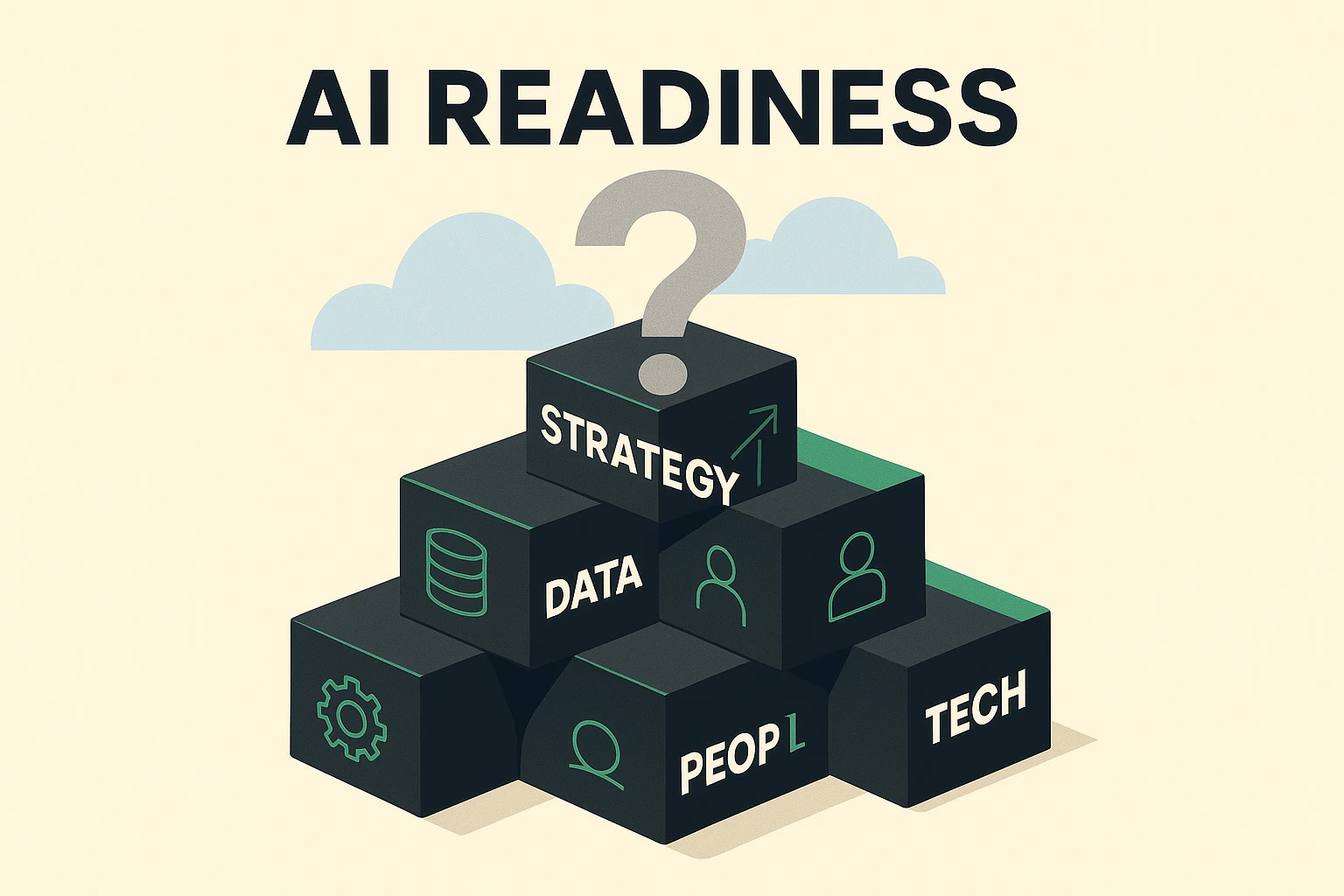
In the bustling world of mid-market businesses—companies with 100 to 500 employees—the buzz around Artificial Intelligence (AI) is unavoidable. It promises efficiency, innovation, and a competitive edge. Yet, beneath the excitement, a crucial question often goes unaddressed: Is your business actually ready for AI?
Many mid-market leaders fear that AI is only for tech giants with limitless budgets and R&D departments. Or, perhaps, they jump in headfirst, only to find their ambitious AI projects stalling, delivering lackluster results, or even failing outright. This isn't just a hunch; studies reveal that a significant percentage of enterprise generative AI initiatives see no measurable impact on P&L due to weak integration (MIT, 2025). For mid-market companies, such failures can be far more catastrophic.
The truth is, successful AI adoption isn't about being the biggest, but about being the most prepared. It’s about understanding your current landscape—your technology, data, people, and processes—before you even think about algorithms. This article will guide you through a practical framework for assessing your mid-market business's AI readiness, turning potential pitfalls into clear pathways for growth.
Foundation: Demystifying AI Readiness for Mid-Market Businesses
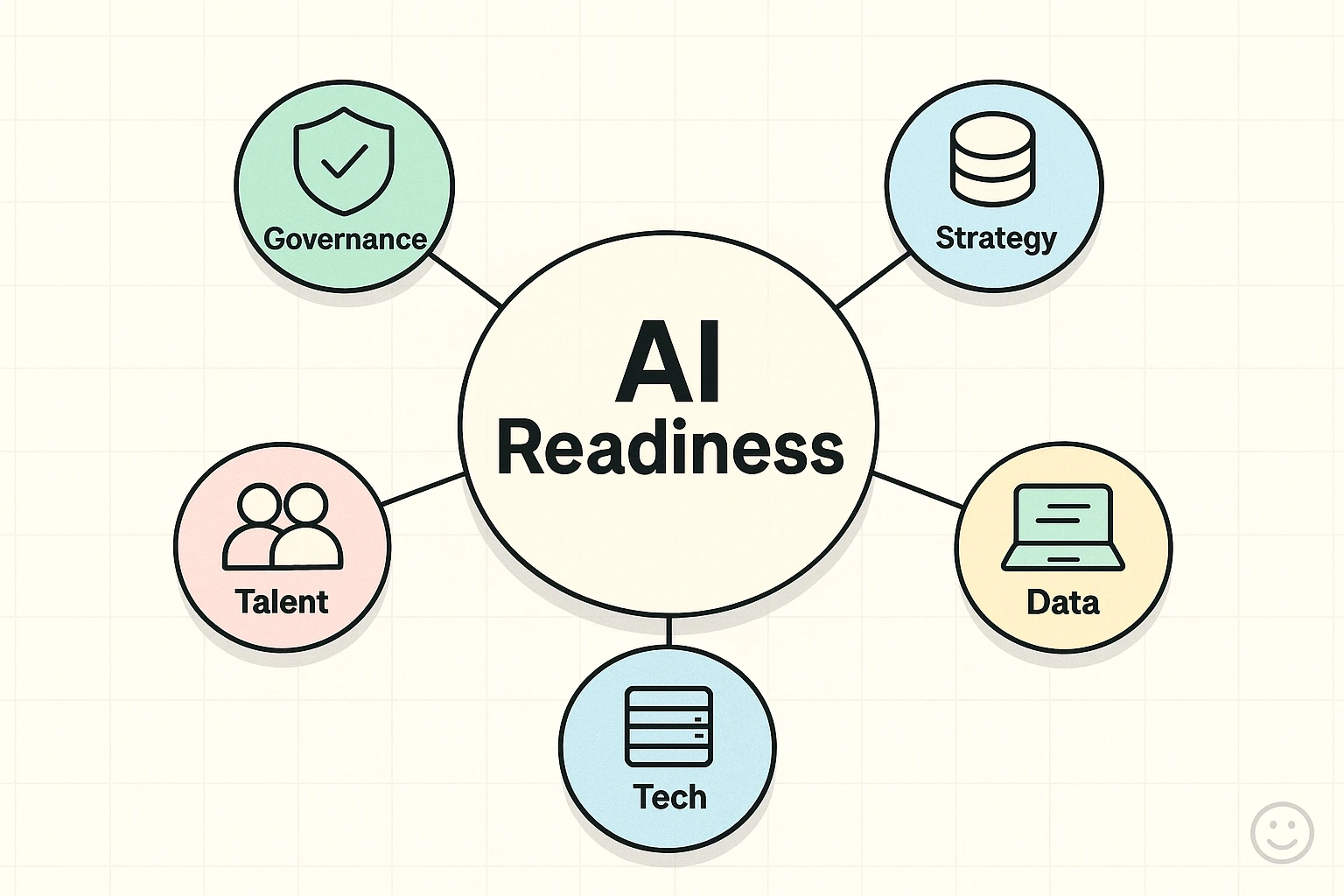
Before we dive into how to assess, let's clarify what AI readiness means, especially for a mid-market context. It's not just about having the latest tech; it’s a holistic view of your organization's capability, capacity, and culture to successfully deploy and derive value from AI.
For mid-market businesses, this means:
- It's more than just buying software: AI isn't an off-the-shelf product that magically transforms your business. It's a strategic shift requiring careful integration.
- Budget and resources matter: Unlike large enterprises, mid-market companies often have tighter budgets and smaller IT teams, making efficient and targeted AI investments critical.
- Agility is an advantage: Your size can be a superpower. Mid-market businesses can often adapt more quickly to new technologies and processes than their larger counterparts, provided they have a clear roadmap.
Common Misconceptions About AI Readiness in the Mid-Market
Let's debunk some common myths that can sidetrack mid-market businesses:
- "AI is only for big tech companies."
- Reality: AI is democratizing. Cloud-based solutions, no-code/low-code platforms, and specialized AI services make it accessible to businesses of all sizes, including mid-market. The key is finding relevant use cases that align with business goals.
- "We need perfect data from day one."
- Reality: While data quality is crucial, waiting for perfection can lead to paralysis. A readiness assessment helps identify data gaps and build a strategy for data improvement alongside AI implementation. Small, targeted AI projects can even help improve data quality over time.
- "AI will solve all our problems."
- Reality: AI is a powerful tool, but it's not a silver bullet. It excels at specific tasks, augmenting human capabilities rather than replacing them entirely. Clear objectives and well-defined problems are essential for successful AI application.
- "Our existing team knows nothing about AI."
- Reality: Building an AI-ready culture involves upskilling, not just hiring new talent. Many valuable AI skills can be taught to your current employees, fostering internal champions and reducing reliance on external hires.
Building: The Mid-Market AI Readiness Assessment Framework
Think of an AI readiness assessment as a health check-up for your business, but specifically with AI in mind. It evaluates key dimensions to ensure you're not just ready for AI, but ready for successful AI. Our framework consolidates stages that can turn readiness findings into strategic actions.
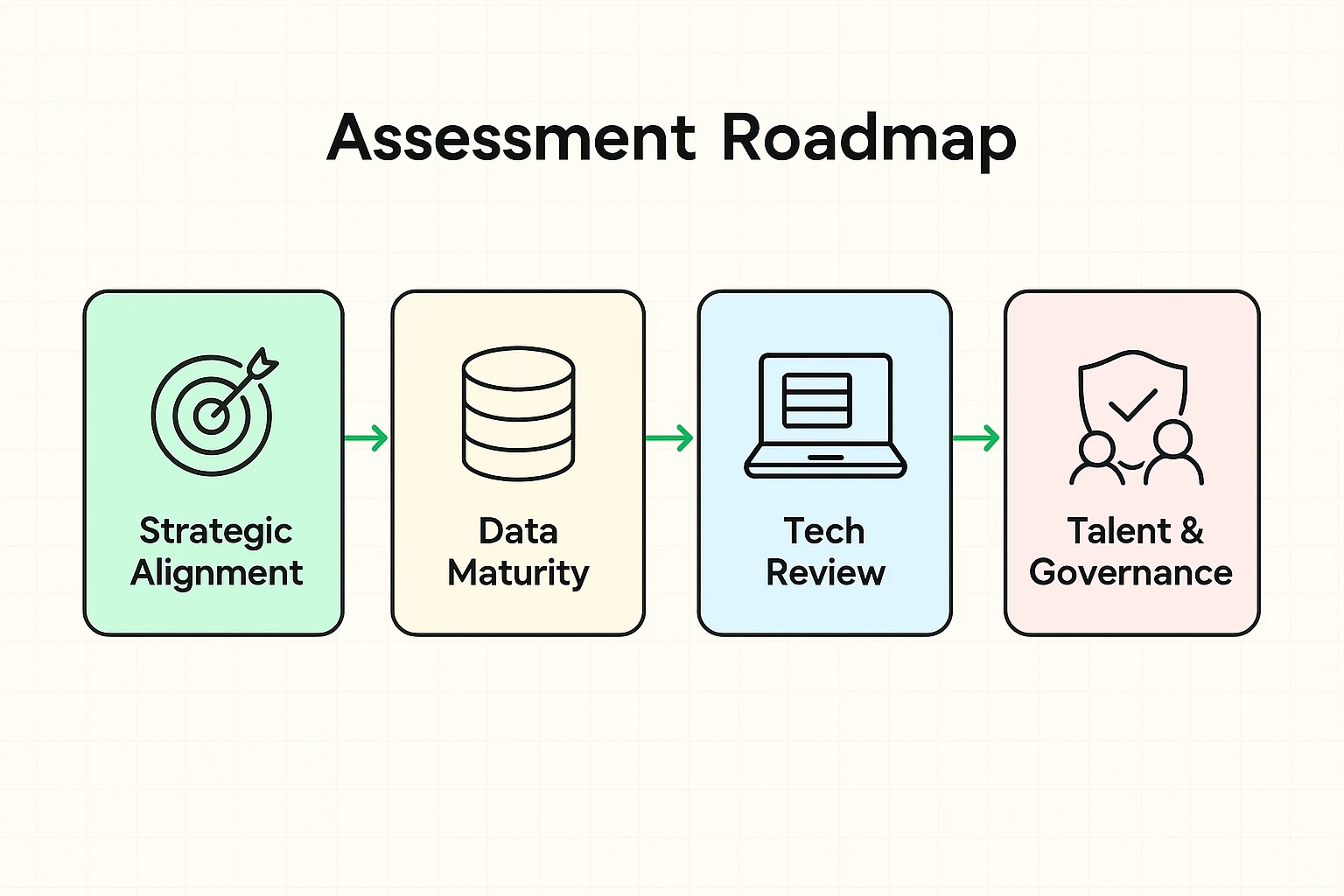
This framework helps you objectively evaluate your current capabilities across critical areas, ensuring any future AI deployments are on solid ground.
Phase 1: Strategic Alignment & Opportunity Identification
This initial phase is about connecting AI to your core business objectives. For mid-market companies, this often means focusing on efficiency gains, cost reduction, or specific competitive advantages.
- Identify Business Goals: What are your top 3-5 strategic goals? How might AI contribute to achieving them? (e.g., "increase lead conversion by 15%", "reduce customer support response times by 50%").
- Pinpoint Key Pain Points: Where are your current bottlenecks, manual processes, or areas of inefficiency? This is often where AI can offer the quickest wins. Consider areas like repetitive tasks in marketing (e.g., content generation, SEO analysis), or streamlining recruitment processes.
- Prioritize Use Cases: Based on your goals and pain points, identify specific AI applications with the highest potential impact and feasibility. Start small and targeted. For example, using AI for automating schema markup or for content refreshing can provide powerful initial insights.
- Stakeholder Engagement: Involve leadership from various departments to understand their challenges and potential AI opportunities. Securing C-suite buy-in from the start is critical for resource allocation and smooth implementation.
Phase 2: Data Maturity Assessment
Data is the fuel for AI. Understanding your data's quality, accessibility, and governance is paramount.
- Data Inventory & Audit: What data do you currently collect? Where is it stored? (e.g., CRM, ERP, spreadsheets, legacy systems).
- Data Quality Evaluation: Is your data accurate, consistent, complete, and up-to-date? Poor data quality is a top reason for AI project failure.
- Data Accessibility: How easily can different systems and teams access and share data? Siloed data is a significant barrier.
- Data Governance & Compliance: Do you have clear policies for data collection, storage, security, and privacy (e.g., GDPR, CCPA)? This is especially critical for mid-market businesses handling sensitive customer information.
- Integration Challenges: Many mid-market businesses operate with disparate systems. Assess the effort required to integrate data sources. Solutions like AI-driven quality control might be considered here to improve data integrity.
Phase 3: Technology Infrastructure Review
Your existing tech stack needs to support AI. This phase assesses your current infrastructure's capabilities and any necessary upgrades.
- Current Infrastructure: What cloud services, on-premise servers, and computing power do you currently use? Is it scalable?
- Software & Systems: List your core business applications (e.g., CRM, marketing automation, HRIS). How well do they integrate? Can they support AI plugins or APIs? Consider how an AI SEO marketing stack might integrate with your existing tools.
- Security & Network: Is your network robust and secure enough to handle increased data traffic and AI model deployment? Assess cybersecurity measures.
- Future Requirements: What infrastructure upgrades or new tools might be needed based on your prioritized AI use cases? Look for cost-effective cloud solutions that offer flexibility.
- AI Tool Integration: Evaluate how new AI tools would integrate with your existing systems. For example, considering how AI crawlability and indexation tools fit within your current SEO strategy.
Phase 4: Talent & Culture Evaluation
People are at the heart of successful AI adoption. Assessing your team's skills and your organizational culture is often overlooked but critical.
- Current Skillset Audit: What AI-related skills do your employees currently possess (e.g., data analysis, programming, prompt engineering)?
- Training & Upskilling Needs: Identify specific gaps between current skills and what's required for your target AI initiatives. Develop a plan for internal training or external courses.
- Change Management Readiness: How open is your organization to change? Do employees understand the benefits of AI, or do they fear job displacement? Foster a culture of learning and experimentation.
- Leadership Buy-in: Does leadership actively champion AI initiatives and allocate necessary resources? Their commitment is contagious.
- Cross-functional Collaboration: AI projects often require collaboration across departments. Assess current collaboration structures and identify ways to enhance them.
Phase 5: Governance & Compliance for Mid-Market
For mid-market businesses, responsible AI use is not just ethical, it's a critical risk management factor.
- Ethical AI Guidelines: Do you have, or need, internal discussions around ethical considerations for AI deployment? (e.g., fairness, transparency, bias).
- Data Privacy & Security: Re-evaluate your data privacy practices in light of AI's data consumption. Ensure compliance with all relevant regulations.
- Regulatory Landscape: Stay informed about industry-specific regulations and evolving AI-related laws that could impact your business.
- Accountability Frameworks: Establish clear roles and responsibilities for AI system oversight, maintenance, and decision-making.
Phase 6: Financial Preparedness & ROI Modeling
AI requires investment. This phase focuses on realistically assessing costs and potential returns for mid-market budgets.
- Budget Allocation: How much are you prepared to invest in AI (software, infrastructure, talent, services)?
- Cost-Benefit Analysis: For each prioritized AI use case, estimate the potential benefits (e.g., cost savings, revenue increase, efficiency gains) against the implementation and ongoing maintenance costs.
- ROI Modeling: Develop realistic ROI projections, recognizing that initial returns might be smaller but grow over time. Focus on tangible, measurable metrics relevant to your business goals.
- Phased Investment: Consider a phased approach to AI investment, starting with smaller, lower-risk projects to demonstrate value and build internal confidence before scaling.
Mastery: Advanced Considerations & Continuous Improvement
An AI readiness assessment isn't a one-time event; it's a continuous journey, especially in the fast-evolving world of AI.
- Industry-Specific Nuances: While this framework is general, tailored considerations apply to different sectors. For instance, a manufacturing company's data maturity assessment would focus heavily on IoT sensor data, while a marketing agency might prioritize CRM data and customer behavior analytics.
- Emerging Technologies: Keep an eye on advancements like Generative AI and no-code/low-code solutions. These can significantly lower the barrier to entry for mid-market businesses, enabling internal teams to build powerful AI agents without extensive coding knowledge.
- Monitoring & Maintenance: AI models need regular monitoring, recalibration, and updates to remain effective. Plan for ongoing maintenance and performance evaluation.
- Scalability Strategies: As your AI initiatives prove successful, consider how they can be scaled across more departments or new product lines.
Action: Your Mid-Market AI Readiness Roadmap & Next Steps
Once you've completed your assessment, you'll have a clear picture of your strengths, weaknesses, opportunities, and threats concerning AI. The next step is to translate these insights into a concrete AI strategy and implementation plan.
Your roadmap should include:
- Prioritized AI Initiatives: Based on your assessment, which AI projects offer the best blend of impact and feasibility?
- Resource Allocation Plan: How will you budget for technology, talent development, and external expertise?
- Timeline & Milestones: Set realistic timelines with clear milestones for each AI initiative.
- Risk Mitigation Strategy: Address the challenges identified in your assessment (e.g., data quality improvement, upskilling programs).
- Partnership Strategy: Identify areas where external expertise, like AI consulting or implementation services, can bridge internal gaps.
Ultimately, a thorough AI readiness assessment can save your mid-market business from costly missteps and position you for genuine competitive advantage. It moves you from simply "thinking about AI" to strategically preparing for an "AI-first" future.

Frequently Asked Questions (FAQ) About Mid-Market AI Readiness
Q1: Why is an AI readiness assessment specifically important for mid-market businesses?
A1: Mid-market businesses often have unique constraints and advantages. Unlike large enterprises, they may lack dedicated AI departments or huge R&D budgets. Unlike small businesses, they have significant operations and data volumes. An assessment helps them identify realistic, impactful AI use cases, optimize limited resources, manage risk, and leverage their agility to gain a competitive edge without the burden of enterprise-level complexity or the haphazard approach of a startup.
Q2: How long does an AI readiness assessment typically take for a mid-market company?
A2: The duration can vary greatly depending on the company's size, data complexity, and internal resources. A streamlined initial assessment might take a few weeks to a month. A more in-depth assessment involving all departments and detailed data audits could take 2-3 months. The key is to keep it focused and agile, aiming for actionable insights rather than exhaustive reports.
Q3: What if our data quality is poor? Should we wait to do an AI readiness assessment?
A3: Absolutely not! Identifying poor data quality is one of the primary benefits of an AI readiness assessment. It helps you understand where your data issues lie and allows you to create a targeted data improvement plan before investing heavily in AI. Many AI initiatives can even be designed to help clean and refine data over time. Starting with an assessment prevents costly failures due to faulty data down the line.
Q4: We have limited IT staff. Can we still conduct an effective AI readiness assessment?
A4: Yes, but you might need to lean on external expertise. While your internal team is invaluable for context, external consultants specializing in AI readiness can provide frameworks, tools, and best practices. They can help your limited IT staff focus on gathering the right information and interpreting it effectively, alleviating the burden of setting up the entire assessment process from scratch.
Q5: What are some "quick wins" a mid-market company can aim for after an AI readiness assessment?
A5: After assessing readiness, look for AI use cases that are:
- High-impact, low-complexity: Simple automation of repetitive tasks.
- Data-rich, easily accessible: Where you already have good data.
- Visible: Projects that demonstrate clear ROI to build internal buy-in.
Examples include:
- Automating customer support FAQs with chatbots.
- Using AI to personalize marketing emails or generate social media content.
- Streamlining internal reporting or data analysis with AI-powered tools.
- Automating mundane tasks in the recruitment process, such as initial resume screening.
- Optimizing workflows using AI-powered process automation.
For instance, leveraging AI for ai schema markup automation can be a quick win for SEO, or ai-driven quality control for specific processes.
Q6: How does AI readiness tie into developing an overall AI strategy?
A6: The AI readiness assessment is the indispensable precursor to developing a sound AI strategy. It provides the empirical data needed to answer critical questions:
- What's feasible? (Based on your tech and data maturity)
- What's impactful? (Based on strategic alignment and identified pain points)
- What's achievable with current resources? (Based on talent and financial preparedness)
Without an assessment, an AI strategy is essentially a wish list. With it, you build a realistic, prioritized roadmap that maximizes your chances of success and provides clear steps for implementation. It ensures your AI strategy is built on a solid understanding of your actual capabilities and needs.
Ready to unlock your mid-market business's AI potential? Understanding your readiness is the crucial first step. If you're looking to turn your AI ambitions into a clear, actionable strategy, explore how tailored AI business solutions can provide the guidance and implementation expertise you need.
Join Our Growing AI Business Community
Get access to our AI Automations templates, 1:1 Tech support, 1:1 Solution Engineers, Step-by-step breakdowns and a community of forward-thinking business owners.
Latest Blogs
Explore our latest blog posts and insights.