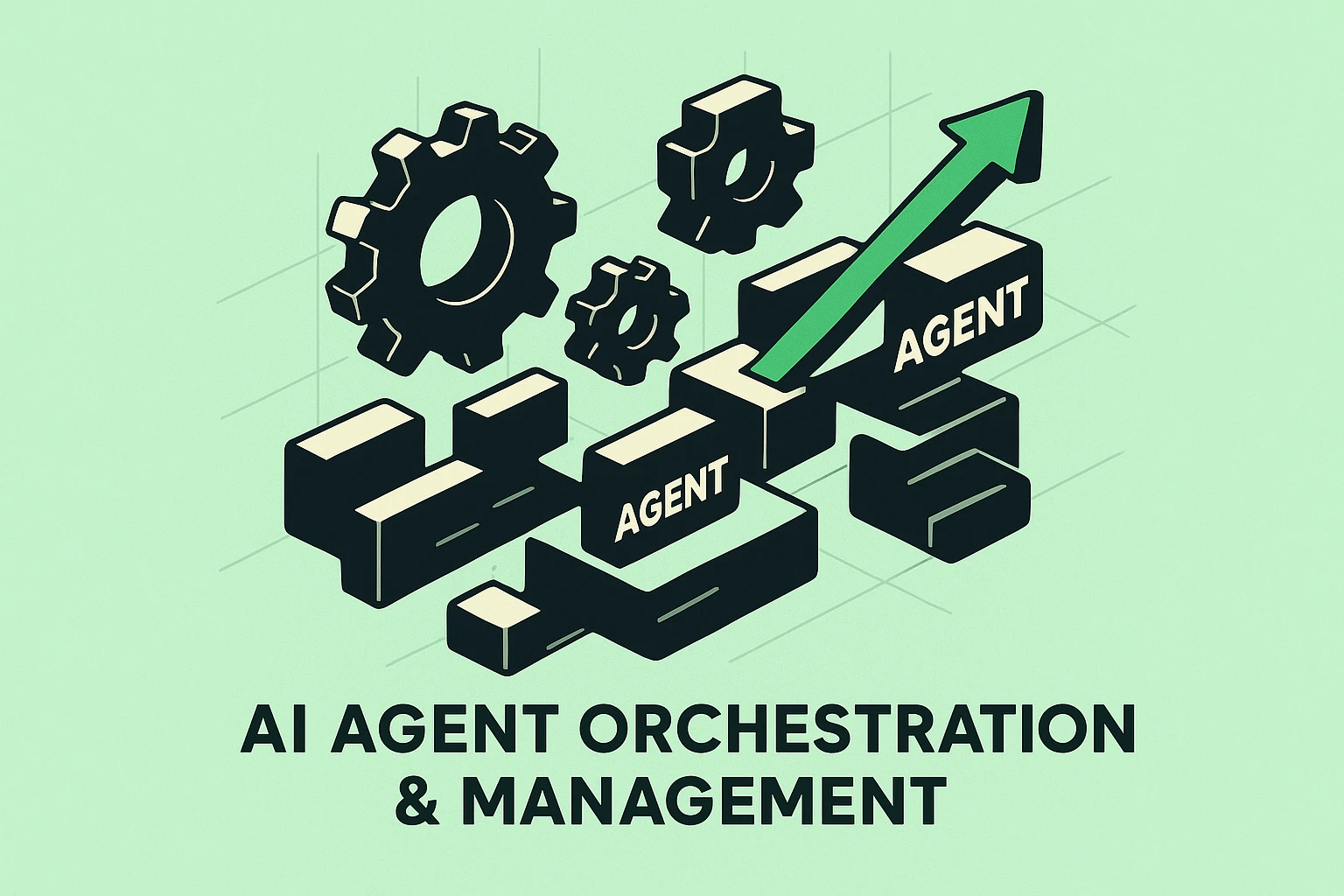
You’re actively evaluating how AI can transform your business, moving past the hype to tangible, operational solutions. The promise of individual AI agents is clear, but the real challenge—and the greatest opportunity—lies in how these agents work together, communicate, and evolve within your existing systems. This is where AI agent orchestration becomes not just a technical detail, but a strategic imperative.
You're not alone in sensing the shift. The global AI agents market is projected to surge to $7.6 billion in 2025, up from $5.4 billion in 2024. And nearly 88% of enterprises are expected to regularly use AI in at least one function by 2025. This isn't a trend; it's the new operating reality that forward-thinking leaders are embracing. But the path from aspiration to implementation—especially with multiple agents—is fraught with complexity.
This guide will cut through that complexity. We'll provide you with the frameworks, insights, and practical considerations you need to confidently evaluate, deploy, and manage an "AI-first" business strategy powered by agent orchestration. Think of this as your practical roadmap, not just for adopting AI, but for mastering its collaborative potential.
Why AI Agent Orchestration is No Longer Optional for Enterprises
The initial excitement around single-purpose AI tools was understandable. They tackled specific tasks, offering glimpses of efficiency. But as businesses matured in their AI adoption, a new problem emerged: "siloed AI agents." Each agent optimized for its narrow function, failing to communicate or coordinate with others, leading to fragmented workflows and bottlenecked automation. This negates the very purpose of integrating AI – to create seamless, intelligent processes.
Consider a marketing department. An AI agent might generate blog posts, another might handle SEO optimization, and yet another manage LinkedIn outreach. Without orchestration, these operate as isolated entities. The blog post agent doesn't proactively inform the SEO agent about new content, nor does the LinkedIn agent know when to promote it based on performance. The result? Manual hand-offs, missed opportunities, and subpar performance. This is the very kind of manual process that can be streamlined through intelligent automation, similar to how BenAI helps businesses reduce manual SEO workflows with AI.
True enterprise automation demands a higher level of intelligence—one where AI agents don't just perform tasks, but collaborate, adapt, and learn from each other. That’s the core promise of AI agent orchestration. It means:
- Enhanced Efficiency: Automating entire multi-step workflows, not just individual tasks.
- Greater Agility: Rapidly adapting to changing business needs by reconfiguring agent interactions.
- Improved Experiences: Delivering cohesive and intelligent interactions across all customer and internal touchpoints.
- Self-Improving Workflows: Agents learn from interactions, leading to continuous optimization.
- Scalability: Handling increased workload and complexity without linear increases in human effort or manual intervention.
In short, orchestration elevates AI from a collection of tools to a strategic, interconnected system that drives tangible business value. In fact, companies investing in generative AI are seeing a 3.7x ROI for every dollar spent. And 66% of companies adopting AI agents report measurable value through increased productivity. This isn't just about doing more; it's about doing it smarter, at scale, and with a clear return on investment.
Deep Dive into AI Agent Orchestration Patterns & Architectures
When you’re designing an AI agent system, the fundamental choice isn't just "which agent?" but "how will these agents behave together?" Understanding orchestration patterns is key to architecting robust, adaptable, and efficient multi-agent systems.
Core Orchestration Patterns
Drawing from best practices, particularly those articulated by Microsoft Learn, these are the fundamental patterns you’ll encounter:
- Sequential Orchestration: Agents perform tasks one after another, in a defined order.
- When to Use: Simple, linear workflows where the output of one agent is the direct input for the next. Example: Lead qualification (Agent 1 reviews criteria, then Agent 2 initiates outreach).
- When to Avoid: Highly dynamic, non-linear processes, or when parallel execution would significantly speed things up.
- Concurrent Orchestration: Multiple agents perform tasks simultaneously, independent of each other, and then their results are gathered.
- When to Use: Tasks that can run in parallel, contributing to a final aggregated outcome. Example: Market research (Agent 1 gathers competitor pricing, Agent 2 analyzes industry trends, both report to a summary agent).
- When to Avoid: When tasks have strict dependencies, or when immediate feedback between agents is critical.
- Group Chat Orchestration: Agents communicate and collaborate in a shared "chat" environment, self-organizing to solve problems, often moderated by a specialized "meta-agent" or human.
- When to Use: Complex problem-solving scenarios requiring collective intelligence, debate, or dynamic task delegation. Example: Brainstorming content ideas (Agent 1 is a creative writer, Agent 2 is an SEO expert, Agent 3 is a market analyst, all contributing to a common goal).
- When to Avoid: Highly structured, repetitive workflows where explicit process definition is more efficient.
- Handoff Orchestration: An agent begins a task and, upon reaching a certain point or difficulty, passes it off to another specialized agent or a human for completion.
- When to Use: Workflows that require specialized expertise at different stages, or human intervention for validation, nuanced decision-making, or ethical oversight. Example: Customer support (AI agent handles common queries, escalates to human agent for complex issues).
- When to Avoid: When seamless, unbroken automation is the primary objective and the "handoff" introduces unnecessary friction.
- Magentic Orchestration: Typically refers to a pattern where agents are dynamically selected and combined to achieve a goal, often by a central orchestrator that manages resources and task allocation. This pattern enables highly flexible and adaptive systems.
- When to Use: Complex, adaptive systems that need to respond to a wide variety of inputs and dynamically assemble the best set of agents and tools to address them. Example: Personalized digital assistant (selects relevant agents for scheduling, research, communication based on user query).
- When to Avoid: Simpler, predefined workflows where the overhead of dynamic agent selection is unwarranted.
{"placement":"Architecture & patterns section, near 'Deep Dive into Patterns & Architectures'","caption":"Clear schematic of orchestration patterns—compare Sequential, Concurrent, and Handoff architectures to choose the right orchestration style.","url":"https://cdn.prod.website-files.com/67e9385982ae2a6da44faf34/6932e235979c4a5e59031af6_file.png"}
These patterns often combine in real-world scenarios, creating sophisticated multi-agent system architectures. The core components of any multi-agent system architecture include:
- Agents: The individual AI entities with specific capabilities.
- Communication Protocols: How agents exchange information (e.g., message queues, APIs).
- Orchestrator: The central component defining logic, managing agents, and arbitrating conflicts.
- Tools/Plugins: External services and APIs that agents can utilize.
- Large Language Models (LLMs): Often the "brain" for agents, providing reasoning and natural language capabilities.
Choosing the right pattern and architecture is paramount to successful AI agent deployment, ensuring your investment delivers on its promise while avoiding common pitfalls.
Selecting Your Toolkit: Frameworks, Platforms, and Low-Code/No-Code Solutions
With the architecture in mind, the next critical step is selecting the right tools to build and manage your orchestrated AI agents. The landscape is rich with options, from powerful coding frameworks to intuitive low-code/no-code platforms. The "best" choice always depends on your specific needs, technical capabilities, and the desired speed of deployment.
Code-First Frameworks for Bespoke Orchestration
For developers and organizations with significant engineering resources, code-first frameworks offer unparalleled flexibility and control. They allow for highly customized orchestration logic:
- LangChain: A popular framework for developing applications powered by LLMs. It provides modular components for building agents, chains, and retrieval-augmented generation (RAG) systems. Its strength lies in its extensive integrations and flexibility.
- LangGraph: Built on LangChain, LangGraph enables the creation of cyclical graphs for more complex, stateful agent behaviors where agents might revisit steps. Ideal for robust, multi-turn interactions.
- AutoGen (Microsoft): Focuses on multi-agent conversation frameworks, allowing agents to converse with each other to solve tasks. Excellent for group chat orchestration patterns and dynamic problem-solving.
- OpenAI Agents SDK: Directly leverages OpenAI's models, offering powerful capabilities for creating agents that interact with external tools and APIs.
- LlamaIndex: Primarily focused on RAG, helping LLMs interact with custom data sources. While not an orchestration framework itself, it's a critical component for agents needing access to proprietary information.
- CrewAI: Specifically designed for orchestrating autonomous AI agents, enabling them to take on roles, share goals, and perform sequential or collaborative tasks, often leveraging tools.
- Semantic Kernel (Microsoft): A lightweight SDK that lets you easily combine your AI models (like OpenAI, Azure OpenAI, Hugging Face) with conventional programming languages. Facilitates the integration of AI capabilities into existing applications.
- Google ADK (Agent Development Kit): Google's approach to building and deploying agents, typically integrated within their cloud ecosystem.
These frameworks offer deep control but come with a steeper learning curve and require proficiency in programming languages like Python.
Low-Code/No-Code (LCNC) Platforms for Rapid Deployment
For businesses looking to quickly prototype, deploy, and manage AI agent orchestration without extensive coding, LCNC platforms are a game-changer. They democratize access to sophisticated AI capabilities, allowing business users and citizen developers to contribute:
- Budibase, NocoBase: General-purpose LCNC platforms that can be extended to include AI agent workflows.
- MindStudio.ai, Lindy.ai, Marketer Milk: AI-specific LCNC platforms that often provide visual builders for configuring agent behaviors, tool integrations, and orchestration flows. They are often geared towards specific use cases.
- Langflow, Zapier, Stack AI: Platforms that offer visual interfaces to build and deploy complex AI flows, often integrating with various LLMs and external services. These are excellent for connecting different AI agents and existing business tools.
{"placement":"Upper-middle of the pillar article, in the 'Selecting Your Toolkit' section","caption":"Side-by-side comparison of agent platforms with integration and scalability bars—quickly identify trade-offs and shortlist the best fit for your needs.","url":"https://cdn.prod.website-files.com/67e9385982ae2a6da44faf34/6932e235e71db4d8d5841e4e_file.png"}
The choice between code-first and LCNC often boils down to:
- Speed vs. Customization: LCNC offers speed for many common tasks but might limit deep customization. Code-first provides maximum customization but takes more time and expertise.
- Technical Skill: LCNC empowers non-developers; code-first requires programming skills.
- Maintenance & Scaling: Both have their complexities. LCNC abstracts away some infrastructure, while code-first demands more hands-on DevOps.
{"placement":"Low-code/no-code section, within 'Selecting Your Toolkit' and 'Low-Code/No-Code' subsection","caption":"A concise decision flow to choose low-code or code-first agent deployment—clearly weigh speed, control, and trade-offs for pilots.","url":"https://cdn.prod.website-files.com/67e9385982ae2a6da44faf34/6932e235c273437b735ef8ec_file.png"}
At BenAI, we understand this nuanced landscape. We often leverage a hybrid approach, using robust frameworks for core agent development while employing visual, LCNC tools for orchestration and integration, particularly when it comes to linking with existing business systems. This allows us to deliver advanced functionality with the agility businesses demand.
Overcoming the Challenges: Best Practices for Deployment & Management
The journey to effective AI agent orchestration isn't without its hurdles. Less than 10% of organizations have scaled AI agents in any individual function, primarily due to complexities in integration, risk, compliance, and lack of technical expertise. Proactive planning and adherence to best practices are essential.
Scalability: Beyond a Single Agent
Deploying one agent is simple; scaling dozens, or even hundreds, requires careful planning. You need strategies for:
- Resource Allocation: Dynamically assigning compute resources (e.g., CPU, GPU, memory) to agents based on real-time demand. Containerization (Docker, Kubernetes) is often critical here.
- Load Balancing: Distributing tasks evenly across multiple agent instances to prevent bottlenecks.
- Asynchronous Communication: Using message queues (e.g., Kafka, RabbitMQ) to allow agents to communicate without blocking each other, improving throughput.
- Cost Optimization: Scaling resources up and down based on demand to manage cloud computing costs effectively.
Conflict Resolution in Agent Interactions
What happens when two agents try to perform conflicting actions or propose contradictory solutions? This is where orchestration intelligence truly shines.
- Pre-defined Protocols: Establish clear rules for agent interaction and decision-making hierarchies.
- Arbitration Agents: Implement a dedicated meta-agent whose sole purpose is to detect and resolve conflicts, potentially using a more powerful LLM for ethical or complex trade-offs.
- Human-in-the-Loop (HITL): For critical conflicts, the system should be designed to escalate to a human operator. This also plays a vital role in governance and trust.
- Negotiation Frameworks: For more sophisticated agents, enable negotiation protocols where agents can exchange proposals and counter-proposals to reach consensus.
Integration & Interoperability
Your AI agents won't operate in a vacuum. They need to connect with your existing CRMs, ERPs, databases, and other applications.
- API-First Approach: Design agents and orchestrators to consume and expose APIs, ensuring seamless integration with other systems.
- Standardized Data Formats: Use common data formats (JSON, XML) for inter-agent communication and data exchange with external systems.
- Middleware & ETL Tools: Leverage integration platforms (iPaaS) or Extract, Transform, Load (ETL) tools to bridge communication gaps between disparate systems.
Governance, Security & Human-in-the-Loop
Governance is non-negotiable for autonomous AI systems. Frameworks like the NIST AI Risk Management Framework (RMF) provide a structured approach to managing risks.
- Audit Trails: Log all agent actions, decisions, and communications to ensure traceability and accountability.
- Access Controls: Implement strict role-based access control (RBAC) for who can configure, monitor, or stop agents.
- Data Privacy: Ensure agents handle sensitive data in compliance with regulations (GDPR, HIPAA, etc.). Encryption at rest and in transit is crucial.
- Continuous Monitoring: Actively monitor agent behavior, outputs, and system health for anomalies or deviations from expected norms.
- Human Oversight: Design specific human review points and override capabilities for high-stakes decisions, or when an agent's confidence score drops. This ensures ethical and responsible AI deployment. New roles like agent trainers and orchestrators are emerging, underscoring the need for tailored training programs.
Performance Monitoring & Optimization
Just like any other business process, AI agents need continuous monitoring and optimization to ensure they deliver promised value.
- Key Performance Indicators (KPIs): Define clear metrics for agent success (e.g., task completion rate, accuracy, processing time, cost per transaction).
- Observability Tools: Use specialized tools (e.g., LangSmith for LangChain, or custom dashboards) to visualize agent activity, detect errors, and track performance trends.
- Continuous Learning Loops: Implement mechanisms for agents to
- Self-Correct: Agents learn from feedback, identifying incorrect outputs and adjusting their behavior.
- Learn from Human Feedback: Human corrections or approvals become data points for agents to improve upon.
- Adapt to Environmental Changes: Agents can be designed to detect shifts in their operating environment and adjust their strategies accordingly.
{"placement":"Performance monitoring and ROI section, adjacent to 'Performance Monitoring & Optimization'","caption":"Performance dashboard highlighting ROI, adoption, time-to-resolution, and savings—quantify agent orchestration benefits for decision-makers.","url":"https://cdn.prod.website-files.com/67e9385982ae2a6da44faf34/6932e235ce25d938073a4c83_file.png"}
Effective management goes beyond initial deployment. It’s a continuous cycle of monitoring, learning, and refinement. BenAI specializes in integrating these continuous learning loops to ensure your AI agents aren't just performing, but constantly getting better.
Real-World Applications: Transformative Use Cases in Enterprise
The true power of AI agent orchestration becomes clearer when you see its impact across diverse enterprise functions. This isn't theoretical; businesses are achieving significant ROI and productivity gains by implementing orchestrated AI.
- Marketing & Sales:
- Lead Nurturing & Qualification: Orchestrated agents can analyze inbound leads, gather additional intelligence from public sources, personalize outreach emails (see our insights on scaling LinkedIn lead generation with AI automation), schedule follow-ups, and even answer initial questions, handing off only qualified, engaged prospects to human sales teams.
- Content Creation & Distribution: Agents collaborate to research keywords, generate content drafts (as explored in our piece on AI automation content structuring), optimize for SEO, and distribute across multiple channels, including social media (e.g., AI-driven LinkedIn campaign optimization) and email newsletters (AI newsletter content generation).
- Recruiting & HR:
- Candidate Sourcing & Screening: Agents can scour job boards, social media, and internal databases for potential candidates, screen resumes against job descriptions, conduct initial qualification chats, and schedule interviews, dramatically reducing time-to-hire.
- Onboarding & Training: Orchestrated agents can guide new hires through onboarding processes, provide personalized training modules, and answer common HR queries, freeing up HR staff for more strategic tasks.
- Customer Service:
- Proactive Support: Agents monitor customer behavior, identify potential issues before they arise, and proactively offer solutions or intervention, moving beyond reactive chatbots.
- Complex Query Resolution: A multi-agent system can triage complex customer issues, gather information from various internal systems, synthesize a solution, and present it to a human agent, who then provides the final personalized response.
- IT Operations & Support:
- Automated Incident Response: Agents monitor system logs and performance, detect anomalies, diagnose root causes, and trigger automated remediation steps, escalating to humans only for truly novel or critical issues.
- User Provisioning: Automatically handle user account creation, software access, and resource allocation based on roles and permissions.
- Finance & Legal:
- Invoice Processing & Reconciliation: Agents can extract data from invoices, match them against purchase orders, identify discrepancies, and flag items for human review, accelerating financial closing cycles.
- Contract Review & Compliance: Agents can review legal documents against compliance standards, identify clauses of concern, and summarize key terms, assisting legal teams in due diligence.
- Manufacturing & Supply Chain:
- Predictive Maintenance: Agents analyze sensor data from machinery, predict potential failures, and schedule maintenance proactively, reducing downtime.
- Inventory Optimization: Agents monitor demand fluctuations, supplier lead times, and warehouse capacity to optimize ordering and stocking levels, minimizing waste and ensuring product availability.
These examples underscore a crucial point: orchestrated AI agents aren't just about replacing human tasks; they're about amplifying human capabilities, creating new efficiencies, and unlocking growth potential that was previously unimaginable. They are the engine behind the "AI-first business" model that BenAI champions.
The Future of AI Agent Orchestration: Trends to Watch
The field of AI agent orchestration is characterized by rapid innovation. Keeping an eye on emerging trends is vital for future-proofing your AI strategy.
- Dynamic and Adaptive Orchestration: The shift is towards orchestrators that don't just follow predefined rules but can dynamically adapt to changing conditions, learn from new data, and even reconfigure agent teams on the fly to solve novel problems. This moves beyond static workflows to truly intelligent, self-optimizing systems.
- Agentic Interoperability Protocols: As more proprietary and open-source agents emerge, there's a growing need for standardized communication protocols that allow agents from different vendors or built with different frameworks to seamlessly "speak" to each other. This will unlock a truly composable AI ecosystem.
- Decentralized Agent Architectures: Instead of a single central orchestrator, we might see more decentralized architectures where agents operate with greater autonomy, coordinating through emergent behaviors and shared goals, similar to how human teams collaborate.
- Enhanced Human-Agent Teaming: The emphasis will increasingly be on designing systems where humans and AI agents collaborate as peers, each leveraging their unique strengths. This involves sophisticated interfaces for human monitoring, intervention, and guidance, fostering trust and effectiveness.
- Robust Agent Governance Frameworks: Beyond current security and compliance, future governance will include more sophisticated methods for ensuring AI agent fairness, transparency, and accountability, including "AI bill of materials" for each agent's components and training data.
- AI Agent Markets: Imagine marketplaces where specialized AI agents can be "hired" by orchestrators on demand to perform specific tasks, enabling highly flexible and cost-efficient intelligent automation.
These trends highlight a future where AI agent orchestration isn't merely about managing complexity but about harnessing emergent intelligence and fostering unprecedented levels of automation and innovation. Leaders who strategically invest in understanding and implementing these evolving concepts will be best positioned to lead the way in AI adoption.
Frequently Asked Questions About AI Agent Orchestration
What's the difference between AI orchestration and AI agent orchestration?
AI orchestration is a broader term referring to the management and coordination of AI models, algorithms, and data pipelines across an entire AI lifecycle. AI agent orchestration specifically focuses on managing and coordinating multiple AI agents, which are autonomous entities designed to perform tasks, solve problems, or interact with environments. It's a subset, a more focused and advanced form of AI orchestration, dealing with the collaboration of intelligent entities rather than just passive models.
Is AI agent orchestration only for large enterprises?
While large enterprises often have the complex workflows that most benefit from AI agent orchestration, the rise of low-code/no-code platforms means that smaller businesses and agencies can also leverage these concepts. For example, a growth agency could use orchestrated agents for robust SEO Content Structuring and personalized client reporting. The distinction is less about company size and more about the complexity of the problems you're trying to solve and your appetite for automation.
How do I ensure my AI agents communicate effectively?
Effective communication is paramount. It relies on:
- Standardized Protocols: Using common APIs and data formats (like JSON).
- Clear Definitions: Each agent understands its role, outputs, and expected inputs from other agents.
- Shared Knowledge: A common data layer or knowledge base that agents can access and update.
- Orchestrator Logic: The orchestrator defines the communication flow, ensuring messages reach the correct agents at the right time.By actively defining these elements, you can prevent miscommunication and ensure smooth workflow execution.
What are the biggest security risks with multi-agent systems?
The primary risks include:
- Vulnerabilities in individual agents: Each agent can be a potential entry point if not secured.
- Inter-agent communication risks: Data in transit between agents must be encrypted.
- Credential management: Securely storing and accessing API keys or system credentials used by agents.
- Insider threats: Malicious modification of agent code or orchestration logic.
- "Runaway" agents: Agents operating outside their intended parameters without human oversight.Mitigating these requires robust access controls, continuous monitoring, and strict governance frameworks.
How do low-code/no-code platforms fit into AI agent orchestration?
LCNC platforms are democratizing factor. They allow non-developers to visually design, deploy, and manage AI agent workflows by dragging and dropping components and configuring rules. This significantly speeds up prototyping and reduces reliance on extensive developer resources. While they might offer less deep customization than code-first frameworks, they're excellent for pilots, internal tool automation, and integrating various existing services with AI agents. They can also be used in conjunction with code-first agents as an orchestration layer.
Your AI-First Business Starts Here
You've seen the data: AI agent orchestration isn't just about streamlining tasks; it’s about unlocking massive ROI and transforming your entire operational landscape. But as a decision-maker, you understand that selecting the right approach—and the right partner—is crucial.
BenAI stands ready to be that partner. We move beyond theoretical discussions to practical implementation, designing and deploying custom-built, cutting-edge AI automation solutions that directly address your business challenges. Whether you're a marketing agency grappling with reducing manual SEO workflows with AI, a recruiting firm seeking to optimize candidate management, or an enterprise aiming for comprehensive digital transformation, we have the proven systems and world-class expertise.
Don't just witness the AI revolution; lead it. Let's discuss how your AI-first business starts here, with intelligent orchestration that scales, adapts, and delivers measurable value.
Ready to transform your operations? Book A Call with BenAI today to explore tailored AI agent orchestration strategies for your organization.
Join Our Growing AI Business Community
Get access to our AI Automations templates, 1:1 Tech support, 1:1 Solution Engineers, Step-by-step breakdowns and a community of forward-thinking business owners.
Latest Blogs
Explore our latest blog posts and insights.