Navigating the complex landscape of Software-as-a-Service (SaaS) solutions requires a discerning approach, especially in the middle-of-the-funnel (MOFU) where potential customers actively evaluate options. Here, companies face the acute challenge of converting informed awareness into decisive action. A robust SaaS SEO strategy, optimized for specific user intent and designed to build trust, significantly impacts lead generation and sustained growth by guiding prospects from consideration to conversion.
The Unique Middle-of-the-Funnel Challenge for SaaS
The middle-of-the-funnel (MOFU) presents distinct challenges for SaaS companies, acting as the critical juncture between initial brand awareness and final purchase. As potential customers move beyond problem identification, they begin actively researching, comparing solutions, and seeking validation for their investment. This stage demands more than surface-level information; it requires deep validation and contextual relevance to compel a decision. For SaaS businesses, overlooking dedicated MOFU content strategies results in high bounce rates, lost opportunities for free trial sign-ups or demo requests, and ultimately, stagnated growth.
Decoding Middle-of-the-Funnel User Intent: What Your Prospects Really Want
MOFU users, unlike their top-of-funnel counterparts, are not just exploring problems; they are rigorously vetting solutions, products, and vendors. Their intent shifts from broad informational queries to specific commercial investigations. Understanding these underlying needs is crucial for crafting content that resonates and converts.
Users primarily seek actionable strategies and comprehensive guides on how to leverage SEO to generate leads and drive growth for their SaaS businesses, focusing on the "how-to" and "what works," according to SerpScraper's 2025 analysis. This active evaluation often manifests in specific search behaviors, such as queries for:
- "Best [SaaS category] software" or "[SaaS category] comparison"
- "[Competitor A] vs. [Competitor B] review"
- "How to [solve specific problem] with [SaaS solution]"
- "Alternatives to [popular SaaS tool]"
Beyond explicit searches, users also seek validation, requiring proof that SEO is an effective lead generation channel for SaaS. They explore statistics and case studies to confirm efficacy. Furthermore, they are looking for specific tactics related to keyword research, content creation, technical optimization, and link building relevant to the SaaS ecosystem. This often includes a desire for competitive intelligence to discover ways their SaaS SEO efforts can outperform rivals and information that helps them choose the right SEO tools or agencies.
Hidden intents, such as justifying SEO investment to internal stakeholders, future-proofing against evolving search algorithms like AI Overviews, and ensuring scalability of SEO strategies, also influence MOFU behavior. Prospects also exhibit a desire for ease of implementation, especially those in smaller SaaS businesses with limited SEO expertise, according to Perplexity AI's 2025 analysis.
The SaaS Middle-of-the-Funnel Content Pyramid: Formats for Every Evaluation Stage
Effective MOFU content for SaaS companies employs a diverse range of formats, each designed to address specific evaluation criteria and build trust. These formats collectively guide prospects toward a confident decision by providing comprehensive information and validation at every step.
Strategic Guides & Whitepapers
Deeply researched guides and whitepapers serve to establish thought leadership and provide in-depth solutions to specific pain points. These long-form assets cater to users who require thorough understanding before commitment, offering insights into complex challenges and demonstrating expertise. An example includes a comprehensive guide on AI SEO automation which details strategies for driving growth. These detailed resources support the brand as an authority, influencing decision-makers who need extensive information to justify their choices. Thought leadership content for industry authority is a key component, as highlighted by SerpScraper's 2025 analysis.
Comparison Pages: Ours vs. Theirs
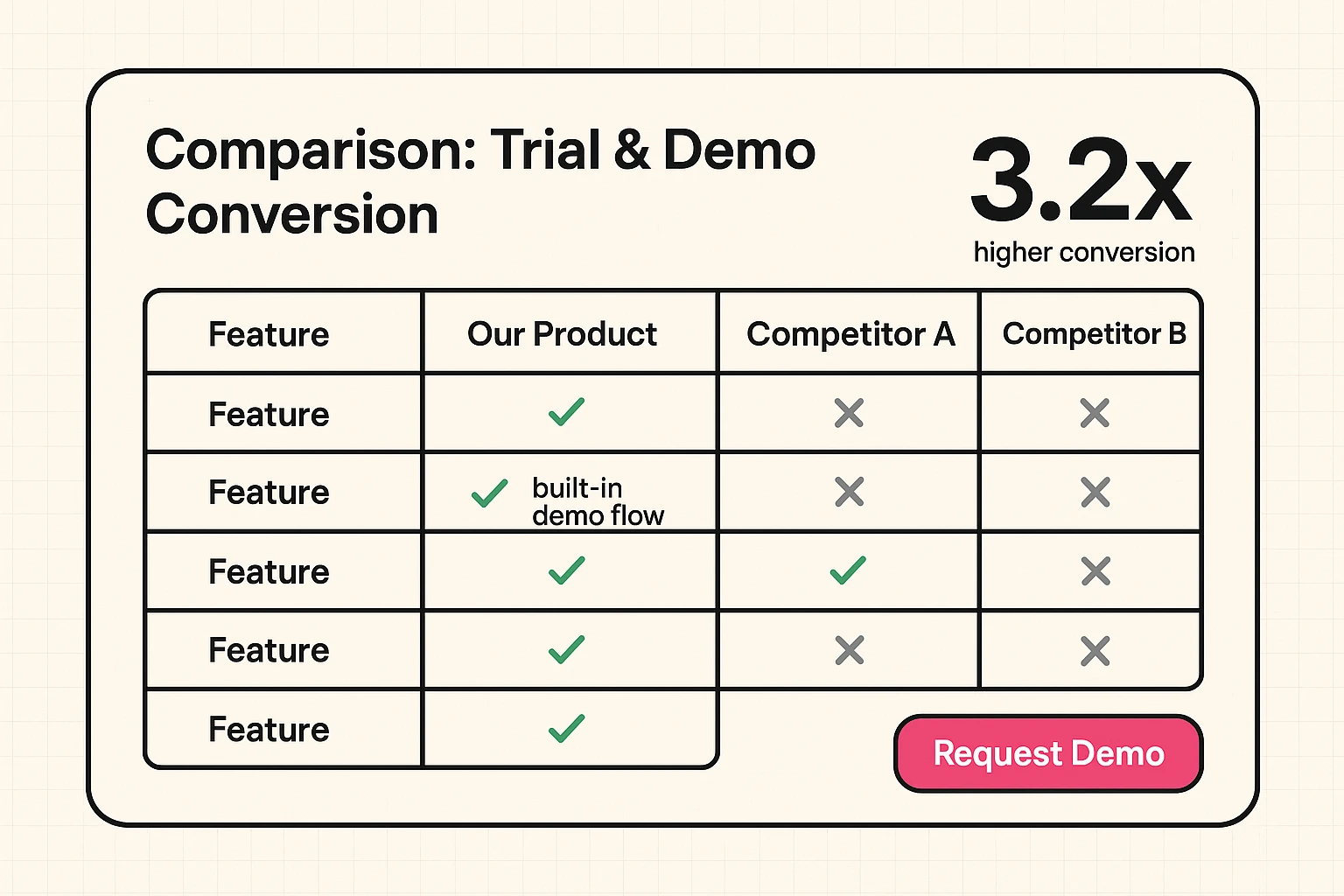
Comparison pages are critical MOFU assets, directly addressing the user's need to evaluate competing solutions. These pages objectively highlight key differentiators, feature matrices, and unique selling propositions, often leading to significantly higher conversion rates. Comparison pages ("Tool A vs Tool B") convert 3.2 times higher than regular feature or pricing pages, according to the Digital World Institute. This underscores their crucial value in the MOFU. These pages, as exemplified by a side-by-side feature comparison, act as potent decision aids by clarifying product distinctions and accelerating demo or trial sign-ups.
Interactive Tools & Product Walkthroughs
Embedding or linking to interactive demos and calculators directly within content allows prospects to experience the product’s value firsthand. These tools enable users to solve specific problems using the SaaS product, moving beyond theoretical understanding to practical application. This integration of product-led content is vital, as top-ranking content often seamlessly weaves in how a company's own SaaS tools can solve discussed problems, offering practical application alongside instruction, according to Digital World Institute's 2025 findings.
Case Studies & Success Stories
Quantifiable results and relatable scenarios presented in case studies and success stories build credibility and emotional resonance. These narratives showcase real customer transformations, providing tangible evidence of value and demonstrating how the SaaS product has solved similar problems for others. Case studies are the highest-converting content type for B2B SaaS, driving an average 7% visitor-to-lead rate, as per the Digital World Institute.
Detailed Feature & Solution Pages
Optimized feature and solution pages, built with Answer Engine Optimization (AEO) principles, provide immediate and precise answers to user questions, making them ideal for capturing AI-driven citations and conversions. These pages detail specific functionalities that directly solve user problems and are structured for clarity and scannability, often incorporating clear FAQs and structured data. Optimizing feature and solution pages for user intent is critical in SaaS for lead generation, according to SerpScraper's 2025 analysis.
Optimizing for AI-Driven Search: The AEO Advantage in MOFU
The evolving search landscape, particularly with the rise of Generative AI and AI Overviews, mandates a shift towards Answer Engine Optimization (AEO) in MOFU content. AEO ensures that content is structured to be easily understood and cited by AI models, increasing visibility and authority. Over 56% of citations for B2B queries in relevant AI search results come from product pages, emphasizing the need for structured product content, as reported by SearchEngineJournal in 2025.
Strategies for Structuring Content
Content intended for AI-driven search must be concise, well-organized, and directly answer specific user questions. This involves using clear subheadings formatted as questions, followed by succinct, definitive answers, enabling quick extraction by AI. For example, a page discussing AI for schema markup automation can leverage this structure to answer common queries about implementation and benefits.
Importance of Structured Data
Implementing structured data, such as FAQ and HowTo schema, provides explicit signals to search engines and AI models about the content's purpose and format. SoftwareApplication schema can further enhance visibility for product-centric pages. This allows AI to accurately interpret and present information, granting the content a higher chance of being featured in AI Overviews, which appear in up to 47% of search results.
Getting "Featured" by AI
To increase the likelihood of content being cited or directly answered by AI, it must offer comprehensive, accurate, and unique insights. This requires addressing micro topic clusters around specific features or solutions, using precise language, and providing verifiable data. This strategy ensures content appeals to both human users and advanced AI algorithms seeking authoritative answers. An actionable anatomy of an AEO-optimized feature page demonstrates where instant answers, FAQ schema, and technical checks reside to capture AI-driven citations and conversions.

Technical SEO for MOFU Conversions: Beyond the Basics
Technical SEO provides the foundational infrastructure necessary for search engines to effectively crawl, index, and rank SaaS content, directly impacting MOFU conversions. While often overlooked by competitors, robust technical SEO is critical for dynamic SaaS platforms, ensuring optimal performance and user experience. The average page loading time for first-page results is 1.65 seconds, yet 72.3% of sites have slow loading speeds, indicating a significant optimization opportunity, according to Powered by Search's 2025 research.
Focus on Core Web Vitals
Core Web Vitals (CWV) — encompassing Largest Contentful Paint (LCP), First Input Delay (FID), and Cumulative Layout Shift (CLS) — are crucial metrics for page experience. Optimizing for CWV ensures fast loading times, responsiveness, and visual stability, directly improving user engagement and reducing bounce rates on MOFU pages. These factors contribute to better rankings and higher conversion potential, as a seamless user experience encourages deeper exploration of the product.
Advanced JavaScript SEO Rendering Techniques
For modern SaaS applications built with JavaScript frameworks, advanced rendering techniques are vital. Ensuring proper crawlability and indexability of client-side rendered content prevents critical MOFU content from being overlooked by search engine bots. Strategies include server-side rendering (SSR), static site generation (SSG), or dynamic rendering to guarantee that all relevant content and links are accessible to search engines for proper evaluation and ranking, as discussed in no-code AI technical SEO automation.
Internal Linking Strategies for Passing Authority
Strategic internal linking not only improves navigation for users but also distributes link equity throughout the site, signaling to search engines the relative importance of connected pages. For MOFU, this means directing authority from high-ranking top-of-funnel content to conversion-focused feature, solution, and comparison pages. An effective internal linking strategy enhances the visibility of critical evaluation pages, thereby driving more qualified traffic. Further insights into this can be found in our discussion on automated internal linking strategies.
Managing Duplicate Content Across Product Versions/Geos
SaaS companies often face challenges with duplicate content due to multiple product versions, regional variations, or localized content. Implementing canonical tags, hreflang annotations, and careful content syndication strategies prevents search engine confusion and ensures that the intended authoritative version of MOFU content is indexed and ranked, preserving SEO value across diverse offerings.
Measuring MOFU Success: KPIs That Matter for SaaS Lead Gen & Growth
Measuring MOFU success for SaaS goes beyond traditional traffic metrics, focusing instead on key performance indicators (KPIs) that directly correlate with lead generation and revenue growth. These metrics provide a clear understanding of how MOFU content contributes to the sales pipeline and overall business objectives.
Beyond Traffic: Trial Sign-ups, Demo Requests, MQLs
While traffic indicates interest, MOFU success is predominantly measured by conversions such as free trial sign-ups, demo requests, and the generation of Marketing Qualified Leads (MQLs). These actions signal active consideration and a strong intent to evaluate the product. SEO leads have a 14.6% close rate, significantly higher than outbound marketing efforts (1.7%), according to SeoProfy, highlighting the impact of qualified MOFU traffic.
Attribution Modeling for Long-Term Impact
Attribution modeling helps understand the long-term impact of MOFU content on Customer Acquisition Cost (CAC) and Customer Lifetime Value (CLV). By tracking user journeys from initial engagement with MOFU content to conversion and retention, businesses can accurately attribute revenue to specific content pieces and optimize their strategy for maximum ROI. This deeper level of analysis reveals the true value of MOFU efforts, providing justification for sustained investment. This type of reporting can be effectively visualized using AI SEO reporting dashboards.
Building Trust & Authority: The E-E-A-T Signal for SaaS
Establishing Expertise, Experience, Authority, and Trust (E-E-A-T) is paramount for SaaS companies, especially within the MOFU, where prospects scrutinize credibility before making a commitment. Strong E-E-A-T signals enhance ranking potential and directly influence conversion rates.
How Expert Authors, Verifiable Data, and External Citations Enhance Credibility
Content authored by recognized industry experts, supported by verifiable data, and featuring credible external citations significantly boosts trustworthiness. For MOFU content, this includes referencing industry research (e.g., from the Digital World Institute or SeoProfy), quoting subject matter experts, and integrating product-specific data. This approach showcases deep domain knowledge and validates claims, a strategy integral to automated on-page SEO with AI solutions.
Leveraging Third-Party Reviews and Community Engagement
Beyond internal efforts, third-party reviews and active community engagement provide crucial social proof. Testimonials on comparison pages, positive reviews on G2 or Capterra, and a thriving user community underscore the product's reliability and positive user experience. This external validation reinforces trust, influencing prospects who are actively seeking unbiased opinions during their evaluation process.
Actionable Roadmap: Implementing a Winning MOFU Strategy
Developing a robust MOFU strategy requires a structured, phased approach that moves from quick wins to long-term advantages. This roadmap ensures continuous improvement and measurable impact on lead generation and growth.
Quick Wins:
- Optimize High-Traffic Feature/Solution Pages for AEO: Immediately implement FAQ schema, ensure clear Q&A subheadings, and refine language to match user intent for instant answers. This aims for quick visibility in AI Overviews and improved content scannability.
- Create 1-2 Strategic Comparison Pages: Target high-value competitor keywords with dedicated "ours vs. theirs" pages. Focus on clear differentiators, incorporate social proof, and highlight key benefits to convert comparison-focused traffic.
- Review and Enhance Calls-to-Action (CTAs) on Existing MOFU Content: Ensure all MOFU content features clear, compelling, and relevant CTAs for trials, demo requests, or consultations, optimizing their placement and messaging for maximum conversion.
Long-Term Advantages:
- Develop Integrated Product Walkthroughs/Interactive Demos: Plan and develop interactive elements or embedded product walkthroughs to visually demonstrate value within MOFU content. This transitions users from passive reading to active engagement.
- Build a Comprehensive "SaaS SEO Lead Gen Hub": Create a central resource that organizes and links to all MOFU sub-topics (comparison pages, feature guides, case studies, technical SEO deep dives), enhancing user experience and content discoverability.
- Implement Advanced Technical SEO Audits & Monitoring: Set up continuous monitoring for Core Web Vitals, JavaScript rendering issues, and canonicalization. Regular audits ensure ongoing site health and prevent technical hurdles from impacting MOFU content performance. Insights from AI crawlability and indexation can inform these efforts.
- Launch Original Research/Data Studies: Conduct and publish original industry insights or data studies using internal results. This establishes thought leadership, attracts high-quality backlinks, and positions the brand as an indispensable source of information in the SaaS ecosystem.

Frequently Asked Questions
How do I measure the ROI of my SaaS MOFU SEO efforts?
Measuring the ROI of MOFU SEO involves tracking specific conversion metrics such as free trial sign-ups, demo requests, and Marketing Qualified Leads (MQLs) generated directly from MOFU content. Attribution modeling (e.g., first-touch, multi-touch) helps connect these conversions back to specific MOFU content pieces, offering a comprehensive view of their impact on customer acquisition cost and lifetime value. Platforms that automate client SEO reports can provide valuable data here, as discussed in AI SEO reporting dashboards.
What are the best content types for different SaaS models (e.g., freemium vs. enterprise)?
For freemium SaaS models, MOFU content should focus on product-led growth (PLG) strategies, including "how-to" guides, interactive tutorials, and comparison pages that highlight ease of use and value proposition, driving free sign-ups. For enterprise SaaS, content should emphasize detailed case studies, whitepapers, strategic guides, and direct competitor comparisons that address complex business challenges and provide strong ROI justification, facilitating demo requests and consultations.
How often should I update my MOFU content?
MOFU content, particularly feature pages and comparison content, requires regular updates to maintain accuracy and relevance. For comparison pages, monthly or quarterly reviews are advisable to reflect competitor changes. Feature pages should be updated with every significant product release or enhancement. General guides and whitepapers benefit from annual reviews to incorporate new industry trends and data.
Is technical SEO less important for MOFU than for TOFU content?
No, technical SEO is equally, if not more, critical for MOFU content. While TOFU benefits from broad visibility, MOFU content aims for high-intent, conversion-driven traffic. Technical issues like slow page loading times, JavaScript rendering problems, or poor indexability can directly deter prospects at the crucial evaluation stage, impacting trial sign-ups or demo requests, as illuminated by our discussion on no-code AI technical SEO automation.
How can I adapt my MOFU strategy for AI-powered search engines?
Adapting for AI-powered search involves implementing Answer Engine Optimization (AEO) principles. This includes structuring content with clear question-and-answer formats, leveraging structured data (FAQ, HowTo, SoftwareApplication schema), and focusing on comprehensive, authoritative answers to specific user queries. Creating scannable, precise content that AI models can easily parse and cite will increase visibility and drive qualified leads, as evidenced by insights into AI crawlability and indexation.
To transform your SaaS business into an AI-first entity that consistently generates leads and fuels growth, a meticulously crafted MOFU SEO strategy is essential. By embracing strategic content, optimizing for AI-driven search, and maintaining a robust technical foundation, your brand can effectively guide prospects through the evaluation stage, converting consideration into commitment. Ready to refine your MOFU content strategy and unlock your full lead generation potential? [Book a Call] to explore tailored AI growth systems for marketing, recruiting, and broader enterprise solutions.
Join Our Growing AI Business Community
Get access to our AI Automations templates, 1:1 Tech support, 1:1 Solution Engineers, Step-by-step breakdowns and a community of forward-thinking business owners.

Latest Blogs
Explore our latest blog posts and insights.