Imagine this: your business has a great overall 4.5-star rating online. Sounds good, right? But then you notice a persistent trickle of customer comments mentioning "waited too long for parking" or "the checkout line was always slow after 3 PM." Or maybe, "Sarah on Tuesdays is amazing!" but "John on weekends seemed rushed." These tiny, specific details lurk within mountains of reviews, masked by the overall score. You know they're important, but how do you find them, let alone act on them?
You're not alone. Many businesses struggle to move beyond generic review management into insights that drive real, local operational improvements. The truth is, simply tracking your average star rating or general sentiment misses a goldmine of information – the hyper-local feedback that can pinpoint specific issues and opportunities in your daily operations. This is where AI-powered hyper-local sentiment analysis steps in, transforming raw customer thoughts into actionable knowledge.
It’s like moving from knowing your car works (overall sentiment) to understanding exactly why the back-left tire consistently loses pressure every Tuesday after you hit a specific pothole on your commute (hyper-local insight!).

The Difference Between 'Local' and 'Hyper-Local' Insights
Before we dive into the "how," let's clarify what "hyper-local" truly means in this context.
What is Sentiment Analysis?
At its core, sentiment analysis (also known as opinion mining) is the use of natural language processing (NLP), text analysis, and computational linguistics to systematically identify, extract, quantify, and study affective states and subjective information. In simpler terms, it's about figuring out the emotional tone—positive, negative, or neutral—behind a piece of text. AI's role in this domain is to automate and scale this process, allowing machines to "read" and interpret human language. Early methods relied on keywords or rule-based systems, but modern AI uses machine learning and deep learning to understand context and nuance, even accounting for specific parts of speech and how words relate to each other.
Why 'Local' is Not Enough
Many businesses already analyze reviews for "local" insights. This might involve understanding overall sentiment about a specific store location or product line. For example, "Customers at our downtown branch generally like the service." This is valuable, but it lacks the necessary detail for surgical operational improvements.
The Power of 'Hyper-Local'
Hyper-local sentiment analysis takes this a colossal step further. It zeroes in on ultra-specific elements within a review that relate to precise, granular details of a customer's experience. We're talking about:
- Specific staff members: "Michael at the front desk was so helpful."
- Particular store areas or features: "The lighting near the fitting rooms was too dim."
- Exact times or situations: "Waiting for coffee at 8 AM on a Monday is always a nightmare."
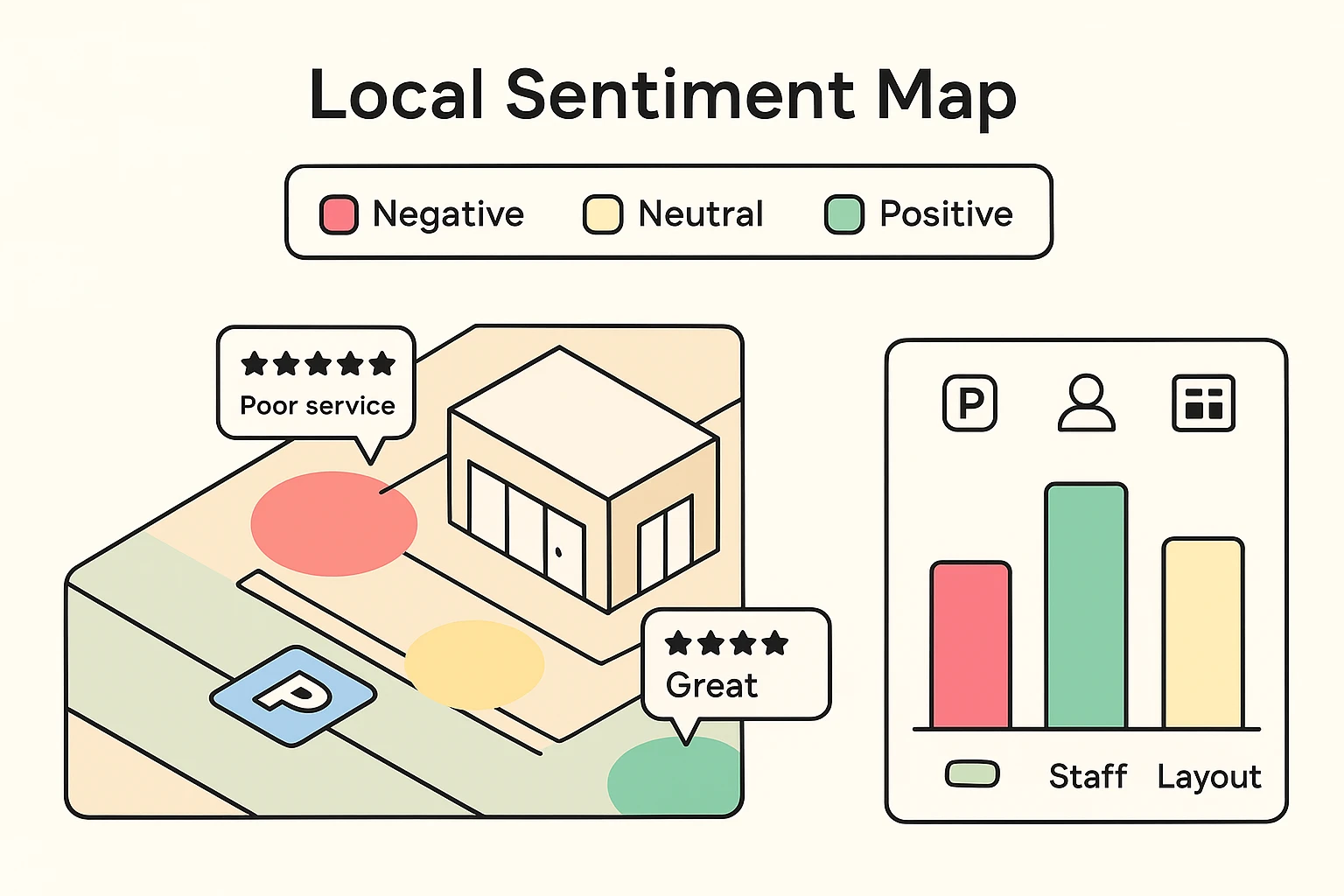
- Surrounding environment: "Parking is impossible on Tuesdays across from our office."
- Specific products or services in a micro-context: "The latte I got from this particular barista was perfect."
These tidbits, often buried in longer reviews, are the keys to unlocking precise fixes and optimizations. They help businesses answer "what, where, and when" about problems and successes, rather than just "if."
Why Hyper-Local Sentiment Analysis Matters for Your Business Operations
Think about it: generic positive feedback ("Great store!") might make you feel good, but it doesn't tell you what to replicate. Generic negative feedback ("Bad service!") signals a problem, but not how to fix it. Hyper-local insights, however, provide direct pathways to operational excellence.
Identifying Pain Points with Precision
Instead of broadly knowing "customers dislike waiting," hyper-local analysis reveals:
- "Customers dislike waiting at the drive-thru between 12 PM and 2 PM." (This suggests staffing issues or a bottleneck in the kitchen during peak lunch hours.)
- "Customers dislike waiting for a specific staff member who is often overwhelmed." (This points to training needs or workload distribution.)
This precision allows for targeted interventions rather than blanket solutions, saving resources and increasing impact.
Optimizing Staffing and Training
Reviews frequently mention staff by name or by their role. Hyper-local analysis can highlight:
- Top-performing employees (and what makes them great), enabling you to replicate best practices.
- Areas where staff might need additional training (e.g., "slow at the register," "uninformed about product X").
- Specific shifts or times when staffing levels might be inadequate, leading to negative experiences.
Enhancing Physical Spaces and Product Placement
Customer reviews don't just talk about service. They often describe the physical environment:
- "The music was too loud near the seating area."
- "It's hard to find the dairy section; it's tucked away."
- "The bathroom was always messy."
Such feedback can guide decisions on store layout, ambiance, cleanliness protocols, or even the most effective placement of promotions.
Improving Specific Product or Service Offerings
While general product reviews exist, hyper-local sentiment can connect product feedback to specific locations or circumstances. For example, a restaurant might learn that "the vegan options are fantastic at the downtown location, but limited at the suburban one." This allows for localized menu adjustments.
Boosting Local SEO and Reputation
Beyond direct operational fixes, leveraging hyper-local insights significantly contributes to your local SEO efforts. Google and other platforms prioritize businesses that demonstrate responsiveness and continuous improvement based on specific, local feedback. Addressing these granular issues proactively enhances your online reputation and implicitly improves your visibility in local searches. For more on optimizing local presence, consider how AI can enhance your AI Local SEO Visibility.
The AI Magic: How It Works
The journey from raw customer review to actionable hyper-local insight is powered by sophisticated AI.
1. Data Collection & Preprocessing
The first step is gathering customer reviews from various sources like Google My Business, Yelp, TripAdvisor, social media, and internal feedback loops. The challenge of hyper-local analysis is often in the volume of data and its unstructured nature.
Then, AI cleans this data. This involves:
- Tokenization: Breaking down sentences into individual words or phrases.
- Lemmatization/Stemming: Reducing words to their base form (e.g., "running," "ran," "runs" all become "run").
- Noise Removal: Filtering out irrelevant information, spam, or emojis (unless emojis are part of the sentiment analysis).
2. Natural Language Processing (NLP)
This is where the AI truly "understands" the language. Modern NLP leverages advanced models to:
- Entity Recognition: Identifying specific names (staff, products, locations), places, dates, and times mentioned in reviews.
- Part-of-Speech Tagging: Labeling each word as a noun, verb, adjective, etc., to understand grammatical structure.
- Dependency Parsing: Understanding the relationships between words in a sentence – often crucial for discerning complex nuances.
3. Aspect-Based Sentiment Analysis
Instead of just labeling an entire review as positive or negative, aspect-based sentiment analysis focuses on specific attributes or entities mentioned. For example, in the review "The food was great, but the service was slow," a general sentiment model might average it out to neutral, but an aspect-based model would correctly identify "food" as positive and "service" as negative.
For hyper-local insights, this is critical. AI can be trained to recognize aspects like "parking," "wait time," "checkout experience," "product availability," or even specific staff members, and then gauge the sentiment attributed to each of these aspects. This often involves fine-tuning large language models using specific datasets relevant to your business or industry, enabling them to understand the unique context and jargon of your local customer base.
4. Interpretation and Visualization
Once the AI has processed and analyzed the sentiment around hyper-local aspects, the data needs to be presented in an understandable way. This often involves:
- Dashboards: Visualizing trends, common pain points, or high-performing assets.
- Heatmaps: Showing where sentiments cluster geographically or within a store layout.
- Automated reports: Flagging urgent issues or highlighting positive shout-outs daily or weekly.

The Challenges: Why It's Not Always Simple
While incredibly powerful, hyper-local sentiment analysis isn't without its hurdles.
Nuance, Sarcasm, and Context
Language is complex. AI can struggle with:
- Sarcasm: "Oh, the super fast service meant I only waited an hour."
- Context: "The restaurant was lively, but the noise level was off the charts." (Is "lively" positive, or does the qualifier "noise level off the charts" make it negative overall regarding ambiance?)
- Local Dialects & Slang: AI models trained on general language might misinterpret regional colloquialisms or unique phrases.
These require advanced NLP models and often "human-in-the-loop" verification to refine AI interpretations.
Data Volume and Quality
To achieve meaningful hyper-local insights, you need a substantial volume of reviews. Small businesses with sparse review data might find it harder to gather enough statistically significant examples for precise analysis. Data quality—like reviewers using vague language versus specific details—also impacts output.
Integration with Existing Systems
Translating sentiment data into actionable business process improvements often requires integrating this new intelligence with existing operational systems, like point-of-sale (POS) data, staffing schedules, or customer relationship management (CRM) platforms. This can be technically challenging.
Cost and Expertise
Developing or implementing a robust hyper-local sentiment analysis system requires investment in AI tools, platforms, or expert consulting. For businesses new to AI, the learning curve can be steep. This is where strategic guidance and custom implementation services are invaluable.
From Insight to Action: Operationalizing Hyper-Local Feedback
The real magic happens when insights translate into tangible changes. Here's how businesses can turn hyper-local sentiment analysis into operational gold:
- Prioritize Issues: Not all negative feedback requires immediate action. AI can help identify recurring, high-impact issues. For example, if 70% of negative reviews mention "wait time at peak hours," that's a higher priority than one mention of a "scratched table."
- Assign Ownership: Once an issue is identified (e.g., "poor parking access on Mondays"), assign it to the relevant department or team (e.g., operations manager, facilities).
- Implement Targeted Solutions:
- Staffing: If "slow service on weekends" is a theme, adjust weekend staff schedules, or provide specific training (e.g., mastering prompt engineering for AI agents and automation systems could streamline staff workflows).
- Layout/Facilities: If "dim lighting near fitting rooms" is a complaint, upgrade lighting in that specific area.
- Communication: If "confusing menu options" is a theme, create clearer signage or train staff on explaining complex items.
- Monitor and Iterate: After implementing a change, use hyper-local sentiment analysis to track its impact. Did "wait time during lunch" sentiment improve after adding a new register? This continuous feedback loop drives ongoing optimization.
- Amplify Positives: Don't just focus on negatives. Identify specific positive feedback (e.g., "Sarah was amazing") and celebrate those successes. Share "best practices" identified from positive hyper-local reviews across your organization. You can also use this feedback to craft more compelling AI newsletter content generation that highlights your strengths.
FAQs: Your Questions About Hyper-Local Sentiment Analysis
Q1: Is hyper-local sentiment analysis just for large enterprises?
No, while large enterprises can leverage it across multiple locations, even single-location small businesses can benefit immensely. The principles apply universally: understanding granular feedback helps any business owner or manager make better, more specific decisions that affect their local customers. The tools and methods can be scaled to fit different budgets and needs.
Q2: How accurate is AI sentiment analysis, particularly with local nuances?
Modern AI is remarkably accurate, especially with advancements in deep learning and fine-tuning. However, no AI is 100% perfect. Challenges remain with sarcasm, complex idioms, and highly localized slang that the model hasn't been specifically trained on. The best approach often involves a "human-in-the-loop" model, where AI performs the heavy lifting and experts review or fine-tune interpretations, especially for critical decisions. This combination ensures high accuracy.
Q3: What kind of data do I need for hyper-local sentiment analysis?
You need customer reviews and feedback that explicitly mention specific details about your business. This includes:
- Reviews from Google My Business, Yelp, TripAdvisor, Facebook, etc.
- Direct customer feedback from surveys or comment cards.
- Social media mentions (especially for specific locations or events).
- Any text-based customer interaction where specific elements of their experience are described. The more detailed and specific the reviews, the better the hyper-local insights will be.
Q4: How quickly can I see results from implementing hyper-local sentiment analysis?
The speed of results depends on several factors: the volume and consistency of your customer reviews, the efficiency of your AI analysis system, and your ability to act on insights quickly. You might spot immediate, clear-cut issues within days of initial analysis. More significant operational overhauls will naturally take longer to implement and show an impact on subsequent reviews. The key is establishing a continuous feedback loop.
Q5: Can AI directly tell me how to solve a problem identified in reviews?
AI is excellent at identifying what the problem is and where it's happening. For instance, it can tell you "customers are unhappy with parking on Tuesdays." However, the "how to solve it" still requires human strategy and business understanding. AI can assist by providing data on potential solutions (e.g., "other businesses in the area mention valet parking favorably"), but the decision and implementation fall to human management. It enhances your decision-making, rather than replacing it entirely.
Q6: Can hyper-local sentiment analysis help with competitor analysis?
Yes, applying hyper-local sentiment analysis to your competitors' reviews can provide incredible insights. You can discover their strengths and weaknesses at a granular level, understanding what their customers love or hate about their specific locations, products, or service aspects. This intelligence can inform your own strategy to stand out and capture market share. For a broader approach to understanding the competitive landscape, explore AI competitor SEO analysis.
Your AI-First Journey to Operational Excellence
The era of generic customer feedback analysis is fading. Businesses that truly thrive will be those that listen at the hyper-local level, leveraging AI to unearth the granular truths hidden within every review. This isn't just about better customer service; it's about building a leaner, more responsive, and ultimately more profitable operation, location by location, interaction by interaction.
By transforming how you listen to your customers, you’re not just managing your reputation; you're actively shaping your operational future.
Ready to uncover the hyper-local truths driving your business? Explore how BenAI's custom AI implementations can help you build your AI-first business by translating complex review data into actionable operational strategies.
Join Our Growing AI Business Community
Get access to our AI Automations templates, 1:1 Tech support, 1:1 Solution Engineers, Step-by-step breakdowns and a community of forward-thinking business owners.

Latest Blogs
Explore our latest blog posts and insights.