For e-commerce decision-makers, a sudden drop in organic traffic isn't just a concern it's a crisis. You're searching for answers, sifting through general SEO advice that doesn't quite fit your complex product catalog or the unique dynamics of online retail. The question isn't if an SEO disaster can strike an e-commerce business, but when, and more importantly, how to recover effectively. Revenue losses from downtime are a universal fear for organizations, with 100% of surveyed organizations experiencing them in 2025 alone. You need a specialized rescue plan, not generic platitudes.
At BenAI, we understand that e-commerce SEO is a different beast. It's not just about keywords; it's about delicate technical infrastructures, dynamic product data, and the relentless evolution of search algorithms. This guide cuts through the noise, offering a comprehensive framework to diagnose, recover from, and ultimately prevent the unique SEO disasters that plague online retailers.
When the Digital Storefront Crumbles: Understanding E-commerce SEO Disasters
Imagine a significant portion of your product pages vanishing from Google's index, or your best-performing category pages suddenly cannibalizing each other. These aren't hypothetical nightmares; they're common e-commerce SEO disasters that can decimate organic visibility, traffic, and sales. While average e-commerce sites achieve around 9,625 organic monthly visits, generating over £11,790.58/month in organic value, a disaster can wipe this out swiftly.
E-commerce businesses are uniquely vulnerable to these drops for several reasons:
- Vast, Dynamic Inventories: Thousands or even millions of product and category pages mean a single technical error can have catastrophic, widespread consequences.
- Faceted Navigation Complexities: The typical filters and sorting options can easily create duplicate content issues or dilute authority if not managed meticulously.
- Dependency on Product Data Feeds: Errors in Google Merchant Center feeds or invalid structured data can cripple rich snippet visibility and product discoverability.
- Algorithm Update Sensitivity: E-commerce sites are often hit hard by Google updates (like Core or Product Reviews updates) due to their content volume and commercial focus, impacting conversion-focused keywords.
The financial impact is immediate and severe. E-commerce SEO conversion rates average 2.4-4.4%, significantly higher than the general e-commerce average. Losing organic visibility means losing highly qualified customers at a critical stage of their buying journey.
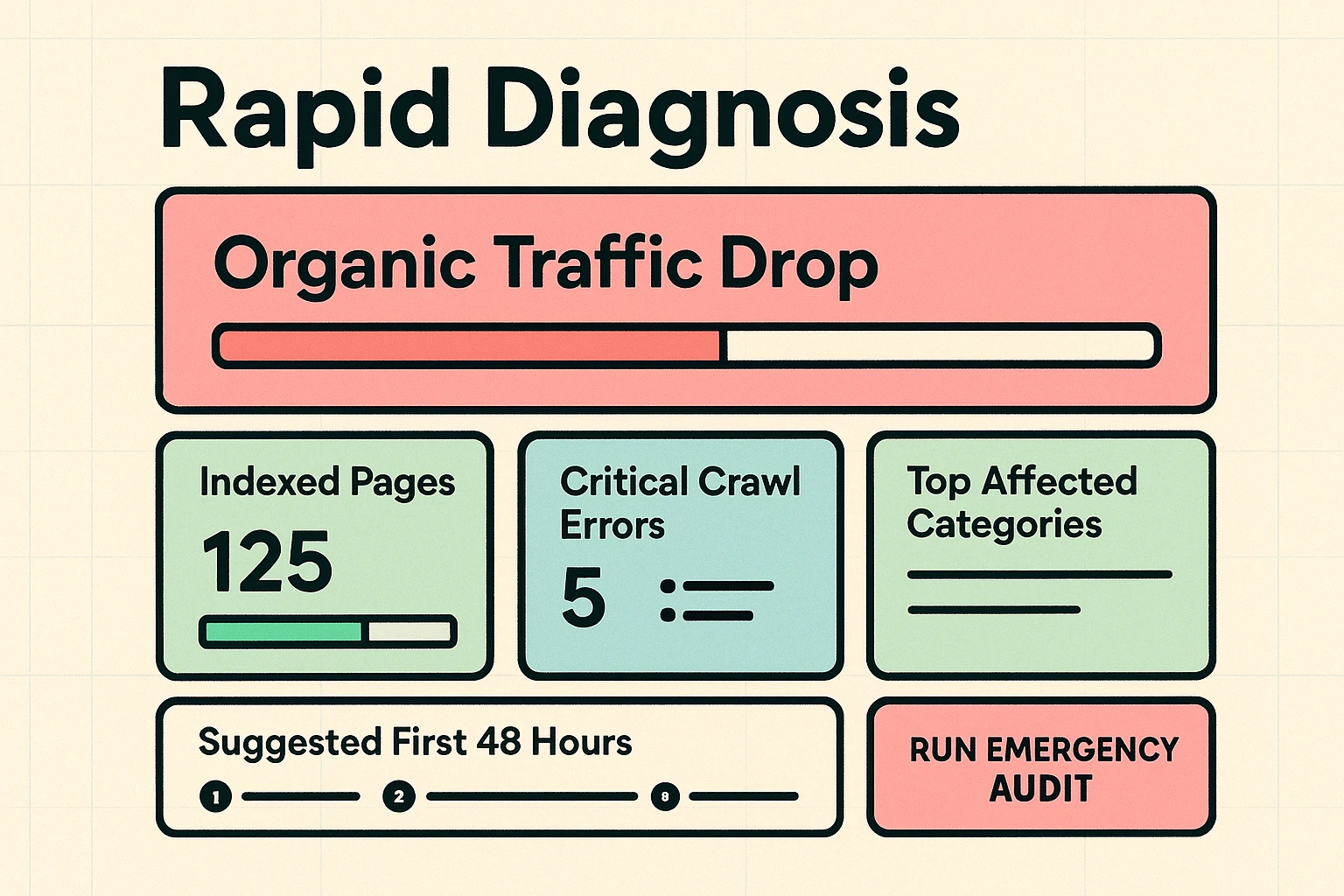
Phase 1: Rapid Diagnosis – Identifying the E-commerce SEO Black Hole
When disaster strikes, panic is a luxury you can't afford. Your first step is rapid diagnosis to pinpoint the exact cause and scope of the problem.
Product Page De-indexation Emergency Response
One of the most terrifying e-commerce SEO disasters is the mass de-indexation of product pages. The causes are varied, often technical:
- Crawl Budget Exhaustion: Googlebot might be spending budget on low-value pages, neglecting critical product pages.
- Misconfigured Robots.txt: An accidental directive could block entire sections of your site.
- Canonicalization Errors: Incorrect canonical tags can tell search engines to ignore unique product pages.
- Thin Content: Pages with minimal unique descriptions, relying solely on manufacturer copy, are prone to being de-indexed, especially after content quality updates.
Diagnostic Checklist:
- Google Search Console (GSC): Immediately check the "Index Coverage" report for spikes in "Excluded by 'noindex' tag," "Blocked by robots.txt," or "Crawled—currently not indexed" errors. Pay close attention to any sudden drops in "Valid" pages.
- Screaming Frog/Site Audit Tool: Perform a full crawl to identify widespread technical issues. Look for noindex tags, robots.txt blocks, and canonical issues.
- Cross-Reference Analytics: Correlate drops in organic traffic for specific product segments with de-indexation data.
Immediate Actions:
- Verify Robots.txt: Ensure no critical directories are accidentally blocked.
- Check
noindexTags: Use GSC's "URL Inspection" tool on affected pages to see Google's rendered view and identify any inadvertentnoindexdirectives. - Submit Sitemaps: Ensure sitemaps are up-to-date and submitted to GSC. Prioritize critical product categories. Learn more about ensuring your AI-driven strategies align with crawlability and indexation best practices.
Category Page Cannibalization & Faceted Navigation Fallout
Faceted navigation, while essential for user experience, is a notorious source of SEO issues. When not optimized, it can lead to:
- Duplicate Content: Different URL variations (e.g., /shoes?color=red and /red-shoes) compete for the same keywords.
- Crawl Budget Waste: Googlebot might spend valuable crawl budget on low-value filtered pages instead of authoritative categories.
- Authority Dilution: Link equity gets spread across numerous similar pages, weakening the signal to your primary category pages.
Identifying Cannibalization:
- Keyword Ranking Analysis: Use tools like Semrush or Ahrefs to see if multiple pages are ranking for the same target keyword, often with fluctuating positions.
- GSC 'Performance' Report: Look for impressions and clicks shifting between similar category pages.
- Site Audit Tool: Identify pages with duplicate titles and meta descriptions, common with unoptimized faceted navigation.
Prioritizing Indexation: Implement noindex, follow on filter pages providing little unique value, or use canonical tags judiciously to point to the preferred category page. Focus on prioritizing the indexation of your most important category pages to recover lost authority.
Mass Product Data Issues (Schema, Feeds, and Updates)
Accuracy in product data is pivotal for e-commerce visibility. Errors in schema markup, Google Merchant Center feeds, or API integrations can lead to a significant loss of rich snippets and visibility in product carousels. The average e-commerce site scores 67/100 on Lighthouse, with 70.5% needing "improvement", highlighting how technical issues like these are pervasive.
Impact & Troubleshooting:
- Rich Snippets: Incorrect schema (e.g., missing price, availability, or rating) means you lose prime space in SERPs.
- Google Merchant Center (GMC): Disapprovals due to data quality issues can halt product listings entirely.
- Product Feed Errors: Large-scale errors can result from API integration problems or recent site updates.
Addressing the Issue:
- GSC 'Enhancements' Report: Check for
Productstructured data errors. - GMC Diagnostics: Regularly review your product feed diagnostics for disapprovals and warnings.
- Data Validation: Implement automated checks for critical product data fields before pushing updates.
Phase 2: Strategic Recovery – Rebuilding E-commerce SEO Foundations
Once you've diagnosed the immediate issues, the next phase is to systematically rebuild your e-commerce SEO foundation. This isn't just about fixing; it's about strategizing for long-term resilience.

Recovering from Algorithm Updates: An E-commerce Perspective
Google's algorithm updates can feel like seismic shifts, especially for e-commerce. Latest trends emphasize AI-ready content, Core Web Vitals, E-E-A-T (Experience, Expertise, Authoritativeness, Trustworthiness), and mobile optimization.
E-E-A-T in E-commerce:
- Product Reviews: Leverage user-generated content for genuine authority. 90% of consumers read reviews before making a purchase. Actively solicit and display reviews.
- Expert Content: Don't just list products; provide buying guides, comparison charts, and expert advice (e.g., "Best Hiking Boots for Different Terrains"). This builds trust and expertise.
- Brand Authority: Ensure your "About Us" and "Contact Us" pages clearly establish your business credentials and customer service.
Content Refresh Strategies:
- Identify Affected Pages: Use GSC and analytics to list product/category pages that saw the largest drops post-update.
- Enhance Content Quality: For thin product descriptions, add unique selling points, usage instructions, and benefits. For category pages, expand introductory text with keyword-rich content that genuinely helps users. Consider AI-powered on-page SEO automation to streamline this process.
Technical SEO Deep Dive for E-commerce Resilience
Technical SEO is the bedrock of e-commerce visibility. Without a robust foundation, all other efforts are compromised.
- Core Web Vitals Restoration: Mobile devices account for 77% of retail website visits, emphasizing the need for impeccable mobile experience. Google prioritizes user experience. Use tools like Lighthouse and GSC's Core Web Vitals report to identify issues. Focus on Largest Contentful Paint (LCP), Cumulative Layout Shift (CLS), and First Input Delay (FID). Our AI-powered site speed analysis tools can help uncover technical bottlenecks.
- Mobile-First Indexing: Ensure all interactive elements, product variants, and informational content are fully accessible and functional on mobile devices. Don't let your mobile implementation be an afterthought. Find out how AI can aid mobile-friendliness testing.
- Advanced Crawl Budget Optimization: For large e-commerce sites, efficient crawl budget is crucial. Use
noindex, followon internal search results, filter pages with limited value, and pagination pages that don't add unique content. Optimize sitemap structure to prioritize key pages. Read more about using AI for crawlability and indexation. - HTTPS and Security Restoration: Ensuring your site is fully secure is non-negotiable. If a security incident led to the disaster, prioritize restoring HTTPS certificates and addressing any malware or spam issues immediately.
Content & Intent Alignment for MOFU Restoration
Mid-funnel (MOFU) customers are comparing options, reading reviews, and looking for confidence in their purchase. Your content needs to reflect this.
- Rethinking Product Descriptions: Go beyond basic features. Answer potential customer questions, highlight unique benefits, and weave in relevant keywords naturally.
- Leveraging User-Generated Content (UGC): Reviews, Q&A sections, and customer photo galleries provide fresh, authentic content that builds trust and implicitly addresses long-tail queries.
- Building Informational Content Assets: Support your commercial pages with buyer guides, "how-to" articles, and comparison charts that address mid-funnel queries. Link these strategically to your product and category pages to pass authority and guide users.

Phase 3: Performance Restoration & Long-Term Prevention
Recovery is not just about fixing; it's about building a more resilient system. This phase ensures your e-commerce SEO not only returns to previous levels but also establishes safeguards against future disasters.
Dealing with Seasonal Traffic Variance in Recovery
E-commerce businesses experience seasonal peaks and troughs. It's crucial to distinguish a natural seasonal dip from an ongoing SEO disaster. Use historical data to benchmark performance against previous years. Proactive seasonal optimization during recovery can include:
- Timely Content Updates: Refreshing product descriptions and category pages with seasonal keywords.
- Promotional Landing Pages: Creating optimized landing pages for seasonal sales that can be reused annually.
Competitive Landscape Shifts: Opportunity from Adversity
During your recovery, analyze what your competitors are doing. Use tools like Semrush to identify:
- New Keyword Opportunities: Are competitors ranking for keywords you've overlooked?
- Content Gaps: Are they creating buyer guides or comparison content that addresses customer pain points better than you?
- Technical Advantages: Are their sites outperforming yours on Core Web Vitals?
A crisis can be an opportunity to not just catch up but to surpass the competition by adopting innovative strategies, including no-code AI technical SEO automation to gain an edge.
Monitoring & Alert Systems for E-commerce SEO Health
Continuous monitoring is your best defense against future SEO disasters.
- Google Search Console: Set up performance and index coverage alerts. Monitor crawl stats and core web vitals regularly.
- Google Analytics: Track organic traffic, conversions, and revenue. Segment data by product category to quickly spot anomalies.
- Third-Party Tools: Utilize tools like Semrush, Ahrefs, or Moz to monitor keyword rankings, backlinks, and technical health. Set up custom alerts for significant drops in rankings or traffic.
- AI Visibility & Citation Metrics: Emerging KPIs for 2025 include monitoring AI visibility scores and prompt-win rates, especially with the rise of AI-powered search. Stay ahead of these trends. Explore the future of AI SEO automation trends to future-proof your strategy.

From Crisis to Competitive Advantage: The Future of E-commerce SEO Resilience
Recovering from an e-commerce SEO disaster is a demanding journey, but it's also an unparalleled opportunity to fortify your digital presence. The statistics are clear: E-commerce SEO offers significant long-term ROI, reaching 5.2x after 36 months. This indicates that a robust and proactive strategy is not just about recovery but about sustained growth.
Generic SEO advice won't cut it for the nuanced challenges of e-commerce. You need specialized strategies that address the unique technical infrastructure, dynamic product data, and ever-evolving algorithm sensitivities of online retail. BenAI provides the world-class AI implementations, training, and consulting to transform your business into an "AI-first" entity, capable of not just recovering from disasters but leading the way in AI adoption.
By following a holistic, proactive, and AI-conscious SEO strategy, you move beyond merely restoring performance. You build a resilient e-commerce ecosystem that is prepared for future challenges, consistently captures high-intent traffic, and drives sustainable growth. Don't just recover; come back stronger.
Frequently Asked Questions
Q1: How quickly can I expect to see results after implementing an e-commerce SEO recovery plan?
The timeline for recovery varies significantly based on the severity of the disaster and the resources deployed. Immediate technical fixes (like robots.txt corrections or canonical tag adjustments) can show results within days or weeks as Google re-crawls and re-indexes pages. However, full performance restoration and achieving new growth usually takes 3-6 months or longer. For major algorithm-related drops, a comprehensive recovery plan needs patience, as Google’s systems need time to re-evaluate your site after significant improvements. Our structured recovery roadmaps aim for tangible progress within the first 60-90 days, leading to consistent gains over 6 months or more, as proven by the long-term ROI of e-commerce SEO.
Q2: What are the most common causes of e-commerce SEO disasters that BenAI specializes in recovering from?
We frequently encounter and specialize in recovering from:
- Mass Product Page De-indexation: Often caused by crawl budget issues, incorrect robots.txt directives, thin content, or canonical tag mismanagement.
- Category Page Cannibalization: Resulting from poorly optimized faceted navigation, leading to multiple pages competing for the same keywords and diluting authority.
- Large-Scale Product Data Feed Errors: Issues with Google Merchant Center feeds, invalid structured data, or API integration problems that impact rich snippets and product visibility.
- Significant Drops Post-Algorithm Updates: Especially those affecting content quality (E-E-A-T), technical performance (Core Web Vitals), or product review relevancy.BenAI focuses on custom-built solutions tailored to these complex, e-commerce-specific problems.
Q3: How does BenAI's approach differ from general SEO agencies when it comes to e-commerce recovery?
Most general SEO agencies focus on broad strategies that don't always translate effectively to the unique complexities of e-commerce. BenAI's differentiation lies in our deep specialization and AI-first approach. We provide:
- E-commerce Specificity: Our strategies are built ground-up for dynamic product catalogs, faceted navigation, product data feeds, and conversion-focused keywords, addressing granular issues often overlooked by general SEO.
- AI-Driven Diagnostics & Solutions: We leverage advanced AI tools and methodologies for rapid diagnosis of complex technical issues, automated content optimization, and proactive monitoring tailored to e-commerce. This allows for faster identification of issues like AI visibility scores and prompt-win rates, key emerging KPIs.
- Proactive Preparedness: Beyond recovery, we implement resilient systems and AI agents to prevent future disasters, ensuring long-term stability and growth.
- Custom Implementations: We don't offer one-size-fits-all solutions. Our "Enterprise Solutions" provides custom AI implementations, training, and consulting, ensuring a solution perfectly aligned with your business needs and challenges.
Q4: Can AI truly help in recovering from an SEO disaster, or is it more of a buzzword?
AI is not just a buzzword; it's a game-changer for e-commerce SEO disaster recovery and prevention. At BenAI, we harness AI for:
- Rapid Diagnostics: AI-powered crawlers and analytics can process vast amounts of data quickly to pinpoint de-indexation, crawl errors, and content quality issues on a large scale that human auditors would take weeks to find.
- Content Optimization: AI helps in identifying gaps in product descriptions, optimizing category page content for E-E-A-T principles, and generating variants for A/B testing at speed.
- Predictive Analysis: AI can help forecast the impact of algorithm updates or identify potential issues before they become disasters by analyzing patterns in search data and site performance.
- Automation: From automated on-page SEO suggestions to no-code technical SEO automation, AI agents can implement fixes and monitor changes continuously, allowing your team to focus on strategic initiatives. This is why we emphasize "proven AI systems" to automate tasks, reduce manual work, and create capacity.
Q5: What kind of data or access does BenAI need to start a recovery process?
To initiate an effective recovery, we typically require access to:
- Google Search Console: Full access to all properties for diagnostic reports (Index Coverage, Core Web Vitals, Performance).
- Google Analytics: Access to historical data for traffic analysis, conversion tracking, and correlating SEO drops with business impact.
- Website CMS/E-commerce Platform Backend: Varies by platform (Shopify, Magento, Salesforce Commerce Cloud, etc.) for implementing technical changes.
- Product Data Feeds: Access to Google Merchant Center and any internal product data management systems.
- Site Crawl (Screaming Frog/Sitebulb): A recent comprehensive site crawl or the ability to perform one.
- FTP/SFTP/Hosting Access: For direct file modifications if necessary (e.g., robots.txt).We approach this collaboratively, ensuring all access is secure and transparent, aligning with our consulting and implementation services.
Join Our Growing AI Business Community
Get access to our AI Automations templates, 1:1 Tech support, 1:1 Solution Engineers, Step-by-step breakdowns and a community of forward-thinking business owners.

Latest Blogs
Explore our latest blog posts and insights.