The automotive industry is in constant motion, and how your customers find you online is no exception. If you’re a dealership or manufacturer navigating the complex world of digital marketing, you’re likely evaluating how to stand out. You know that 95% of car buyers start their journey online, and that 53% of automotive website traffic originates from organic search. This isn't just about showing up in search results; it's about being the definitive resource that converts curiosity into a confident purchase.
But with so much information available, how do you cut through the noise and ensure your hard-earned SEO investments deliver real, measurable results? The answer lies in moving beyond basic optimization to a sophisticated strategy that embraces technical excellence, hyper-local precision, and user-centric content.
Beyond the Basics: Precision SEO for the Automotive Lifecycle
Many automotive businesses struggle with fragmented information and generic online tools. Customers are looking for specific answers and authoritative guidance, whether they're trying to find an OEM part number, understand a VIN, or locate a service center. Our approach tackles these challenges head-on—transforming your online presence into an intuitive, trusted hub.
The Power of Identification: VIN, License Plate, and OEM
Understanding vehicle identifiers like VINs, license plates, and OEM numbers is crucial for buyers, sellers, service centers, and parts departments. These aren't just strings of characters; they're gateways to vital information. Whether it’s verifying a vehicle’s history, ensuring part compatibility, or checking for crucial recalls from official sources like NHTSA, these numbers drive critical decisions.
Right now, your customers are searching for clarity. Queries like "how to find my VIN number online" or "how to find OEM number on car" dominate search results, often leading to fragmented answers across various specialized sites like Carfax, AutoCheck, NHTSA, J.D. Power, and AutoZone. Imagine consolidating this search experience into one seamless, authoritative platform.
Interactive Tools: Your Customer's First Stop
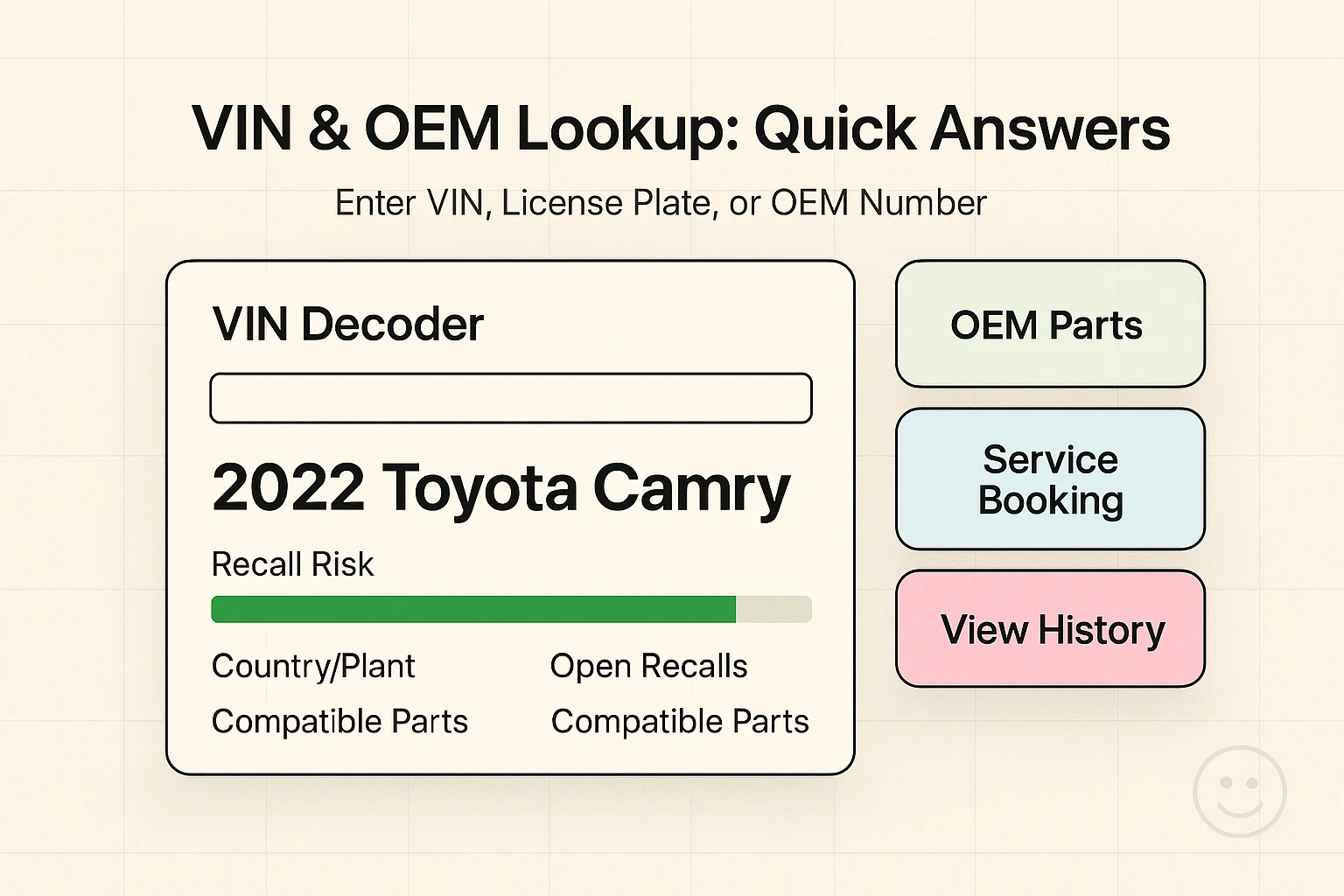
A key part of our strategy is integrating interactive tools directly into your website. An embedded VIN decoder, for example, can immediately provide free data points like make, model, year, and a summary of recalls directly from NHTSA. This addresses your customers' primary transactional intent, offering immediate value and building trust. Imagine the impact of having an "All-in-One" interactive hub that combines fragmented information from across the web onto your own digital storefront. It’s about being the first and last place customers need to look.
The Foundational Six Figures: How to Locate Your Numbers
Sometimes, the challenge isn't decoding the numbers, but finding them in the first place. Providing clear, visual, step-by-step guides for locating VINs, license plates, and OEM numbers is a crucial service that differentiates your online offering.
On the Vehicle: Visual guides (images, diagrams) showing common physical locations on the dashboard, door jamb, engine block, or directly on the parts themselves.In Your Documents: Clear instructions on where to find these numbers on registration, title, insurance, owner’s manuals, and service records.Online and Alternative Methods: How to navigate state DMV portals, manufacturer websites, or when to contact a dealership for specifics, like an Audi PIN.
Beyond Data Retrieval: Making Informed Decisions
Middle-of-the-funnel buyers aren't just looking for data; they're looking for guidance. They want to understand what the data means, how it impacts their decision, and what their next steps should be. This is where you can truly become a trusted advisor.
Vehicle History Reports: Carfax vs. AutoCheck
When evaluating a used vehicle, the question inevitably comes down to which history report to trust. Carfax and AutoCheck are strong competitors, each with unique strengths. Carfax is often preferred by consumers for its detailed service history, while AutoCheck, backed by Experian, is popular with dealers for its “AutoCheck Score” and integration with auction data. Providing an unbiased, detailed comparison empowers your customers, whether they are individual buyers or other dealers.
Feature / AspectCarfax (www.carfax.com)AutoCheck (www.autocheck.com)
Best Use Case
Primary FocusDetailed Service History, Accident RecordsAuction Data, "AutoCheck Score," Title EventsConsumers seeking maintenance historyData SourcesService records, DMV, collision centersExperian data, auctions, title informationDealers, those needing quick risk assessmentUnique AngleConsumer-facing brand recognition, maintenance recordsAutoCheck Score (risk metric), auction data integrationConsumers for in-depth pre-purchase checks**Strength **Comprehensive service history, damage reportsDealer-centric tools, quick risk evaluationDealers for inventory, consumers for red flags**Weakness **Can be more expensive, info limited to what's reportedLess granular service records, less consumer brand powerSupplement with third-party inspectionCostHigher for single reports, package deals availableOften more budget-friendly, bulk pricing for dealershipsEvaluate cost vs. specific data needs
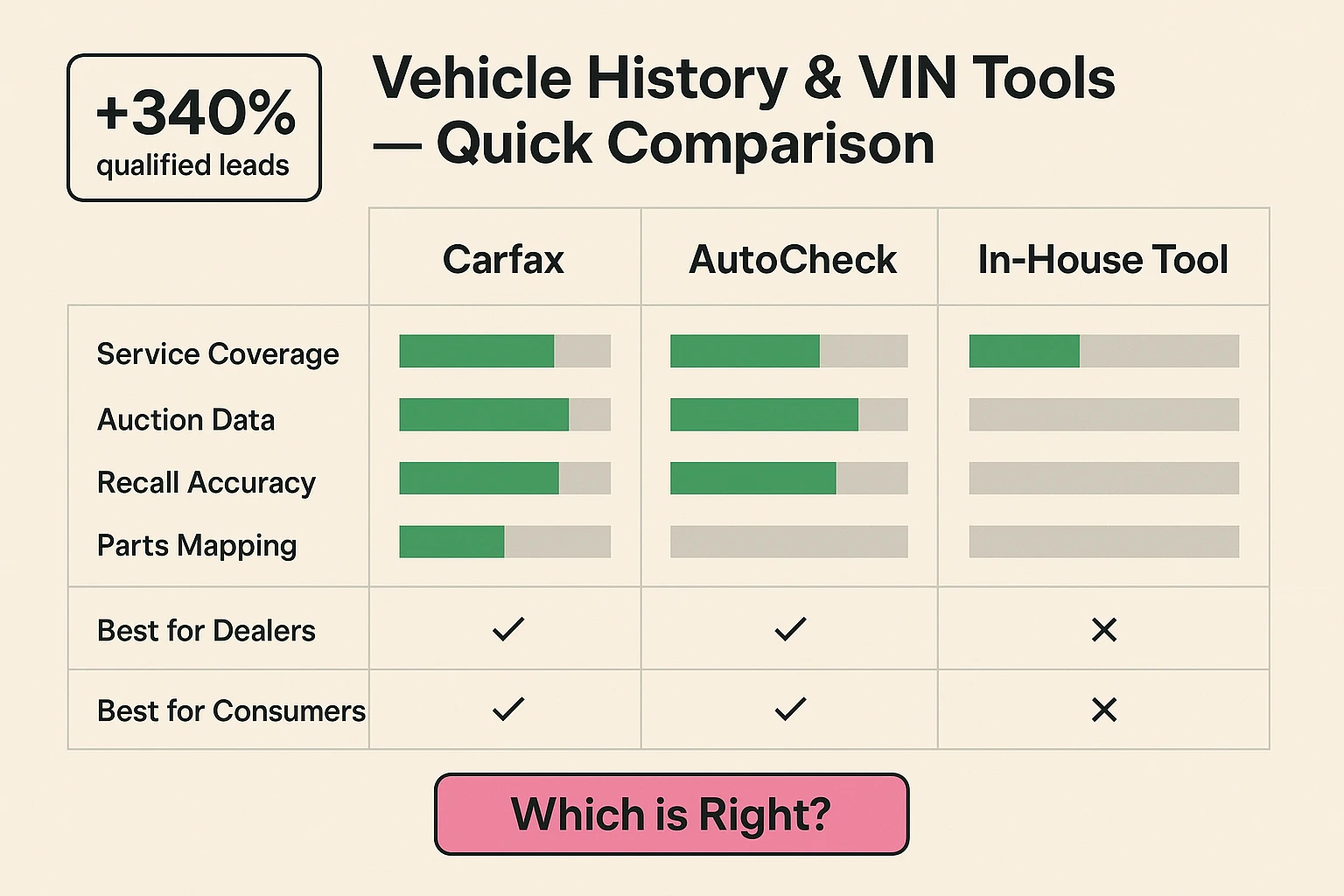
This comparison builds trust by acknowledging potential gaps in any single report and educating users to make the most informed decision. It positions you as an honest broker, not just a seller.
Legal & Ethical Considerations: Briefly addressing potential privacy concerns with license plate lookups and how these numbers contribute to protecting against vehicle fraud further cements your brand as a responsible, knowledgeable authority.
OEM vs. Aftermarket Parts: For OEM queries, explaining the value proposition of Original Equipment Manufacturer (OEM) parts, their warranty implications, and how to verify authenticity provides essential context for customers making purchasing decisions.
The Unseen Edge: Technical SEO for Automotive
While front-end content is crucial, the real competitive advantage in automotive SEO often lies unseen—in robust technical implementation. Competitors frequently overlook detailed structured data, dynamic content tagging for large inventories, and crucial crawl budget management. Ignoring these elements means their vast inventory pages might not be fully indexed, or they miss out on critical rich snippet opportunities.
Here's where BenAI's expertise shines. We focus on transforming these overlooked technical details into a strategic asset.
Structured Data Excellence: We implement granular schema for every vehicle, part, and service type. For instance, detailed JSON-LD markup can specify "2023 Ford F-150 Lariat OEM fender part number" directly on your product pages. This dramatically increases your chances of appearing in rich snippets and other enhanced search results, especially as 70% of automotive queries are zero-click.
Want to learn more about how we use AI to automate schema markup? Explore our insights on AI Schema Markup Automation.
Dynamic Inventory Tagging: For dealerships and manufacturers managing thousands of vehicle models and parts, dynamic SEO tagging ensures that even niche listings are optimized and discoverable. This means every specific trim, color, and feature combination can be uniquely optimized without manual intervention, a task made efficient through No-Code AI Technical SEO Automation.
Crawl Budget Management: For sites with large inventories, search engines have a "crawl budget" indicating how many pages they'll process. Inefficient sites waste this budget, leading to lower indexing rates. We optimize your site structure and server configurations to ensure search engines efficiently discover and index your most important inventory. Understanding AI for Crawlability and Indexation is vital here.
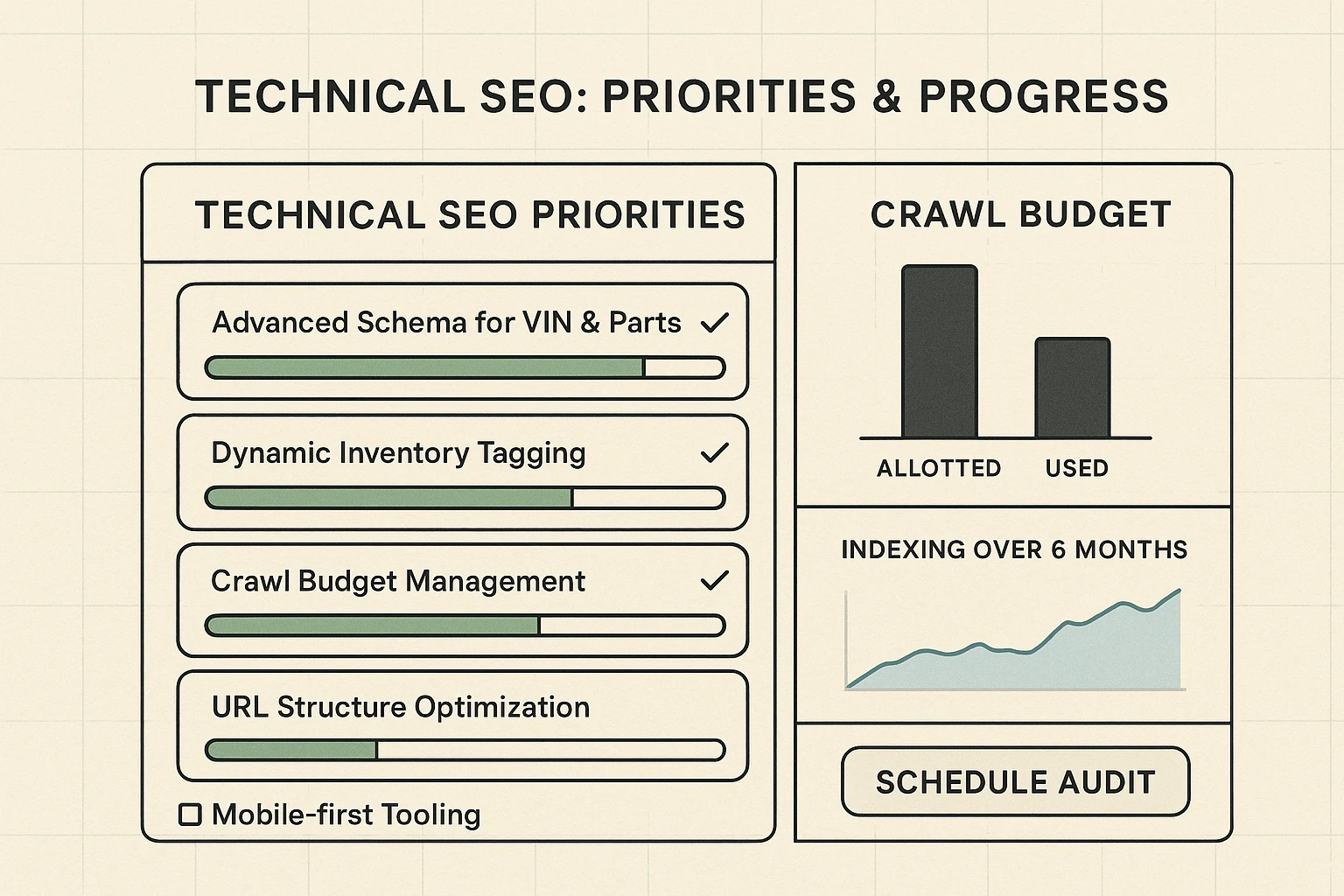
This level of technical precision isn't just about rankings; it’s about ensuring every single vehicle in your inventory has the strongest possible chance to be discovered by a high-intent buyer. We use AI to reduce manual SEO workflows, allowing your team to focus on strategy.
Local SEO: Hyper-Targeting Your Community
For dealerships and service centers, local search is paramount. When 50% of “near me” searches lead to a store visit within a day, optimizing for local intent isn't optional—it's essential. This means going beyond basic Google Business Profile setup.
We help you implement hyper-localized content, targeting niche services like "EV charging station repair [City neighborhood]" or "luxury car detailing [specific district]". This granular approach ensures you capture the voice-based, long-tail queries that are rapidly growing, with over 50% of online searches projected to be voice-based by 2025.
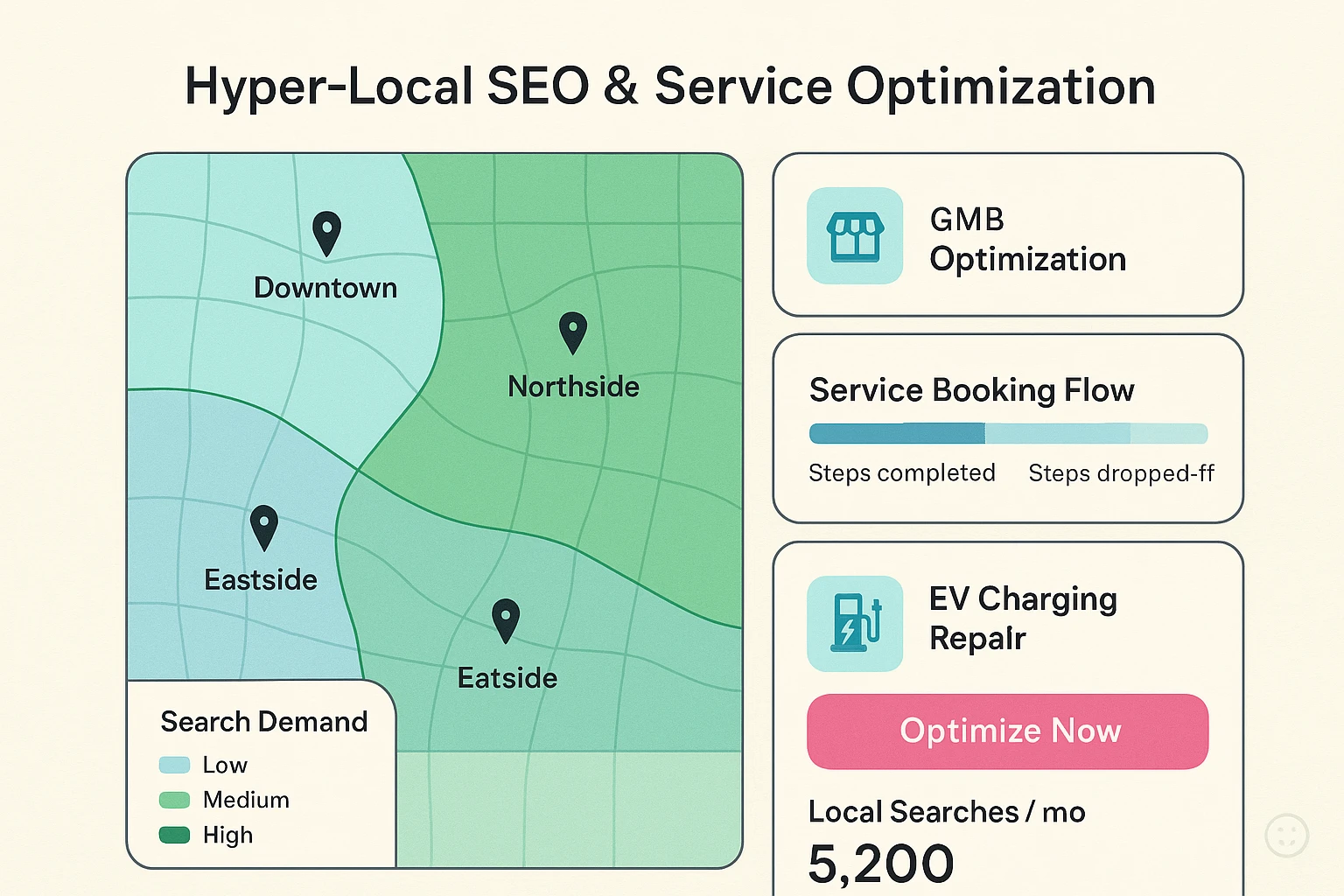
By integrating your online presence with local search results, we refine user experience, reducing "booking friction points" and driving more in-person visits and service appointments. Our strategies for AI Local SEO Visibility can help you dominate local SERPs.
Frequently Asked Questions About Automotive SEO
Q1: Why is technical SEO so important for dealerships and manufacturers with large inventories?
A1: With vast product catalogs, it's easy for many pages to go unnoticed by search engines if not technically optimized. Competitors often overlook deep structured data, dynamic content tagging, and crawl budget management. This means search engines might not fully index every vehicle or part. We implement granular schema and efficient crawling strategies to ensure comprehensive indexing and help your inventory show up for specific, high-intent searches. High-volume websites especially benefit from advanced strategies that ensure their content is not just present, but prioritized by search engines.
Q2: How can BenAI help me improve my automotive content strategy?
A2: We focus on creating content that serves clear user intent, from answering specific "how-to" questions about finding a VIN to providing detailed comparisons of vehicle history reports. Our approach helps your site become an authoritative resource, building trust and guiding customers through their evaluation process. We also leverage AI to help with AI-Powered Content Marketing Strategy, ensuring your content is both engaging and optimized for search.
Q3: What is "zero-click content" and why does it matter for automotive SEO?
A3: Zero-click content refers to search results where users find the answer directly on the Google Search Results Page (SERP) without clicking through to a website. These often appear as featured snippets or AI Overviews. Given that 70% of automotive queries are zero-click, optimizing for these direct answers is crucial to capture visibility and establish authority even when users don't visit your site immediately. Our technical SEO strategies, particularly with structured data, enhance your chances of appearing in these prominent positions.
Q4: How does BenAI address the rise of voice search in automotive?
A4: With over 50% of online searches expected to be voice-based by 2025, optimizing for conversational, long-tail queries is vital. We help you create content that answers natural language questions, aligning with how people speak rather than just type. This includes developing hyper-localized content that addresses spoken queries like, "Where's the nearest Ford service center that does EV battery diagnostics?"
Q5: Can BenAI help with SEO for specific automotive niches like luxury cars or EVs?
A5: Absolutely. Our strategies are highly adaptable. Whether you're targeting buyers for luxury vehicles, electric vehicles, commercial fleets, or specialized auto repair services, we tailor our approach. This involves specific keyword targeting, structured data for unique features (e.g., charging ports, specialized repair services), and content that speaks directly to the unique concerns and interests of those niche audiences.
Your Path to Automotive SEO Leadership
The decision to invest in advanced automotive SEO is a strategic one, aimed at future-proofing your business and securing market leadership. While many agencies offer generic SEO, BenAI specializes in the intricate technical and content needs of dealerships and manufacturers. We understand that a 340% increase in qualified leads with comprehensive SEO is not just a statistic—it’s a transformation.
If you’re evaluating solutions to drive significant, measurable growth in your automotive business, we invite you to connect with us. Let’s discuss how a tailored, AI-powered SEO strategy can make your business an AI-first entity, automating workflows and capturing market share in ways your competitors can't.
Ready to take your automotive SEO to the next level?
Join Our Growing AI Business Community
Get access to our AI Automations templates, 1:1 Tech support, 1:1 Solution Engineers, Step-by-step breakdowns and a community of forward-thinking business owners.

Latest Blogs
Explore our latest blog posts and insights.