Imagine launching your brilliant product in a new country. You've painstakingly translated your website, your ads, even your brand name. You expect a global boom. Instead, you hear crickets. Why? Because you didn't just translate words; you unknowingly lost the message entirely in transit.
This isn't a problem of poor grammar; it's a profound misunderstanding of intent, culture, and context. Trying to connect with global audiences through mere linguistic translation is like trying to understand a complex inside joke by just knowing the definition of each word. You get the semantics but entirely miss the humor, the history, and the shared understanding.
For businesses looking to thrive globally, navigating diverse markets means understanding not just what people search for, but why they search for it – their underlying needs, cultural values, and preferred communication styles. This is where Artificial Intelligence for multilingual keyword research and cross-cultural intent mapping becomes not just helpful, but absolutely critical. It’s the difference between speaking to an audience and truly speaking with them.
The Global Puzzle: More Than Just Different Tongues
Before AI entered the scene, expanding internationally was a Herculean task for marketers. Typically, it involved a mix of:
- Direct Translation: Taking keywords from one language and translating them literally. This almost always misses the mark. For example, the direct translation for "car insurance" in German might be "Autoversicherung," but the common search term is "Kfz-Versicherung" – a more specific, technical term. Miss this, and you miss your audience.
- Manual Market Research: Hiring local experts, running focus groups, and conducting surveys. Effective, but incredibly slow, expensive, and difficult to scale across dozens of markets.
- Guesswork & Gut Feelings: Relying on assumptions about what different cultures want. A recipe for wasted ad spend and missed opportunities.
The result? Global campaigns that felt off, irrelevant, or even offensive. Businesses struggled to identify growth opportunities, understand what content truly resonated, and ultimately, build trust with international customers.
Not Just Tools, But a True Paradigm Shift
The good news is that we're past the era of blind international expansion. AI isn't just offering new tools; it's enabling a fundamental shift in how we approach multilingual keyword research and, more profoundly, how we map cross-cultural intent.

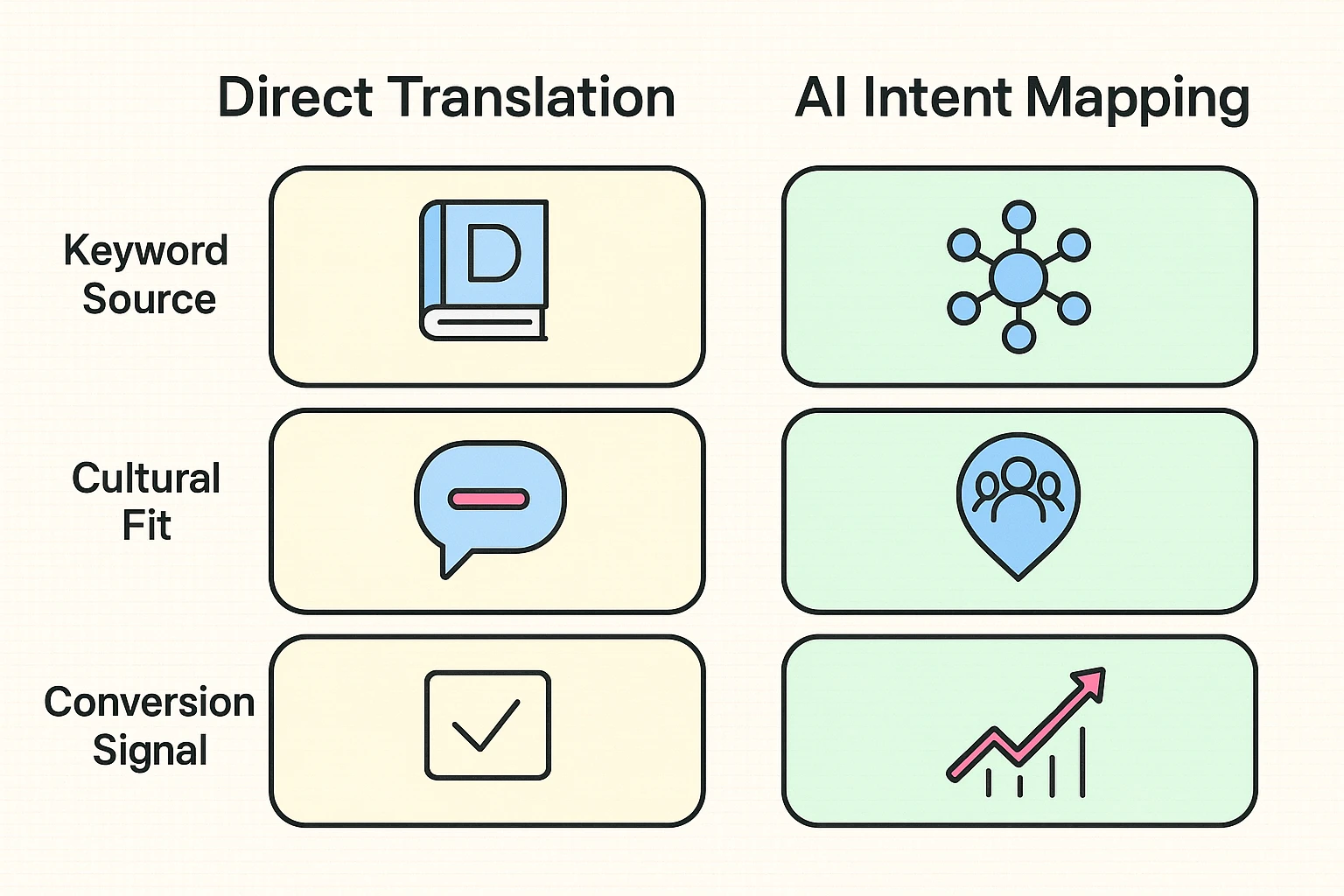
Translation vs. Intent Mapping: The Critical Distinction
- Translation: Converts words from one language to another. It's about linguistic equivalence.
- Intent Mapping: Uncovers the underlying purpose behind a search query, considering cultural context, local idiom, and unspoken expectations. It’s about cultural equivalence of need.
AI, particularly with advanced Natural Language Processing (NLP) and Large Language Models (LLMs), allows us to move beyond mere translation. It helps us understand the subtle nuances that make a search query in Japan different from one in Germany, even if they're "literally" about the same product. This includes:
- Regional Dialects: Spanish in Spain is different from Spanish in Mexico. AI helps identify these regional variations and preferred terms.
- Cultural Context: A search for "best vacation" might lead to a luxurious resort in one culture, but a family-friendly, budget-conscious trip in another. AI can pick up on these cues.
- Emotional Resonance: The emotional weight behind certain terms can vary significantly. AI can help measure and map this.
This isn't just about SEO anymore; it's about connecting with your audience on a deeper, more meaningful level. For a deeper dive into optimizing your global digital presence, explore BenAI's insights on AI International SEO.
Building: The AI-Powered Cross-Cultural Intent Mapping Framework
So, how do we actually do this? It's not about pushing a button and getting perfect answers. It's a strategic, multi-phase process that brilliantly combines the scalable analytical power of AI with the irreplaceable qualitative insights of human cultural experts.
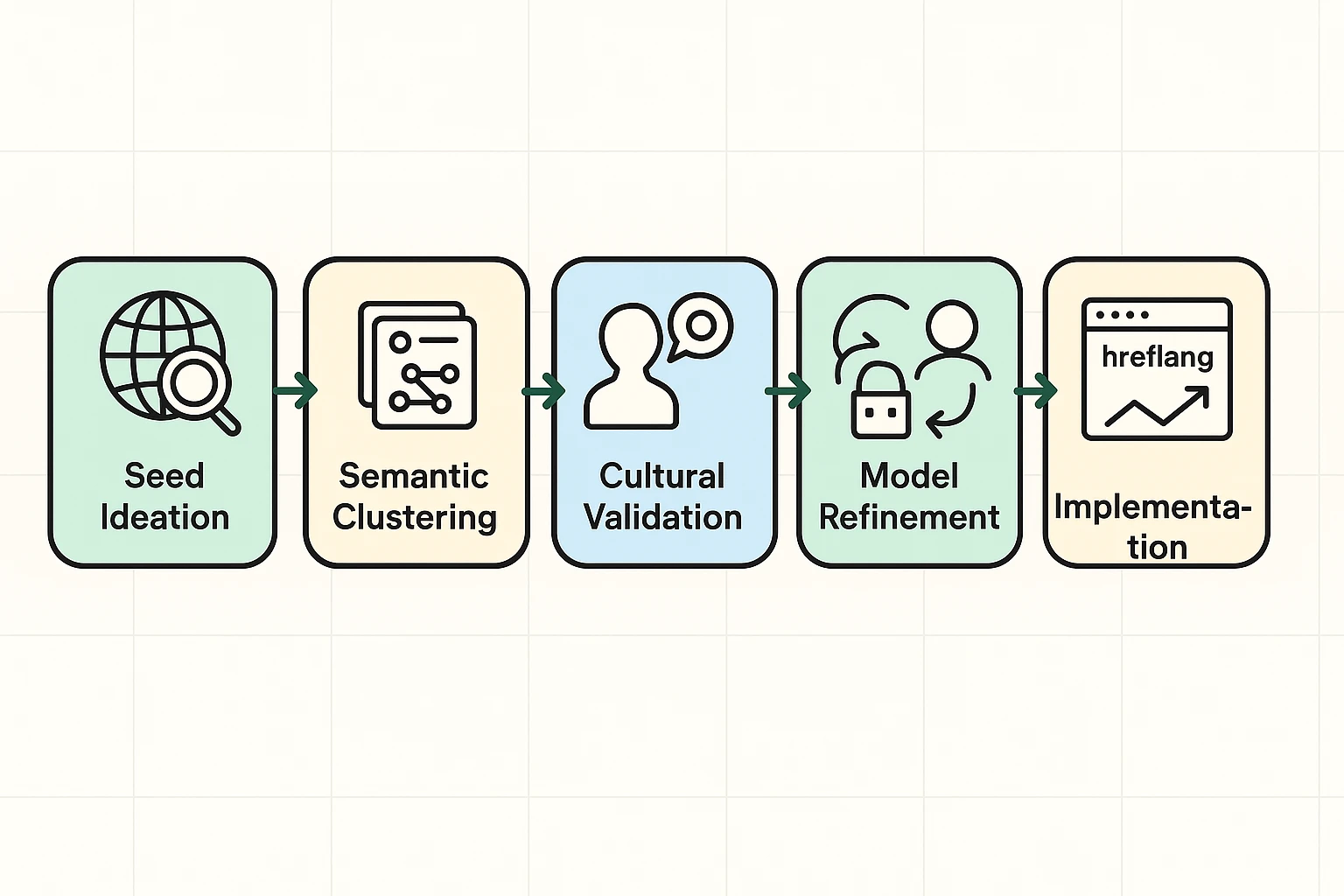
Phase 1: Market & Linguistic Segmentation
Before AI can scour for intent, we need to tell it where to look. This phase involves:
- Identifying Target Regions: Beyond just countries, think about provinces, states, or even major cities where language or culture shifts.
- Defining Linguistic Varieties: Is it simplified Chinese or traditional? Parisian French or Canadian French? AI tools can then be configured to understand these specific linguistic nuances.
- Initial Cultural Hypothesis: Based on existing market research or expert knowledge, form initial hypotheses about cultural values and communication styles in each segment.
Phase 2: AI-Assisted Seed Keyword & Query Generation
This is where AI shines in generating a vast base of potential queries.
- Broad Keyword Ideation: Using tools like Semrush, Ahrefs, or dedicated AI platforms, generate seed keywords based on your core offerings in each target language.
- Leveraging LLMs: Prompting advanced LLMs (like GPT-4) with your product/service and target market cultural context to generate highly specific, colloquial, and intent-rich search queries. For example, "What problems does this product solve for someone in [Culture X]?"
- Competitor Analysis: AI assists in analyzing competitor keyword strategies in local markets, helping to identify gaps they might be missing due to cultural oversight. This aligns perfectly with AI Competitor SEO Analysis.
Phase 3: Deep NLP & Semantic Analysis
With a large pool of queries, AI now steps in to organize and uncover deeper meaning.
- Clustering Similar Queries: AI uses NLP to group semantically similar queries, even if they use different words. "Cheap flights to Paris" and "affordable airfare France" are understood as having similar intent.
- Intent Classification: AI algorithms categorize queries by intent (informational, navigational, transactional, commercial investigation). This is crucial because what constitutes "informational" or "transactional" can vary culturally.
- Trend Identification: AI can spot emerging trends or shifts in language usage that might indicate changes in cultural priorities or evolving needs. For insights into future trends, delve into Future AI SEO Automation Trends.
Phase 4: Cultural Validation & Intent Mapping (The Human-in-the-Loop)
This is the most critical phase, where human expertise validates and refines AI's output.
- Local Expert Review: Linguists and cultural experts in each market review AI-generated clusters and intent classifications. They identify instances where AI might have missed cultural nuances, misinterpreted slang, or overlooked local sensitivities. This is where "aha moments" happen, uncovering insights AI alone might never see.
- Cultural Contextualization: Experts provide context for why certain terms are used, their emotional weight, and their implications for product positioning or content creation. This could involve applying frameworks like Hofstede's cultural dimensions to understand communication styles (e.g., direct vs. indirect communication).
- Refining AI Models: The feedback from human experts is used to fine-tune AI models, making them smarter and more culturally aware over time. This continuous learning process is vital for quality content. For maintaining quality, refer to BenAI's AI-Driven Quality Control Guide.
Phase 5: Technical Implementation for Global Reach
Once culturally aligned intent is mapped, it needs to be technically implemented.
- Hreflang Tags: Properly implement hreflang tags to tell search engines which regional or language variation of a page is intended for which audience.
- Localized URLs & Content: Ensure URLs, metadata, and content are fully localized, not just translated, to reflect the identified cultural intent.
- Schema Markup: Use schema markup to provide search engines with structured data, enhancing understanding of local products, services, and events.
Mastery: Advanced Applications & Strategic Impact
Truly mastering AI for multilingual keyword research goes beyond foundational steps. It involves leveraging AI for deeper strategic impact and maintaining a proactive stance.
- Predictive Analytics for Emerging Trends: AI can analyze vast datasets (social media, news, search queries) to predict emerging cultural trends and shifts in consumer intent before they become mainstream. This allows businesses to be pioneers rather than followers.
- Personalized Content Experiences: With a deep understanding of cross-cultural intent, AI can help tailor content, recommendations, and entire user journeys to individual cultural segments, leading to dramatically higher engagement and conversion rates. This ties into developing AI Content Strategy Clusters for niche markets.
- Measuring Real ROI: Move beyond simple keyword rankings. Track how culturally aligned content impacts metrics like local market share, customer lifetime value, and brand sentiment in specific regions.
- Ethical AI & Bias Mitigation: Be aware that AI models can inherit biases from their training data. Continuously audit AI outputs for cultural insensitivity, stereotypes, or unintended messaging. Local expert review is crucial here.
Action: Building Your Own Multilingual AI SEO Stack & Roadmap
Ready to build your international AI engine? Here's how to begin:
- Tool Selection: Beyond standard SEO platforms, look into specialized AI tools for NLP, sentiment analysis across languages, and large-scale data processing. Many tools now offer robust APIs that can be integrated to build a custom solution.
- Team Integration: This is not a purely technical task. Your team needs:
- AI Specialists: To implement and train models.
- Linguists and Cultural Experts: To provide essential human validation and context.
- SEO Strategists: To guide the overall approach and measure impact.
- Continuous Learning & Adaptation: Global markets are dynamic. Regularly reassess your keyword and intent maps, adapt to new cultural trends, and continuously refine your AI models with new data and human feedback.
This journey is about adopting an "AI-first" mindset, not just for tools, but for how you strategically approach global markets.
Frequently Asked Questions About AI for Multilingual Keyword Research
What is multilingual keyword research?
Multilingual keyword research is the process of identifying and analyzing search terms that your target audience uses in different languages and regions to find products, services, or information. It goes beyond simple translation to capture cultural nuances and localized search behavior.
How is AI changing multilingual keyword research?
AI transforms multilingual keyword research by enabling deeper semantic analysis, identifying subtle cultural intent shifts, automating the generation of relevant localized terms, and helping to cluster queries based on meaning rather than just keywords. It makes the process faster, more scalable, and more accurate than manual methods.
What is cross-cultural intent mapping?
Cross-cultural intent mapping is the process of understanding the underlying motivation or purpose behind a search query, taking into account the cultural context, values, and communication styles of a specific linguistic or cultural group. It ensures that your content and messaging align with what your audience actually means, not just what they say.
Why can't I just use Google Translate for keyword research?
Direct translation tools like Google Translate are great for literal word-for-word conversions, but they often miss the cultural context, idiomatic expressions, regional dialects, and varying search behaviors that are crucial for effective keyword research. This can lead to irrelevant keywords, missed opportunities, and a campaign that feels out of touch.
What are some common pitfalls in multilingual keyword research?
Common pitfalls include:
- Direct Translation Fallacy: Assuming literal translations will work.
- Ignoring Regional Variations: Neglecting dialect or cultural differences within the same language (e.g., Portuguese in Portugal vs. Brazil).
- Lack of Cultural Context: Misunderstanding how local values or social norms influence search behavior.
- Over-reliance on Automated Tools: Not incorporating human review or local expert validation.
- Underestimating Competition: Failing to analyze local competitors' keyword strategies.
How do AI and human expertise work together in this process?
AI handles the heavy lifting of data processing, semantic analysis, and initial query generation, providing immense scale and speed. Human experts (linguists, cultural consultants) then validate, refine, and add qualitative wisdom to this AI output, ensuring cultural accuracy, sensitivity, and deep intent understanding that AI alone cannot achieve. It's a "human-in-the-loop" approach that leverages the strengths of both.
Can AI identify new market opportunities in different languages?
Yes! By analyzing search trends, content gaps (see AI Keyword and Content Gap Analysis), and competitor strategies across various linguistic datasets, AI can uncover underserved niches or emerging popular topics in different markets that a human might miss. This can point to new product development or content creation opportunities.
How do I get started with AI for multilingual keyword research?
Start by defining your target markets and their linguistic specificities. Then, explore AI-powered SEO tools or consider partnering with an AI solutions provider like BenAI. Begin with a hybrid approach, using AI for initial data insights, and then validating and refining those insights with native speakers and cultural experts. Consider joining a community like the BenAI Community for shared resources and best practices.
Join Our Growing AI Business Community
Get access to our AI Automations templates, 1:1 Tech support, 1:1 Solution Engineers, Step-by-step breakdowns and a community of forward-thinking business owners.

Latest Blogs
Explore our latest blog posts and insights.