Imagine growing your website into a sprawling digital empire, reaching customers in dozens of countries, speaking countless languages. It’s an exciting vision, full of global potential. But then reality sets in: ensuring each user sees the right version of your content, in their preferred language, for their specific region. This is where Hreflang tags come in – the unsung heroes of international SEO.
But here’s the catch: managing Hreflang tags for complex multilingual sites is often a manual, error-prone nightmare. One missing tag, one incorrect country code, and suddenly your perfectly translated content is hidden from its intended audience, or worse, flagged for duplicate content. While traditional guides offer a great foundation, they often skim over the sheer scale of the challenge for enterprise-level sites.
What if there was a way to navigate this complexity with precision, speed, and continuous accuracy? Enter AI-driven Hreflang tag generation and validation. This isn't just about automation; it's about transforming a headache into a strategic advantage, ensuring your global content truly resonates without breaking a sweat.
The Brains Behind the Tags: How AI Handles Hreflang
AI brings a new level of sophistication to Hreflang management. It’s not just a simple script; it’s a system that understands context, learns from data, and proactively prevents errors. Think of it as having a hyper-intelligent, tireless SEO expert on your team, dedicated solely to Hreflang.
Here’s a glimpse into the AI-powered engine rooms:
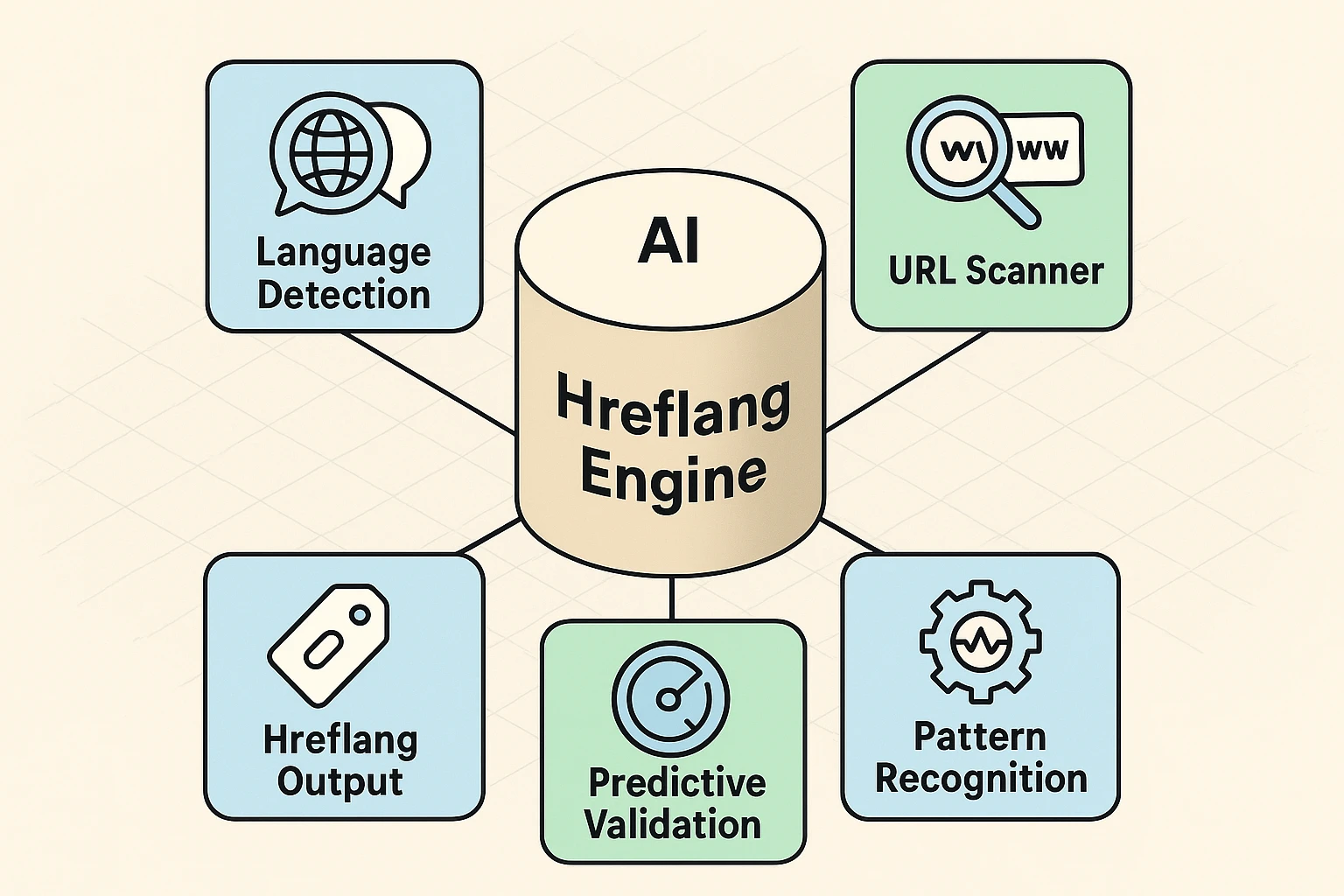
- Language Detection & Content Scanning: AI algorithms use natural language processing (NLP) to accurately identify the language of your content, even across nuanced dialects or regional variations. It scans your entire site, from page content to metadata, to build a comprehensive map of your multilingual offerings.
- Pattern Recognition & Error Prevention: AI learns common Hreflang syntax and implementation patterns. More importantly, it can spot subtle inconsistencies and potential validation errors long before they impact your rankings. This includes detecting issues like missing reciprocal tags, incorrect ISO codes, or conflicts with canonical tags.
- Predictive Validation: This is where AI truly shines. Based on historical data and real-time site changes, AI can predict where Hreflang errors are likely to occur. This proactive approach helps you address problems before search engines even crawl them, keeping your international SEO clean and effective.
Here’s a visual breakdown of how these AI components work together:
Why Hreflang is a Complex Beast for Global Sites
For anyone managing an international website, Hreflang tags are both essential and notoriously tricky. They’re snippets of code that tell search engines like Google which language and geographical region a specific page is targeting. This seems simple enough, but a glance at their intricate syntax and deployment methods quickly reveals why they’re often a source of significant SEO challenges.
The Manual Maze: Endless Possibilities for Error
Historically, Hreflang implementation relies heavily on manual effort or basic rule-based systems. For a site with just a few language versions, this might be manageable. But for a global enterprise with hundreds, or even thousands, of distinct URLs for different countries and languages—think separate pages for English speakers in the US, UK, and Australia, plus Spanish for Mexico and Spain, and German for Germany and Switzerland—the complexity explodes.
Common pitfalls that plague manual Hreflang management include:
- Missing Reciprocal Links: The biggest offender. If Page A links to Page B with an Hreflang tag, Page B must link back to Page A. Miss one, and the entire cluster of Hreflang tags for those pages becomes invalid.
- Incorrect ISO Codes: Using the wrong language (ISO 639-1) or region (ISO 3166-1 Alpha 2) codes. A common mistake is using a country code instead of a language code, or vice-versa, or simply making a typo.
- Conflicting Canonical Tags: Hreflang and canonical tags work in tandem, but if a canonical tag points to a different URL than the Hreflang cluster, it creates confusion for search engines.
- No Default (x-default): Neglecting to include an x-default tag for users whose language/region doesn't match any specified variants.
- Placement Issues: Hreflang tags must be placed correctly in the HTML head, HTTP headers, or XML sitemap. Incorrect placement renders them ineffective.
- Scalability Nightmare: As your site grows, adding new regions or languages means manually updating Hreflang for every single related page. This becomes a full-time job prone to burnout and costly errors.
These issues don't just lead to incorrect targeting; they can result in search engines perceiving your translated pages as duplicate content, diluting your SEO efforts and hindering your international visibility. This is a common and critical challenge that our content on International SEO Crisis Guide further explores.
Building the Future: AI’s Role in Hreflang Generation and Optimization
The good news? AI offers a powerful solution to these vexing problems. By automating and intelligently managing Hreflang, AI transforms a complex task into a streamlined, high-accuracy operation.
Automated Generation: From Content to Code with AI
Manual Hreflang generation involves painstaking work: identifying equivalent pages, determining language and region codes, and crafting the correct syntax. AI automates this entire process:
- Content Discovery: AI actively crawls your website, identifying all existing language and region variations of your content. It uses advanced algorithms to understand the relationships between pages.
- Language and Region Identification: Leveraging NLP, AI accurately identifies the primary language and intended region of each page. It's smart enough to differentiate between en-US, en-GB, and en-AU for English, or es-MX and es-ES for Spanish, ensuring precise geo-targeting crucial for international ranking.
- Automatic Tag Formation: Once identified, AI dynamically generates the correct Hreflang tags for each page, complete with reciprocal links and x-default declarations where appropriate. This eliminates the risk of human error from manual entry and ensures compliance with Google's guidelines.
Intelligent Optimization: Beyond Simple Generation
AI doesn't just generate; it optimizes. Unlike basic scripts, AI understands context:
- Semantic Analysis: AI can analyze the meaning of your content to suggest optimal Hreflang groupings. For example, if two pages in different languages cover the exact same product with slightly different descriptions, AI can confirm their equivalency, reducing ambiguity for search engines.
- User Behavior Integration: In advanced scenarios, AI can even learn from user behavior data (e.g., bounce rates, conversions from specific regions) to suggest adjustments to Hreflang implementation, ensuring visitors land on the most relevant page for them.
Continuous Validation: The Ever-Watchful Eye
One of the most significant advantages of AI for Hreflang is its capacity for continuous, real-time validation. Your website is a living entity, constantly changing. New pages are added, old ones are removed, content is updated. Each change can potentially break Hreflang tags.
Here's how AI provides ongoing vigilance:
- Real-time Monitoring: AI continuously monitors your website for any changes that could affect Hreflang tags. This includes broken URLs, content updates, or new page deployments.
- Error Detection: It immediately flags common errors like:
- Invalid ISO codes: Catching en-USA instead of en-US.
- Missing reciprocal links: Ensuring every connection is two-way.
- Canonical conflicts: Highlighting where Hreflang is contradicted by a canonical tag.
- Duplicate Hreflang annotations: Preventing redundant or conflicting tags.
- Alerts and Reporting: When an error is detected, AI systems can instantly generate alerts and comprehensive reports, pinpointing the exact issue and its location. This allows your team to address problems promptly, before they negatively impact your SEO performance.
This automated pipeline ensures your Hreflang strategy remains robust and accurate, even as your complex multilingual site evolves.

In short, AI addresses the fundamental issues that make Hreflang so challenging: scale, complexity, and the human propensity for error. By handing off these tasks to AI, SEO professionals can focus on higher-level strategy, rather than painstaking manual auditing. This is the essence of no-code AI technical SEO automation – making complex technical tasks accessible and efficient.
Why AI is No Longer an Option, But a Necessity for Complex Sites
For sprawling websites catering to a global audience, the sheer volume of pages and the dynamic nature of content make manual Hreflang management unsustainable, if not impossible. Here’s why AI isn't just a nice-to-have, but a critical investment:
- Unprecedented Accuracy: Manual processes, regardless of how meticulous, are prone to human error. AI eliminates these mistakes, ensuring every tag is perfectly formed and interconnected.
- Scalability on Demand: Whether you have 50 or 50,000 language variations, AI scales effortlessly. It can process vast amounts of data and generate/validate tags at a speed and volume impossible for human teams.
- Time and Cost Efficiency: The time saved from manual generation, auditing, and troubleshooting translates directly into significant cost savings. This frees up your SEO team to focus on strategic initiatives rather than tedious technical tasks.
- Continuous Compliance: With continuous validation, your Hreflang implementation remains compliant with search engine guidelines, protecting your international rankings and user experience.
- Improved Geo-Targeting: By minimizing errors, AI ensures your content consistently reaches the correct global audience, leading to higher engagement, better visibility, and improved conversion rates, a key factor in AI International SEO.
The choice becomes clear when you compare the outcomes:

Frequently Asked Questions
Q1: Is AI replacing SEO professionals for Hreflang?
No, AI is an powerful tool that assists and augments SEO professionals. It handles the repetitive, high-volume, and error-prone tasks of Hreflang generation and validation, freeing up SEOs to focus on strategic planning, content localization strategy, and complex problem-solving that still requires human intuition and expertise. Think of it as a force multiplier for your team.
Q2: How does AI handle non-standard language/region variations?
Advanced AI systems are designed to be flexible. They can be trained on specific language subsets or custom region definitions. If your site uses a unique variation like "en-CA" for Canadian English, AI will learn to recognize and correctly generate tags for these specific configurations. Many solutions allow for custom rule sets to accommodate truly unique structures.
Q3: What specific AI technologies are used in Hreflang solutions?
The primary technologies include:
- Natural Language Processing (NLP): For accurate language detection, semantic analysis of content, and understanding linguistic nuances.
- Machine Learning (ML): To identify patterns in correct and incorrect Hreflang implementations, predict potential errors, and continuously improve validation accuracy.
- Computer Vision (less common but present): Some tools might use CV for analyzing visual elements that indicate language or region (e.g., flags on a selector).
- Knowledge Graphs: To understand relationships between different content versions and their target audiences.
Q4: How does AI perform continuous validation beyond simple syntax checks?
AI goes deeper than just checking if tags look right. It continuously monitors the referenced URLs to ensure they are live and accessible (no 404s), checks for reciprocal links on every page within an Hreflang set, identifies conflicting canonical tags, and can even analyze server response headers for Hreflang. As your site changes, AI automatically re-validates the entire Hreflang structure, ensuring integrity.
Q5: What are the limitations of current AI Hreflang solutions?
While powerful, AI isn't perfect. Current limitations can include:
- Initial Setup Complexity: Integrating AI with vast, legacy CMS systems can sometimes require upfront configuration.
- Understanding Intent: While good at language detection, AI might struggle with highly conceptual content where the intended audience is ambiguous without specific human input.
- Cost: Advanced AI solutions can be a significant investment, especially for smaller businesses, though this is changing rapidly.
- Requires Training Data: For highly unique site structures, the AI might need some initial training or oversight to learn your specific content mapping.
Q6: How do I integrate AI Hreflang solutions into my existing tech stack?
Most AI Hreflang solutions offer various integration methods:
- APIs: For direct programmatic integration with your CMS, marketing automation platforms, or custom systems.
- Plugins/Connectors: For popular CMS platforms like WordPress, Shopify, or Magento.
- Cloud-based Services: Where you provide the URLs or sitemaps, and the AI platform handles the processing.
The goal is usually to make integration as seamless as possible, fitting into your existing workflow for tasks like content publishing or AI Schema Markup Automation.
Your Gateway to Global SEO Mastery
The world is your market, and AI is your compass for navigating its linguistic and regional intricacies. Embracing AI-driven Hreflang generation and validation is no longer a luxury for complex multilingual sites; it's a strategic imperative. It's about minimizing risk, maximizing reach, and ensuring every corner of your digital empire is perfectly optimized for its local audience.
Ready to transform your international SEO challenges into opportunities? Explore how intelligent automation can redefine your approach. Dive deeper into our blog for more insights on leveraging AI for peak performance across your digital properties.
Join Our Growing AI Business Community
Get access to our AI Automations templates, 1:1 Tech support, 1:1 Solution Engineers, Step-by-step breakdowns and a community of forward-thinking business owners.

Latest Blogs
Explore our latest blog posts and insights.